Introduction
An engineer calls a component a snap-fit housing. A patent writer describes a cover retained by resilient tabs. An older document uses a drawing to show almost the same arrangement and describes the connection in broader terms. A search built around the engineer’s wording can miss all the documents the team needs to read.
Patent search tools help researchers move between words, technical classifications, related applications, citations, and official records. Their value depends on the decision at hand. An engineer exploring design alternatives needs a different result from a legal team preparing to assess a launch in a particular country. Start by defining the result someone will use, then select the search and verification tools that can produce it.
Write the question before you open the database
Three tasks can begin with the same invention and require different research paths. A design team might look for existing ways to solve a mechanical problem. A team preparing a prior-art search might seek dated disclosures about a specific combination of features. A freedom-to-operate review may focus on potentially relevant rights and claim language in particular jurisdictions. The researcher’s handoff should show which of those questions guided the work.
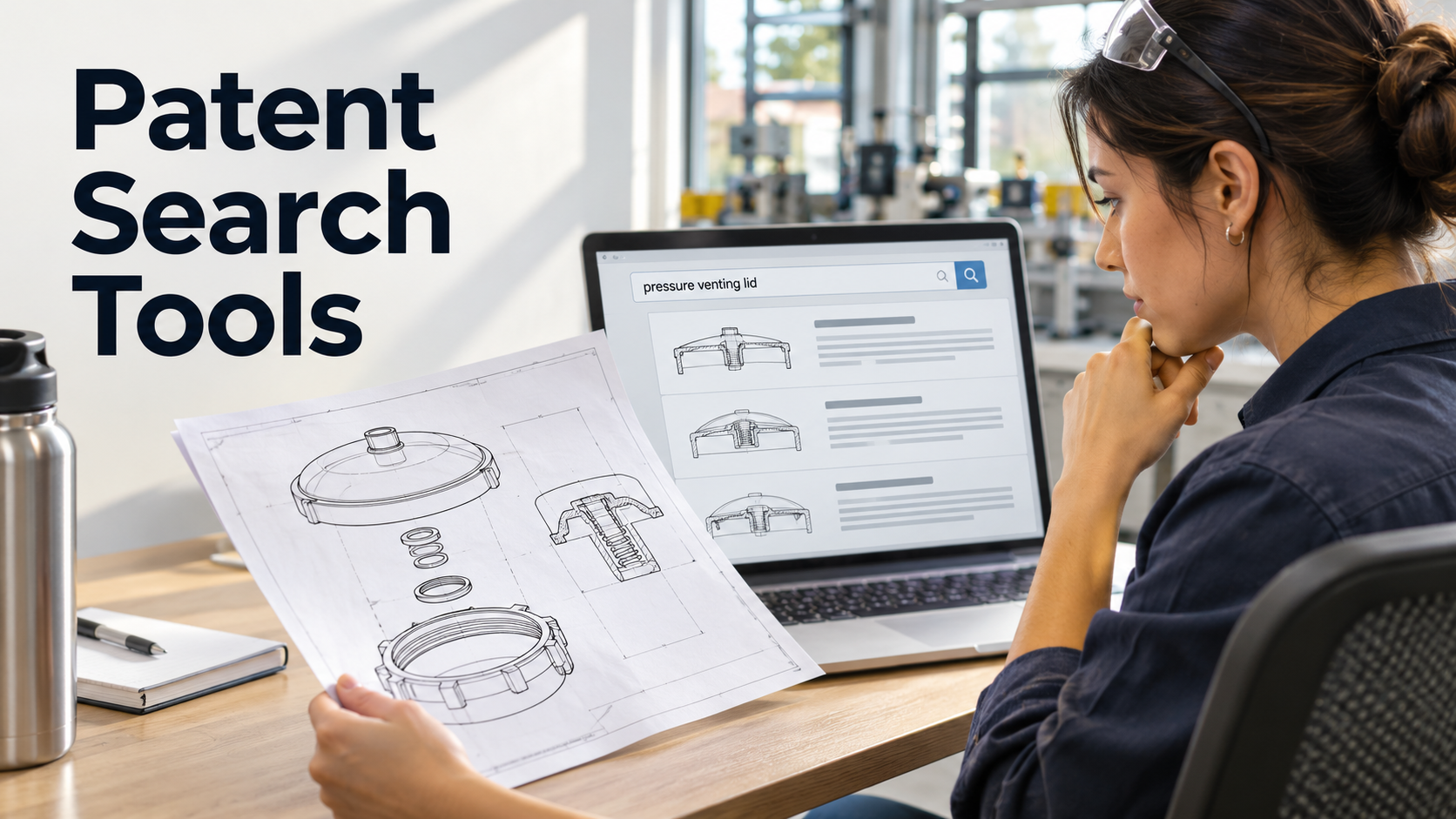
For example, imagine a reusable beverage container with a lid that vents pressure before it opens. A design search can cast a broad net across containers, valves, and closures. A search focused on the proposed arrangement should separately examine the vent path, the order of operations, and the relationship between the release mechanism and the seal. Those features might appear together in a single document or in several unrelated fields. Record what each source actually discloses so the next reviewer can evaluate that distinction.
An early planning note should name the features, relevant geography, date boundaries, and intended use of the findings. If you expect legal counsel to review the results, agree on the form of the handoff. A concise list of documents with marked passages often saves more review time than a large export with only titles.
Use a public database to build a reference set
Espacenet and USPTO Patent Public Search are useful starting points with different roles. The European Patent Office describes Espacenet as its patent search service and directs users who need automated data retrieval to Open Patent Services. The USPTO provides Patent Public Search for searching U.S. patent documents. Both are worth trying with a small set of known documents before comparing their usefulness for a specific search.
Begin with one document your team already knows is relevant. Search for its publication number, then examine the title, abstract, drawings, claims, classifications, and related records. Note which features appear in the abstract and which require reading farther. Use this exercise to see whether your chosen search interface makes the fields you need easy to retrieve and inspect.
Repeat with two or three documents that use different terminology. A good reference set contains variations in language and structure. It gives you a way to tell whether a query has become too narrow. When a change in wording drops a known reference, investigate the reason. Perhaps the key term only appears in the description, or a field restriction excludes it. That finding is more valuable than a simple count of hits.
Expand in three directions
Find alternate language. Pull functional terms from relevant documents and the vocabulary engineers use in adjacent fields. For a pressure-venting lid, search the function of releasing pressure as well as words associated with the closure. Consider terms such as bleed, equalize, and relieve where they fit the mechanism. Test them in small groups so you can see which terms introduce noise.
Follow classifications. Patent classifications group documents by technical subject. Check the codes shared by relevant documents and read the descriptions of nearby groups. A classification search can surface material whose terminology differs from your original queries. Combine codes with a distinctive feature when the group is broad. If a code repeatedly produces relevant material from another industry, add that industry’s terms to the search log.
Trace related records and citations. A useful document can lead to earlier cited work, later citing documents, and related publications. Follow citations with a question in mind. You might want to find the source of a particular mechanism or see how later documents describe the same problem. Capture why you retained a reference and which direction you followed. A citation may help you discover a document whose relevance still needs to be established from the text.
These approaches work best together. A keyword search supplies the first documents, classifications widen the field, and citations help explain how the technical discussion developed. Update the search as you discover new terms or mechanisms.
Keep families, versions, and dates visible
A patent family view can make a long result list easier to review by grouping related documents. Read at least one representative document for technical screening and preserve the identifiers of the versions that matter. Different publications can contain different claim language, and a group heading alone cannot tell a reviewer which version contains the passage you relied on.
Keep dates attached to their meaning. A spreadsheet column titled “date” creates avoidable confusion when some entries reflect a claimed priority date and others reflect publication or grant. Label each date, keep the source, and record any ambiguity for the person interpreting it. Where status matters to a decision, check the relevant official register and record which jurisdiction and version you examined.
This step is particularly important when you pass findings to someone who did not run the search. A reviewer should be able to open the exact document, locate the highlighted passage, and understand why you retained it. If you used a machine translation, record that fact alongside the passage so the reviewer can decide whether further language review is needed.
Give paid platforms a measurable assignment
A specialist platform may be worth paying for if it reduces the effort required to screen international documents, organize families, share annotations, or rerun a recurring search. Its value is easiest to assess with a real assignment. Give two researchers the same reference set, feature description, and expected handoff. Ask each to log time spent locating documents, removing duplicates, checking status, and preparing evidence.
Assess the export as closely as the search interface. Verify whether a result includes stable identifiers, query history, family relationships, and the notes your reviewers will need. Confirm what happens to shared projects and annotations at the end of a subscription. If the work depends on coverage of particular languages or offices, test examples from those places and inspect how the product handles source text and translations.
An occasional searcher may do well with public databases and a disciplined spreadsheet. A research team that runs weekly alerts or sends hundreds of records through review has more reason to pay for workflow and collaboration. The test should show where the team saves effort and whether the final work product remains easy to audit.
Hand off evidence someone can use
For each important result, record the publication identifier, the version consulted, the relevant feature, and the paragraph, figure, or claim where you found it. Keep the query, database, and search date in a separate log. Record the search boundaries and explain any major coverage gaps. If you screened related documents as a group, preserve enough detail to reconstruct that choice later.
Return to the lid example. A useful result might point to one figure that shows the vent channel and a paragraph that explains when it opens. A second document might illustrate a similar seal with a different release sequence. With that evidence in hand, an engineer can compare mechanisms and a legal reviewer can see which facts still need investigation. The search tool has earned its place when it makes that comparison easier to find, inspect, and reproduce.