Introduction
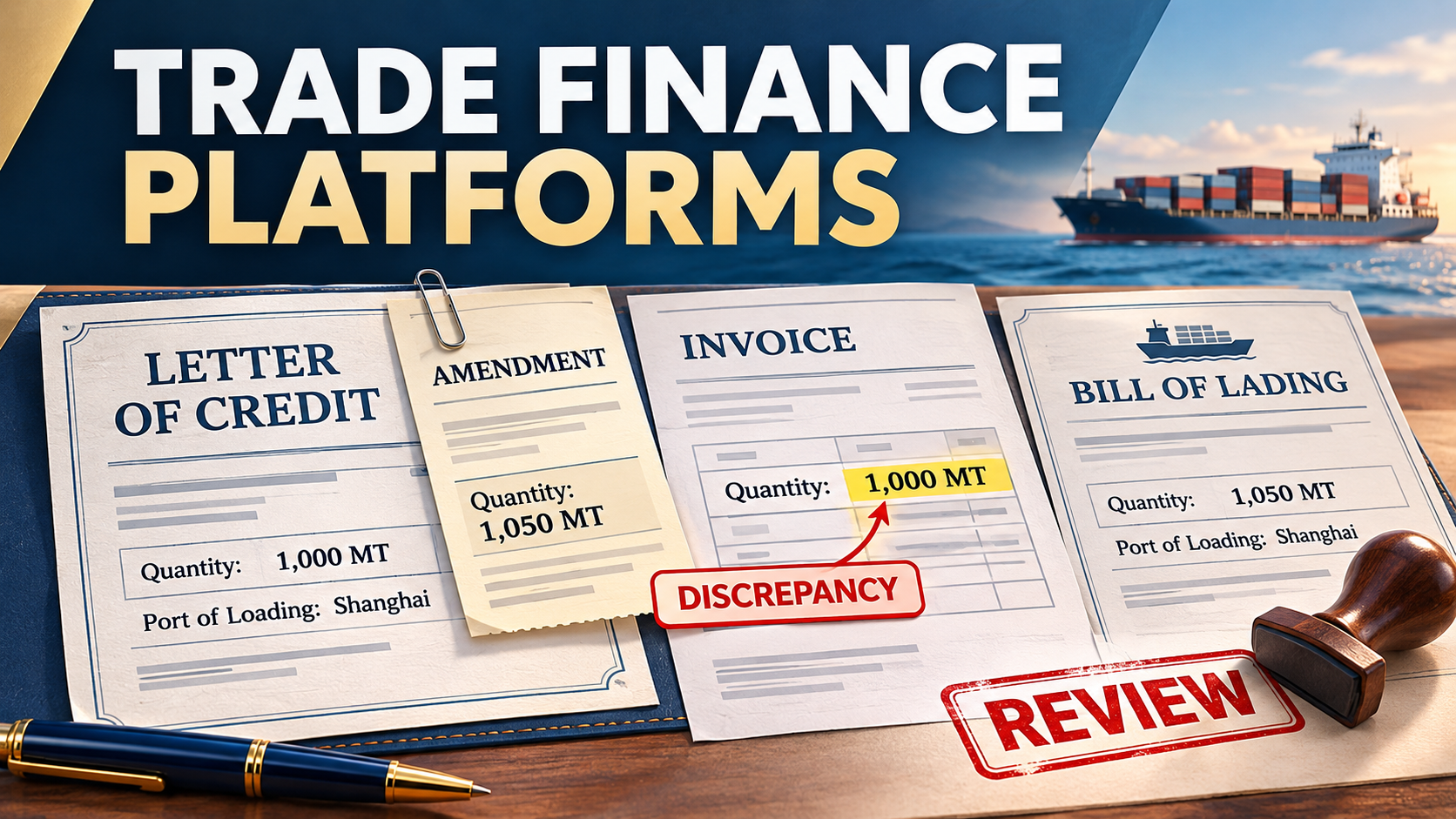
A shipment has left port and the exporter presents its documents. The invoice and transport record show different details, and the trade team needs to establish whether the difference matters under the credit. Meanwhile, an amendment has arrived through another channel. A trade finance platform earns its value by assembling the right terms, documents, deadlines, and approvals while the team decides how to proceed.
The category spans bank trade processing, corporate trade portals, supply chain finance, and electronic document networks. A buyer who treats these as interchangeable can select a capable product that covers only one step in the workflow. Begin with the instrument, the parties, and the operational burden that needs attention.
Identify the instrument before comparing vendors
A documentary letter of credit involves a bank undertaking on defined terms and a process for examining a presentation. The application must track the issued instrument, amendments, documents, and relevant dates. Guarantees and standby instruments can require different wording, claim workflows, and approvals. Supply chain finance built around approved invoices places more emphasis on buyer approval, funding eligibility, and settlement with suppliers.
A bank processing documentary instruments needs operational controls around issuance, checking, liability, and accounting. A corporate treasury team may chiefly need to submit requests, track exposure, compare bank responses, and know which documents are outstanding. A document network can help exchange records between parties. Its usefulness depends on participation and the legal and contractual acceptance of the records it handles.
Describe the intended operating model in a single transaction map. Name who initiates the instrument, who can approve terms, who examines documents, and who posts fees or settlements. Identify which parties will use the platform and which will remain on external channels. A proposed tool can then be evaluated against the work it will actually own.
Show examiners the operative terms
Trade operations need a history of issuance, amendments, communications, and acknowledgments. A platform should help staff identify the terms applicable to a particular presentation while preserving the earlier versions. An amendment awaiting acceptance may require different handling from one already in effect. Ask the vendor to demonstrate how examiners see that distinction in their regular work area.
Use a test credit with a relevant amendment and a mixed set of documents. Have an examiner record discrepancies against specific terms and route the case for review. Then supply a replacement document and verify whether the old examination remains accessible. If the case needs a waiver or another decision, inspect the authority required and how the platform retains the correspondence.
Document extraction can reduce rekeying. Test it on poor-quality scans and layouts from several issuers. Ask how staff see the source behind each extracted field and whether they can distinguish a machine suggestion from an approved value. An extraction accuracy claim says little about how the platform handles a field it reads incorrectly on the last day available for action.
Evaluate electronic records by trade corridor
A scanned document, a digitally signed record, and an electronic transferable record can play different roles. For a transferable document, the ability to establish control and integrity can be central to its treatment. UNCITRAL’s Model Law on Electronic Transferable Records describes a framework for functional equivalence. Adoption and implementation vary across jurisdictions. UNCITRAL Model Law on Electronic Transferable Records
Check the laws, applicable rules, instrument terms, and participating organizations for the actual trade corridor. Confirm which carriers, banks, and counterparties can issue, receive, transfer, or surrender the record in the proposed arrangement. Ask how the platform preserves evidence of control and which part of that evidence the institution can retrieve after a provider change.
Plan for a counterparty that still requires paper or uses another network. Establish how the transaction continues, what controls apply to any conversion, and who confirms that the prior form can no longer be used where required. A limited pilot with cooperative parties may prove one corridor. It offers less evidence about a global rollout with different legal and commercial conditions.
Connect trade records to limits and accounting
An instrument can create contingent exposure, consume a credit limit, incur fees, and later generate a settlement. The trade system may own the instrument details while external systems own limits, screening, accounting, and payments. Map the event that each integration needs and how the originating transaction is referenced.
Test a limit service that responds after a delay. Show whether staff can see that issuance is pending and what happens if the request is sent again. Test a fee reversal and a partial drawing as well. Finance should be able to reconcile the trade record to the ledger and identify outstanding items after the end of the day.
For screening, identify which data are available at each event and who reviews potential matches. A name, destination, or vessel may become known or change after issuance. The platform should support the institution’s policy for when checks occur and record their status. Review how restricted information is protected across internal teams and external portals.
Rehearse the case that requires judgment
Use a pilot with an amended letter of credit, a document discrepancy, and an external service that temporarily fails. Invite trade operations, finance, and integration staff to work from their normal views. Ask the team to identify the operative terms, retrieve the source records, and explain how the case can proceed. Include a record of the settlement and any fees so the exercise follows the transaction to completion.
Compare the commercial model using actual expected usage. Instruments, messages, bank connections, document volumes, and implementation support can each affect cost. Determine who pays for onboarding counterparties and maintaining integrations. A platform with fewer supported parties can still fit a well-defined corridor, while a broader program may place a premium on interoperability and support.
Choose based on the part of the transaction that the organization needs to improve. A corporate portal can solve bank visibility problems. A bank processing platform can improve case control and accounting integration. An electronic record network can address specific document exchanges. The strongest pilot demonstrates how people recover when the terms, the documents, and the timeline all change in the same transaction.