Introduction
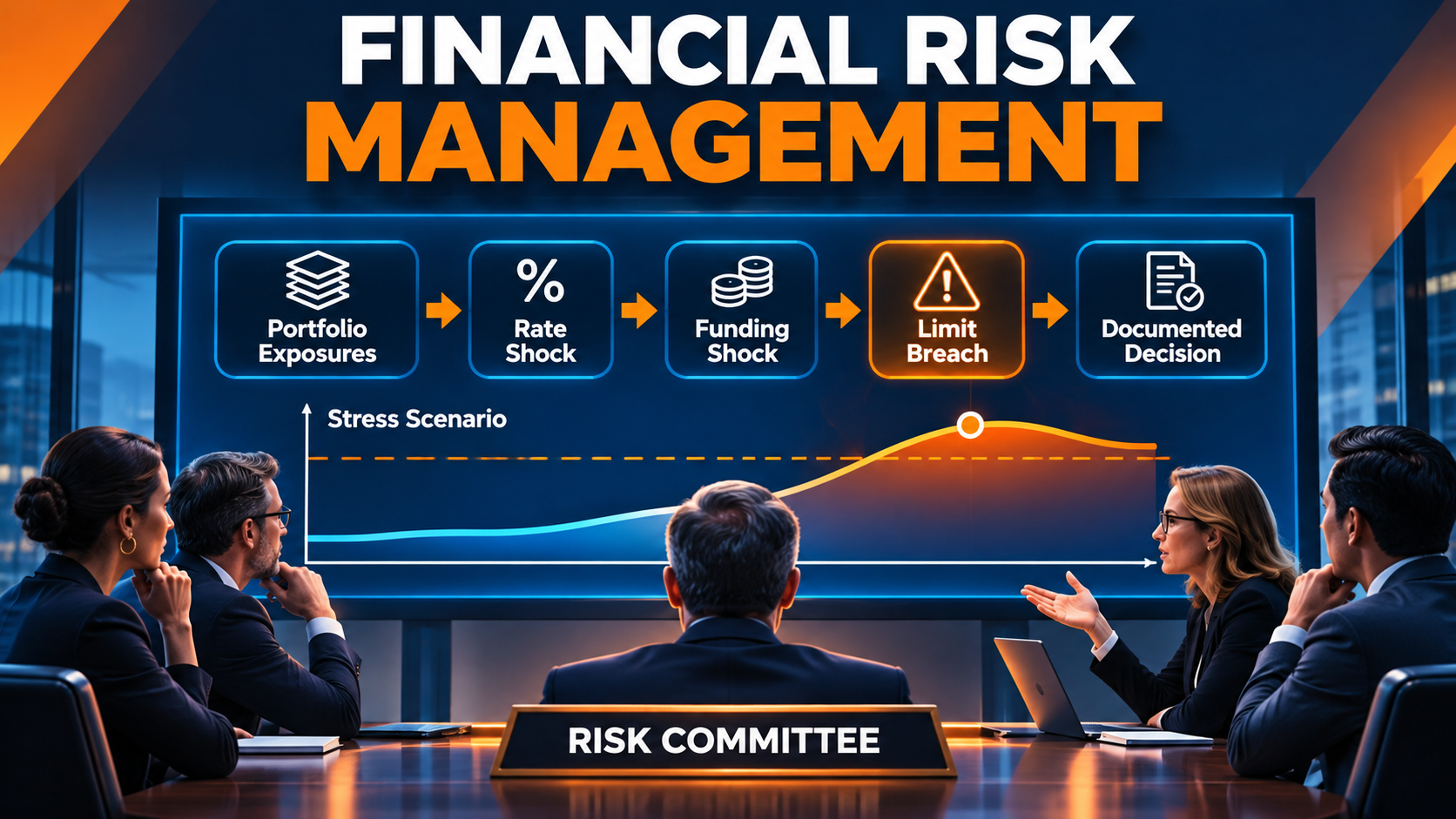
A risk committee reviews a dashboard showing that a stress scenario produces a material loss. The members ask which exposures drive it, whether the funding assumptions changed, and what actions would reduce the effect. The report owner can answer the first question only by requesting another run. The problem is less about the dashboard than the connection between positions, models, scenarios, and decisions.
Financial risk management software covers several kinds of work. It can measure market, credit, counterparty, liquidity, or interest rate risk. It can monitor limits, run scenarios, support approvals, and produce reports. The category includes specialist engines and platforms that aggregate results across teams. The buying decision begins with the exposures the institution needs to understand and the action it expects people to take.
Name the decision before selecting the model
A trading desk may need daily market risk and sensitivity measures. A credit team may need portfolio concentration and loss estimates. A treasury team may focus on cash flows and funding under stress. Their measures can use different horizons, units, and assumptions. Placing them on the same dashboard can support a discussion if the distinctions remain visible.
Write a decision statement for each high-priority requirement. A market risk manager might need to identify which positions drove a limit breach before approving new activity. A liquidity committee might need to know which entity runs short of funding under a scenario and how soon it must act. These statements determine the necessary level of detail and the speed of the workflow.
Compare the platform against the intended decisions. A risk aggregation system can make existing measures more accessible without replacing specialist pricing or credit models. A calculation engine can improve modeling but still require integration to route limit breaches and retain committee decisions. Ask where the organization already has adequate capability and where the gap creates material delay.
Trace the exposure before challenging the result
Risk measures depend on the positions and reference data supplied to the model. Missing positions, inconsistent counterparty identifiers, and stale prices can distort a result before the calculation begins. The platform should let a reviewer see the population, relevant valuation time, and treatment of incomplete records.
Take a sample exposure and trace it from the source system through transformations, model inputs, aggregation, and the report. Test a correction to the source. Determine whether the platform records the original data, calculates an updated result under a controlled process, and identifies which report is approved. A clear lineage is especially valuable when a result feeds more than one committee or external process.
Legal entity, currency, collateral, and netting assumptions need particular attention where they affect the exposure. Ask whether data needed for those decisions exists in a reliable form and who approves the mapping. A powerful calculation engine cannot compensate for missing agreement details or unclear ownership of the source records.
Make scenarios consistent and inspectable
A scenario can combine changes in rates, spreads, exchange rates, asset prices, or other conditions. Different models may consume different parts of it. Record the scenario definition, model versions, exposure date, and any assumptions about future management actions. The Basel Committee’s stress testing principles provide a reference for banks considering objectives, governance, methodology, and use of results. Basel Committee stress testing principles
Ask the platform to explain a result at several levels. Start with the institution-wide figure and drill down by business, portfolio, and relevant risk driver. Determine whether the platform stores component results or needs a new run for each question. Where interactions or nonlinear effects matter, ask how the team can interpret the contribution of different shocks without relying on a simplistic allocation.
Test a change to one assumption. For example, shorten the period in which management expects to replace funding, then compare the output against the approved scenario. Keep both versions and record which one went to the committee. A scenario tool should make controlled exploration easy while preserving the evidence behind official results.
Connect limits to the action that follows
A limit record needs a definition, owner, threshold, effective period, and escalation path. Where the policy permits exceptions, the system should retain their scope and duration. Review how it handles exposures near a limit and what it does when the data needed to assess a limit is late or incomplete.
Demonstrate a breach from detection through resolution. Ask who receives the notification, what evidence appears with it, and how the team records the decision. Check whether an exception expires automatically or needs review. A chart that changes color when a threshold is crossed helps people notice the problem. The operational workflow establishes what happened next.
Consider recurring breaches as a separate management problem. Reporting should help distinguish a genuine concentration from an obsolete limit, a change in business mix, or a data-quality issue. Track duration and recurrence along with the size of the breach. Those details can shape how the committee responds.
Decide which work stays with specialist teams
A broad platform can simplify common data definitions, approvals, and reporting. Its models may be sufficient for some portfolios and too limited for others. A specialist engine can offer the depth needed for a particular exposure and still require aggregation with the institution’s other results. Compare candidates using the same portfolios and involve the teams responsible for validating the methods.
Include ongoing costs for data feeds, compute, model changes, validation, integration, and retention. Test how peak workloads affect the time to deliver results. A scenario process may require many repeated calculations around a committee meeting, even when typical daily use is moderate. Review what can be rerun independently and how the platform handles incomplete output.
Choose a pilot that takes a known exposure through an adverse scenario and a resulting limit or funding decision. Introduce a missing position and an amended assumption, then ask a second reviewer to reproduce the approved result. The platform has demonstrated its value when the institution can identify the drivers, document the uncertainty, and show the decision it made from that evidence.