Introduction
Passwords have been a fundamental part of digital authentication for decades. However, password reuse, phishing attacks, credential theft, and account recovery weaknesses continue to create security challenges.
Passkeys and FIDO2 authentication technologies offer an alternative to traditional password-based sign-in. They use public-key cryptography to authenticate users without requiring a reusable password to be transmitted to an application.
Modern authentication platforms increasingly support passkeys, security keys, biometric verification, and device-based authentication. These technologies can improve account security while reducing the effort required for routine sign-in.
Passkeys are particularly relevant to organizations implementing phishing-resistant authentication. They can help protect employee accounts, customer identities, and privileged access to sensitive systems.
However, adopting passkeys involves more than enabling a new login button. Organizations must consider device compatibility, credential synchronization, recovery procedures, account enrollment, and integration with existing identity infrastructure.
Different authentication platforms address these challenges in different ways. Some focus on enterprise workforce authentication, while others provide customer identity services, hardware security keys, or developer authentication infrastructure.
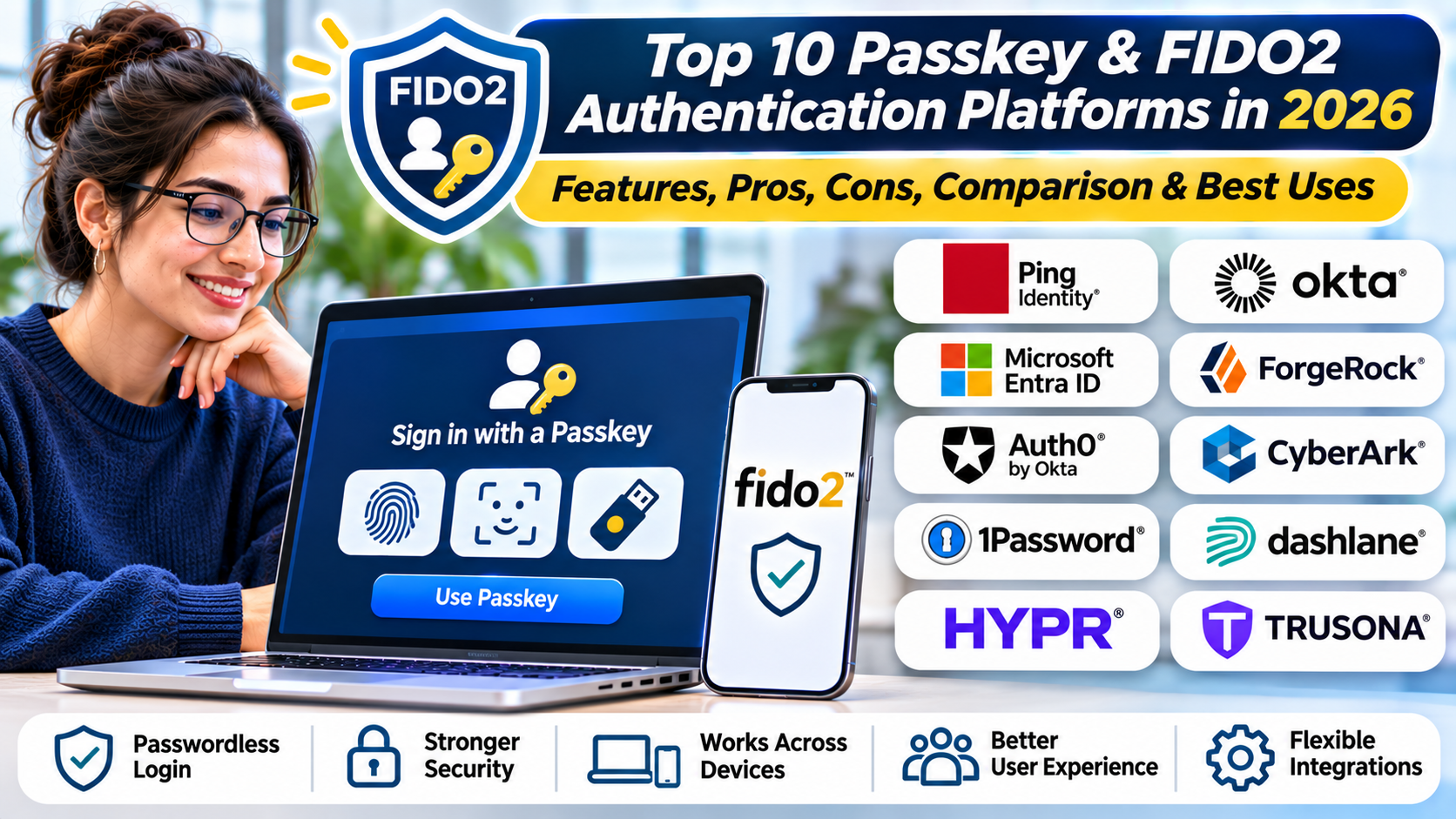
This guide compares ten Passkey and FIDO2 authentication platforms in 2026. It examines their features, benefits, limitations, practical applications, and suitability for different organizations.
What Are Passkey & FIDO2 Authentication Platforms?
Passkey and FIDO2 authentication platforms provide technologies for authenticating users through cryptographic credentials rather than relying exclusively on traditional passwords.
FIDO2 combines Web Authentication, commonly called WebAuthn, with the Client to Authenticator Protocol, or CTAP. These standards support authentication through compatible devices, browsers, and authenticators.
A passkey is a FIDO credential designed to provide a convenient passwordless sign-in experience. Depending on the implementation, passkeys may be synchronized across devices or remain bound to a particular authenticator.
The authentication process uses a public and private key pair. The service stores the public key, while the private key remains protected by the authenticator or credential provider.
How Passkey Authentication Works
Registration: A user enrolls a passkey with a compatible application or identity provider.
Key Generation: The authenticator creates a cryptographic key pair for the relying party.
Public Key Storage: The application stores the public key and associated credential information.
Private Key Protection: The private key remains protected within the authenticator environment.
Authentication Challenge: The application sends a cryptographic challenge during sign-in.
User Verification: The authenticator may require a biometric check, PIN, or another supported verification method.
Cryptographic Signature: The authenticator signs the challenge using the private key.
Verification: The application validates the signature using the registered public key.
Why Passkeys and FIDO2 Matter
Passkeys reduce dependence on reusable secrets that attackers can steal through phishing or credential database breaches. Their authentication process is bound to the legitimate service’s identity.
FIDO2 authentication also supports phishing-resistant multi-factor authentication when appropriately implemented. This is especially valuable for administrators and users accessing sensitive business applications.
However, passkeys do not eliminate every account security risk. Session theft, compromised devices, insecure recovery procedures, and malicious applications can still create vulnerabilities.
Organizations should therefore evaluate the complete identity lifecycle, including enrollment, authentication, recovery, revocation, and monitoring.
Top 10 Passkey & FIDO2 Authentication Platforms in 2026
1. Microsoft Entra ID
Short Description
Microsoft Entra ID is a cloud identity and access management platform that supports passwordless and phishing-resistant authentication methods. Its capabilities include FIDO2 security keys and passkey-related authentication workflows.
The platform is particularly relevant to organizations using Microsoft 365, Azure, and other enterprise applications. It provides centralized identity management and access policies for employees and administrators.
Microsoft Entra ID supports authentication methods that can reduce reliance on passwords. Administrators can configure supported passkey and FIDO2 options according to organizational requirements.
Its integration with Conditional Access allows organizations to apply authentication requirements based on users, applications, and other available signals. Authentication strengths can help enforce phishing-resistant methods for selected resources.
However, implementing passkeys requires careful planning around device enrollment, supported authenticators, account recovery, and administrative policies. Some capabilities also depend on licensing and platform compatibility.
Key Features
- FIDO2 Authentication: Supports compatible security keys and passkey workflows.
- Passwordless Sign-In: Enables supported authentication methods without traditional passwords.
- Conditional Access: Applies access policies based on configured identity and security conditions.
- Authentication Strengths: Allows administrators to require selected authentication assurance levels.
- Identity Integration: Connects authentication to Microsoft and compatible third-party applications.
- User Enrollment Policies: Controls supported authentication method registration.
- Sign-In Monitoring: Provides visibility into relevant authentication events.
- Enterprise Administration: Supports centralized identity governance and security configuration.
Benefits
Microsoft Entra ID can help organizations standardize phishing-resistant authentication across workforce applications. Its identity management capabilities make it useful for enterprises with complex access requirements.
Integration with existing Microsoft environments may reduce the need for separate authentication infrastructure. Centralized policies can also simplify administration.
However, organizations should validate authentication method support across their applications and devices.
Pros
- Enterprise identity management.
- FIDO2 and passkey support.
- Strong Microsoft ecosystem integration.
- Conditional Access capabilities.
- Centralized authentication policies.
- Useful sign-in monitoring.
- Suitable for large organizations.
Cons
- Licensing varies by capability.
- Advanced policies require expertise.
- Some features depend on supported devices.
- Enrollment and recovery require planning.
- Non-Microsoft applications may need additional integration.
Use Cases
Enterprise Workforce Authentication: Employees can sign in using approved passwordless methods.
Privileged Account Protection: Administrators can use phishing-resistant authentication.
Microsoft 365 Access: Organizations can apply compatible authentication policies.
Hybrid Identity Environments: Teams can coordinate authentication across supported systems.
Security Modernization: Enterprises can reduce reliance on passwords.
Best For
Microsoft Entra ID is best suited for enterprises using Microsoft identity infrastructure and requiring centrally managed phishing-resistant authentication.
2. Okta
Short Description
Okta is an identity and access management platform supporting workforce and customer authentication. Its authentication capabilities include passkeys and FIDO2-based methods through compatible services and configurations.
The platform helps organizations manage authentication across cloud applications and business environments. It is particularly relevant to enterprises with diverse application portfolios.
Okta supports passwordless authentication approaches and policy-driven access controls. These capabilities can help organizations reduce exposure to phishing and password-related attacks.
Its authentication ecosystem includes device-related controls, application integrations, and administrative management. Specific capabilities depend on the selected Okta products and licensing.
However, organizations must plan enrollment, recovery, device compatibility, and policy enforcement. Passwordless authentication should be implemented as part of a complete identity security strategy.
Key Features
- Passkey Authentication: Supports compatible passkey sign-in workflows.
- FIDO2 Support: Integrates with supported FIDO authenticators.
- Workforce Identity: Manages employee authentication and application access.
- Customer Identity Options: Supports selected customer authentication scenarios.
- Adaptive Access Policies: Applies authentication rules based on configured conditions.
- Application Integrations: Connects with supported enterprise applications.
- Authentication Monitoring: Provides administrative visibility into sign-in activity.
- Centralized Identity Management: Supports organizational authentication policies.
Benefits
Okta can help organizations introduce phishing-resistant authentication across diverse applications. Its integration ecosystem is useful for enterprises with multiple software providers.
Policy-based authentication allows security teams to align sign-in requirements with organizational risk. Centralized administration also supports consistent identity management.
Pros
- Broad identity integration capabilities.
- Supports passkeys and FIDO2.
- Workforce and customer identity options.
- Centralized authentication management.
- Adaptive policy capabilities.
- Suitable for heterogeneous application environments.
Cons
- Commercial licensing.
- Implementation complexity.
- Product capabilities vary by edition.
- Recovery procedures require careful design.
- Integration testing is necessary.
Use Cases
Workforce Passwordless Authentication: Employees can use supported passkeys.
Enterprise SSO: Organizations can combine authentication with application access.
Customer Login: Businesses can implement compatible passkey experiences.
Privileged Access: Teams can require stronger authentication.
Identity Modernization: Organizations can reduce password dependence.
Best For
Okta is best suited for enterprises requiring flexible identity integration and policy-driven passkey authentication.
3. Yubico
Short Description
Yubico develops hardware security keys and authentication technologies that support FIDO2 and related standards. Its YubiKey products are widely used for phishing-resistant authentication.
Yubico differs from software identity platforms because its primary offering includes physical authenticators. These devices can store credentials and perform cryptographic authentication operations.
YubiKeys are relevant to organizations protecting privileged accounts, employee identities, and sensitive applications. They can provide hardware-bound authentication that does not depend on synchronizing private keys across devices.
Yubico also provides enterprise-oriented services and tools for managing security key deployments. These can support organizations distributing authenticators to large workforces.
However, hardware-based authentication requires physical device management. Organizations must plan replacement keys, lost-device recovery, enrollment, and employee onboarding.
Key Features
- FIDO2 Security Keys: Supports phishing-resistant authentication.
- Hardware-Bound Credentials: Protects private keys within compatible physical authenticators.
- WebAuthn Compatibility: Works with supported websites and identity platforms.
- Multiple Form Factors: Offers different connection options across product models.
- User Verification: Supports PIN-based and other compatible verification methods.
- Enterprise Deployment Services: Provides selected security key management capabilities.
- Multi-Protocol Support: Certain models support additional authentication standards.
- Cross-Platform Compatibility: Works with compatible operating systems and browsers.
Benefits
Yubico provides a strong option for organizations requiring hardware-backed authentication. Physical security keys can reduce dependence on passwords and help resist phishing.
The devices are particularly useful for privileged users and high-assurance authentication scenarios. They can also complement enterprise identity providers.
Pros
- Hardware-backed authentication.
- Strong phishing resistance.
- Broad FIDO2 compatibility.
- Suitable for privileged accounts.
- Multiple device options.
- Integrates with major identity platforms.
- Supports enterprise deployment workflows.
Cons
- Hardware purchase costs.
- Physical distribution requirements.
- Lost keys require recovery procedures.
- Compatibility varies by model.
- Not a complete identity provider by itself.
Use Cases
Administrator Authentication: Privileged users can authenticate with security keys.
Enterprise Workforce Security: Organizations can distribute hardware authenticators.
Developer Account Protection: Engineers can secure sensitive services.
High-Assurance Access: Teams can enforce hardware-bound credentials.
Account Recovery Planning: Organizations can enroll backup authenticators.
Best For
Yubico is best suited for organizations and individuals prioritizing hardware-backed, phishing-resistant authentication.
4. Cisco Duo
Short Description
Cisco Duo is an identity security and access platform offering multi-factor authentication, device trust capabilities, and passwordless authentication options. It supports compatible WebAuthn and FIDO2 authenticators.
The platform is designed for organizations seeking stronger authentication across business applications. It can integrate with existing identity infrastructure rather than requiring every application to use a completely new identity provider.
Duo supports security keys and compatible passwordless methods in selected authentication workflows. This helps organizations improve authentication assurance.
Its device-related security capabilities can also support access decisions. Organizations can evaluate authentication requirements alongside available endpoint information.
However, feature availability depends on the deployment model and licensing. Administrators should confirm which applications support the desired passwordless experience.
Key Features
- FIDO2 Authentication: Supports compatible security keys.
- Passwordless Workflows: Provides supported passwordless sign-in methods.
- Multi-Factor Authentication: Offers multiple authentication options.
- Device Trust: Supports selected device-related access controls.
- Application Integrations: Connects with compatible enterprise systems.
- Access Policies: Allows organizations to configure authentication requirements.
- Authentication Reporting: Provides administrative visibility.
- Enterprise Deployment: Supports centralized management.
Benefits
Cisco Duo can help organizations strengthen authentication without replacing every existing identity system. Its integration approach is useful for enterprises with established application environments.
Phishing-resistant methods can improve protection for sensitive accounts. Device-related policies may provide additional security context.
Pros
- Enterprise MFA capabilities.
- Supports FIDO2 authenticators.
- Passwordless options.
- Device trust integration.
- Broad application compatibility.
- Centralized administration.
- Suitable for workforce security.
Cons
- Licensing costs.
- Passwordless support varies by integration.
- Not every application supports identical workflows.
- Device policies require planning.
- Recovery methods must be secured.
Use Cases
Employee Authentication: Organizations can strengthen workforce sign-in.
VPN Access: Teams can apply compatible MFA policies.
Privileged Account Protection: Administrators can use security keys.
Device-Aware Access: Organizations can consider endpoint conditions.
Authentication Modernization: Enterprises can introduce passwordless methods.
Best For
Cisco Duo is best suited for organizations seeking FIDO2 authentication alongside existing MFA and device trust infrastructure.
5. Auth0
Short Description
Auth0 is a customer identity platform that helps developers implement authentication and authorization in applications. It supports passkey-related workflows and compatible WebAuthn authentication capabilities.
The platform is particularly relevant to software companies building customer-facing applications. It provides authentication infrastructure that developers can integrate into websites and services.
Auth0 supports different login methods, identity connections, and configurable authentication experiences. Passkeys can help reduce password friction for supported users.
Its development tools allow teams to integrate authentication without building every identity component internally. However, the implementation still requires careful configuration and testing.
Organizations must consider passkey enrollment, account recovery, device compatibility, and existing user migration. Customer authentication experiences should also account for users who cannot use passkeys.
Key Features
- Passkey Authentication: Supports compatible passwordless customer login.
- WebAuthn Integration: Uses supported standards-based authentication methods.
- Customer Identity Management: Provides authentication for applications.
- Developer SDKs: Supports integration with common application frameworks.
- Hosted Login Options: Offers managed authentication experiences.
- Identity Federation: Connects with supported external identity providers.
- Authentication Policies: Provides configurable security controls.
- Monitoring and Logs: Supports investigation of authentication activity.
Benefits
Auth0 can reduce the engineering effort required to implement customer authentication. Its passkey capabilities can improve sign-in convenience for supported users.
Developers can combine passkeys with other login methods during migration. This flexibility is useful for applications with diverse customer populations.
Pros
- Developer-oriented identity platform.
- Supports passkey workflows.
- Application integration tools.
- Customer identity capabilities.
- Flexible login methods.
- Managed authentication infrastructure.
- Useful for SaaS applications.
Cons
- Commercial pricing considerations.
- Integration requires development work.
- Passkey migration needs planning.
- Recovery design remains important.
- Advanced customization can increase complexity.
Use Cases
SaaS Authentication: Applications can offer passkey sign-in.
Consumer Applications: Businesses can simplify customer login.
Passwordless Migration: Developers can introduce passkeys gradually.
Identity Federation: Applications can support multiple identity sources.
Authentication Security: Teams can reduce reliance on reusable passwords.
Best For
Auth0 is best suited for developers and SaaS businesses implementing passkey authentication in customer-facing applications.
6. Descope
Short Description
Descope is an authentication and identity platform focused on developer-oriented login workflows. It supports passwordless authentication methods, including passkeys.
The platform is relevant to teams building modern web and mobile applications. It provides tools for implementing authentication flows without developing every component from the beginning.
Descope offers configurable authentication experiences that can combine passkeys with other supported methods. This allows organizations to design enrollment and recovery journeys.
Its workflow-oriented approach can be useful for teams seeking visual configuration and application integration. Developers can tailor authentication behavior to different user requirements.
However, organizations must evaluate security policies, integration complexity, and pricing. Passwordless authentication still requires careful account recovery and identity verification.
Key Features
- Passkey Support: Enables compatible passkey authentication.
- Passwordless Login: Supports authentication without traditional passwords.
- Authentication Flow Design: Provides configurable login workflows.
- Developer SDKs: Integrates with supported application frameworks.
- Customer Identity Capabilities: Supports user authentication management.
- Multiple Authentication Methods: Enables flexible sign-in options.
- Account Recovery Workflows: Supports configurable recovery experiences.
- Administrative Management: Provides tools for authentication configuration.
Benefits
Descope can simplify implementation of modern authentication experiences. Its workflow capabilities help developers design login journeys without creating every component manually.
Passkeys can be introduced alongside existing authentication methods. This supports gradual migration and user compatibility.
Pros
- Passkey-focused capabilities.
- Developer-friendly integration.
- Configurable authentication flows.
- Passwordless login options.
- Useful for customer applications.
- Supports multiple authentication methods.
- Flexible user experiences.
Cons
- Commercial pricing.
- Requires integration work.
- Recovery policies need careful design.
- Platform dependency considerations.
- Complex workflows require testing.
Use Cases
Customer Login: Applications can implement passkeys.
SaaS Platforms: Teams can modernize authentication.
Passwordless Onboarding: Developers can simplify sign-up.
Authentication Migration: Organizations can support existing users.
Custom Login Workflows: Teams can design application-specific experiences.
Best For
Descope is best suited for application developers seeking configurable passkey and passwordless authentication workflows.
7. Hanko
Short Description
Hanko is an authentication platform and technology ecosystem focused on passkeys and modern login experiences. It provides developer-oriented tools for implementing WebAuthn-based authentication.
The platform is particularly relevant to teams seeking passkey-first application design. It emphasizes standards-based authentication and integration with modern software applications.
Hanko offers components and services intended to simplify authentication implementation. Developers can use supported tools to integrate passkey enrollment and sign-in.
Its approach is useful for organizations that want passkeys to play a central role in their authentication experience. However, compatibility and deployment requirements must be evaluated carefully.
Teams should also assess current product offerings, hosting options, and maintenance status before adoption. Authentication infrastructure requires reliable long-term support.
Key Features
- Passkey Authentication: Supports WebAuthn-based login.
- Developer Integration: Provides tools for application authentication.
- Passwordless Experiences: Emphasizes reduced password dependence.
- Authentication Components: Offers supported login interface capabilities.
- Standards-Based Design: Uses modern authentication technologies.
- User Enrollment: Supports passkey registration workflows.
- Application Integration: Connects authentication to supported applications.
- Deployment Options: Provides implementation approaches according to current offerings.
Benefits
Hanko can help developers implement passkey-oriented authentication without building every WebAuthn component independently. Its focus on modern authentication is useful for new applications.
The platform may also support organizations experimenting with passwordless-first user experiences.
Pros
- Passkey-oriented approach.
- Standards-based authentication.
- Developer integration tools.
- Suitable for modern applications.
- Supports passwordless design.
- Useful for authentication prototyping.
Cons
- Current product availability should be verified.
- Integration requires development expertise.
- Enterprise features may differ from larger identity providers.
- Recovery design remains necessary.
- Long-term maintenance should be evaluated.
Use Cases
Passkey-First Applications: Developers can build modern login experiences.
Web Authentication: Teams can integrate WebAuthn.
Authentication Prototypes: Engineers can test passwordless workflows.
Customer Applications: Businesses can simplify sign-in.
Identity Modernization: Teams can evaluate passkey adoption.
Best For
Hanko is best suited for developers and product teams prioritizing passkey-first authentication experiences.
8. 1Password
Short Description
1Password is a password and credential management platform that also supports passkey storage and use. It allows users to manage compatible passkeys alongside other authentication credentials.
The platform is relevant to individuals and organizations transitioning from passwords to passkeys. It provides a familiar credential management environment during the migration.
1Password supports passkey creation and sign-in on compatible applications and devices. Its synchronization capabilities can make passkeys available across supported environments.
The platform is useful for users who want a centralized method for managing different credential types. Organizations can also use its business-oriented management capabilities.
However, 1Password is not a complete identity provider for every enterprise application. Users must understand the security model of synchronized credentials and account recovery.
Key Features
- Passkey Storage: Saves compatible passkeys.
- Passkey Sign-In: Supports authentication on compatible services.
- Credential Management: Organizes passwords and other login information.
- Cross-Device Synchronization: Provides access to supported credentials across devices.
- Browser Integration: Supports passkey workflows in compatible browsers.
- Business Management: Offers selected organizational administration capabilities.
- Secure Credential Storage: Protects stored authentication information.
- Password-to-Passkey Transition: Supports mixed credential environments.
Benefits
1Password can simplify passkey adoption for users who already manage credentials through a password manager. It provides a consistent interface for passwords and passkeys.
Cross-device availability can improve convenience. However, organizations should consider whether synchronized passkeys meet their authentication assurance requirements.
Pros
- Passkey storage and management.
- Cross-platform availability.
- Familiar credential interface.
- Supports password migration.
- Business management features.
- Useful browser integration.
- Convenient synchronization.
Cons
- Subscription costs.
- Not a complete identity provider.
- Synchronization trust model requires evaluation.
- Some high-assurance scenarios require hardware-bound credentials.
- Recovery procedures remain important.
Use Cases
Personal Passkey Management: Users can store supported passkeys.
Business Credential Management: Teams can manage authentication information.
Passwordless Migration: Users can transition gradually.
Cross-Device Login: Individuals can access compatible credentials.
Developer Accounts: Engineers can manage supported passkey sign-ins.
Best For
1Password is best suited for individuals and organizations seeking convenient passkey management alongside existing credentials.
9. Google Cloud Identity
Short Description
Google Cloud Identity is an identity management service supporting workforce authentication and access to compatible applications. Google’s broader account authentication ecosystem also supports passkeys and FIDO2-based sign-in.
The platform is relevant to organizations using Google Workspace and Google Cloud services. It provides identity management capabilities that can support secure access across compatible environments.
Google’s passkey ecosystem includes platform authenticators and supported hardware security keys. These methods can help reduce dependence on passwords for eligible authentication workflows.
Organizations can apply authentication and security policies through compatible Google identity services. The exact passkey experience depends on account type, application, and administrative configuration.
However, administrators should distinguish consumer Google Account passkey features from enterprise Cloud Identity controls. Capabilities and enforcement options are not necessarily identical.
Key Features
- Passkey-Compatible Authentication: Supports relevant Google account authentication workflows.
- FIDO2 Security Keys: Works with supported hardware authenticators.
- Workforce Identity Management: Provides organizational identity services.
- Google Ecosystem Integration: Supports compatible Workspace and Cloud environments.
- Authentication Policies: Offers selected administrative controls.
- Multi-Factor Authentication: Supports stronger sign-in methods.
- Identity Federation: Connects with supported applications and identity systems.
- Administrative Visibility: Provides relevant account and authentication management tools.
Benefits
Google Cloud Identity can help organizations manage authentication within Google-oriented environments. Passkey and security key capabilities may strengthen supported sign-in workflows.
Organizations already using Google services may benefit from existing identity integrations. However, enterprise policy requirements should be validated before deployment.
Pros
- Google ecosystem integration.
- Supports FIDO2 security keys.
- Passkey-related authentication capabilities.
- Workforce identity management.
- Administrative security controls.
- Suitable for Google-centric organizations.
Cons
- Passkey support varies by account and workflow.
- Enterprise policies require careful configuration.
- Advanced features may depend on licensing.
- Third-party integration requires testing.
- Not every consumer account capability applies to managed identities.
Use Cases
Google Workspace Security: Organizations can strengthen authentication.
Cloud Administration: Teams can protect supported cloud accounts.
Security Key Deployment: Employees can use compatible FIDO2 authenticators.
Workforce Identity: Administrators can manage organizational accounts.
Passwordless Evaluation: Teams can test supported passkey workflows.
Best For
Google Cloud Identity is best suited for organizations using Google Workspace and Google Cloud identity infrastructure.
10. HYPR
Short Description
HYPR is an enterprise authentication platform focused on passwordless and phishing-resistant identity security. It provides capabilities intended to reduce reliance on passwords in workforce environments.
The platform is particularly relevant to organizations with demanding authentication requirements. It supports authentication approaches based on modern cryptographic technologies and compatible authenticators.
HYPR emphasizes enterprise deployment, authentication assurance, and integration with existing identity infrastructure. These capabilities can support organizations transitioning from passwords to stronger methods.
Its solutions are relevant to employee authentication, workstation access, and selected enterprise application workflows. Actual capabilities depend on the deployment and product configuration.
However, passwordless transformation requires careful planning. Organizations must address enrollment, device compatibility, fallback authentication, recovery, and operational support.
Key Features
- Passwordless Authentication: Supports authentication without reusable passwords.
- FIDO-Based Security: Uses compatible phishing-resistant authentication technologies.
- Enterprise Integration: Connects with supported identity environments.
- Workforce Authentication: Supports employee sign-in workflows.
- Authentication Policies: Provides centralized security configuration.
- Device-Oriented Authentication: Supports compatible device-based methods.
- Administrative Management: Provides enterprise deployment capabilities.
- Security Monitoring: Supports relevant authentication visibility.
Benefits
HYPR can help enterprises implement passwordless authentication across selected workforce environments. Its focus on phishing-resistant methods is useful for organizations reducing credential-related risks.
Enterprise integration and policy management can support large-scale deployments. However, implementation success depends on application compatibility and operational readiness.
Pros
- Enterprise passwordless focus.
- Phishing-resistant authentication.
- Supports FIDO-based technologies.
- Workforce-oriented capabilities.
- Centralized management.
- Suitable for high-security environments.
- Identity integration options.
Cons
- Commercial pricing.
- Enterprise deployment complexity.
- Requires integration planning.
- Device compatibility must be validated.
- Recovery and fallback procedures remain necessary.
Use Cases
Enterprise Passwordless Programs: Organizations can reduce password dependence.
Workforce Authentication: Employees can use supported cryptographic methods.
High-Assurance Access: Security teams can strengthen sensitive sign-ins.
Identity Modernization: Enterprises can replace selected legacy authentication workflows.
Privileged User Protection: Organizations can apply stronger authentication controls.
Best For
HYPR is best suited for enterprises implementing large-scale phishing-resistant and passwordless workforce authentication.
Comparison Table: Top 10 Passkey & FIDO2 Authentication Platforms
| Platform | Primary Category | Best For | Standout Capability | Pricing Model |
|---|---|---|---|---|
| Microsoft Entra ID | Workforce identity | Microsoft enterprises | Conditional Access and FIDO2 | Free and paid tiers |
| Okta | Workforce and customer identity | Diverse enterprise environments | Identity integrations and policies | Commercial |
| Yubico | Hardware authenticators | High-assurance authentication | Hardware-bound FIDO2 credentials | Hardware and enterprise services |
| Cisco Duo | MFA and access security | Enterprise workforce | MFA and device trust | Commercial |
| Auth0 | Customer identity | SaaS developers | Application authentication integration | Free and paid tiers |
| Descope | Developer authentication | Modern applications | Configurable passwordless flows | Free and paid tiers |
| Hanko | Passkey-oriented authentication | Passkey-first developers | WebAuthn integration | Offering-dependent |
| 1Password | Credential management | Individuals and businesses | Passkey storage and synchronization | Subscription |
| Google Cloud Identity | Workforce identity | Google-centric organizations | Google identity integration | Free and paid tiers |
| HYPR | Enterprise passwordless | Large organizations | Workforce passwordless authentication | Commercial |
Which Passkey & FIDO2 Authentication Platform Is Right for You?
1. Identify the Authentication Environment
Workforce authentication and customer authentication have different requirements. Enterprise employees may use managed devices and centralized identity policies, while customers use diverse personal devices.
Microsoft Entra ID, Okta, and HYPR are relevant to workforce authentication. Auth0, Descope, and Hanko provide developer-oriented options for application authentication.
2. Evaluate Credential Types
Passkeys can be synchronized across compatible devices or remain bound to particular authenticators. The appropriate model depends on usability and security assurance requirements.
Hardware-bound credentials may be preferred for certain privileged or high-risk accounts. Synchronized passkeys can offer convenient access across devices.
3. Assess Phishing Resistance
FIDO2 authentication is designed to resist conventional credential phishing through cryptographic binding to the legitimate service. However, organizations should verify that the selected implementation meets their authentication requirements.
Fallback methods can weaken overall protection if they allow attackers to bypass stronger authentication.
4. Review Device Compatibility
Passkey support varies across browsers, operating systems, authenticators, and applications. Organizations should test representative device combinations.
Users may also need supported methods for signing in on shared or unfamiliar devices.
5. Design Account Recovery
Recovery is one of the most important parts of passkey deployment. Users may lose devices, replace hardware, or become unable to access synchronized credentials.
Organizations should provide secure recovery methods that do not undermine phishing-resistant authentication.
6. Consider User Experience
Passkeys can reduce password entry and simplify routine authentication. However, confusing enrollment and recovery experiences may reduce adoption.
Clear instructions and accessible alternatives are important for successful deployment.
7. Evaluate Enterprise Management
Large organizations may require centralized policies, authentication logs, device enrollment controls, and compliance reporting. Identity platforms differ significantly in these capabilities.
The right solution should integrate with existing governance processes.
8. Review Pricing and Operational Costs
Costs may include identity subscriptions, hardware authenticators, development integration, employee training, and support.
Organizations should consider total deployment and maintenance costs rather than authentication licensing alone.
Best Passkey & FIDO2 Platforms for Different Users
| User Type | Recommended Platforms | Main Reason |
|---|---|---|
| Microsoft Enterprises | Microsoft Entra ID | Workforce identity integration |
| Multi-Application Enterprises | Okta | Flexible identity ecosystem |
| Privileged Administrators | Yubico | Hardware-backed authentication |
| MFA-Focused Organizations | Cisco Duo | Authentication and device security |
| SaaS Developers | Auth0 | Customer authentication infrastructure |
| Application Teams | Descope | Configurable passkey workflows |
| Passkey-First Developers | Hanko | WebAuthn-oriented implementation |
| Individual Users | 1Password | Passkey storage and management |
| Google Workspace Organizations | Google Cloud Identity | Google identity integration |
| Large Passwordless Programs | HYPR | Enterprise passwordless deployment |
Practical Example: Implementing Passkeys for an Enterprise Workforce
Consider a company with several thousand employees using cloud applications and internal business systems. The organization wants to reduce phishing-related account compromise and simplify employee authentication.
Step 1: Review Existing Authentication
The security team identifies applications using passwords, SMS codes, authenticator applications, and hardware security keys. This helps determine where phishing-resistant authentication can be introduced.
Step 2: Define Security Requirements
The organization establishes authentication requirements for regular employees, administrators, and privileged users. High-risk roles may require hardware-bound credentials.
Step 3: Select an Identity Platform
The company evaluates Microsoft Entra ID, Okta, HYPR, and other compatible solutions. Selection depends on existing identity infrastructure, device support, and policy capabilities.
Step 4: Choose Authenticators
The organization identifies supported platform passkeys and hardware security keys. It also determines whether synchronized credentials are acceptable for different user groups.
Step 5: Pilot Enrollment
A small employee group enrolls passkeys and tests authentication across common applications. The pilot includes different operating systems and devices.
Step 6: Configure Access Policies
Administrators apply phishing-resistant authentication requirements to selected applications. Fallback authentication is reviewed to prevent unnecessary security weaknesses.
Step 7: Establish Recovery Procedures
The company defines secure processes for lost devices, replacement authenticators, and account recovery. Help desk personnel receive training on identity verification.
Step 8: Expand Deployment
The organization gradually enrolls additional employees. Adoption and support metrics help identify problems.
Step 9: Monitor Authentication
Security teams review relevant sign-in events and suspicious account activity. Monitoring includes recovery attempts and unexpected authentication changes.
Step 10: Maintain the Program
The organization regularly reviews authenticator policies, application compatibility, and recovery controls. Passkey adoption becomes part of the broader identity security program.
Frequently Asked Questions (FAQs)
1. What is a passkey?
A passkey is a cryptographic credential used for passwordless authentication. It allows users to sign in through compatible devices and authenticators without entering a traditional password.
2. What is FIDO2?
FIDO2 is a collection of authentication standards involving WebAuthn and CTAP. It enables compatible cryptographic authentication methods.
3. What is WebAuthn?
WebAuthn is a web authentication standard that allows applications to use compatible public-key credentials. It is a foundation for passkey authentication.
4. Are passkeys more secure than passwords?
Passkeys can provide stronger resistance to phishing and credential theft than traditional passwords. Overall account security still depends on device protection and recovery procedures.
5. Can passkeys be stolen?
Private keys are designed to remain protected by the authenticator or credential provider. However, compromised devices, insecure recovery, and stolen sessions can still create risks.
6. Are passkeys the same as biometrics?
No. Biometrics may be used to unlock a passkey locally, but the authentication process relies on cryptographic credentials.
7. What is a FIDO2 security key?
A FIDO2 security key is a compatible authenticator that performs cryptographic authentication. Many are physical hardware devices.
8. What is the difference between a passkey and a security key?
A passkey is a credential, while a security key is a type of authenticator that can store and use credentials. Passkeys can also be managed through compatible platform authenticators and credential providers.
9. What are synchronized passkeys?
Synchronized passkeys are credentials made available across compatible devices through a credential provider. Their security depends partly on the provider’s protection and recovery model.
10. What are device-bound passkeys?
Device-bound passkeys remain associated with a particular authenticator. They can be useful for environments requiring stronger control over credential portability.
11. Can passkeys replace multi-factor authentication?
A properly implemented passkey can provide multi-factor characteristics when user verification and possession of the authenticator are required. Organizations should evaluate the authentication assurance of each implementation.
12. Do passkeys work across devices?
Many passkey ecosystems support cross-device authentication or synchronization. Availability depends on device, operating system, browser, and credential provider compatibility.
13. What happens if a user loses a passkey device?
Recovery depends on the credential type and provider. Users may rely on another enrolled authenticator, synchronized credentials, or an approved account recovery process.
14. Can businesses enforce passkeys?
Many enterprise identity platforms provide policies for requiring supported phishing-resistant authentication methods. Enforcement capabilities vary by product and application.
15. Are passkeys resistant to phishing?
FIDO2 authentication is designed to bind credentials to legitimate relying parties. This provides strong resistance to conventional credential phishing.
16. Can passkeys be used for customer applications?
Yes. Developers can implement passkeys through compatible WebAuthn infrastructure and customer identity platforms.
17. What is the difference between FIDO2 and traditional MFA?
Traditional MFA can include methods vulnerable to phishing, such as one-time codes. FIDO2 uses cryptographic authentication designed to resist credential phishing.
18. Do passkeys require internet access?
Authentication depends on the application and its connectivity requirements. Local authenticator operations do not necessarily require a separate internet connection, but online services generally do.
19. Are passkeys suitable for privileged accounts?
Yes, especially when organizations use appropriately managed, phishing-resistant authenticators. Hardware-bound credentials may be preferred for certain high-assurance environments.
20. What is the future of passkey authentication?
Passkey adoption is expected to continue across consumer applications, enterprise identity systems, and developer platforms. Interoperability, recovery security, and device management will remain important areas of development.
Conclusion
Passkey and FIDO2 Authentication Platforms provide modern approaches to reducing password dependence and improving resistance to phishing. They use public-key cryptography to authenticate users through compatible devices and authenticators.
Microsoft Entra ID and Okta offer enterprise identity capabilities, while Yubico provides hardware-backed authentication. Cisco Duo combines stronger authentication with broader access security controls.
Auth0, Descope, and Hanko provide options for developers implementing passkeys in applications. 1Password supports credential management, Google Cloud Identity integrates with Google-oriented environments, and HYPR focuses on enterprise passwordless authentication.
The right platform depends on workforce or customer requirements, authenticator types, application compatibility, recovery processes, and security policies.
Successful passkey adoption requires careful planning beyond the initial login experience. Organizations should design secure enrollment, recovery, monitoring, and access governance to achieve sustainable authentication improvements.