Introduction
A security team receives a container image from an internal build pipeline.
The image passes vulnerability scanning, but a more difficult question remains: was this artifact actually produced from the approved source repository by the organization’s trusted build system?
The image name is correct. The registry is familiar. The build job appears to have succeeded.
None of these facts independently proves the artifact’s origin.
An attacker who compromises a build process or publishing workflow may introduce software that looks legitimate.
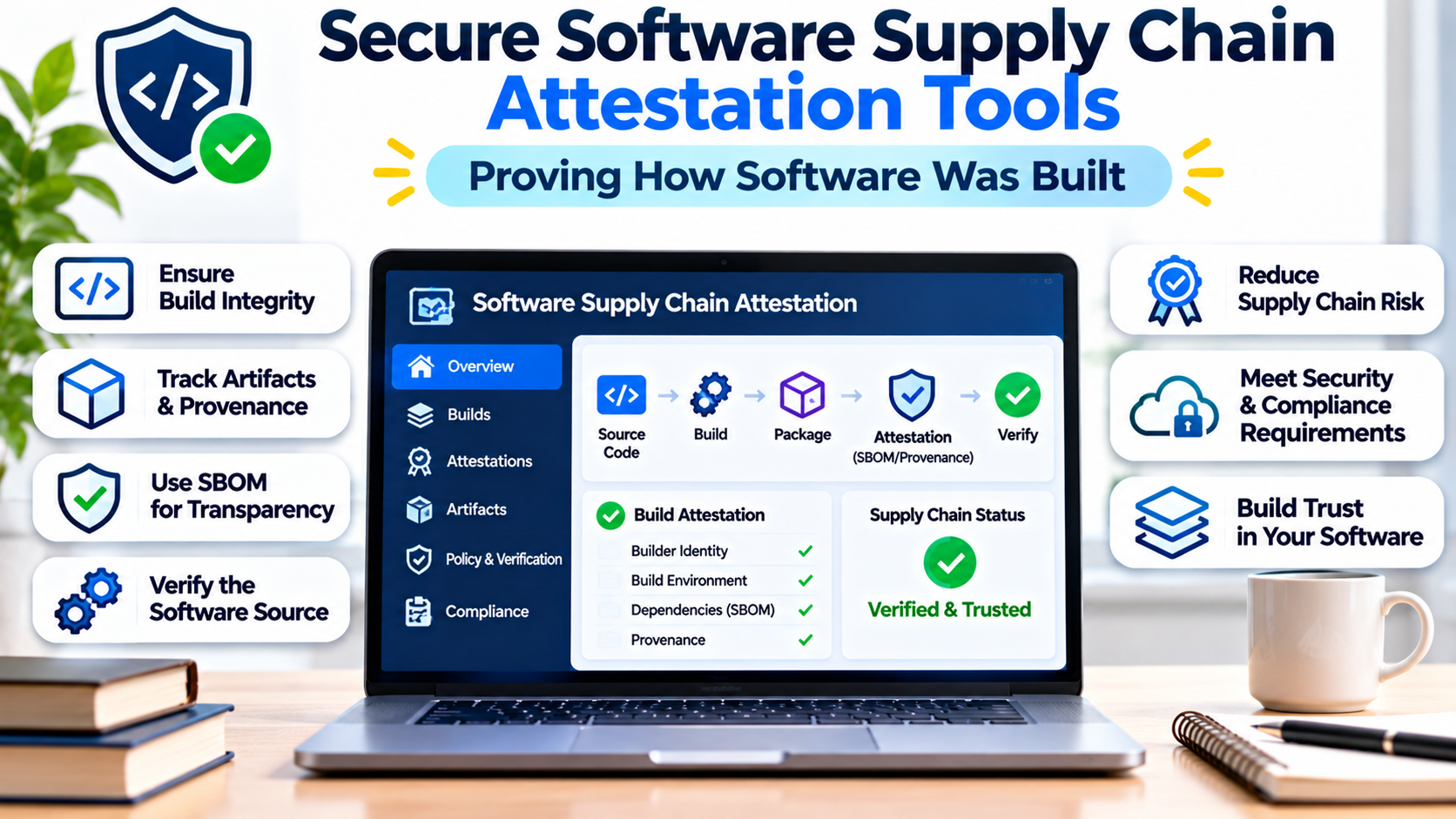
Secure software supply chain attestation tools help organizations collect and verify evidence about how software artifacts were produced.
SLSA, short for Supply-chain Levels for Software Artifacts, provides a framework for strengthening software supply chain integrity.
Build provenance is a central part of this approach.
However, producing provenance metadata is not enough. The information must come from a trustworthy source, remain bound to the correct artifact, and be verified before it influences a security decision.
The Problem Provenance Is Designed to Solve
Modern software delivery involves many systems.
Source code may reside in one platform. Dependencies come from package registries. CI/CD systems build artifacts, which are then published to container registries or package repositories.
Each transition creates opportunities for tampering or misconfiguration.
A malicious change could enter through source code, a compromised dependency, an unauthorized build step, or the artifact publishing process.
Traditional security scanning can identify some resulting problems.
However, scanning does not necessarily establish who built an artifact or whether the build used approved inputs.
Provenance provides evidence about the production process.
The purpose is to make software origins more verifiable.
What Is SLSA?
SLSA is a framework for improving the integrity of software supply chains.
Its build security model describes progressively stronger guarantees around how software is produced.
The framework addresses risks such as unauthorized modifications to build inputs or outputs.
SLSA is not a commercial software product.
It is also not a guarantee that an application contains no vulnerabilities.
Instead, it defines requirements and evidence that can help organizations assess whether software was produced through an appropriately controlled process.
Tools can implement parts of those requirements, but the presence of a tool does not automatically establish conformance.
What Build Provenance Contains
Build provenance describes the process used to produce a software artifact.
A provenance statement may identify the artifact, the build system, relevant inputs, and the build process.
The SLSA provenance specification uses an in-toto attestation structure.
Important concepts include:
Subject
The subject identifies the artifact associated with the attestation.
A cryptographic digest is commonly used to bind the statement to exact artifact content.
Builder
The builder identifies the build platform or relevant build system identity.
This is important because a trusted build platform may provide stronger evidence than metadata supplied directly by arbitrary build scripts.
Build Definition
The build definition describes relevant parameters and dependencies associated with the build.
Run Details
Run details provide information about the execution of the build process.
The precise structure depends on the applicable provenance specification.
The important question is whether the information is sufficiently complete and trustworthy for the consumer’s verification policy.
Attestations, Signatures, and Provenance Are Different
These terms are closely related but should not be used interchangeably.
| Concept | Main purpose |
|---|---|
| Provenance | Describes where and how an artifact was produced |
| Attestation | Associates an authenticated statement with an artifact |
| Digital signature | Provides cryptographic evidence associated with a signing identity or key |
| SLSA | Defines a framework and requirements for supply chain integrity |
| SBOM | Describes software components and dependencies |
| Vulnerability scan | Identifies known or suspected security issues |
| Verification policy | Determines which evidence is acceptable |
An artifact can have a valid signature but still be built through an untrusted process.
Similarly, an artifact can include detailed provenance that should not be trusted because the statement was generated by an untrusted actor.
A strong verification process examines both the evidence and its origin.
Tools and Platforms for Supply Chain Attestation
| Tool or platform | Main role | Important consideration |
|---|---|---|
| SLSA GitHub Generator | Provenance generation for supported GitHub Actions workflows | Build integration and trust assumptions |
| GitHub Artifact Attestations | Generating and verifying artifact attestations | Workflow identity and verification policy |
| Tekton Chains | Attestations and signing for Tekton pipelines | Pipeline configuration and artifact identification |
| in-toto | Framework for authenticated software supply chain metadata | Layouts, attestations, and verification design |
| Sigstore Cosign | Signing and verifying artifacts and attestations | Identity and trust policy |
| GUAC | Graph-based analysis of software supply chain metadata | Data ingestion and analysis requirements |
| Witness | Recording and verifying software build evidence | Integration and policy configuration |
| Google Cloud Build | Managed build workflows with provenance-related capabilities | Supported build modes and platform controls |
| Google Binary Authorization | Deployment policy enforcement using trusted evidence | Platform integration and attestation requirements |
These products address different parts of the evidence lifecycle.
Some generate attestations, others sign them, and others evaluate whether the evidence satisfies a deployment policy.
SLSA GitHub Generator
The SLSA GitHub Generator project provides reusable workflows for generating provenance in supported GitHub Actions scenarios.
Its purpose is to help projects produce provenance associated with their release artifacts.
The security value depends on the design of the build workflow and the trust boundary around provenance generation.
If arbitrary application code can freely forge the identity or contents of an attestation, the resulting statement offers limited assurance.
Organizations should therefore evaluate how the generator separates provenance production from untrusted build steps.
They should also verify that their artifact type and release process are supported.
GitHub Artifact Attestations
GitHub Artifact Attestations provide a way to associate signed attestations with artifacts produced through supported GitHub Actions workflows.
They can help consumers verify information about a build’s origin.
This is particularly relevant to teams already using GitHub for source control and CI/CD.
However, generating an attestation should not be confused with verifying it.
A consumer needs to check the artifact digest, expected repository or workflow identity, and other relevant claims.
The verification process should reject evidence that does not match the organization’s policy.
For example, an attestation produced by an unauthorized workflow should not be accepted merely because its cryptographic signature is valid.
Tekton Chains
Tekton Chains extends Tekton-based CI/CD environments with capabilities for producing signed software supply chain metadata.
It can observe completed task or pipeline executions and generate attestations based on supported configurations.
This makes it relevant to organizations running build pipelines on Kubernetes with Tekton.
A major implementation concern is identifying the correct input and output artifacts.
The resulting provenance must be bound to the artifacts that consumers will actually deploy.
Organizations should also understand the distinction between task-level and pipeline-level provenance.
Producing several statements for the same artifact without clear semantics can complicate downstream verification.
Tekton Chains is most useful when its generated evidence is incorporated into a defined release and deployment policy.
in-toto: Describing and Verifying Supply Chain Steps
in-toto provides a framework for securing software supply chain processes through authenticated metadata.
It can help organizations define expected steps and verify evidence associated with those steps.
This is useful when a software delivery process involves several parties or systems.
For example, an organization may want evidence that source code passed through an approved build and release process.
However, in-toto requires careful policy design.
A verification process is only as meaningful as the expectations it checks.
A policy that accepts any valid signature without considering who signed the statement may provide weak protection.
Sigstore Cosign and Attestation Verification
Cosign is commonly associated with signing and verifying container images and other artifacts.
It also supports attestation-related workflows.
This makes it a useful component of a broader provenance architecture.
However, Cosign is not itself a substitute for SLSA requirements.
A cryptographically valid attestation may still describe a build that fails the organization’s security policy.
Verification should examine the attestation’s subject, predicate type, signer identity, and relevant provenance claims.
The strongest approach combines cryptographic verification with policy evaluation.
GUAC: Understanding Relationships Between Supply Chain Evidence
GUAC, the Graph for Understanding Artifact Composition, is designed to help analyze software supply chain information.
Its graph-based approach can connect evidence involving artifacts, dependencies, and other supply chain relationships.
This can be useful when organizations need to understand the implications of a compromised dependency or suspicious artifact.
However, GUAC should not be mistaken for a build system or an automatic source of trusted provenance.
Its usefulness depends on the quality and coverage of the information it ingests.
A graph containing incomplete or unverified data can still lead to incorrect conclusions.
Witness: Recording Build Evidence
Witness provides capabilities for recording and verifying evidence associated with software build processes.
It can be relevant to teams seeking to instrument build steps and establish verifiable expectations.
The main evaluation question is whether the tool can capture the evidence required by the organization’s threat model.
For example, recording the command executed during a build may be useful, but it does not automatically prove that every dependency was trustworthy.
The verification policy needs to define which evidence is required and how it should be authenticated.
Managed Cloud Build and Deployment Controls
Managed cloud services can participate in software supply chain integrity workflows.
Google Cloud Build provides build infrastructure with provenance-related capabilities in supported configurations.
Google Binary Authorization can enforce deployment policies based on trusted evidence.
These services illustrate an important architectural distinction.
Generating provenance during a build and enforcing policy during deployment are separate responsibilities.
Organizations should verify the supported artifact types, provenance guarantees, and policy capabilities of the exact service configuration.
A managed service reduces some infrastructure responsibilities, but it does not eliminate the need for correct identity and policy design.
The Difference Between Generating and Verifying Provenance
Many supply chain initiatives begin by adding provenance generation to CI/CD pipelines.
This is useful, but it is only the first step.
A provenance statement has little protective value if every artifact is accepted regardless of what the statement says.
Verification should establish:
- The attestation is cryptographically valid.
- The statement applies to the exact artifact being evaluated.
- The signing identity or build platform is trusted.
- The source repository matches expectations.
- The build workflow or process is approved.
- Relevant dependencies and parameters satisfy policy.
- Required evidence is present and interpretable.
The specific checks depend on the organization’s threat model and the provenance guarantees available.
Why the Build Platform Must Be Trusted
A central challenge in provenance is determining who can make claims about a build.
Consider a build script that writes a JSON file declaring that the build was secure.
The file may be accurate, but it could also be modified by the same code being built.
This creates a weak trust boundary.
Stronger provenance designs rely on the build platform to produce or authenticate evidence independently of untrusted build instructions.
The platform’s identity, isolation properties, and control over the build process therefore matter.
A provenance document cannot establish stronger guarantees than the system that produced it.
SLSA Levels and Their Meaning
SLSA build levels describe increasing requirements for software build integrity.
Higher levels involve stronger controls and guarantees.
However, organizations should avoid treating the levels as a generic product ranking.
A tool cannot be labeled fully compliant merely because it emits a provenance file.
The relevant build process must satisfy the applicable requirements.
Organizations should also distinguish between a supplier’s claim and independently verifiable evidence.
A meaningful assessment identifies the specific requirements met, the build environment involved, and the evidence supporting the claim.
Provenance Does Not Replace an SBOM
A software bill of materials, or SBOM, describes components and dependencies included in software.
Build provenance explains how an artifact was produced.
These records answer different questions.
An SBOM can help identify whether a vulnerable library is present.
Provenance can help establish which source and build process produced the artifact.
Both may be useful during incident response.
However, neither automatically proves that an application is free from malicious behavior.
Supply chain security requires multiple complementary controls.
Attestation Storage and Distribution
Evidence must remain available when consumers need to verify an artifact.
Attestations may be distributed alongside software artifacts or through supported registries and services.
The storage design should preserve the relationship between the artifact and its evidence.
Cryptographic digests help establish that relationship.
Organizations should consider what happens when artifacts are copied between registries or mirrored to another environment.
If evidence becomes unavailable during distribution, downstream verification may fail.
A reliable release process should treat attestations as part of the artifact distribution workflow.
Designing a Practical Attestation Policy
Start with a small number of meaningful requirements.
For example, an organization may require production images to originate from an approved repository and a designated CI/CD workflow.
It may also require provenance to identify the expected build platform.
These checks are more useful than a vague policy requiring any attestation.
Next, decide where verification occurs.
Possible enforcement points include package publication, registry promotion, deployment approval, and cluster admission.
The chosen enforcement point should prevent untrusted artifacts from reaching the protected environment.
Common Implementation Mistakes
Trusting Any Valid Signature
A signature establishes a cryptographic relationship with a key or identity.
It does not automatically establish that the signer is authorized.
Failing to Check the Artifact Digest
An attestation must refer to the exact artifact being evaluated.
Tags and filenames alone are insufficient.
Treating Self-Reported Metadata as Independent Evidence
Build scripts can produce useful metadata, but their claims may not be independent of the code being built.
Generating Evidence Without Enforcement
A large collection of attestations provides limited preventive value if no consumer checks them.
Ignoring Build Dependencies
A trusted source repository does not eliminate risks involving compromised dependencies or build tools.
How to Evaluate Attestation Tools
Begin with the existing build platform.
For GitHub Actions, investigate GitHub Artifact Attestations and relevant SLSA generator workflows.
For Tekton environments, evaluate Tekton Chains.
For broader supply chain verification, examine in-toto and complementary signing tools.
For organizations needing relationship analysis, GUAC may provide additional value.
Then test the full workflow.
Produce an artifact, generate evidence, distribute both, and verify the result from a separate environment.
Finally, introduce a deliberate policy violation.
For example, attempt to verify an artifact built by an unauthorized workflow.
The system should reject it for a clear, documented reason.
Final Thoughts
Secure software supply chain attestation is about turning claims of trustworthy software production into evidence that consumers can verify.
SLSA provides the framework. Provenance describes the build. Attestation tools help produce and authenticate evidence. Verification policies determine whether that evidence is acceptable.
The strongest implementation does not stop after generating metadata.
It establishes trusted build identities, binds evidence to exact artifacts, and enforces meaningful rules before software reaches sensitive environments.
The objective is not to collect the most attestations. It is to make unauthorized or unexpected software production harder to conceal and easier to reject.