Introduction
A person downloads a habit tracker with a simple goal: take a short walk every afternoon.
The first few days go well. The app displays a growing streak, sends encouraging reminders, and makes progress visible.
Then an unexpected appointment interrupts the routine.
The streak disappears.
Instead of helping, the app begins to feel like another obligation.
This experience reveals an important distinction between recording habits and building sustainable behavior.
Wellness habit tracking apps can help people remember routines, notice patterns, and reflect on progress. But their design can also encourage excessive tracking, unrealistic goals, or discouragement after ordinary interruptions.
Choosing the right application requires more than comparing calendars and colorful progress charts.
The most useful tool is one that supports a realistic wellness routine while allowing flexibility when life changes.
What Are Wellness Habit Tracking Apps?
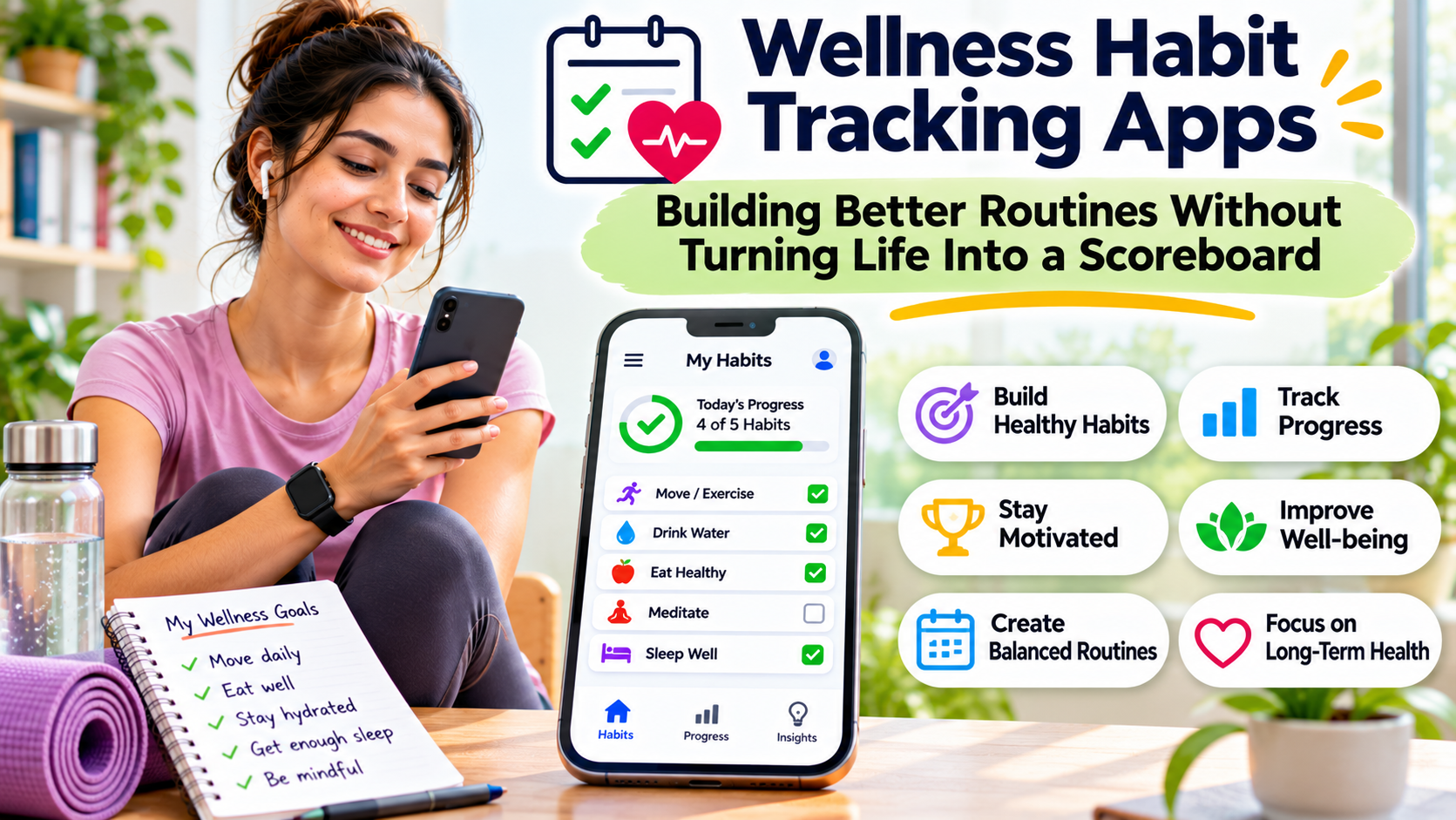
Wellness habit tracking apps help users establish, record, and review recurring behaviors associated with daily well-being.
Common examples include sleep routines, movement, hydration, mindfulness, relaxation, and personal self-care activities.
Most applications allow users to create habits and record whether they completed them.
Some include reminders, progress charts, streaks, journals, and goal-setting features.
Others incorporate gamification, guided activities, or broader planning tools.
These applications differ from specialized medical monitoring systems.
A wellness tracker may help someone remember a bedtime routine, but it does not automatically diagnose or treat a sleep disorder.
Similarly, a hydration reminder is not a substitute for individualized medical guidance.
The distinction matters because wellness applications often use health-related language without providing clinical services.
Why Habit Tracking Sometimes Works
Habit tracking can make behavior more visible.
A person may believe they walk regularly but discover that the routine occurs only once or twice a week.
Recording activity can help identify patterns and obstacles.
Reminders may also support consistency when a behavior is easy to forget.
However, tracking alone does not guarantee lasting change.
The behavior must be practical, meaningful, and compatible with daily life.
Awareness Versus Motivation
Tracking can increase awareness of what happens.
Motivation involves reasons for continuing the behavior.
These are related but different.
A chart showing completed walks may encourage some users.
Others may find the same chart uninteresting or stressful.
A good application should support reflection without assuming that every user responds positively to competition or streaks.
The Importance of Small Actions
A habit that requires major effort every day may be difficult to sustain.
Smaller actions can be easier to repeat.
For example, a person trying to develop a reading routine might begin with a few minutes rather than a demanding daily target.
The app should make it possible to define modest goals and adjust them over time.
Different Types of Habit Tracking Apps
The category includes several distinct design approaches.
Simple Habit Trackers
These applications focus on recording whether a behavior occurred.
They often use checklists, calendars, or basic charts.
Their main advantage is simplicity.
They may suit users who already know what they want to do and need a lightweight record.
Goal and Routine Planners
Routine planners help users organize activities around times of day or recurring schedules.
They may be useful for morning routines, evening preparation, or other structured activities.
However, they can become complicated when every part of the day is assigned a task.
Gamified Habit Trackers
Gamified applications use rewards, characters, points, or other game elements.
These can make routine activities more engaging.
But game mechanics may also encourage users to focus on rewards rather than the purpose of the behavior.
Wellness Journals
Some applications combine habit tracking with mood entries, reflections, or daily journals.
This approach may help users consider how routines relate to their experiences.
The trade-off is greater input effort.
Integrated Wellness Platforms
Broader wellness applications may combine activity tracking, sleep information, mindfulness content, and habit reminders.
They can reduce the number of separate tools needed.
However, integrated platforms may collect more personal information and present more notifications than users want.
Wellness Habit Tracking Apps Worth Exploring
Several established applications illustrate different approaches to habit tracking.
Habitify
Habitify focuses on creating and monitoring recurring habits.
Its approach emphasizes routine organization, reminders, and progress visibility.
It is relevant to users who want a dedicated habit tracker rather than a broad task management platform.
The main evaluation questions are whether its scheduling options match the user’s routines and whether its progress features feel useful.
Users should verify current subscription conditions and device compatibility.
Streaks
Streaks is a habit-focused application associated with a straightforward, goal-oriented approach.
Its design emphasizes completing recurring activities and maintaining progress.
It may appeal to users who prefer a focused habit tracker within supported Apple device environments.
However, streak-based motivation is not ideal for everyone.
Someone who finds broken streaks discouraging should evaluate whether the application offers enough flexibility.
Loop Habit Tracker
Loop Habit Tracker is an Android-oriented habit tracking application with an emphasis on straightforward habit records and progress analysis.
It may interest users who prefer a focused tool without a broad wellness subscription.
Its open-source orientation is another relevant distinction.
Users should still verify current maintenance, installation sources, and compatibility before adopting it.
Habitica
Habitica approaches habit management through role-playing game mechanics.
Users interact with tasks and habits through a game-like reward system.
This can appeal to people who find traditional checklists unengaging.
However, its game structure may be unnecessary for someone who simply wants to remember a daily walk.
Habitica illustrates how motivational design can matter as much as the underlying tracking functions.
Finch
Finch combines self-care activities with a virtual companion and encouraging interactions.
Its approach emphasizes emotional engagement and small daily actions.
It may suit users who appreciate supportive prompts and a less conventional habit tracking experience.
However, users should evaluate whether the virtual companion experience helps them focus on their goals or becomes a distraction.
Comparing Habit Tracking Approaches
| App or approach | Main emphasis | Best evaluation question |
|---|---|---|
| Habitify | Structured habit tracking | Can it represent my actual routine? |
| Streaks | Completion and streaks | Do streaks motivate or discourage me? |
| Loop Habit Tracker | Focused habit records | Do I prefer a simple tracking experience? |
| Habitica | Game-based motivation | Will game mechanics help me stay engaged? |
| Finch | Supportive self-care interaction | Does the companion approach feel useful? |
| Basic checklist or calendar | Minimal recordkeeping | Do I need a dedicated app at all? |
These products should not be ranked solely by the number of features.
Their differences are largely about how they encourage users to interact with routines.
The Most Important Feature: Flexible Goal Design
A useful habit tracker should accommodate different types of goals.
Not every habit is best measured by daily completion.
For example, a person may want to exercise several times per week rather than every day.
Another may want to maintain a consistent bedtime routine on most nights.
The app should represent these goals accurately.
Daily Versus Weekly Goals
Daily reminders can help with activities intended to happen every day.
Weekly targets are often more appropriate for activities that require recovery, scheduling flexibility, or occasional participation.
Software that forces every goal into a daily streak may distort the user’s intentions.
Completion Versus Quantity
Some habits can be recorded as completed or not completed.
Others benefit from quantities, durations, or frequency.
A reading routine might be tracked by minutes.
A movement goal might be tracked by sessions.
However, more detailed measurement is not always better.
Users should record only what helps them make decisions.
Why Streaks Can Become a Problem
Streaks are common because they are easy to understand.
A continuous sequence of completed days provides visible evidence of consistency.
For some users, this is motivating.
For others, it creates pressure.
A single missed day can make an otherwise successful routine feel like a failure.
Measure Recovery, Not Just Perfection
Sustainable habits involve interruptions.
Travel, illness, changing schedules, and family responsibilities can affect routines.
A useful application should make it easy to resume without treating every interruption as a major setback.
Users may benefit from reviewing overall frequency instead of focusing exclusively on uninterrupted streaks.
Avoid Turning Wellness Into Punishment
Wellness activities should support quality of life.
An app that makes users feel guilty for resting, missing a target, or changing priorities may not be serving its purpose.
The ability to pause, revise, or remove habits is an important design feature.
Reminders That Help Instead of Interrupting
Notifications are one of the main reasons people use habit trackers.
But their usefulness depends on timing and relevance.
A reminder to prepare for bed may be helpful when it appears at an appropriate time.
The same reminder may become irritating if it continues after the user’s schedule changes.
Choose Meaningful Reminder Times
Reminders should reflect real routines.
A notification tied to an existing activity may be more useful than one scheduled at an arbitrary hour.
For example, someone might prefer a reminder to stretch after finishing work.
The app should allow timing changes without requiring the habit to be recreated.
Limit Notification Overload
A person tracking ten habits may receive numerous prompts throughout the day.
This can make reminders easier to ignore.
Start with the most important routines.
Additional tracking can be introduced only when it provides clear value.
Habit Tracking and Mental Well-Being
Wellness habit tracking can overlap with mood tracking, mindfulness, and self-care.
These functions may support reflection.
However, tracking emotional states or behaviors too frequently can become counterproductive for some people.
An app should not pressure users to record every feeling or maintain perfect daily performance.
If tracking increases anxiety, distress, or compulsive checking, reducing or stopping the activity may be appropriate.
People experiencing significant mental health concerns should seek appropriate professional support rather than rely solely on a habit tracker.
Sleep, Hydration, and Movement Tracking
These are common wellness categories, but they require careful interpretation.
Sleep Routines
A habit tracker can help users maintain a consistent routine around bedtime.
It may record whether a planned activity occurred.
However, it does not necessarily measure sleep quality or identify medical sleep problems.
Hydration
Hydration reminders may be useful for people who simply forget to drink during the day.
However, fluid needs vary according to individual circumstances.
An application should not be treated as a source of universal medical advice about fluid intake.
Physical Activity
Habit trackers can help users remember planned movement.
They may also provide a record of completed activities.
However, appropriate activity levels depend on personal circumstances, goals, and relevant health considerations.
The software should allow flexible targets rather than impose the same expectations on every user.
Privacy: A Habit Tracker Can Reveal More Than Expected
Habit records may appear harmless individually.
Together, they can reveal detailed patterns about a person’s daily life.
An application may contain information about sleep schedules, work routines, emotional states, health-related activities, and personal priorities.
Users should review data collection and sharing practices.
Questions to Ask Before Installing
Consider whether the application requires an account.
Check whether information is stored locally or synchronized with external services.
Review available export and deletion options.
Determine whether the app uses advertising or analytics services and what information may be shared.
Also consider device permissions.
A simple checklist application should not automatically need access to every category of personal information.
Cross-Device Synchronization and Reliability
Some users want their habits available on a phone, tablet, and computer.
Others prefer a single-device experience.
Cross-device synchronization can be convenient, but it introduces additional complexity.
Users should verify whether the app preserves entries correctly across devices.
They should also understand what happens when internet access is unavailable.
For important records, export and backup options can be valuable.
However, many casual habit tracking needs do not justify a complicated synchronization system.
Free Versus Paid Habit Tracking Apps
Habit trackers may be free, paid once, or offered through subscriptions.
Paid plans may include additional habits, reminders, statistics, synchronization, or customization.
The relevant question is whether those functions improve the user’s experience.
A person tracking two routines may not benefit from an expensive subscription.
Someone managing several schedules across devices may value advanced options.
Users should review current pricing and renewal terms before purchasing.
A paid app should not be assumed to produce better behavior change.
How to Test a Habit Tracker Properly
A useful trial should focus on a small number of realistic habits.
Begin with one activity the user genuinely wants to repeat.
Create a schedule that reflects ordinary life.
Then use the app for enough time to experience both successful and missed entries.
Observe how the application responds to interruptions.
Does it allow the user to resume easily?
Can reminders be adjusted?
Are progress summaries understandable?
Next, test editing the habit.
A goal may change from daily to several times per week.
The platform should handle that change without unnecessary confusion.
Finally, review privacy settings, data export, and subscription conditions.
A Better Habit Tracking Strategy
Software works best when paired with a realistic approach to behavior change.
Start With One Meaningful Habit
Choose an activity with a clear purpose.
A smaller number of habits makes it easier to understand what is working.
Make the Action Specific
A vague goal such as be healthier is difficult to track.
A specific action such as take a short walk after lunch is easier to recognize and record.
Plan for Interruptions
Decide how to resume after a missed day.
The goal is continued participation, not a perfect record.
Review Patterns Occasionally
A weekly review may reveal useful information without requiring constant monitoring.
Ask whether the routine is practical and whether it still serves its purpose.
Change the Goal When Needed
Habits should adapt to changing circumstances.
A useful application should make adjustments feel normal rather than like failure.
When a Simple Calendar Is Better
Dedicated habit tracking software is not always necessary.
A calendar, notebook, or basic checklist may be sufficient for a small number of routines.
These alternatives can reduce notifications, subscription costs, and personal data collection.
A dedicated app becomes more valuable when reminders, flexible scheduling, or progress analysis solve a specific problem.
The best tool is the simplest one that reliably supports the desired behavior.
Frequently Asked Questions
Do habit tracking apps actually help build habits?
They can support awareness, reminders, and consistency. Results depend on the person, the behavior, and whether the routine is realistic.
Is it better to track habits every day?
Not necessarily. Some habits are daily, while others are better represented by weekly or flexible schedules.
Are streaks necessary for motivation?
No. Streaks help some users but discourage others. Overall consistency and the ability to resume can be more useful.
Can a wellness habit tracker replace medical advice?
No. Habit trackers can organize routines, but they do not replace professional assessment or individualized medical guidance.
How many habits should someone track?
There is no universal number. Starting with a small set of meaningful habits often makes tracking easier to maintain.
Are free habit tracking apps enough?
Often, yes. A free app or basic checklist may be sufficient when the goal is simple reminders and completion records.
Final Thoughts
Wellness habit tracking apps are useful when they make healthy routines easier to remember and maintain.
Their value does not come from creating the longest streak or collecting the greatest amount of data.
It comes from helping users understand their behavior, adjust their routines, and continue after ordinary interruptions.
A simple tracker may be ideal for someone who wants a clear daily checklist.
A flexible planning app may suit a person managing several recurring activities.
A gamified or companion-based application may help someone who enjoys more interactive encouragement.
The right choice is the one that supports well-being without turning it into another source of pressure.