Introduction
A clinical trial collects information from hospitals, laboratories, patient questionnaires, and medical devices. Each source contributes important evidence about treatment outcomes and participant safety.
However, the information does not always arrive in the same format or at the same time.
A laboratory result may use an unexpected unit. A participant’s visit date may conflict with another record. A medical term may require coding before analysis. A corrected value may need to be traced back to its original entry.
These problems can affect the reliability of clinical research.
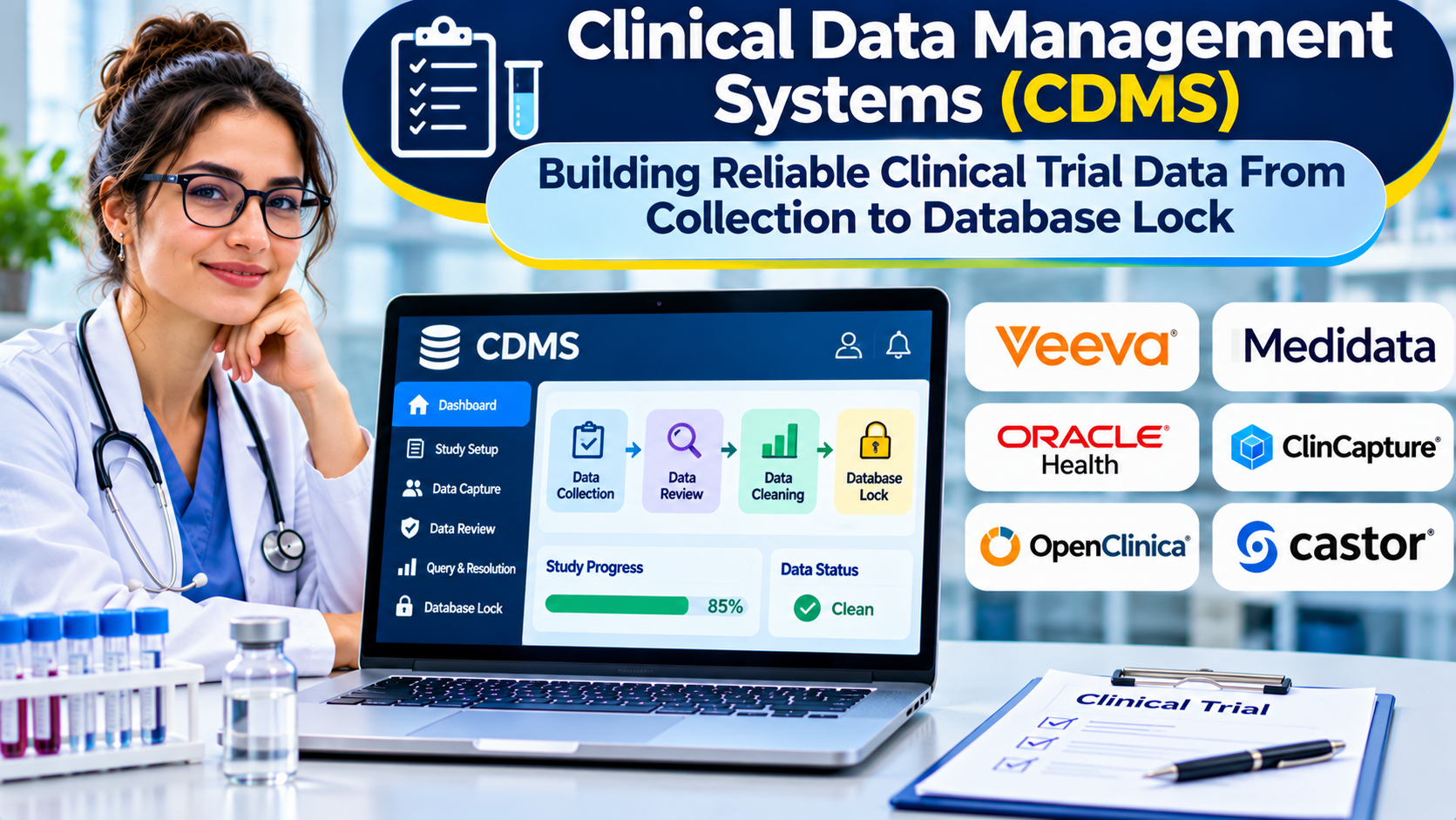
Clinical data management systems (CDMS) help research organizations collect, review, validate, reconcile, and prepare clinical trial data.
Yet choosing a CDMS is not simply a matter of finding software that stores case report forms. Modern studies generate data from multiple sources, and the quality of the final dataset depends on how those sources are connected.
The most important question is whether the platform can preserve trustworthy data throughout the study, from initial capture to final database lock.
What Is a Clinical Data Management System?
A clinical data management system is software used to manage clinical research data throughout its operational lifecycle.
It supports processes that help ensure trial information is complete, consistent, traceable, and suitable for analysis.
Depending on the product, capabilities may include electronic data capture, edit checks, query management, medical coding, data reconciliation, review workflows, and controlled data exports.
The term CDMS can describe a broad clinical data management environment rather than one application.
This distinction matters because vendors use overlapping terminology.
An electronic data capture system, commonly called EDC, primarily supports the collection and management of clinical trial information through electronic forms and related workflows.
A broader CDMS may also bring together data from laboratories, electronic clinical outcome assessments, wearable devices, imaging systems, and other sources.
Some products combine these functions in one platform. Others use integrated applications.
Organizations should evaluate the actual data lifecycle rather than relying on product labels.
Why Clinical Data Quality Cannot Be Fixed at the End
A common misconception is that data cleaning happens after a trial finishes collecting information.
In practice, data quality must be managed throughout the study.
Consider a participant whose laboratory result is entered with the wrong measurement unit.
If the problem is identified immediately, the site may be able to correct it using the appropriate source documentation.
If the discrepancy remains unresolved until the final analysis, investigators may need to reconstruct events months later.
That can delay the study and complicate interpretation.
A well-designed CDMS helps teams detect and resolve problems while relevant information is still available.
However, the system cannot guarantee quality through automated checks alone.
Data managers, clinical reviewers, investigators, and other authorized personnel must interpret discrepancies and make appropriate decisions.
The Clinical Data Lifecycle
Clinical data management begins before the first participant’s information enters the system.
Study design and data requirements
The research protocol defines the study’s objectives, assessments, and relevant procedures.
Data management teams translate those requirements into a collection and review framework.
This may involve defining electronic case report forms, data fields, validation rules, controlled terminology, and data transfer specifications.
A CDMS should help maintain consistency between the protocol and the configured data collection environment.
Data collection
Clinical sites and connected systems submit study information.
Some data may be entered manually into electronic forms.
Other information may arrive through laboratory transfers, patient-reported assessments, or approved integrations.
The platform should preserve the relationship between each data value, its source, and the relevant study context.
Validation and cleaning
Validation checks identify information that appears incomplete, inconsistent, or outside expected parameters.
These checks may generate queries for review.
Authorized users investigate and resolve discrepancies according to documented procedures.
Reconciliation
Different systems may contain related information.
For example, a clinical database and a safety database may both contain records relevant to adverse events.
Reconciliation helps teams identify and resolve appropriate differences between those records.
Database lock and delivery
After required review and cleaning activities are completed, the study may proceed to database lock.
A lock restricts changes according to the organization’s controlled procedures.
The data can then be delivered for statistical analysis and other authorized uses.
A database lock is not simply a technical switch. It represents the completion of defined review and approval activities.
Electronic Case Report Forms and Study Build
Electronic case report forms, or eCRFs, provide structured fields for collecting study information.
They may include demographic details, medical history, treatment administration, laboratory results, and clinical assessments.
The forms must reflect the study protocol.
A CDMS should allow authorized teams to define fields, data types, required values, and relationships between forms.
Reusable study components
Organizations conducting many studies may benefit from standard form libraries.
Reusable components can promote consistency.
However, standardization should not override protocol-specific requirements.
A form suitable for one therapeutic area may be inappropriate for another.
The platform should support controlled reuse while allowing necessary study-specific configuration.
Protocol amendments
Clinical protocols sometimes change during an active study.
These changes may affect assessments, visit schedules, or data collection requirements.
The CDMS must support appropriately controlled modifications.
Organizations should test how the platform handles existing participant records when forms or validation rules change.
Historical information should remain understandable.
Edit Checks and Query Management
Edit checks are rules used to identify data that may require attention.
For example, a system may detect a missing required value or an inconsistency between two related fields.
Some checks can operate during data entry.
Others run after information is imported or during centralized review.
An edit check should not automatically change a clinically meaningful value merely because it appears unusual.
The query lifecycle
A query may be opened when a discrepancy is identified.
The relevant site or authorized user reviews the issue.
They may correct the data, provide clarification, or explain why the original value is appropriate.
The query can then be reviewed and closed according to established procedures.
A useful CDMS should preserve this history.
It should also distinguish unresolved questions from discrepancies that have been appropriately explained.
Avoid excessive automated queries
Poorly designed validation rules can create unnecessary work.
For example, a rule may repeatedly flag a clinically plausible result because its expected range is too narrow.
High query volumes do not necessarily indicate better data quality.
Organizations should assess whether validation rules identify meaningful problems without overwhelming sites.
Medical Coding and Standard Terminology
Clinical studies frequently collect information that requires standardized coding.
Adverse events may be coded using MedDRA.
Concomitant medications may be coded using relevant medication dictionaries, including WHODrug where appropriate.
Coding helps organizations analyze information consistently.
However, coding requires suitable processes and qualified oversight.
A CDMS or connected coding application may support dictionary searches, coding suggestions, and review workflows.
Buyers should verify which dictionaries are supported and how updates are managed.
They should also determine how coding decisions are documented.
Automated suggestions can assist reviewers, but they should not replace appropriate clinical judgment.
CDMS Software Options Worth Evaluating
Several established platforms support clinical data management through different architectures.
Medidata Rave EDC and Clinical Data Studio
Medidata Rave EDC supports electronic clinical data capture, review, cleaning, and reporting.
Medidata also offers Clinical Data Studio for centralized data management and review across multiple sources.
This distinction is important.
An organization evaluating Medidata should determine whether its requirements are primarily focused on site data capture or on broader cross-source data oversight.
Buyers should examine study configuration, external data integration, query workflows, reporting, and the services included in their proposed environment.
Veeva Vault CDMS
Veeva Vault CDMS brings together clinical data management applications within the Veeva clinical technology ecosystem.
Its portfolio includes capabilities associated with electronic data capture and broader data management workflows.
Organizations should evaluate how study builds, data review, and connected clinical applications work together.
The decision should consider existing vendor relationships, integration requirements, and the operational impact of adopting a broader platform.
Oracle Clinical One Data Collection
Oracle Clinical One Data Collection supports electronic clinical trial data collection and related workflows.
Oracle’s clinical technology portfolio also includes applications for other aspects of trial execution.
Organizations should identify which functions are available within the specific proposed products.
A unified vendor environment may simplify some integrations, but the actual data flows and responsibilities still require validation.
OpenClinica
OpenClinica offers electronic data capture technology for clinical research.
It may be relevant to research organizations seeking configurable study data collection and associated management workflows.
Buyers should investigate its study design capabilities, integrations, user experience, data exports, and support arrangements.
The evaluation should distinguish essential clinical data management requirements from functions provided by other systems.
Castor EDC
Castor provides electronic data capture software used in clinical research.
It can be relevant to organizations seeking digital study forms and data collection workflows.
However, an EDC product should not automatically be treated as a complete enterprise clinical data management environment.
Organizations should confirm the capabilities required for multi-source reconciliation, medical coding, centralized review, and downstream data preparation.
Comparing CDMS Architectures
| Approach | Potential advantage | Main consideration |
|---|---|---|
| EDC-centered platform | Focused clinical form collection and cleaning | External data management may require additional tools |
| Integrated clinical data suite | Connected capture, review, and related workflows | Greater platform scope and implementation effort |
| Centralized data management layer | Oversight across multiple data sources | Integration and data mapping requirements |
| Research-focused EDC | Potentially simpler study setup | Enterprise governance and complex study needs |
| Custom clinical database | Tailored initial functionality | Validation, maintenance, and traceability risks |
The correct architecture depends on the study portfolio.
A small investigator-led study may need a straightforward EDC environment.
A multinational clinical development program may require extensive integrations and centralized data review.
Managing External Data Sources
Clinical trials increasingly collect information outside traditional case report forms.
Examples include central laboratory results, electronic patient-reported outcomes, medical imaging, and wearable device measurements.
These sources may use different identifiers, formats, and transfer schedules.
A CDMS must connect the information without losing its meaning.
Data mapping
Data mapping defines how information from one system corresponds to fields or structures in another.
For example, a laboratory may use one test code while the clinical data platform uses a different standard representation.
The integration must establish the relationship.
Incorrect mappings can create errors even when the original source data is accurate.
Transfer validation
Organizations should verify that incoming files or messages are complete and correctly structured.
They should also detect missing records, unexpected duplicates, and rejected transfers.
A successful technical connection does not guarantee correct clinical interpretation.
Data managers need visibility into transfer exceptions.
Data lineage
Data lineage describes where information originated and how it changed.
For clinical research, it helps teams understand transformations and corrections.
A reviewer should be able to determine whether a value came from site entry, a laboratory feed, or another authorized source.
This traceability is particularly important when discrepancies arise.
Clinical Data Standards and Interoperability
Clinical data management often involves standards developed by the Clinical Data Interchange Standards Consortium, or CDISC.
Relevant standards may include CDASH for data collection, SDTM for standardized tabulation data, and ADaM for analysis datasets.
These standards serve different purposes.
Organizations should not assume that support for one standard guarantees support for the others.
The CDMS may also need to exchange information using suitable data models and technical formats.
Buyers should request demonstrations of the specific exports and integrations they require.
Standards support requires governance
A platform may provide standard templates, but study teams still need appropriate definitions and mapping procedures.
Different interpretations of a data element can undermine consistency.
Organizations should establish standards governance across studies.
This helps reduce unnecessary differences between projects and improves downstream analysis.
Regulatory Expectations and Data Integrity
Clinical research data may be subject to Good Clinical Practice requirements and applicable electronic record regulations.
Organizations should evaluate the relevance of ICH E6, FDA requirements, and other jurisdiction-specific obligations.
Electronic systems may need appropriate access controls, audit trails, electronic signatures, validation, and record retention arrangements.
However, software features alone do not establish regulatory compliance.
The sponsor or responsible organization must ensure that its configured systems and procedures meet applicable requirements.
Audit trails
An audit trail helps document relevant changes to records.
It may include the previous value, revised value, user, timestamp, and reason for change.
The exact requirements depend on the system’s intended use and applicable obligations.
A useful audit trail should allow authorized reviewers to reconstruct important events.
It should not merely record that someone opened a screen.
Computerized system validation
Organizations should establish documented confidence that the system performs as intended.
Validation activities should reflect risk, configuration, integrations, and operational use.
The vendor may provide supporting documentation.
However, the organization remains responsible for its own system governance and controlled processes.
Database Lock Is a Business Process, Not Just a Button
Database lock is often described as the final stage of clinical data management.
However, reaching that stage requires coordination across several teams.
Outstanding queries may need resolution.
External data reconciliation may need completion.
Medical coding may require review.
Data management and other authorized functions may need to confirm readiness.
The CDMS should support these activities and preserve the associated decisions.
What happens after a lock?
Occasionally, an issue may be identified after a database has been locked.
Organizations need controlled procedures for determining whether an unlock or correction is appropriate.
The software should preserve relevant history.
A post-lock change must not erase the original state of the data without traceability.
Security and Participant Confidentiality
Clinical databases may contain sensitive participant information.
Organizations should minimize unnecessary personal identifiers and use appropriate access controls.
Study personnel should receive access based on their responsibilities.
A site user may need access to participants at their own site without access to unrelated records.
Central data managers may require broader review permissions.
The system should support these distinctions.
Institutions should also evaluate encryption, authentication, auditability, backup, recovery, and vendor data processing arrangements.
Cross-border studies may introduce additional legal requirements.
A Practical CDMS Vendor Evaluation
A useful evaluation should reproduce a complete study data workflow.
Begin by creating a small study with several electronic forms.
Enter representative participant data.
Introduce a missing value and an inconsistent date.
Examine how the system generates and resolves queries.
Next, import laboratory results.
Include one record with an unmatched participant identifier.
Ask the vendor to demonstrate how the exception is identified and investigated.
Then change a form through a simulated protocol amendment.
Finally, perform review activities and demonstrate the database lock procedure.
This approach tests operational reliability rather than isolated features.
Implementation Costs and Long-Term Ownership
CDMS pricing may depend on studies, users, modules, data volumes, and service arrangements.
Implementation can involve study configuration, integrations, migration, validation, training, and support.
Organizations should also account for ongoing changes.
A protocol amendment may require additional configuration and testing.
A new laboratory provider may require another integration.
A study expansion may increase support needs.
The full financial evaluation should include these responsibilities.
Measuring Data Management Effectiveness
Useful measures include unresolved query age, data transfer failures, reconciliation backlogs, and time required for review activities.
Organizations may also examine the number of corrections discovered late in the study.
However, faster database lock should not become the only objective.
A study that closes queries quickly without adequate investigation may create serious quality risks.
The goal is reliable data supported by proportionate and well-documented processes.
Choosing a CDMS That Protects the Meaning of Clinical Data
Clinical data management systems are part of the evidence infrastructure of clinical research.
They connect data collection, validation, review, reconciliation, and delivery.
The right platform depends on the number and complexity of studies, the diversity of data sources, and the organization’s regulatory responsibilities.
A strong selection process should test actual data flows, exceptions, protocol changes, and final review procedures.
The most valuable CDMS is not necessarily the one with the greatest number of automated features.
It is the system that helps qualified teams understand where information came from, identify what requires attention, and produce reliable datasets for scientific analysis.
When clinical data remains accurate, traceable, and interpretable, the technology supports the central purpose of clinical research: generating trustworthy evidence.