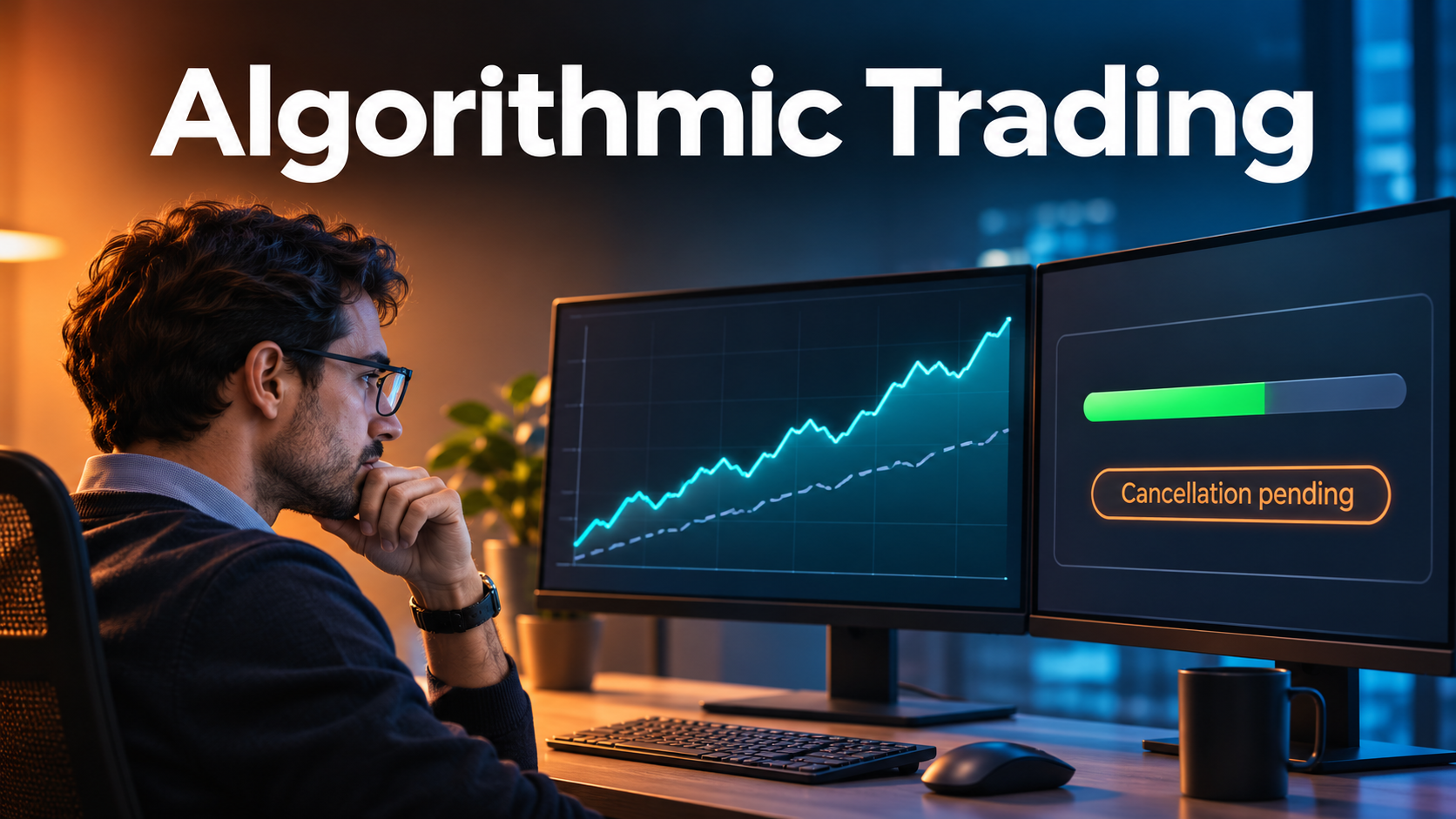
The first useful test of an algorithmic trading platform is a deliberately ordinary order. Submit it in a controlled environment, let it fill in part, and interrupt the connection while a cancellation is pending. When service returns, check the strategy’s position against the broker’s record. If the two disagree, see whether the platform can explain the discrepancy before it sends another order. A profitable simulation tells you very little about that moment.
Algorithmic trading platforms span research libraries, broker-hosted automation, managed strategy runtimes, and institutional execution infrastructure. Some products help a researcher express a rule and test it against historical prices. Others let an engineering team deploy that rule, supervise orders, and recover after a failure. Decide how much of that lifecycle you want the platform to own. The answer affects both what you buy and the engineering work you retain.
Read a backtest as a record of assumptions
A backtest is a simulation built from market data and assumptions about how a strategy would have interacted with the market. Examine when the simulator makes information available. If a signal depends on the final close of a bar, an assumed fill at that same close needs a credible explanation. A daily strategy can look attractive because the engine lets it act on information that would only have been available after the assumed execution.
Execution assumptions deserve equal attention. A market order in a model may execute at a reference price plus an estimated cost. In live trading, available liquidity, the spread, order size, and delays can affect the outcome. A limit order creates a different problem. A price reaching the order’s limit provides incomplete evidence about whether the strategy would have obtained a fill. Other orders may have had priority, and the visible market data may reveal little about the exact queue.
Check fees, market hours, corporate actions, and missing data using examples you can verify. If you trade instruments with contract expirations, model how the strategy switches contracts and which prices it could have traded. If a dataset includes a revised field, determine when the original value became available. Keep a record of dataset versions and configuration alongside results. A comparison between two strategy runs is meaningful when the team can identify the input that changed.
Separate the work of developing a strategy from evaluating it on unseen periods or markets. Repeatedly revisiting a supposedly untouched sample can turn it into another development dataset. Run sensitivity checks around costs and execution assumptions. The aim is to see which assumptions drive the result and whether the strategy remains interesting when those inputs move within plausible ranges.
Follow the order through every environment
Research, market replay, paper trading, and live deployment each provide different evidence. Historical replay is useful for reproducing a scenario and changing one assumption. Paper trading can test scheduling, market-data consumption, order submission, and how the strategy responds to simulated fills. A broker’s paper environment may use different execution logic from live venues. Ask the platform and the broker what each environment actually models.
One useful exercise is to follow a single decision across all four environments. Capture the input data, decision time, strategy version, intended quantity, and resulting order. Compare how each environment handles rejects, partial fills, and cancellation requests. The objective is a clear explanation for any difference. Identical outcomes are rarely a sensible requirement where the simulated and live environments have different information.
Keep strategy intent separate from broker order state. The strategy may request a cancellation, while the order remains live until an acknowledgement arrives. A fill can arrive during that interval. The FIX Trading Community order-state specification describes transitions and execution reports that help teams reason about cases like these. A platform can use FIX, a broker API, or another interface. The operational requirement remains the same. The system must represent pending, acknowledged, and final states accurately enough for an operator to act.
Recover positions before restarting automation
Picture a worker that restarts after transmitting an order but before recording the broker response. If it repeats the original instruction, the broker could already have a live order or a completed trade. Test how the platform links an internal intent to the broker’s identifiers. Determine which actions are safe to retry automatically, which need reconciliation, and who can release a strategy when its state remains uncertain.
An operator needs to see current positions, working orders, pending actions, and the age of the information. The platform should define what it does when one source stops updating. For example, a stalled market feed may warrant pausing fresh orders while preserving an authorized way to manage orders already working at the broker. Document what happens if the broker connection also becomes unavailable. A pause control inside the strategy runtime may have limited reach once an order has left that process.
Review risk controls at the level where they actually apply. A strategy can maintain its own limits, a firm can run centralized checks, and a broker can enforce separate controls. For U.S. broker-dealers subject to the market access rule, SEC staff guidance discusses controls designed to prevent erroneous orders, including appropriate price and size parameters and controls addressing duplicative orders. Determine which party owns each applicable obligation and test the operation of the controls you rely on.
Choose how much infrastructure to own
A broker-native environment can shorten the path from idea to supervised operation when the firm trades a small range of products and accepts the broker’s connectivity model. Check what happens if the team needs an unsupported order type, wants to export events, or uses another broker. Evaluate how the broker handles credentials and who can make production changes.
A research framework paired with separately engineered live infrastructure gives developers control over data processing and execution assumptions. It also makes the team responsible for carrying state safely across the interfaces between components. Budget for on-call coverage, integration maintenance, and release engineering. A framework that can simulate a strategy still needs a clear route into the firm’s order and position controls.
An institutional platform can make sense when desk supervision, multiple brokers, and durable records matter across several strategies. Evaluate broker connectivity by account, market, order type, and direction of data flow. A connector that submits orders may handle reconciliation through a separate channel. Ask about certification schedules and how upgrades affect existing strategies. If the firm expects frequent changes, require a realistic demonstration of the change process.
Make the final demonstration an operating shift
Ask a portfolio researcher to publish a candidate version, an independent reviewer to approve it, and an operator to supervise it. Then introduce a controlled market-data interruption, a broker rejection, and a partial fill followed by an attempted cancel. Have the operator explain the current position, show which limits applied, and identify what a restart would do. Include both the normal handoff and the decision to stop trading.
Calculate recurring costs using the planned markets, data subscriptions, environments, connectivity, and support model. Some expenses appear only when a team adds users, runs strategies simultaneously, or retains enough data to reconstruct incidents. Account for the staff time required to investigate errors and maintain integrations. Compare that cost with the evidence from the operating shift. A useful algorithmic trading platform lets its operators explain every live order and every change in position, including the ones that occur during a failure.