Introduction
A museum curator needs to locate a painting requested for an exhibition. The collections manager knows the object is in storage, but its location record has not been updated. The conservator has treatment notes in a separate folder. Meanwhile, the registrar needs to confirm whether the loan agreement permits the painting to travel.
The museum possesses the information, but it cannot bring the information together quickly enough.
This is the problem museum collection management software is designed to address.
A collection management system provides structured records for objects, their histories, locations, condition, ownership, and use. It helps museum professionals preserve knowledge about collections while supporting daily operations.
Choosing such a platform is not simply a database purchase. It is a decision about how the institution will document, protect, and make its collections accessible over time.
What Is Museum Collection Management Software?
Museum collection management software is a specialized system for recording and administering objects held by museums, galleries, heritage institutions, and other collecting organizations.
It is often called a collections management system, or CMS.
Unlike a general inventory application, a museum CMS must represent the complex relationships surrounding cultural objects.
A single object may have multiple titles, makers, previous owners, historical locations, conservation events, exhibition records, and rights restrictions.
Its significance may also change as new research emerges.
The software should preserve these relationships rather than reducing an object to a name, number, and storage location.
Common functions include accessioning, cataloging, location tracking, conservation documentation, loan management, exhibition planning, and collection reporting.
Some products also support public collection portals and digital asset management.
The availability and depth of these functions vary considerably.
The Most Important Record Is More Than an Object Description
Consider an archaeological artifact discovered during an excavation.
The museum may need to record its material, dimensions, condition, cultural context, excavation location, acquisition circumstances, and subsequent movements.
Researchers may later revise its dating or attribution.
A suitable system must distinguish between established facts, interpretations, and uncertain information.
It should also preserve the evidence supporting important claims.
Accession and identification
An accession record documents the formal entry of an object or group of objects into a collection.
The museum may assign accession numbers according to its established numbering policy.
These identifiers connect physical objects with their documentation.
The system should help prevent accidental duplication and maintain relationships between objects and accession records.
For example, a collection acquired as one group may contain many individually cataloged items.
The platform should represent both the acquisition and its constituent objects.
Cataloging and description
Cataloging records what an object is and why it matters.
Relevant fields may include creator, title, object type, materials, techniques, dimensions, inscriptions, dates, cultural associations, and subject information.
Museums should evaluate how well a platform handles uncertainty.
An object’s creator may be unknown or disputed. Its production date may be an approximate range.
A rigid database that requires misleading precision can damage the quality of collection information.
Provenance and ownership history
Provenance describes an object’s history of ownership, custody, and movement.
It is particularly important when institutions investigate the circumstances under which an object was acquired.
Provenance research may involve incomplete records, disputed claims, and sensitive historical circumstances.
Software should allow staff to document evidence and uncertainty without presenting assumptions as verified facts.
An object record should not simply contain a single free-text field labeled “provenance” if the museum needs to analyze multiple ownership events and supporting documents.
Location Tracking Must Reflect Physical Reality
Knowing that an object belongs to a museum is different from knowing where it is.
Objects may move between galleries, storage rooms, conservation laboratories, photography studios, and external institutions.
Location tracking should record the current location and, where appropriate, movement history.
A useful system may support hierarchical locations such as building, floor, room, cabinet, shelf, and container.
Some museums use barcodes or RFID technology to support inventory checks.
However, hardware integration must be verified for the specific product and deployment.
Why movement history matters
Imagine a sculpture that was moved to conservation, then transferred to temporary storage.
If staff overwrite its location without retaining history, they may lose information needed to investigate discrepancies.
A stronger workflow records the movement, date, responsible staff member, and relevant authorization.
This creates accountability without requiring separate paper registers.
Conservation Records Are Part of the Collection’s History
Conservation work can change an object’s physical condition and the way it is understood.
A museum may need to record condition assessments, treatment proposals, materials used, photographs, and completed interventions.
The system should connect these records to the relevant object.
It should also preserve historical assessments rather than replacing them whenever a new examination occurs.
Conservators may need more detailed documentation than general collection staff.
Therefore, institutions should evaluate whether conservation functionality is sufficiently specialized or whether a separate conservation application is required.
Access to sensitive information
Not every conservation note should be publicly accessible.
Some records may contain security information, confidential assessments, or sensitive cultural details.
The CMS should support appropriate access controls and publication rules.
Loans and Exhibitions Create Complex Workflows
Museums frequently lend objects to other institutions or borrow objects for exhibitions.
A loan can involve approvals, insurance, transport arrangements, condition reports, facilities requirements, and contractual obligations.
A collections management platform may help coordinate these activities.
However, the institution should verify whether the product supports its actual loan procedures.
For example, can the system distinguish an outgoing loan from an incoming loan?
Can it associate several objects with one agreement?
Can staff record deadlines and attach supporting documents?
Can the registrar identify objects that are already committed to another exhibition?
These practical questions are more useful than a general claim that the software supports loan management.
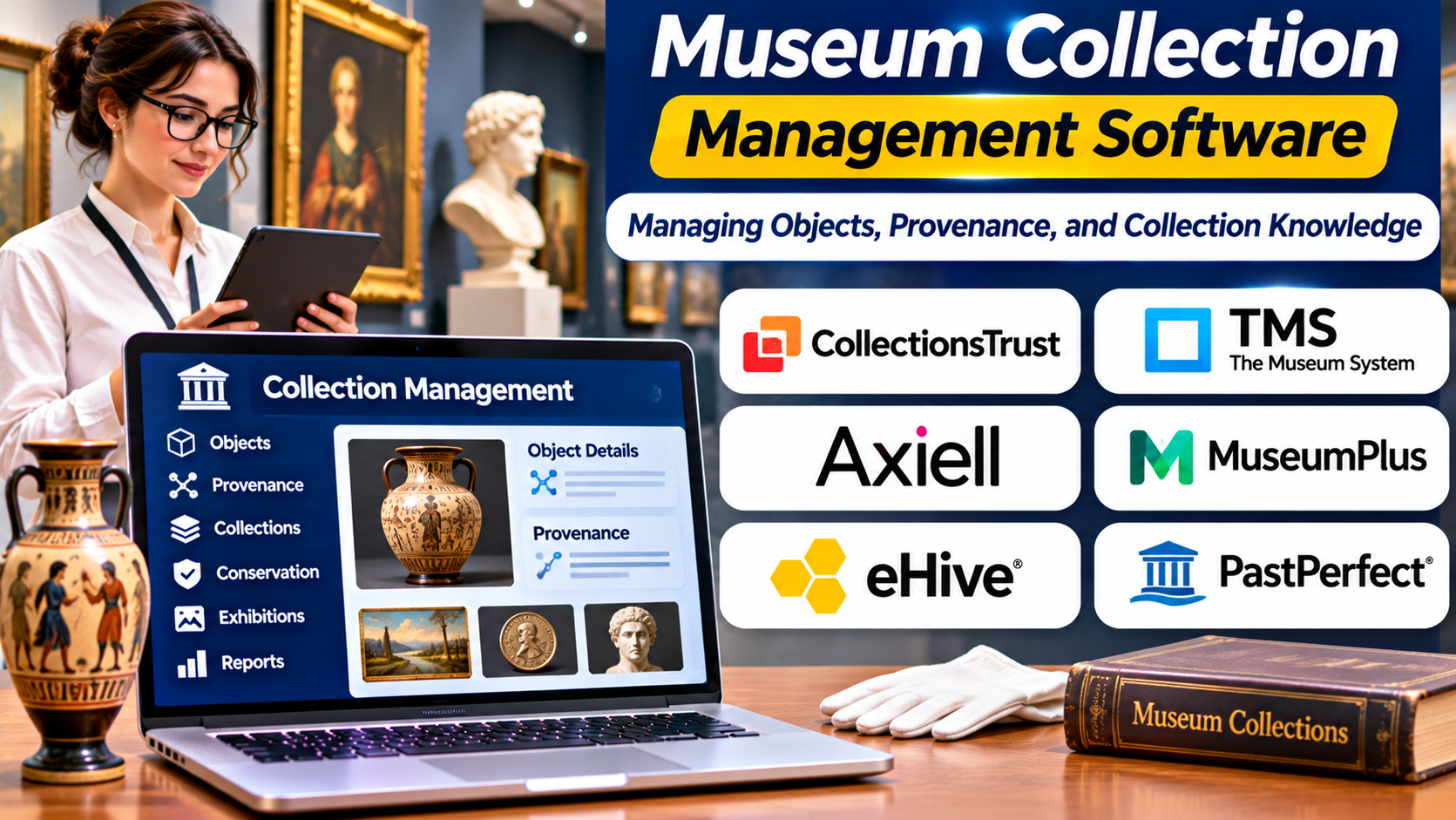
Museum Collection Management Software Options
Several established products serve different collecting institutions and technical environments.
TMS Collections
TMS Collections, associated with Gallery Systems, is a specialist museum collections management product.
It is relevant to institutions that require detailed object documentation and workflows involving collections, exhibitions, loans, and related museum activities.
Museums evaluating TMS should investigate its data model, reporting options, user permissions, deployment arrangements, and integration requirements.
A detailed demonstration should use the institution’s own object records and loan scenarios.
Axiell Collections
Axiell Collections is designed for collection management in museums and heritage organizations.
Its approach includes structured collection documentation and related workflows.
Institutions should evaluate its suitability for their collection types, cataloging practices, and public access requirements.
The important question is whether the system can represent the museum’s existing records without forcing excessive simplification.
MuseumPlus
MuseumPlus, from zetcom, is another specialist collections management platform.
It addresses museum collection documentation and operational workflows.
It may be relevant to institutions seeking a dedicated system for object information, movements, exhibitions, and related records.
Buyers should confirm the functionality and deployment options included in their proposed configuration.
CollectiveAccess
CollectiveAccess is an open-source platform used for managing and publishing collections.
Its architecture includes components for collection cataloging and public-facing presentation.
It can be attractive to institutions that need a configurable data model and have access to appropriate implementation expertise.
However, flexibility comes with responsibility.
A museum should evaluate hosting, configuration, upgrades, security, and the technical effort required to maintain customizations.
CollectionSpace
CollectionSpace is an open-source collections management application designed for museums and related institutions.
It provides an alternative to proprietary museum CMS products.
Organizations should assess the available deployment and support arrangements, the fit of its workflows, and the resources needed for implementation.
Open-source availability does not eliminate the cost of reliable operation.
Choosing Between Different CMS Approaches
| Approach | Potential benefit | Main consideration |
|---|---|---|
| Specialist commercial museum CMS | Established museum-oriented workflows | Licensing, implementation, and vendor dependence |
| Highly configurable collections platform | Adaptable data structures | Configuration and governance effort |
| Open-source collections system | Deployment and customization flexibility | Technical maintenance and support |
| General-purpose database | Simple initial setup | Limited support for museum-specific relationships |
| Separate specialist applications | Deep functionality in individual areas | Integration and consistency challenges |
A small museum with a modest collection may not need the same platform as a national institution managing millions of records.
However, collection size is not the only consideration.
A relatively small collection with complex provenance, conservation, or cultural sensitivity requirements can demand sophisticated documentation.
Metadata Standards and Controlled Vocabularies
Museum data becomes more useful when it follows consistent descriptive practices.
Standards and frameworks such as SPECTRUM, CIDOC CRM, and relevant controlled vocabularies can inform how institutions organize collection information.
These serve different purposes.
SPECTRUM provides guidance for museum collection management procedures.
CIDOC CRM is a conceptual framework for representing cultural heritage information and relationships.
Controlled vocabularies help maintain consistent terminology for concepts such as object types, materials, and creators.
A vendor’s reference to these standards should not be accepted without further investigation.
Museums should ask which workflows or data structures are supported and whether interoperability has been demonstrated.
Why vocabulary management matters
One cataloger may describe an object as a “photograph.”
Another may use “photographic print.”
Without agreed terminology, searching and reporting become inconsistent.
Controlled vocabularies can improve retrieval, but institutions need policies for creating, approving, and updating terms.
Software supports that work; it does not replace professional cataloging decisions.
Digital Asset Management Is Related but Different
Museums increasingly maintain high-resolution photographs, conservation images, scanned documents, and multimedia files.
These assets may be associated with collection records.
A CMS may store files directly or connect to a dedicated digital asset management system.
The museum should determine where master files are stored, how derivatives are generated, and which application controls rights information.
A photograph of an object is not the same thing as the object itself.
The database should preserve that distinction.
It should also support multiple images of one object, such as front and back views, details, and conservation photographs.
Rights, Repatriation, and Culturally Sensitive Information
Museum collections can include materials whose ownership, interpretation, or public display is contested.
Some objects have restrictions associated with cultural protocols, community agreements, or legal obligations.
A collection management system should allow institutions to document these restrictions.
It should not assume that every cataloged object or image is appropriate for unrestricted publication.
Museums may need to distinguish internal records from information approved for public access.
They may also need workflows for documenting claims, consultations, and changes in object status.
Technology cannot resolve ethical disputes, but it can support transparent recordkeeping.
Public Access and Collection Publishing
Many museums want visitors and researchers to explore collections online.
A public collection portal may display selected object descriptions, images, and related information.
However, internal collection records often contain information unsuitable for publication.
The system should allow staff to control which fields and assets appear publicly.
It should also support corrections and updates without creating contradictory versions of the same record.
Accessibility, search quality, and image rights should be part of the evaluation.
Test the public experience
Ask the vendor to publish a representative object record.
Then change a field in the internal catalog.
Examine how the public display updates and whether approval is required.
Also test what happens when an image must be withdrawn or a record becomes restricted.
These scenarios reveal the relationship between collection administration and public access.
Migrating Museum Records Without Losing Context
Migration is often one of the most demanding parts of a CMS project.
Existing information may be distributed across spreadsheets, legacy databases, paper files, image folders, and staff knowledge.
The migration team must identify which records are authoritative and how relationships should be preserved.
An accession may link to several objects.
An object may link to multiple conservation events.
A loan may include several objects and documents.
If these relationships are flattened during migration, the new database may contain the right words but lose important meaning.
A practical migration sequence
Begin with a data inventory.
Identify important record types, identifiers, controlled vocabularies, and supporting files.
Next, clean obvious duplicates and document mapping rules.
Conduct a trial migration using representative objects.
Validate both individual records and their relationships.
Finally, test everyday workflows such as locating an object, recording a movement, and preparing a loan.
The objective is not simply to transfer records. It is to preserve collection knowledge.
Security and Long-Term Stewardship
A museum CMS may contain valuable information about object locations, security arrangements, ownership, and sensitive collections.
Access should reflect staff responsibilities.
Registrars, curators, conservators, researchers, and public users may require different permissions.
Institutions should evaluate authentication, audit trails, backups, recovery procedures, and vendor access.
They should also examine data export capabilities.
A museum may use the same collection system for many years, but it should remain able to retrieve its information in usable formats.
Long-term stewardship requires planning beyond the current software contract.
A Better Way to Evaluate Museum CMS Products
Instead of asking vendors to demonstrate every feature, museums should prepare a small collection of difficult scenarios.
Include an object with uncertain attribution.
Include a group accession containing multiple items.
Include an object with a complicated movement history.
Include a conservation record with photographs.
Include a loan involving several objects and approval stages.
Ask each vendor to complete the same tasks.
Then evaluate whether the system preserves relationships, supports appropriate permissions, and produces useful reports.
This approach makes meaningful differences visible.
Choosing Software That Protects Collection Knowledge
Museum collection management software should support the professional work of documenting, caring for, researching, and sharing collections.
The right system must accommodate uncertainty, preserve provenance, track physical movements, and manage complex relationships between records.
It should also support the institution’s ethical responsibilities and long-term data stewardship.
A museum should not choose software solely because it has an extensive feature list.
It should choose a platform that represents its collections accurately and helps staff maintain trustworthy records as knowledge changes.
That is what turns a collection database into lasting institutional infrastructure.