Introduction
A radiology department can have excellent imaging equipment and still struggle to deliver examinations efficiently.
Patients may arrive without the required preparation. Imaging orders may contain incomplete information. Technologists may need to enter patient details manually. Radiologists may receive studies without the correct clinical context.
These problems are often caused by fragmented workflows rather than limitations in imaging hardware.
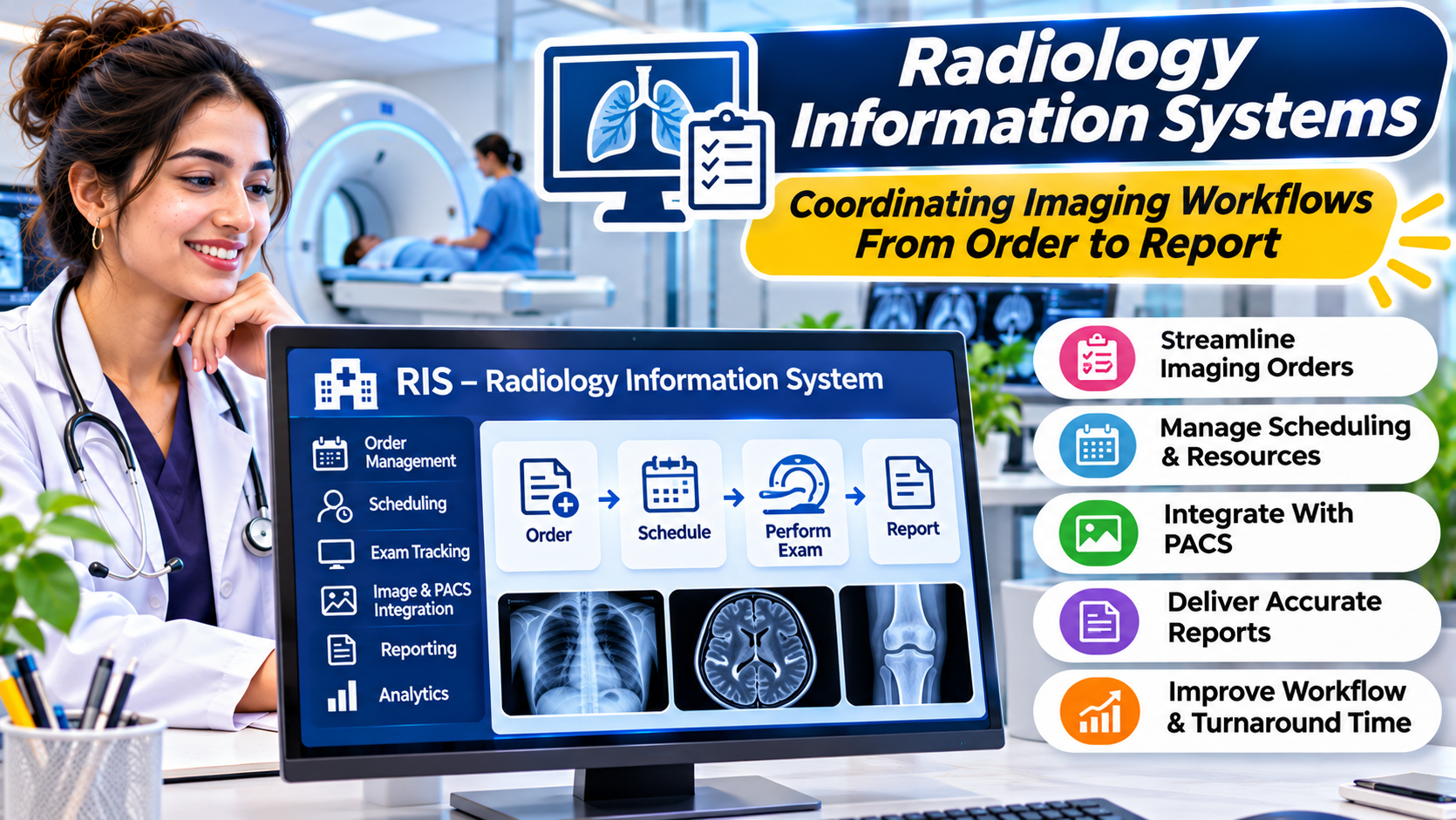
Radiology information systems, commonly called RIS, help coordinate the administrative and clinical processes surrounding diagnostic imaging.
They connect examination requests, scheduling, patient preparation, modality workflows, reporting, and operational tracking.
However, selecting a RIS is not simply about finding software that schedules scans.
The system must support how imaging services actually operate, including exceptions, urgent examinations, specialist reporting, and integration with other healthcare applications.
What Is a Radiology Information System?
A radiology information system is software used to manage information and workflows associated with diagnostic imaging services.
It commonly supports the operational activities surrounding radiology examinations.
Depending on the product, functions may include:
- Imaging order management
- Patient registration and scheduling
- Examination preparation
- Modality worklists
- Patient arrival and status tracking
- Technologist workflows
- Radiologist worklists
- Reporting
- Report distribution
- Billing-related information
- Operational dashboards
- Integration with PACS and EHR systems
A RIS may be a standalone application or part of a broader healthcare information platform.
Its exact scope varies between products.
Some systems focus on departmental workflow.
Others provide more extensive radiology operations and reporting capabilities.
RIS Versus PACS: Two Different Responsibilities
A RIS and a picture archiving and communication system, or PACS, frequently work together.
The RIS coordinates information about imaging examinations.
PACS manages the storage, retrieval, distribution, and viewing of medical images.
Consider a patient scheduled for a CT examination.
The RIS may manage the appointment, preparation details, examination status, and reporting workflow.
The imaging modality produces the images.
PACS stores and distributes those images for diagnostic review.
The radiologist then interprets the study and creates a report through the relevant reporting environment.
The RIS and PACS may exchange information throughout the process.
Some vendors combine these functions in integrated RIS/PACS products.
However, buyers should still evaluate workflow management and image management separately.
A strong image viewer does not automatically provide effective scheduling or reporting coordination.
Following an Imaging Examination Through the RIS
The most useful way to understand a RIS is to examine a complete imaging encounter.
Imaging Order
A clinician requests an examination.
The order may contain patient information, the requested procedure, clinical indications, and other relevant details.
The RIS or connected ordering environment must preserve this information accurately.
Incomplete or inappropriate orders may require clarification.
Scheduling
Scheduling staff select an appropriate appointment.
The process may depend on modality availability, examination duration, preparation requirements, and clinical priority.
A simple calendar may not capture these constraints.
Patient Preparation
Some examinations require specific preparation.
The system may help communicate instructions and record relevant information.
Preparation workflows should reflect the organization’s clinical policies.
Patient Arrival
Staff confirm the patient’s arrival and verify required details.
The RIS may update the examination status.
Modality Worklist
The imaging device may receive patient and examination information through an appropriate worklist interface.
This can reduce manual entry and improve consistency.
Image Acquisition
Technologists perform the examination and record relevant status information.
The modality sends images to PACS or another designated imaging system.
Interpretation
The study becomes available to the appropriate radiologist or interpreting clinician.
Worklist rules may determine how examinations are assigned and prioritized.
Reporting
The radiologist creates and finalizes a report according to the organization’s workflow.
Result Distribution
The report is delivered to the ordering clinician or other authorized recipients.
The organization needs procedures for urgent findings and failed delivery.
Encounter Completion
Administrative and financial processes may use examination status and service information.
The RIS may contribute to billing and operational reporting.
Scheduling Is More Complex Than Managing Appointment Slots
Radiology scheduling involves clinical and operational constraints.
Different examinations require different resources.
An MRI examination may have different scheduling considerations from a routine X-ray.
Some examinations require specialized staff or equipment.
Others involve contrast administration or preparation requirements.
A useful RIS should help scheduling teams account for relevant dependencies.
It should also support rescheduling and cancellations without creating conflicting records.
Resource-Based Scheduling
The system may need to coordinate modalities, rooms, staff, and examination durations.
Priority Management
Urgent examinations may require different handling from routine outpatient appointments.
Preparation Tracking
The workflow should help staff identify whether required preparation information has been communicated and completed.
Appointment Communication
Patients may receive reminders or instructions through integrated communication services.
These functions require accurate contact information and appropriate privacy controls.
Radiology Information System Software Options
The RIS market includes specialized radiology workflow applications and broader imaging informatics platforms.
The following examples illustrate different approaches. Buyers should verify the exact modules, current availability, and regional support.
Intelerad
Intelerad provides medical imaging software, including solutions associated with radiology workflow and enterprise imaging.
Its portfolio is relevant to organizations evaluating connected imaging operations.
Where it fits: Radiology groups and healthcare organizations seeking imaging workflow technology.
Important trade-off: Buyers should confirm which RIS, reporting, PACS, and related capabilities are included in the proposed solution.
RamSoft
RamSoft provides radiology software associated with RIS, PACS, and imaging workflow management.
Its offerings are relevant to imaging centers and radiology organizations evaluating integrated operations.
Where it fits: Imaging providers seeking connected scheduling, workflow, and image management capabilities.
Important trade-off: Evaluate deployment requirements, integration with existing systems, reporting workflows, and support arrangements.
Fujifilm Synapse
Fujifilm’s Synapse portfolio includes imaging informatics technology relevant to radiology workflows.
Organizations evaluating the portfolio should distinguish image management, workflow, and reporting components.
Where it fits: Healthcare organizations considering broader imaging technology environments.
Important trade-off: Confirm the precise products and modules required for RIS functionality.
Epic Radiology
Epic provides radiology-related workflows within its enterprise healthcare information ecosystem.
These capabilities can support imaging operations connected to broader clinical records and orders.
Where it fits: Health systems using Epic or evaluating radiology workflows within an enterprise clinical platform.
Important trade-off: Organizations should examine specialty requirements, integration with PACS, and the scope of the configured radiology functionality.
MEDITECH Radiology Capabilities
MEDITECH provides healthcare information technology that includes radiology-related workflows within its broader clinical environment.
Where it fits: Hospitals evaluating imaging operations alongside an integrated hospital information platform.
Important trade-off: Buyers should verify the relevant modules, PACS connections, reporting functions, and operational fit.
Comparing RIS Deployment Strategies
| Strategy | Potential advantage | Main challenge |
|---|---|---|
| Standalone RIS | Specialized departmental workflow | Integration with EHR and PACS |
| Integrated RIS/PACS | Coordinated workflow and imaging access | Dependence on product suite capabilities |
| EHR-native radiology module | Stronger connection with enterprise clinical records | May require specialized imaging integrations |
| Enterprise imaging workflow platform | Coordination across sites and services | Greater implementation and governance complexity |
The correct strategy depends on existing technology and organizational priorities.
A small imaging center may prefer an integrated RIS/PACS arrangement.
A hospital network may need a radiology workflow layer that connects with multiple systems.
Modality Worklist Integration
Modality worklist is an important capability in many imaging environments.
It allows imaging equipment to receive relevant patient and examination information electronically.
This can reduce manual re-entry and help associate images with the correct study.
However, worklist integration requires careful configuration.
Procedure codes, patient identifiers, and examination details must align across systems.
An incorrect worklist entry can propagate an error into the imaging workflow.
Organizations should test normal and exceptional scenarios.
For example, what happens when an examination changes after the patient arrives?
The system should support appropriate correction procedures.
Radiologist Worklists and Study Prioritization
Radiologists may interpret studies from several modalities, facilities, and clinical services.
A worklist helps organize examinations awaiting review.
However, effective prioritization requires more than sorting by arrival time.
Some studies are urgent.
Others require specialist expertise.
Certain examinations may need comparison with previous studies.
A RIS or connected workflow system may support assignment rules, status tracking, and escalation.
Organizations should examine whether these rules reflect actual clinical responsibilities.
Worklist automation should remain transparent.
Radiologists and administrators need to understand why studies appear in a particular order or queue.
Reporting Workflows
Radiology reporting is one of the most important stages of the imaging process.
A reporting environment may support dictation, speech recognition, structured templates, and electronic report distribution.
Different radiology specialties may require different reporting approaches.
Structured reporting can improve consistency for selected examinations.
However, overly rigid templates may create unnecessary documentation burden.
The reporting workflow should support accurate clinical communication.
It should also make corrections and amendments traceable.
A finalized report may require different permissions and procedures from a draft.
Critical Findings and Communication
Some imaging findings require prompt communication.
Simply finalizing a report may not be sufficient.
Healthcare organizations need policies for identifying, communicating, and documenting critical or unexpected findings.
A RIS may help track notifications and acknowledgments.
However, the organization must define who is responsible for acting on those findings.
Automated notifications should not be treated as proof that the appropriate clinician received and understood the information.
Escalation procedures are important when communication fails.
The software should support the organization’s clinical policy rather than invent its own clinical priorities.
Integrating RIS With EHR and PACS
RIS interoperability depends on several technologies.
HL7 messaging may support the exchange of patient, order, and result information.
DICOM services support imaging-related communication.
FHIR may be relevant to selected healthcare information exchange requirements.
However, the specific interfaces depend on the systems involved.
Organizations should document which application owns each data element.
For example, the EHR may originate the imaging order.
The RIS may coordinate examination scheduling and status.
PACS may manage image objects.
The reporting system may produce the finalized interpretation.
When these systems disagree, staff need a clear process for resolving the discrepancy.
Patient Identity and Examination Matching
Radiology information systems must maintain accurate relationships between patients, encounters, orders, and imaging studies.
A patient may have several examinations during one hospital visit.
The same patient may also have historical studies from other facilities.
Incorrect matching can create serious risks.
Organizations should evaluate how the RIS handles duplicate records, identifier changes, and corrections.
Automated matching should not eliminate appropriate human review.
Auditability is especially important when information must be corrected after image acquisition.
Managing Multisite Radiology Operations
Radiology groups may serve multiple hospitals, imaging centers, or clinics.
A multisite RIS environment introduces additional requirements.
Different facilities may use different scheduling systems, modalities, and clinical protocols.
Radiologists may interpret studies remotely.
The organization may need centralized worklists while preserving local operational responsibilities.
A suitable RIS should help coordinate these activities without obscuring the origin or status of an examination.
Organizations should also consider network reliability and business continuity across sites.
Operational Analytics and Performance Measures
RIS data can support operational improvement.
However, meaningful reporting requires consistent definitions.
Examination Turnaround Time
Turnaround time may be measured from order creation, image completion, or another event to report finalization.
Organizations should define the start and end points clearly.
Report Backlog
A backlog measure can help identify examinations awaiting interpretation.
It should account for priority and clinical context.
Modality Utilization
Utilization can help describe how imaging equipment is scheduled and used.
However, a high utilization rate does not automatically indicate an efficient service.
Preparation time, maintenance, and staffing constraints matter.
Appointment Delays
Scheduling data can reveal long waits or repeated rescheduling.
Interpretation should consider examination complexity and patient needs.
Report Amendment Rates
Amendments may provide information for quality review.
However, an amendment is not automatically evidence of a clinical error.
Metrics should support investigation rather than simplistic performance judgments.
Security and Privacy
RIS platforms process sensitive patient and examination information.
Security requirements should reflect the organization’s legal and operational responsibilities.
Relevant controls include:
- User authentication
- Role-based access
- Audit logging
- Secure interfaces
- Encryption
- Backup and recovery
- Vendor access management
- Account lifecycle procedures
- Incident response
- Data retention policies
Radiology workflows often involve external providers and remote readers.
Access arrangements should be clearly defined.
Organizations should verify that information is shared only with authorized parties.
RIS Downtime and Business Continuity
Radiology departments need procedures for continuing essential work during system outages.
A RIS failure may affect scheduling, patient identification, modality worklists, and report distribution.
Downtime planning should address these dependencies.
Staff may need controlled manual procedures.
The organization must also determine how information created during downtime will be reconciled after restoration.
A successful recovery requires more than restarting the application.
Pending examinations, reports, and status updates must remain consistent.
Data Migration and System Replacement
Replacing a RIS involves moving operational information that may be closely connected to historical images and reports.
Migration planning should address:
- Patient identifiers
- Examination records
- Scheduling information
- Procedure codes
- Report history
- Status information
- Integration mappings
- Audit requirements
- Historical access
Not every field from the old system will map directly to the new one.
Organizations should validate representative records and workflows.
They should also determine how historical reports remain accessible.
The migration strategy must account for clinical continuity as well as technical completeness.
How to Evaluate a RIS Before Purchase
A useful RIS evaluation should follow a complete imaging workflow.
Begin with a realistic imaging order.
Schedule the examination, prepare the patient, and transmit appropriate information to the modality.
Then simulate image acquisition and reporting.
Evaluate whether the system updates statuses correctly and delivers the final report to the intended destination.
Include exceptions.
Test canceled examinations, duplicate orders, patient identifier corrections, and urgent reporting workflows.
Ask radiologists, technologists, schedulers, administrative staff, and IT teams to participate.
A demonstration that covers only routine scheduling will miss important operational risks.
Common RIS Selection Mistakes
Choosing Based on Scheduling Features Alone
Radiology workflows extend from order intake through reporting and communication.
The entire process matters.
Assuming RIS/PACS Integration Is Automatic
Even products from the same vendor may require configuration and validation.
Ignoring Radiologist Worklists
Poor assignment and prioritization can disrupt interpretation workflows.
Underestimating Historical Data Migration
Reports and examination records must remain connected to appropriate patients and studies.
Overlooking Critical Findings Workflows
Report delivery is not always sufficient for urgent clinical communication.
Failing to Define Data Ownership
Conflicting information across EHR, RIS, and PACS can create operational and clinical risks.
Choosing the Right RIS for Your Organization
An independent imaging center may prioritize efficient scheduling, reporting, billing integration, and manageable operating costs.
A hospital radiology department may need deep integration with clinical orders, patient administration, and PACS.
A multisite radiology network may require centralized worklists, cross-facility coordination, and consistent reporting workflows.
Organizations should begin with their imaging services, existing technology, and operational challenges.
Then they should evaluate products using representative workflows and documented integration requirements.
The best RIS is not necessarily the system with the most modules.
It is the one that reliably coordinates imaging work while preserving accurate patient information and clear clinical responsibility.
Building a Better Radiology Workflow
Radiology information systems provide the operational structure behind diagnostic imaging.
They connect orders, scheduling, examinations, interpretation, reporting, and communication.
Their value depends on accurate information and dependable coordination across departments and applications.
A successful RIS implementation requires appropriate integration, usable workflows, clear accountability, and careful planning for exceptions and downtime.
Healthcare organizations should judge RIS technology by how effectively it supports the full imaging journey.
When the system helps every participant understand what needs to happen next, radiology operations become easier to coordinate and clinical information becomes more dependable.