Introduction
Modern technology teams face a unique challenge. Building software is no longer just about writing code and deploying it to a basic web server. Today, applications depend on complex cloud infrastructures, automated continuous delivery pipelines, large volumes of streaming data, machine learning models, artificial intelligence services, strict security guardrails, and continuous cost management.
Because these responsibilities span multiple domains, isolated operational teams often struggle to keep up. When application developers, data engineers, machine learning specialists, security teams, and infrastructure administrators work in separate silos, systems become fragile, feedback loops slow down, and operational friction increases.
To solve these challenges, the technology industry has moved toward an umbrella approach known as XOps.
As a dedicated learning and knowledge platform, XOpsSchool focuses on helping technology professionals understand how these modern operational disciplines connect. Rather than treating DevOps, DataOps, MLOps, AIOps, and infrastructure management as completely separate universes, XOps looks at the bigger picture: how all operational practices can work together to build reliable, scalable, and secure systems.
What is XOps?
At its core, What is XOps is a question about modern operational integration. The letter “X” acts as a variable representing various specialized operational disciplines. Instead of creating a brand-new, isolated tool or technology, XOps is an overarching philosophy and framework that unifies disparate operational practices under a shared set of principles: automation, collaboration, observability, continuous feedback, and reliability.
In the past, organizations practiced DevOps to bridge the gap between software development and IT operations. However, as software systems evolved to process heavy data workloads, run machine learning algorithms, utilize artificial intelligence for monitoring, and manage vast cloud footprints, specialized operational offshoots emerged.
XOps brings these offshoots back together. It recognizes that whether you are managing a software release pipeline, an enterprise data lake, or a production machine learning model, the underlying operational challenges—such as version control, automated testing, deployment safety, monitoring, and governance—share common patterns.
Why XOps Matters in Modern IT
Organizations increasingly need coordinated operations across applications, infrastructure, cloud environments, data pipelines, machine learning models, artificial intelligence, security, and financial governance. When these domains operate in isolation, several common problems arise:
- Operational Silos: Teams use different tools, speak different languages, and lack visibility into how their work impacts other parts of the system.
- Delayed Feedback Loops: Failures in data pipelines or machine learning models often go unnoticed until they affect downstream applications or end users.
- Tool Fatigue: Introducing separate operational tools for every new technology stack without a unified strategy creates administrative overhead and confusion.
- Reliability Gaps: Without standardized observability and incident management, troubleshooting complex, multi-layered applications becomes slow and reactive.
XOps addresses these challenges by encouraging automation, shared processes, and standardized tooling. By viewing operations through an umbrella lens, teams can break down walls, improve collaboration, and ensure that infrastructure, data, and software delivery move at a sustainable pace.
Major XOps Disciplines
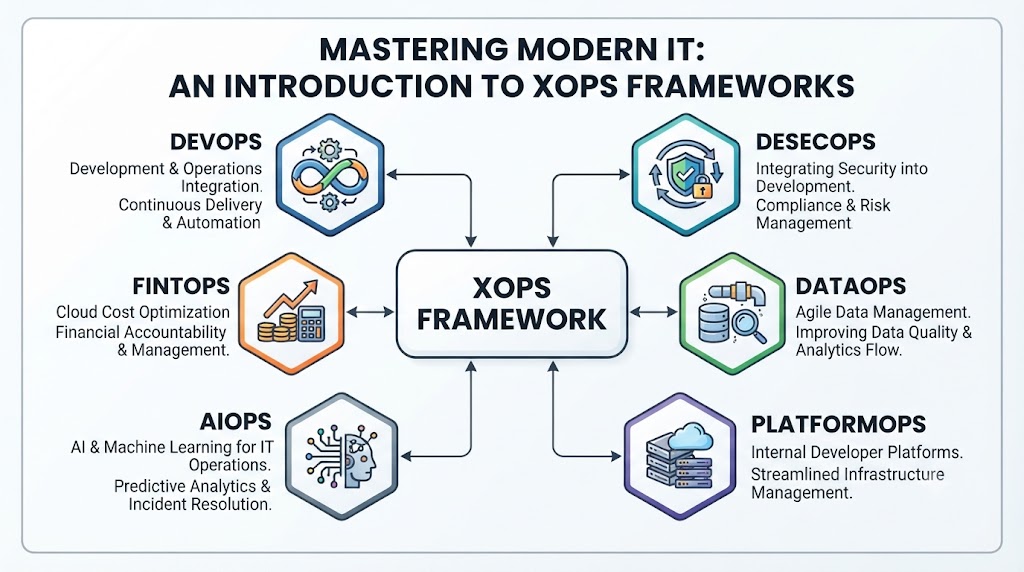
To understand the full scope of XOps, it helps to look at the major disciplines that fall under its umbrella. Each discipline focuses on a specific operational domain while sharing core automation and reliability principles.
DevOps
DevOps focuses on software delivery, continuous integration and continuous delivery (CI/CD), infrastructure automation, containerization, and close collaboration between development and operations teams. It forms the bedrock of modern application deployment and release management.
DataOps
DataOps applies agile and automated practices to data engineering. It focuses on building reliable data pipelines, ensuring data quality, automating orchestration, and maintaining continuous data delivery so that analytics and machine learning systems receive clean, trustworthy data.
MLOps
MLOps bridges the gap between data science and operational engineering. It covers machine learning model deployment, experiment tracking, model versioning, automated testing, and ongoing performance monitoring to ensure models remain accurate in production.
AIOps
AIOps leverages artificial intelligence and machine learning techniques to support IT operations. It helps teams manage massive volumes of monitoring data through anomaly detection, event correlation, alert noise reduction, and intelligent incident analysis.
SecOps
SecOps integrates security practices directly into operational workflows. Rather than treating security as a final gate review, SecOps ensures that vulnerability scanning, compliance checks, and access controls are automated throughout the software and infrastructure delivery lifecycle.
FinOps
FinOps brings financial accountability to cloud and technology operations. It helps cross-functional teams understand, monitor, and optimize cloud infrastructure costs without sacrificing performance or reliability.
Platform Engineering
Platform engineering focuses on building internal developer platforms that provide self-service capabilities, reusable infrastructure components, and standardized workflows, reducing cognitive load for software engineering teams.
XOps Training
As organizations adopt these connected practices, structured XOps Training has become essential for engineers looking to future-proof their careers. A well-designed learning path helps professionals move beyond single-tool expertise and understand how different operational domains interact.
Effective training programs typically cover:
- Fundamentals of modern IT operations and systems thinking
- DevOps foundations, including source control and CI/CD pipelines
- Cloud infrastructure provisioning and automation
- Containerization and orchestration with Docker and Kubernetes
- Observability, monitoring, logging, and tracing
- Data operations and pipeline reliability
- Machine learning and AI operations workflows
- Security, compliance, and cost management fundamentals
Through structured resources provided by platforms like XOpsSchool, learners can explore these topics logically, building a comprehensive understanding of how modern technology environments operate.
XOps Certification
Technical certifications are popular among IT professionals seeking to validate their knowledge and structure their learning goals. An XOps Certification framework helps learners organize complex technical concepts, follow a rigorous syllabus, test their theoretical understanding, and identify knowledge gaps.
However, it is important to remember that certification alone does not equal practical expertise. Certifications demonstrate that a candidate has studied a specific curriculum and understood core concepts, but real-world capability comes from hands-on practice, troubleshooting live systems, and building integrated projects. Certification preparation is most valuable when treated as a milestone within a broader continuous learning journey.
XOps Course
Finding the right XOps Course depends heavily on an individual’s current technical background. A comprehensive educational course should follow a logical progression, starting with basic concepts and moving toward advanced integrations:
- XOps Fundamentals: Understanding the umbrella concept and the relationships between operational disciplines.
- DevOps Concepts: Mastering version control, CI/CD, and basic automation.
- Cloud and Infrastructure: Learning cloud service models and infrastructure as code.
- Container Orchestration: Managing containerized workloads at scale.
- Data and ML Operations: Exploring how data pipelines and machine learning models are deployed and monitored.
- Observability and Reliability: Setting up metrics, logs, alerts, and incident response workflows.
- Security and Governance: Integrating security checks and cost controls into pipelines.
Learners should choose course depth according to their current role, ensuring they build strong foundations before moving into specialized areas like AIOps or MLOps.
XOps Tutorial
Reading conceptual articles is only the first step; practical application is where real learning happens. An effective XOps Tutorial helps learners bridge the gap between theory and execution by guiding them through specific configuration, automation, and integration tasks.
Practical tutorials help learners understand:
- Setting up automated CI/CD workflows using modern version control platforms
- Provisioning cloud infrastructure using code templates
- Configuring container clusters and deployment manifests
- Setting up monitoring dashboards and log collection agents
- Building basic data pipeline validation checks
- Troubleshooting failed deployments and simulated outages
While tutorials provide valuable hands-on practice, learners should experiment independently and modify example configurations to truly master the underlying concepts.
XOps Tools
XOps is not a single software product or proprietary tool. Instead, it encompasses a wide ecosystem of open-source and commercial technologies designed to automate, monitor, and secure different layers of the technology stack.
| Operational Domain | Purpose | Common Tool Categories |
| Source Control | Code management and collaboration | Git-based platforms |
| CI/CD | Automated building, testing, and deployment | Pipeline orchestration engines |
| Containers | Application packaging and clustering | Docker, Kubernetes, Helm |
| Infrastructure | Provisioning and configuration management | Terraform, Ansible |
| Observability | Metrics, logs, traces, and visualization | Prometheus, Grafana, OpenTelemetry |
| GitOps | Declarative continuous delivery | Argo CD, Flux |
| Data Operations | Pipeline orchestration and quality checks | Data workflow engines |
| MLOps | Model lifecycle and experiment management | Model registries, tracking servers |
| AIOps | Intelligent event correlation and anomaly detection | AI-driven monitoring platforms |
Tool selection should always be guided by technical architecture, team skills, scalability requirements, and security needs rather than fleeting industry popularity.
DevOps Training
While XOps represents the broader umbrella, DevOps Training remains the foundational entry point for most modern operations professionals. DevOps teaches the core principles of continuous integration, continuous delivery, infrastructure as code, containerization, and automated testing.
Understanding DevOps is essential because the automation patterns, feedback loops, and collaboration practices established in DevOps form the blueprint for DataOps, MLOps, and SecOps. Without a solid grounding in DevOps fundamentals, advanced operational practices are difficult to sustain.
AIOps Training
As production environments generate overwhelming volumes of telemetry data, AIOps Training helps engineers learn how artificial intelligence and machine learning can assist IT operations teams.
AIOps focuses on:
- Automated anomaly detection in complex metric streams
- Intelligent event correlation to group related alerts during an incident
- Reducing alert fatigue by filtering out noise
- Analyzing historical incident data to improve future response times
While AI tools provide powerful assistance in identifying patterns and diagnosing anomalies, human judgment, architectural understanding, and root-cause analysis remain critical.
MLOps Training
Deploying machine learning models into production introduces unique operational challenges that differ from traditional software. MLOps Training teaches professionals how to manage the complete machine learning lifecycle.
Key learning areas in MLOps include:
- Versioning datasets, code, and trained models
- Automated testing for data drift and model accuracy degradation
- Continuous integration pipelines tailored for machine learning workflows
- Monitoring model performance and resource utilization in production
MLOps ensures that machine learning models do not remain isolated in experimental notebooks but become reliable, scalable components of enterprise applications.
DataOps Training
Data is the lifeblood of modern analytics and artificial intelligence. DataOps Training focuses on applying agile principles and automated testing to data engineering.
Core concepts include:
- Building resilient, scalable data pipelines
- Automating data quality checks and schema validation
- Orchestrating complex data workflows with dependency management
- Implementing data observability to detect broken pipelines before downstream consumers are impacted
DataOps helps data teams deliver reliable, trustworthy data at scale with minimal manual intervention.
How XOps Connects DevOps, DataOps, MLOps, and AIOps
To understand how these disciplines fit together, it helps to examine their primary focus areas and shared foundations:
- DevOps supports application delivery and infrastructure automation.
- DataOps supports reliable data movement, transformation, and quality.
- MLOps supports machine learning model lifecycle management and deployment.
- AIOps applies AI techniques to operational monitoring, alerting, and incident management.
Despite their different focuses, these disciplines share common operational needs. They all rely on version control, automated testing, continuous integration, robust observability, security governance, and feedback loops. XOps connects them by providing a unified mindset: treating operations across code, data, and models with the same rigorous, automated engineering standards.
Who Can Benefit from XOpsSchool?
1. DevOps and Cloud Engineers
Cloud and DevOps professionals can broaden their expertise beyond traditional application deployment and infrastructure management, learning how to support data and machine learning workloads effectively.
2. Data Engineers
Data engineers can leverage DataOps principles to improve pipeline reliability, automate testing, and establish proactive data monitoring across enterprise data systems.
3. Machine Learning Professionals
Data scientists and ML engineers can use MLOps concepts to streamline model deployment, automate retraining, and ensure models perform reliably in production environments.
4. IT Operations and SRE Professionals
Site reliability engineers and operations teams can incorporate AIOps, advanced observability, and platform engineering concepts to improve system resilience and reduce incident resolution times.
5. Developers and Technical Learners
Software developers can gain a deeper understanding of the operational lifecycle, learning how their applications run, scale, and are monitored in cloud environments.
6. Technology Teams and Organizations
Engineering leaders and cross-functional teams can use XOps knowledge to align development, infrastructure, data, security, and cost management under a unified operational strategy.
Common Mistakes When Learning XOps
- Treating XOps as a Single Tool: Assuming that adopting one specific software product solves all operational challenges.
- Learning Tools Without Concepts: Focusing exclusively on CLI commands or platform interfaces without understanding the underlying architectural principles.
- Jumping into Advanced Disciplines Too Quickly: Attempting to study MLOps or AIOps before mastering basic DevOps and cloud fundamentals.
- Ignoring Observability: Building complex pipelines and infrastructure without setting up proper metrics, logs, and tracing.
- Neglecting Security and Cost: Treating security and FinOps as afterthoughts rather than integrating them into daily operational workflows.
Best Practices for Learning XOps
- Start with Fundamentals: Build a strong grasp of networking, Linux, version control, and basic scripting.
- Master DevOps Foundations: Learn CI/CD pipelines, containerization, and infrastructure as code before exploring specialized domains.
- Practice Hands-On: Build small, integrated projects that combine infrastructure provisioning, application deployment, and monitoring.
- Embrace Observability Early: Learn how to collect and analyze metrics and logs to understand system behavior.
- Explore Systematically: Once foundations are secure, gradually expand into DataOps, MLOps, or AIOps based on your professional interests.
Second Professional Table
| Learning Goal | Recommended XOps Area | Skills to Develop |
| Application delivery and infrastructure | DevOps | CI/CD, Docker, Kubernetes, Terraform |
| Reliable data ingestion and transformation | DataOps | Pipeline orchestration, data quality testing |
| Model deployment and tracking | MLOps | Model versioning, experiment tracking, serving |
| Intelligent monitoring and alerting | AIOps | Anomaly detection, event correlation |
| Internal developer self-service | Platform Engineering | Developer portals, reusable templates |
| System uptime and incident response | SRE / Observability | SLIs, SLOs, Prometheus, Grafana |
8-Step XOps Learning Guide
- Step 1: Understand What XOps Means: Learn the basic philosophy of connected operational disciplines and systems thinking.
- Step 2: Build DevOps Foundations: Master source control, continuous integration, containerization, and automated deployment.
- Step 3: Learn Cloud and Infrastructure: Study cloud provider fundamentals, networking basics, and infrastructure as code.
- Step 4: Learn Observability and Reliability: Understand monitoring, logging, metrics, distributed tracing, and incident management practices.
- Step 5: Explore DataOps: Learn how reliable data pipelines, automated testing, and data orchestration work in practice.
- Step 6: Explore MLOps and AIOps: Understand machine learning model lifecycles and AI-assisted operational monitoring.
- Step 7: Learn Security, Governance, and Cost Awareness: Study SecOps integration, compliance baselines, and cloud cost optimization.
- Step 8: Build an Integrated Practical Project: Combine multiple operational practices in a hands-on project to see how components interact.
Frequently Asked Questions
1. What is XOps in simple terms?
XOps is an umbrella approach that connects various IT operational disciplines—such as DevOps, DataOps, MLOps, and SecOps—under a shared set of automation, reliability, and observability principles.
2. How is XOps different from DevOps?
DevOps primarily focuses on bridging software development and IT operations. XOps expands on this by encompassing software, data pipelines, machine learning models, artificial intelligence, security, and financial operations.
3. What disciplines are included in XOps?
Common disciplines include DevOps, DataOps, MLOps, AIOps, SecOps, FinOps, and Platform Engineering.
4. Is XOps suitable for beginners?
Yes, provided learners start with fundamental concepts like basic IT operations, version control, and DevOps before exploring advanced specialized domains.
5. What should an XOps training path include?
A robust training path should cover DevOps foundations, cloud infrastructure, containerization, CI/CD, observability, data operations, machine learning operations, and security governance.
6. What is the purpose of XOps certification?
Certifications help learners structure their study plans, validate theoretical knowledge, and identify knowledge gaps, though they should be paired with practical, hands-on experience.
7. What should learners look for in an XOps course?
Look for courses that emphasize core principles, logical progression from beginner to advanced topics, and practical understanding rather than vendor-locked tool tutorials.
8. Which tools are commonly associated with XOps?
Common tools include Git, GitHub Actions, Docker, Kubernetes, Terraform, Ansible, Prometheus, Grafana, and various pipeline orchestration frameworks.
9. How are DevOps, DataOps, MLOps, and AIOps connected?
They share foundational engineering practices like automation, version control, testing, continuous delivery, and observability, but apply them to different technical domains.
10. How can someone start learning XOps?
Begin by mastering basic DevOps and cloud principles, then explore tutorials and learning resources on platforms like XOpsSchool to understand how different operational practices interconnect.
Conclusion
Modern technology operations require more than isolated technical skills. As systems grow to include complex cloud infrastructures, automated data pipelines, machine learning models, and intelligent monitoring systems, engineers must understand how different operational domains interact.
XOps provides the conceptual umbrella needed to unify these practices. By focusing on shared principles of automation, collaboration, observability, and reliability, technology professionals can build more resilient systems. Platforms like XOpsSchool serve as valuable educational resources for learners seeking to navigate this complex landscape, offering structured insights into how modern IT operations work together.