Introduction
International patients often compare hospitals before choosing where to receive care. Accreditation can provide information about a hospital’s quality and safety systems. It is important to know that accreditation is only one factor to consider. Patients should also review doctors, treatment options, facilities, costs, communication, and follow-up care. Accreditation does not mean a hospital is perfect or guarantee good results.
What Is Hospital Accreditation?
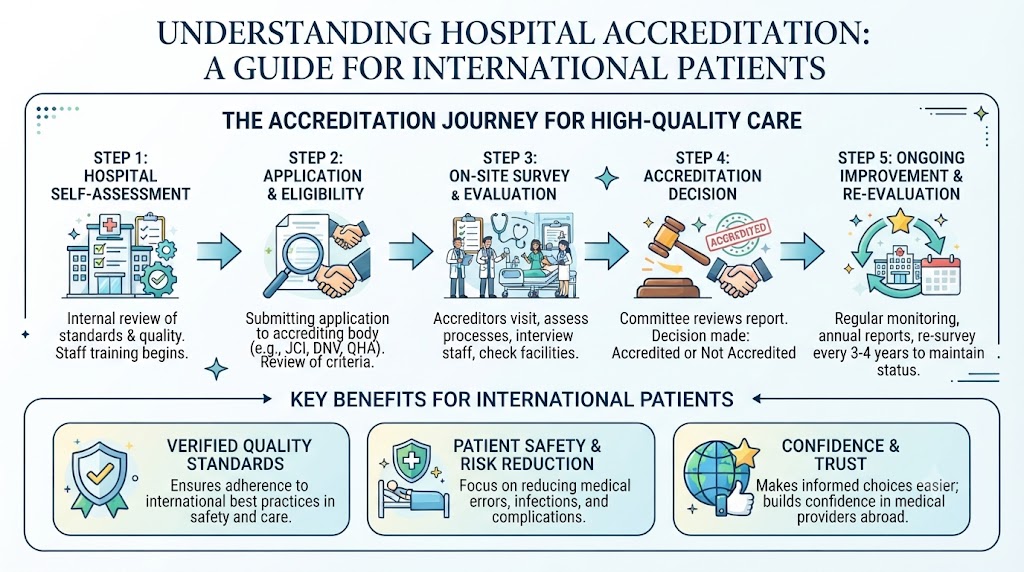
Hospital accreditation is a formal review process. Independent groups check if a hospital meets set quality and safety standards.
Hospitals seek accreditation to show they follow high rules for patient care. The review looks at hospital systems, daily work, and staff training. These standards matter because they help keep patients safe during their stay. Accreditation usually involves a team of experts visiting the hospital to check its work.
Why Accreditation Can Matter to International Patients
Choosing medical care abroad can feel hard. Accreditation may give patients a way to compare hospitals safely.
It covers many parts of a hospital. These include patient safety, quality systems, infection prevention, and staff processes. It also looks at patient rights, medical records, and medication safety. Emergency procedures and care coordination are part of the review too. Accreditation can provide useful information, but it does not remove all risks.
How Accreditation May Support Patient Safety
Safety is a top priority for anyone traveling for health care. Accreditation standards often cover many safety processes.
- Patient identification rules to make sure staff treat the right person.
- Infection control to stop the spread of germs.
- Safe storage and delivery of medicines.
- Safe surgery processes to lower risks in the operating room.
- Clear emergency response plans.
- Regular staff training.
- Accurate record keeping.
- Systems for reporting and reviewing safety issues.
Accreditation helps build strong safety habits, but it cannot prevent every medical error or complication.
Why Accreditation Matters More for International Patients
International patients face unique challenges when seeking care abroad. Different healthcare systems can be confusing. Language barriers can make talking to staff hard. Different medical rules and travel planning add more stress.
Sharing medical records across borders takes extra care. Communication after returning home is also vital. Understanding treatment costs and coordinating care from another country can be difficult. Reviewing hospital quality information may help patients make more informed comparisons.
Accreditation vs Other Hospital Factors
Accreditation is helpful, but it should not be the only factor when choosing a hospital. Patients should look at the full picture.
Important things to check include doctor or specialist experience and relevant treatment services. Hospital facilities and diagnostic services also matter. Patients need to look at emergency support and patient communication. Language support and clear cost information are vital. Recovery and follow-up care need careful planning too.
| Factor | What International Patients Can Check | Why It May Matter |
|---|---|---|
| Accreditation | Current accreditation and scope | Shows that certain standards were reviewed |
| Safety systems | Infection and patient safety processes | Helps patients understand safety practices |
| Specialists | Relevant doctor and specialist information | Helps match care needs |
| Facilities | Treatment and diagnostic services | Shows what care may be available |
| Communication | Language and patient support | Helps patients understand their care |
| Follow-up | Care after treatment | Helps with recovery planning |
How Patients Can Check Accreditation
Patients can take practical steps to check hospital details.
First, check whether the hospital states it is accredited. Identify the exact accreditation organization. Check whether the accreditation is current and active. Look at what specific services or locations the accreditation covers.
Review the official accreditation information on trusted sources. Ask the hospital questions directly if any details are unclear.
Questions International Patients Should Ask
- Is the hospital currently accredited?
- Which organization provided the accreditation?
- What does the accreditation cover?
- When was it reviewed?
- Is the accreditation still active?
- What safety systems are in place?
- What support is available for international patients?
- How is follow-up care handled?
- Who can help with medical records and communication?
Other Things to Check Before Choosing a Hospital
Patients should review more than just accreditation status. Doctor qualifications and hospital services are very important. Look at treatment options and diagnostic facilities. Check infection prevention practices and patient support.
Communication and travel arrangements need clear planning. Review cost estimates and payment rules carefully. Always verify important information directly with the hospital or qualified healthcare professionals.
Common Mistakes International Patients Should Avoid
- Choosing a hospital based only on accreditation.
- Assuming accreditation guarantees treatment success.
- Not checking whether accreditation is current.
- Not checking what the accreditation covers.
- Ignoring doctor or specialist information.
- Focusing only on low cost.
- Not asking about follow-up care.
- Not confirming medical records and communication support.
Simple Checklist for International Patients
- Check the hospital’s current accreditation.
- Identify the accreditation organization.
- Check what the accreditation covers.
- Review the hospital’s services.
- Check relevant specialist information.
- Ask about safety and infection control.
- Ask about international patient support.
- Confirm cost details.
- Ask about follow-up care.
- Keep copies of your medical records.
FAQs
- What is hospital accreditation? Hospital accreditation is a formal review process where independent experts check if a hospital meets high standards for quality and safety.
- Why does accreditation matter for international patients? It gives patients a way to compare hospital safety systems, care quality, and standards when traveling for medical treatment.
- Does hospital accreditation guarantee safe treatment? No. Accreditation shows that a hospital meets set standards, but it does not remove all medical risks or guarantee success.
- How can international patients check a hospital’s accreditation? Patients can check the hospital’s website, identify the accrediting body, verify current dates, and ask the hospital for official details.
- What should patients check besides accreditation? Patients should check doctor experience, treatment services, hospital facilities, communication support, costs, and follow-up care.
- Does accreditation cover all hospital services? Not always. Accreditation may cover specific departments, locations, or services, so patients should check the exact scope.
- Why should international patients ask about follow-up care? Follow-up care helps ensure safe recovery after returning home and lets local doctors know what treatment was done.
- What questions should patients ask about hospital accreditation? Patients should ask who provided the accreditation, when it was reviewed, what services it covers, and if it is currently active.
Conclusion
Accreditation can give international patients useful information about a hospital’s quality and safety systems. It helps patients compare options when planning medical care abroad.
Remember that accreditation is only one part of hospital selection. Patients should also look at specialists, treatment services, facilities, communication, cost, patient support, and follow-up care. Take your time, ask questions, and verify important details before you plan your medical journey.
Introduction
International patients often compare hospitals before choosing where to receive care. Accreditation can provide information about a hospital’s quality and safety systems. It is important to know that accreditation is only one factor to consider. Patients should also review doctors, treatment options, facilities, costs, communication, and follow-up care. Accreditation does not mean a hospital is perfect or guarantee good results.
What Is Hospital Accreditation?
Hospital accreditation is a formal review process. Independent groups check if a hospital meets set quality and safety standards.
Hospitals seek accreditation to show they follow high rules for patient care. The review looks at hospital systems, daily work, and staff training. These standards matter because they help keep patients safe during their stay. Accreditation usually involves a team of experts visiting the hospital to check its work.
Why Accreditation Can Matter to International Patients
Choosing medical care abroad can feel hard. Accreditation may give patients a way to compare hospitals safely.
It covers many parts of a hospital. These include patient safety, quality systems, infection prevention, and staff processes. It also looks at patient rights, medical records, and medication safety. Emergency procedures and care coordination are part of the review too. Accreditation can provide useful information, but it does not remove all risks.
How Accreditation May Support Patient Safety
Safety is a top priority for anyone traveling for health care. Accreditation standards often cover many safety processes.
- Patient identification rules to make sure staff treat the right person.
- Infection control to stop the spread of germs.
- Safe storage and delivery of medicines.
- Safe surgery processes to lower risks in the operating room.
- Clear emergency response plans.
- Regular staff training.
- Accurate record keeping.
- Systems for reporting and reviewing safety issues.
Accreditation helps build strong safety habits, but it cannot prevent every medical error or complication.
Why Accreditation Matters More for International Patients
International patients face unique challenges when seeking care abroad. Different healthcare systems can be confusing. Language barriers can make talking to staff hard. Different medical rules and travel planning add more stress.
Sharing medical records across borders takes extra care. Communication after returning home is also vital. Understanding treatment costs and coordinating care from another country can be difficult. Reviewing hospital quality information may help patients make more informed comparisons.
Accreditation vs Other Hospital Factors
Accreditation is helpful, but it should not be the only factor when choosing a hospital. Patients should look at the full picture.
Important things to check include doctor or specialist experience and relevant treatment services. Hospital facilities and diagnostic services also matter. Patients need to look at emergency support and patient communication. Language support and clear cost information are vital. Recovery and follow-up care need careful planning too.
| Factor | What International Patients Can Check | Why It May Matter |
|---|---|---|
| Accreditation | Current accreditation and scope | Shows that certain standards were reviewed |
| Safety systems | Infection and patient safety processes | Helps patients understand safety practices |
| Specialists | Relevant doctor and specialist information | Helps match care needs |
| Facilities | Treatment and diagnostic services | Shows what care may be available |
| Communication | Language and patient support | Helps patients understand their care |
| Follow-up | Care after treatment | Helps with recovery planning |
How Patients Can Check Accreditation
Patients can take practical steps to check hospital details.
First, check whether the hospital states it is accredited. Identify the exact accreditation organization. Check whether the accreditation is current and active. Look at what specific services or locations the accreditation covers.
Review the official accreditation information on trusted sources. Ask the hospital questions directly if any details are unclear.
Questions International Patients Should Ask
- Is the hospital currently accredited?
- Which organization provided the accreditation?
- What does the accreditation cover?
- When was it reviewed?
- Is the accreditation still active?
- What safety systems are in place?
- What support is available for international patients?
- How is follow-up care handled?
- Who can help with medical records and communication?
Other Things to Check Before Choosing a Hospital
Patients should review more than just accreditation status. Doctor qualifications and hospital services are very important. Look at treatment options and diagnostic facilities. Check infection prevention practices and patient support.
Communication and travel arrangements need clear planning. Review cost estimates and payment rules carefully. Always verify important information directly with the hospital or qualified healthcare professionals.
Common Mistakes International Patients Should Avoid
- Choosing a hospital based only on accreditation.
- Assuming accreditation guarantees treatment success.
- Not checking whether accreditation is current.
- Not checking what the accreditation covers.
- Ignoring doctor or specialist information.
- Focusing only on low cost.
- Not asking about follow-up care.
- Not confirming medical records and communication support.
Simple Checklist for International Patients
- Check the hospital’s current accreditation.
- Identify the accreditation organization.
- Check what the accreditation covers.
- Review the hospital’s services.
- Check relevant specialist information.
- Ask about safety and infection control.
- Ask about international patient support.
- Confirm cost details.
- Ask about follow-up care.
- Keep copies of your medical records.
FAQs
- What is hospital accreditation?
Hospital accreditation is a formal review process where independent experts check if a hospital meets high standards for quality and safety. - Why does accreditation matter for international patients?
It gives patients a way to compare hospital safety systems, care quality, and standards when traveling for medical treatment. - Does hospital accreditation guarantee safe treatment?
No. Accreditation shows that a hospital meets set standards, but it does not remove all medical risks or guarantee success. - How can international patients check a hospital’s accreditation?
Patients can check the hospital’s website, identify the accrediting body, verify current dates, and ask the hospital for official details. - What should patients check besides accreditation?
Patients should check doctor experience, treatment services, hospital facilities, communication support, costs, and follow-up care. - Does accreditation cover all hospital services?
Not always. Accreditation may cover specific departments, locations, or services, so patients should check the exact scope. - Why should international patients ask about follow-up care?
Follow-up care helps ensure safe recovery after returning home and lets local doctors know what treatment was done. - What questions should patients ask about hospital accreditation?
Patients should ask who provided the accreditation, when it was reviewed, what services it covers, and if it is currently active.
Conclusion
Accreditation can give international patients useful information about a hospital’s quality and safety systems. It helps patients compare options when planning medical care abroad.Remember that accreditation is only one part of hospital selection. Patients should also look at specialists, treatment services, facilities, communication, cost, patient support, and follow-up care. Take your time, ask questions, and verify important details before you plan your medical journey.