An IT department can resolve hundreds of tickets and still deliver a poor employee experience.
The problem often lies beyond individual support requests.
Recurring incidents, uncontrolled changes, unclear service ownership, and disconnected systems can make IT operations unpredictable.
IT service management addresses these challenges by organizing how technology services are designed, delivered, supported, and improved.
ITSM tools provide the software foundation for these practices.
What Are ITSM Tools?
IT service management tools help organizations coordinate the processes involved in delivering IT services.
They typically support activities such as incident management, service requests, problem management, change enablement, and knowledge management.
More advanced platforms may include configuration management, service catalogs, automation, and operational analytics.
The goal is not simply to introduce more processes.
It is to make IT services reliable, transparent, and responsive to business needs.
The Core ITSM Practices
Incident Management
Incident management focuses on restoring normal service after an interruption.
For example, when employees cannot access a business application, the immediate priority is restoring access.
Problem Management
Problem management investigates the underlying causes of recurring incidents.
If the same application fails repeatedly, resolving each ticket separately does not eliminate the root cause.
Change Enablement
Change enablement helps organizations assess and coordinate changes to IT services.
A good process balances risk control with the need to deliver improvements quickly.
Service Request Management
Service request management handles routine requests such as software access, equipment, and standard services.
A service catalog can make these requests easier to submit and fulfill.
Knowledge Management
Knowledge management captures useful solutions and operational information.
It reduces repeated troubleshooting and supports consistent service delivery.
ITSM Platforms Worth Evaluating
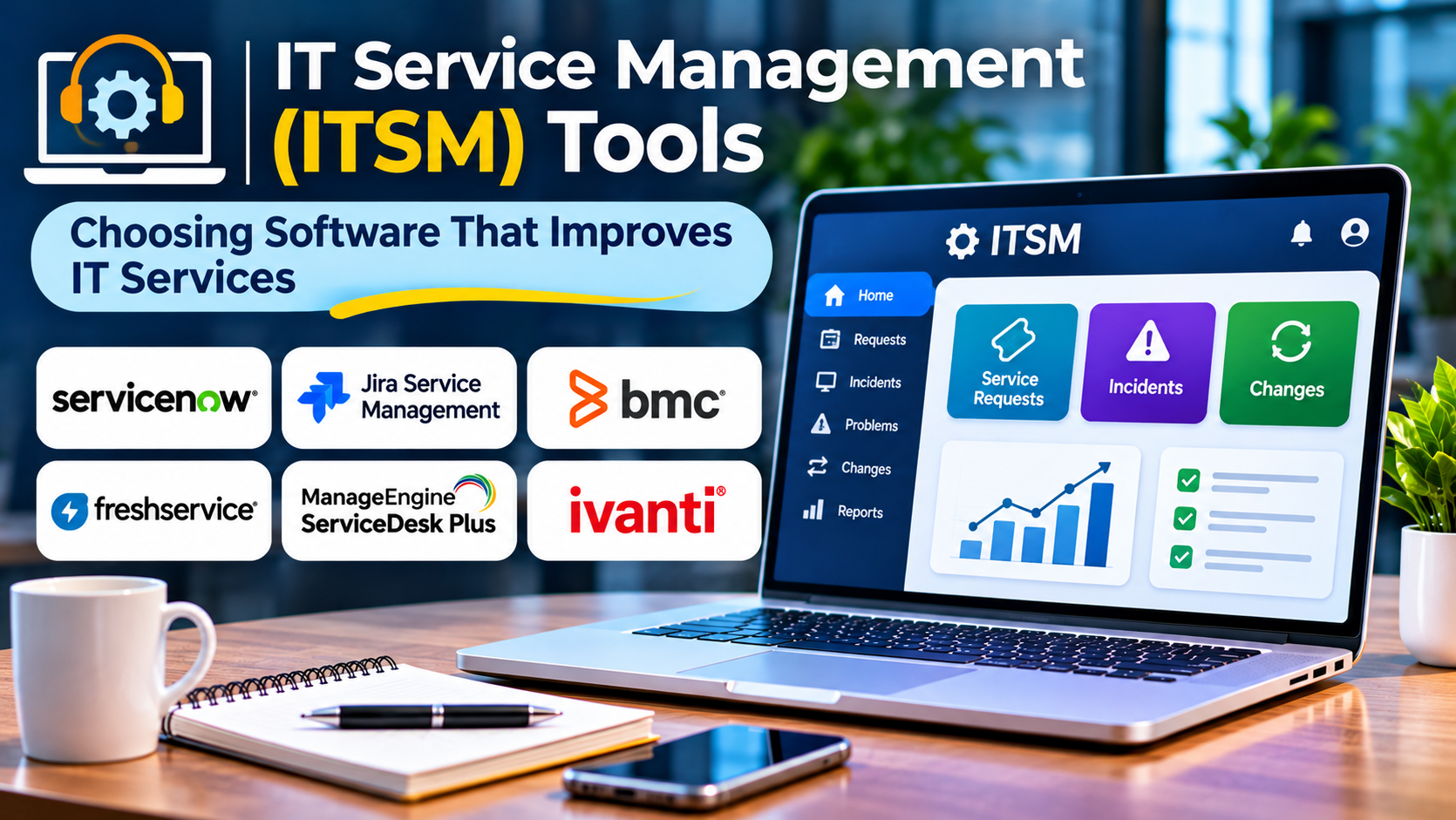
ServiceNow IT Service Management
ServiceNow supports enterprise IT service management through configurable workflows and connected platform capabilities.
It is relevant to organizations with complex service environments and formal governance requirements.
The primary consideration is whether the organization has sufficient implementation and administrative resources.
Jira Service Management
Jira Service Management supports service workflows and integrates with Atlassian development and collaboration products.
It may be particularly relevant where IT operations and software delivery teams work closely together.
Buyers should assess the design of service workflows and integration requirements.
Freshservice
Freshservice provides cloud-based IT service management functionality.
It is worth evaluating for organizations seeking incident, request, change, and related service management capabilities.
Check the features included in the intended subscription tier.
ManageEngine ServiceDesk Plus
ManageEngine ServiceDesk Plus provides IT service management capabilities with related asset and operational functions.
It may appeal to teams that want structured service processes within the ManageEngine ecosystem.
BMC Helix ITSM
BMC Helix ITSM targets enterprise service management requirements.
It is relevant to organizations handling complex IT operations and service processes.
Implementation complexity and integration architecture should be considered carefully.
GLPI
GLPI offers open-source service management and asset management capabilities.
It can be suitable for teams with the expertise to operate and maintain their own environment.
Self-hosting requires ongoing attention to updates, access controls, backups, and support.
ITSM Is Not the Same as ITIL
ITIL is a framework of guidance and practices for service management.
ITSM is the broader discipline of managing IT services.
An ITSM platform can support practices described by ITIL, but installing software does not automatically create effective service management.
Organizations must still define responsibilities, processes, and improvement goals.
What Makes an ITSM Platform Effective?
A Clear Service Catalog
Employees should understand which services are available and how to request them.
A confusing catalog increases support work.
Useful Workflow Automation
Routine approvals, assignments, and notifications can be automated.
Automation should simplify processes rather than reproduce unnecessary bureaucracy.
Reliable Configuration Information
Service teams benefit from understanding which systems support critical business services.
Configuration information should be accurate enough to support incident and change decisions.
Integration With Existing Systems
ITSM software may need to connect with monitoring tools, identity providers, asset systems, and collaboration applications.
Integration quality matters more than the number of connectors advertised.
Meaningful Reporting
Useful reporting connects operational performance with service outcomes.
Organizations should examine service availability, recurring incidents, resolution quality, and employee experience.
How to Choose an ITSM Tool
Begin by assessing service management maturity.
A small IT department may not need complex enterprise workflows.
A large organization with many business services may require advanced governance and configuration management.
Evaluate products using realistic scenarios.
For example, test how the system handles a major service interruption.
Can teams identify the affected service?
Can incidents be assigned and escalated?
Can employees receive accurate updates?
Can the organization investigate the cause afterward?
Also evaluate licensing, implementation, customization, integrations, security, and administrative effort.
Common ITSM Implementation Mistakes
One mistake is trying to implement every available process immediately.
Another is copying complicated workflows without understanding their purpose.
Organizations also sometimes measure success only through ticket closure statistics.
A more effective approach is to introduce a small number of high-value practices, measure results, and expand gradually.
Frequently Asked Questions
What does ITSM stand for?
ITSM stands for IT Service Management.
Are ITSM tools only for large enterprises?
No. Smaller organizations can benefit from structured service requests, incident tracking, and knowledge management.
What is the difference between ITSM and help desk software?
Help desk software primarily handles support requests. ITSM platforms generally support broader service delivery and improvement processes.
Can ITSM tools automate approvals?
Many platforms support approval workflows, although capabilities vary by product and plan.
Final Thoughts
Effective IT service management is about delivering dependable technology services.
ITSM tools support that goal by organizing requests, incidents, changes, knowledge, and service information.
The best platform is one that matches the organization’s operational needs and can be maintained without unnecessary complexity.
Strong processes, clear ownership, and continuous improvement matter as much as the software itself.