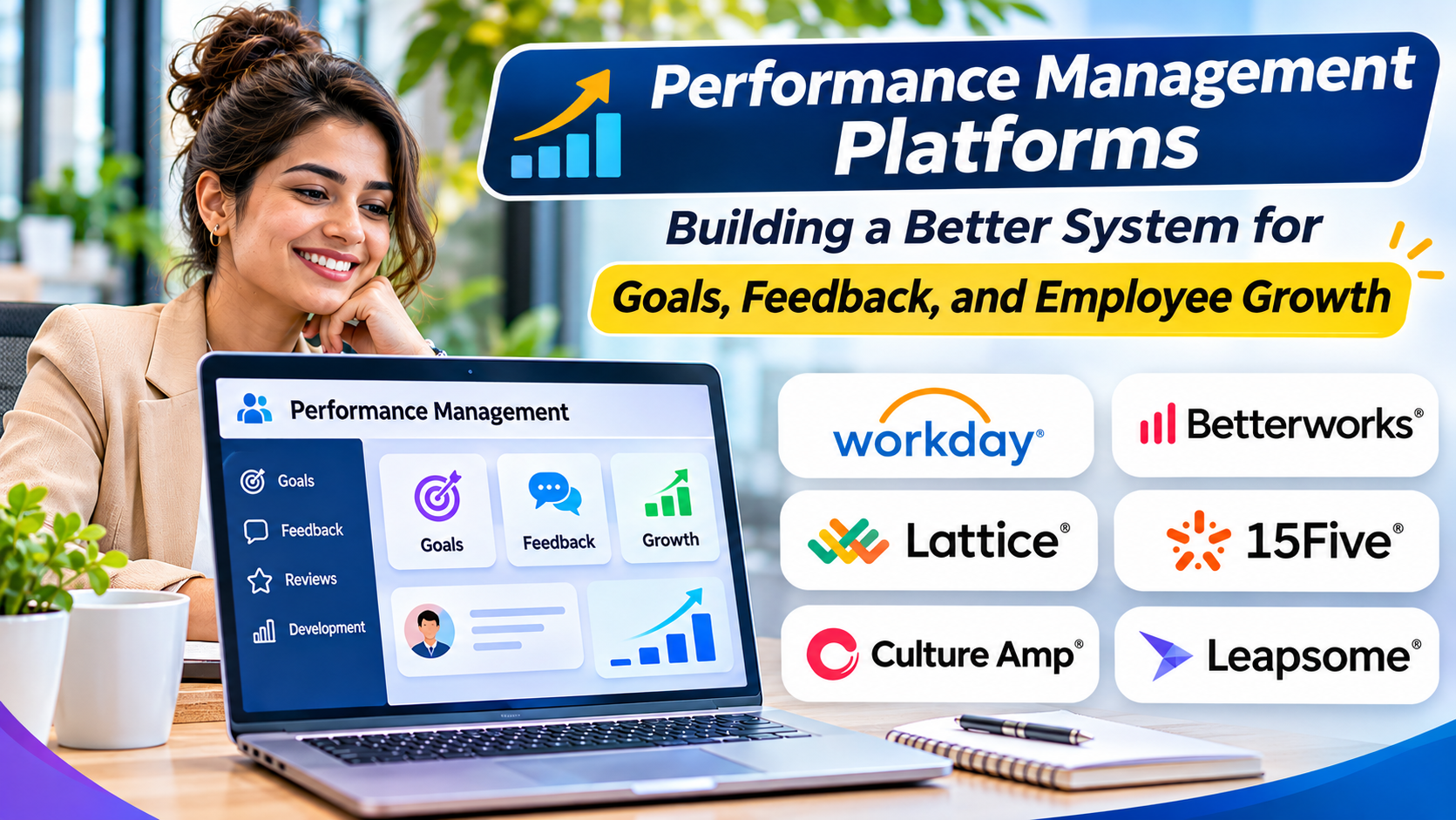
Traditional performance reviews often concentrate on a single meeting or annual rating.
Employees may receive feedback long after the relevant work occurred, while managers struggle to reconstruct months of achievements and challenges.
Performance management platforms can help organizations create a more continuous process.
But software alone cannot make performance evaluations fair, useful, or motivating. Those outcomes depend on clear expectations, meaningful conversations, and responsible management practices.
What Are Performance Management Platforms?
Performance management platforms are applications used to coordinate employee goals, feedback, evaluations, development discussions, and related processes.
Common capabilities include goal tracking, review cycles, manager feedback, self-assessments, performance documentation, and reporting.
Some systems also support compensation reviews, employee engagement, and career development.
The main objective is to help organizations establish expectations, review progress, and support employee improvement.
Why Traditional Performance Reviews Often Struggle
A performance review can become ineffective when employees are evaluated against unclear expectations.
Managers may also rely too heavily on recent events rather than considering the full review period.
Different teams may apply inconsistent standards, making comparisons difficult.
Employees can become frustrated when feedback focuses exclusively on ratings without providing practical development guidance.
Performance management software can improve documentation and process consistency, but organizations must still address these underlying problems.
Performance Management Platforms to Consider
Lattice
Lattice provides performance management and related people management capabilities.
It is relevant to organizations seeking structured reviews, goals, and employee development processes.
15Five
15Five focuses on performance-related workflows, employee feedback, and manager effectiveness.
Its approach deserves consideration when organizations want to encourage more frequent performance conversations.
Leapsome
Leapsome combines performance management with employee development and engagement-related capabilities.
It may appeal to organizations seeking several connected people management processes.
Betterworks
Betterworks provides performance management software focused on goals, feedback, and related workflows.
It is relevant to businesses seeking a structured approach to organizational performance processes.
PerformYard
PerformYard offers performance management functionality for reviews, goals, and feedback.
Organizations should evaluate its workflow configuration against their existing review practices.
Workday
Workday provides performance and talent-related capabilities within its broader HCM environment.
It is particularly relevant when performance management must connect with enterprise employee records and HR processes.
Essential Performance Management Features
| Feature | Why it matters |
|---|---|
| Goal management | Clarifies employee and team expectations |
| Performance reviews | Supports structured evaluations |
| Continuous feedback | Encourages timely conversations |
| Self-assessments | Includes employee perspectives |
| Manager documentation | Preserves relevant performance evidence |
| Development planning | Connects feedback with improvement |
| Reporting | Helps monitor review completion and patterns |
| HRIS integration | Reduces duplicate employee records |
Goals Should Be Meaningful, Not Merely Measurable
Performance management platforms often support objectives and key results, or OKRs, alongside other goal-setting approaches.
However, measurable goals can still be poorly designed.
For example, evaluating a customer support employee solely by the number of tickets closed may encourage speed at the expense of service quality.
Similarly, measuring a software engineer only by code output may overlook reliability, collaboration, and problem-solving.
Organizations should select measures that reflect the actual responsibilities and outcomes of each role.
Improving Feedback Quality
Frequent feedback is not automatically useful feedback.
Effective feedback should be specific, relevant, and connected to observable behavior or results.
Managers should explain what worked, what needs improvement, and what support may be required.
Performance platforms can help document these conversations, but they should not turn every interaction into an administrative formality.
Employees also need opportunities to respond, clarify expectations, and discuss obstacles.
Fairness and Consistency in Evaluations
Performance evaluations can be influenced by unconscious bias, inconsistent expectations, and incomplete information.
Organizations should establish clear criteria and provide managers with appropriate training.
Calibration discussions may help identify differences in evaluation standards, but they must be conducted carefully.
A calibration process should not force ratings into predetermined distributions without considering actual performance evidence.
Automated scoring and AI-generated performance summaries also require scrutiny.
Organizations should ensure that employees are not judged primarily through unexplained or unreliable algorithmic outputs.
Connecting Performance With Development
A performance management system should support employee growth rather than simply classify employees.
Development plans may include training, mentoring, stretch assignments, and changes in responsibilities.
Managers should distinguish between performance problems caused by skill gaps and those caused by inadequate resources or unclear priorities.
The appropriate response will differ.
An employee who lacks training may need support, while someone facing unrealistic workloads may need organizational changes.
Implementing Performance Management Software
Begin by defining the purpose of performance management.
Determine whether the priority is clearer goals, better feedback, more consistent reviews, employee development, or a combination of these objectives.
Review existing processes before configuring the software.
Avoid reproducing unnecessarily complicated forms simply because they were used previously.
Pilot the platform with representative teams and gather feedback from employees and managers.
Test goal updates, review approvals, reporting permissions, and integration with employee records.
Measuring Performance Management Success
Review completion rates are easy to measure, but they reveal little about the quality of performance conversations.
Organizations should also examine whether employees understand expectations, receive useful feedback, and have access to development opportunities.
Manager participation and employee perceptions of fairness can provide additional insight.
The goal is to improve performance management outcomes, not merely complete administrative cycles.
Final Thoughts
Performance management platforms can help organizations connect expectations, feedback, evaluations, and development.
Lattice, 15Five, Leapsome, Betterworks, PerformYard, and Workday offer different approaches to these processes.
The right solution depends on organizational culture, management practices, integration needs, and the complexity of performance workflows.
A successful performance management system should help employees understand what matters, receive constructive guidance, and develop the capabilities needed to succeed.
The technology provides structure. Effective leadership gives that structure purpose.