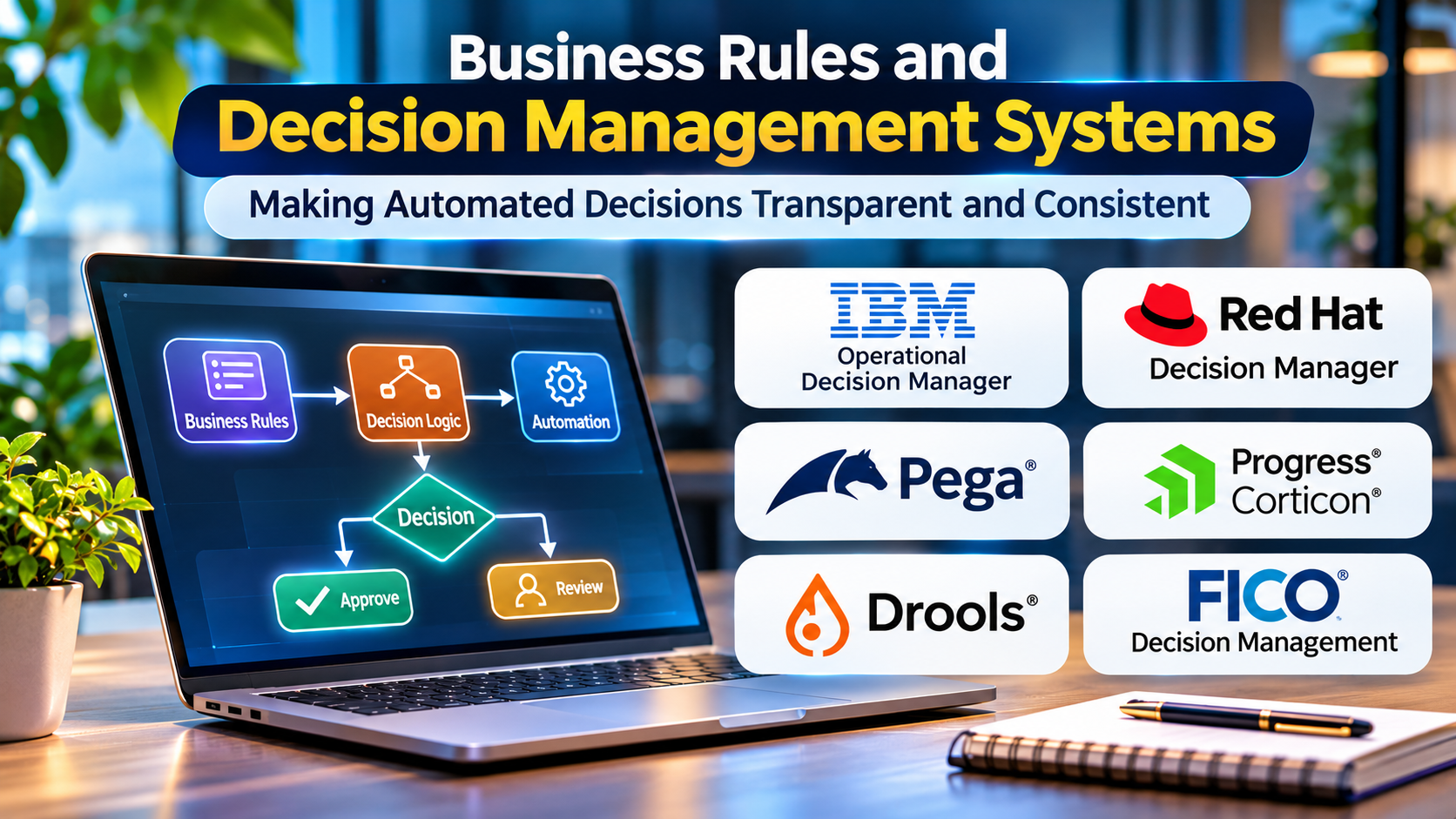
Organizations make thousands of operational decisions based on policies, eligibility criteria, pricing structures, and regulatory requirements.
When these decisions are embedded directly in application code, even a small policy change may require development work, testing, and deployment.
Business rules and decision management systems offer a way to separate decision logic from the applications that use it.
This separation can improve consistency, transparency, and maintainability when implemented carefully.
What Are Business Rules Management Systems?
A Business Rules Management System (BRMS) provides tools for defining, organizing, executing, and maintaining business rules.
Rules typically express conditions and corresponding actions or outcomes.
For example:
If an order exceeds a defined amount and the customer has not completed additional verification, the transaction may require manual review.
Rather than embedding that rule separately in multiple applications, an organization can manage the logic through a dedicated rules system.
Decision management platforms may extend this approach with decision modeling, analytics, and more advanced decision strategies.
Why Externalizing Business Rules Matters
Faster policy updates
Business policies change as organizations introduce products, adjust risk controls, or respond to new requirements.
Centralized rules can reduce the effort needed to update decision logic.
Consistency
When multiple systems use different versions of the same rule, customers may receive inconsistent outcomes.
A shared decision service can help standardize results.
Auditability
Regulated organizations often need to explain how a decision was reached.
Rule histories and decision records can support accountability.
Separation of responsibilities
Business specialists can participate in defining policies while developers focus on application architecture and integration.
However, business-friendly interfaces do not eliminate the need for testing and governance.
Business Rules vs. Decision Management
Business rules define individual conditions and actions.
Decision management addresses how multiple rules, data inputs, and decision models combine to produce an outcome.
A loan eligibility decision, for example, may depend on income, credit information, existing obligations, and product-specific requirements.
A decision management system can organize these factors into a reusable decision service.
Platforms Worth Evaluating
IBM Operational Decision Manager
IBM Operational Decision Manager supports business rule authoring, execution, and governance.
It is relevant to enterprises with complex rule-based decision requirements.
FICO Blaze Advisor
FICO Blaze Advisor provides decision rules management capabilities.
It is particularly relevant to organizations evaluating structured decision automation in financial and other rules-intensive processes.
Red Hat Decision Manager
Red Hat Decision Manager has been associated with enterprise business rules and decision automation using technologies such as Drools.
Organizations should verify current product availability, support arrangements, and the appropriate supported offering before planning a new deployment.
Drools
Drools is an open-source business rules engine used in Java-oriented environments.
It provides flexibility for technical teams but requires engineering ownership of rule development, testing, and operations.
Camunda DMN
Camunda supports decision modeling and execution using Decision Model and Notation (DMN).
It is relevant when decision logic needs to operate alongside orchestrated business processes.
Understanding Decision Tables
Decision tables represent rules in a structured format.
Consider a simplified order review process.
| Order value | Verification status | Decision |
|---|---|---|
| Low | Complete | Continue processing |
| High | Complete | Apply additional checks |
| Any | Incomplete | Request verification |
The thresholds and outcomes in a real implementation should come from approved business policies.
Decision tables are useful because stakeholders can inspect the conditions and identify missing or conflicting cases.
However, large decision tables can become difficult to maintain without proper organization.
What to Look for in a Decision Management Platform
Rule authoring: Can authorized users understand and maintain decision logic?
Version control: Can teams identify which rules were active at a particular time?
Testing: Can the system test expected outcomes, boundary conditions, and conflicting rules?
Execution performance: Does the engine meet application latency and throughput requirements?
Explainability: Can the organization reconstruct why a particular decision occurred?
Integration: Can applications invoke decisions through appropriate APIs or embedded components?
Governance: Are approval workflows, permissions, and change histories available?
Rules Engines vs. Machine Learning
Rules engines follow explicitly defined logic.
Machine learning models identify patterns from data and produce predictions or classifications.
A rules engine may determine whether a customer meets a stated eligibility requirement. A predictive model may estimate the likelihood of a future event.
These technologies can complement each other.
For example, a predictive risk score may become one input to a rules-based decision process.
Organizations should carefully distinguish predictive estimates from binding business policies.
Common Implementation Challenges
Rules can become difficult to understand when they overlap, contradict one another, or depend on poorly defined data.
Another challenge is allowing policy changes without sufficient testing.
Even a small adjustment may affect large numbers of transactions.
Organizations should establish approval procedures, automated regression tests, monitoring, and rollback mechanisms.
When Is a Dedicated Rules System Necessary?
A dedicated system becomes attractive when decision logic changes frequently, is shared across applications, or requires detailed auditability.
For a small application with a handful of stable conditions, ordinary application code may be simpler.
The decision should depend on complexity and governance requirements rather than the desire to introduce another platform.
Frequently Asked Questions
What is the difference between BRMS and BPM?
BRMS manages decision logic. BPM coordinates business processes. They can operate together.
What is DMN?
Decision Model and Notation is a standard for representing business decisions and related logic.
Can business users manage rules without developers?
Some platforms support business-oriented authoring, but testing, integration, and governance may still require technical participation.
Conclusion
Business rules and decision management systems are most valuable when organizations need consistent, explainable, and maintainable decisions.
The strongest implementations combine clear policy ownership, structured decision models, reliable testing, and controlled changes.
The objective is not simply to automate decisions faster. It is to make those decisions dependable and understandable.