A visitor clicks an advertisement promising a free product demonstration, but the link opens a generic company homepage.
The visitor must navigate through menus, locate the product, and search for a demonstration request form.
Many will leave before completing the intended action.
A dedicated landing page solves this problem by connecting a specific marketing promise to a focused experience.
Landing page builders help marketing teams create, publish, and improve these pages without requiring every change to pass through a full website development process.
The challenge is choosing software that supports conversion goals without sacrificing website performance, accessibility, brand consistency, or data quality.
What Is a Landing Page Builder?
A landing page builder is software used to create standalone or campaign-specific webpages.
These pages typically focus on a particular action, such as requesting a demonstration, downloading a resource, registering for an event, or purchasing a product.
Unlike a general website homepage, a landing page usually has a narrower purpose.
Many builders provide visual editors, templates, form creation, integrations, publishing controls, and experimentation features.
However, landing page builders differ considerably in flexibility, technical requirements, and marketing capabilities.
Why Landing Pages Matter
A landing page should continue the conversation started by the advertisement, email, search result, or referral that brought the visitor there.
For example, a campaign promoting payroll software for small businesses should lead to a page explaining that specific solution.
Sending visitors to a broad enterprise software homepage introduces unnecessary decisions.
A well-designed landing page provides a clear connection between the visitor’s expectation and the intended action.
This concept is often called message match.
Good message match can improve clarity, although conversion outcomes depend on the complete experience.
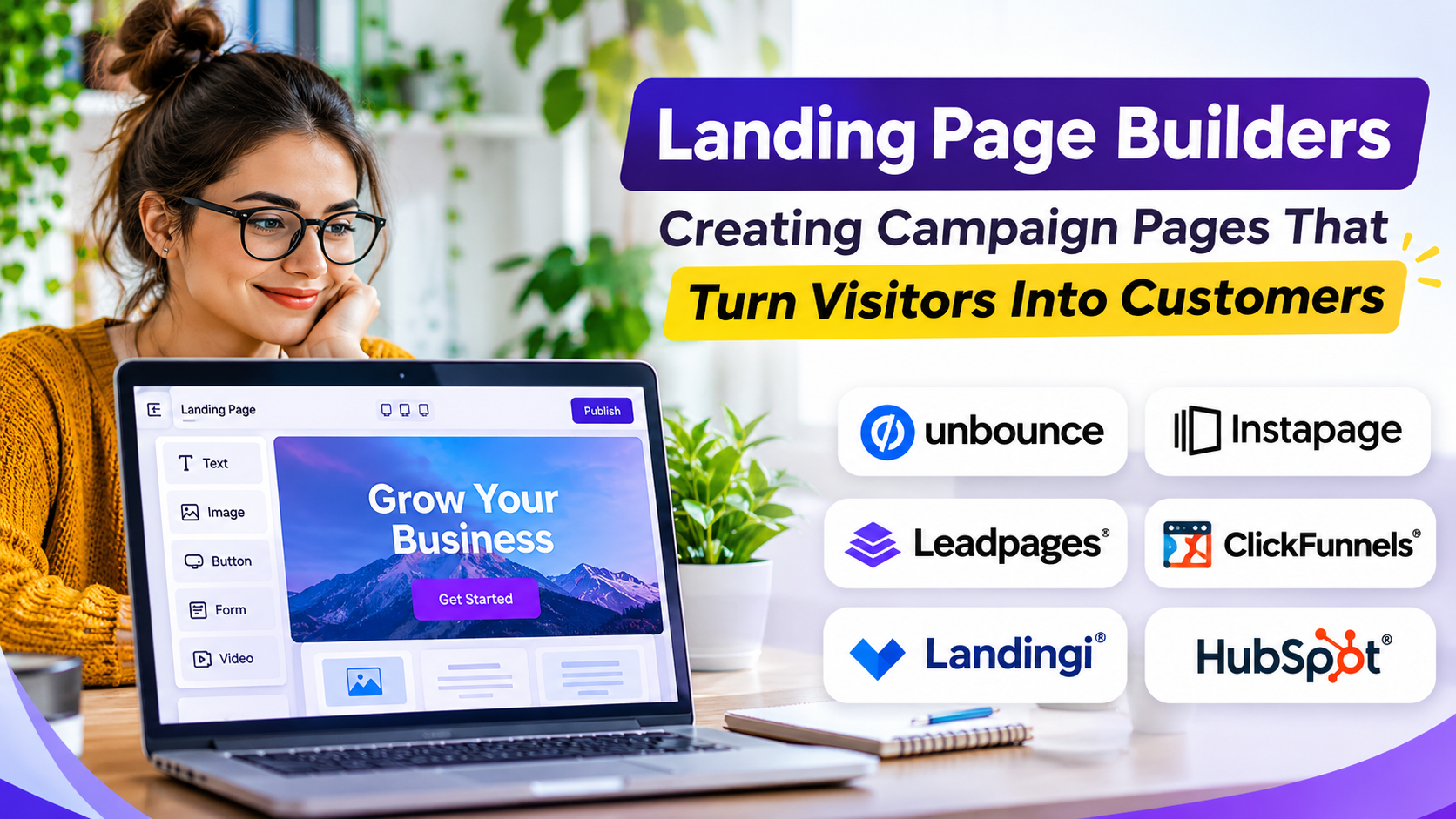
Landing Page Builders Worth Considering
Unbounce
Unbounce specializes in landing page creation and conversion-oriented marketing workflows.
It is relevant to teams building campaign-specific pages and experimenting with different approaches.
Buyers should examine current experimentation capabilities, publishing requirements, and plan limits.
Instapage
Instapage focuses on landing page creation, campaign collaboration, and optimization workflows.
It may appeal to marketing teams coordinating paid advertising campaigns and multiple page variations.
Organizations should evaluate collaboration, governance, integrations, and commercial requirements.
Leadpages
Leadpages provides landing page and lead generation capabilities.
It can be considered by smaller businesses and marketing teams seeking a straightforward publishing workflow.
The evaluation should focus on form handling, design flexibility, and integration with existing marketing systems.
Webflow
Webflow is a broader visual website development platform that can also be used to build landing pages.
It is relevant when design flexibility and control over the wider website experience are important.
Its broader capabilities may introduce more complexity than a campaign-only landing page tool requires.
HubSpot
HubSpot provides landing page capabilities within its wider marketing and customer platform ecosystem.
It may be useful for organizations that want landing page submissions connected to contact records, automation, and CRM workflows.
The main consideration is whether the organization benefits from the integrated environment and its associated costs.
Carrd
Carrd focuses on creating simple, responsive, single-page websites.
It can be useful for lightweight campaigns, personal projects, and straightforward landing pages.
Businesses with advanced experimentation or enterprise workflow requirements may need additional tools.
Comparing Landing Page Builders
| Platform | General emphasis | Suitable evaluation scenario |
|---|---|---|
| Unbounce | Conversion-oriented landing pages | Dedicated campaign pages |
| Instapage | Landing page workflows | Paid advertising campaigns |
| Leadpages | Lead generation pages | Small business marketing |
| Webflow | Visual website development | Design-focused campaigns |
| HubSpot | Integrated marketing workflows | CRM-connected lead generation |
| Carrd | Simple one-page websites | Lightweight landing pages |
These distinctions describe product orientation rather than independently tested conversion performance.
The Anatomy of an Effective Landing Page
A clear headline
The headline should explain the offer or primary benefit quickly.
Visitors should not need to interpret vague slogans to understand why they have arrived.
For example, “Manage Employee Expenses in One Place” communicates more clearly than “Transform the Future of Business.”
A focused value proposition
The page should explain who the offer is for, what problem it addresses, and why it is relevant.
Useful details may include product capabilities, eligibility requirements, pricing context, or what happens after submitting a form.
Avoid unsupported promises.
A visible call to action
The call to action should describe the intended next step.
“Request a Demo” is generally clearer than an ambiguous button labeled “Continue.”
The appropriate wording depends on the offer.
Supporting evidence
Customer testimonials, demonstrations, case studies, and relevant certifications can help visitors evaluate credibility.
Such evidence must be authentic and accurately represented.
A manageable form
Forms should request information necessary for the intended action.
A newsletter signup may need only an email address, while an enterprise demonstration request may require additional business details.
Every field should have a clear purpose.
Mobile Experience and Page Performance
Many campaign visitors arrive on mobile devices.
Landing pages should therefore work well on smaller screens, with readable text, accessible controls, and forms that are practical to complete.
Performance matters too.
Large images, unnecessary scripts, and excessive third-party integrations can slow a page.
A visually impressive design may perform poorly if visitors must wait too long for important content to appear.
Builders should be evaluated using published pages, not only the editor preview.
Integrations That Make Landing Pages Useful
A landing page becomes part of a larger marketing workflow when it connects to other systems.
Common integrations include CRM platforms, email marketing tools, analytics services, payment providers, and automation systems.
For example, when a visitor requests a product demonstration, the form submission may need to create a CRM record, notify the appropriate sales team, and trigger a confirmation message.
These integrations should be tested for duplicate submissions, incorrect field mapping, missing consent records, and failed deliveries.
Landing Page Analytics and Experimentation
Page views alone do not establish success.
Relevant metrics may include form completion rates, qualified leads, cost per acquisition, purchases, and revenue.
A/B testing can help evaluate different headlines, layouts, or calls to action.
However, experiments require sufficient data and appropriate analysis.
A small difference observed over a short period may reflect random variation rather than a genuine improvement.
Teams should also monitor downstream outcomes.
A page generating more leads may not be better if those leads are consistently unqualified.
The Hidden Costs of Landing Page Software
Subscription pricing is only one part of the total cost.
Other considerations include traffic limits, published page allowances, user seats, custom domains, integrations, experimentation features, and support.
Design work, copywriting, analytics implementation, and maintenance also consume resources.
Some businesses may find that their existing website platform already provides sufficient landing page capabilities.
Others may benefit from dedicated software because it allows marketing teams to launch and update campaigns more independently.
How to Choose the Right Landing Page Builder
Start by identifying the intended workflow.
A small business publishing a few lead generation pages may prioritize simplicity and affordability.
An advertising agency managing many client campaigns may need reusable templates, workspace separation, collaboration, and reporting.
A company already using a comprehensive CRM platform may prefer an integrated landing page builder.
A design-focused organization may place greater importance on visual flexibility and control.
Before committing, create and publish a representative page.
Test its mobile layout, loading performance, form submissions, analytics events, accessibility, and integrations.
The published result matters more than how attractive the editing interface appears.
Common Landing Page Mistakes
One frequent mistake is placing several unrelated offers on the same page.
Another is using a headline that does not match the campaign message.
Overly long forms can create unnecessary friction, while insufficient information may leave visitors uncertain about the offer.
Businesses may also focus excessively on button colors or decorative changes while overlooking more significant problems involving clarity, trust, pricing, or product relevance.
Finally, a landing page should not be considered successful solely because it produces a high submission rate.
The quality and commercial value of those submissions matter.
Building a Repeatable Landing Page Workflow
Begin with one clear campaign objective.
Identify the intended audience and the promise that brought visitors to the page.
Create content that explains the offer and addresses likely concerns.
Design a straightforward path to the desired action.
Connect the page to reliable analytics and operational systems.
After launch, review visitor behavior, submission quality, and relevant business outcomes.
Use the findings to guide improvements rather than making arbitrary changes.
Final Thoughts
Landing page builders make it easier to create focused marketing experiences, but software alone does not produce effective campaigns.
Strong landing pages combine a relevant offer, clear communication, usable design, reliable technical implementation, and meaningful measurement.
The best builder is the one that supports these requirements while fitting the organization’s skills, existing technology, and budget.
Ultimately, landing page success depends less on how quickly a page can be published and more on how effectively it helps visitors make an informed decision.