A website can have fast servers, efficient code, and a well-designed interface yet still feel slow to visitors thousands of miles away. The problem is often distance. Every request must travel across networks, compete for bandwidth, and wait for the origin server to respond.
Content delivery networks (CDNs) address this problem by distributing content through geographically dispersed infrastructure. But modern CDN platforms do much more than cache images and JavaScript. They can accelerate applications, protect origins, manage traffic, process requests at the edge, and influence how reliably a digital service operates.
Choosing a CDN is therefore an architectural decision, not simply a search for the provider with the largest advertised network.
What Is a Content Delivery Network?
A content delivery network is a distributed system of servers that delivers web content from locations closer to users or from strategically placed network infrastructure.
Instead of requiring every visitor to retrieve an asset directly from the origin server, a CDN can serve eligible content from an edge cache.
A typical request follows this process:
- A visitor requests a webpage or asset.
- DNS or network routing directs the request toward CDN infrastructure.
- The CDN checks whether a usable cached response exists.
- If the response is available and valid, the CDN serves it.
- Otherwise, the CDN retrieves the content from the origin or another cache layer.
- The response may be cached according to the configured rules.
This reduces repeated origin requests and can improve response times.
However, a CDN does not automatically accelerate every part of an application. Dynamic requests, database operations, authentication, and poorly configured cache policies can still introduce delays.
The Three Decisions That Matter Most
1. What content can actually be cached?
Static assets such as images, fonts, stylesheets, and versioned JavaScript files are natural caching candidates.
HTML responses may also be cached when they are safe to share between visitors.
Personalized pages require more caution. Caching a response containing private account information under a shared cache key can expose information to another user.
Before selecting a provider, classify content into:
- Public static assets
- Public dynamically generated pages
- Personalized responses
- Authenticated API requests
- Streaming or large downloadable files
Each category requires different cache and security policies.
2. Where are your users and origins?
A CDN’s global presence matters, but geographic coverage alone does not determine performance.
Actual delivery depends on network routing, peering relationships, cache availability, origin location, and request patterns.
A provider with extensive global infrastructure may perform differently across individual countries, internet service providers, and mobile networks.
Test representative user locations rather than assuming that advertised network size predicts your results.
3. How much operational control do you need?
Some teams want a straightforward service that caches assets and protects a website.
Others need programmable request handling, complex cache keys, detailed logs, deployment automation, and multiple origins.
Greater flexibility can be valuable, but it also increases configuration and maintenance responsibilities.
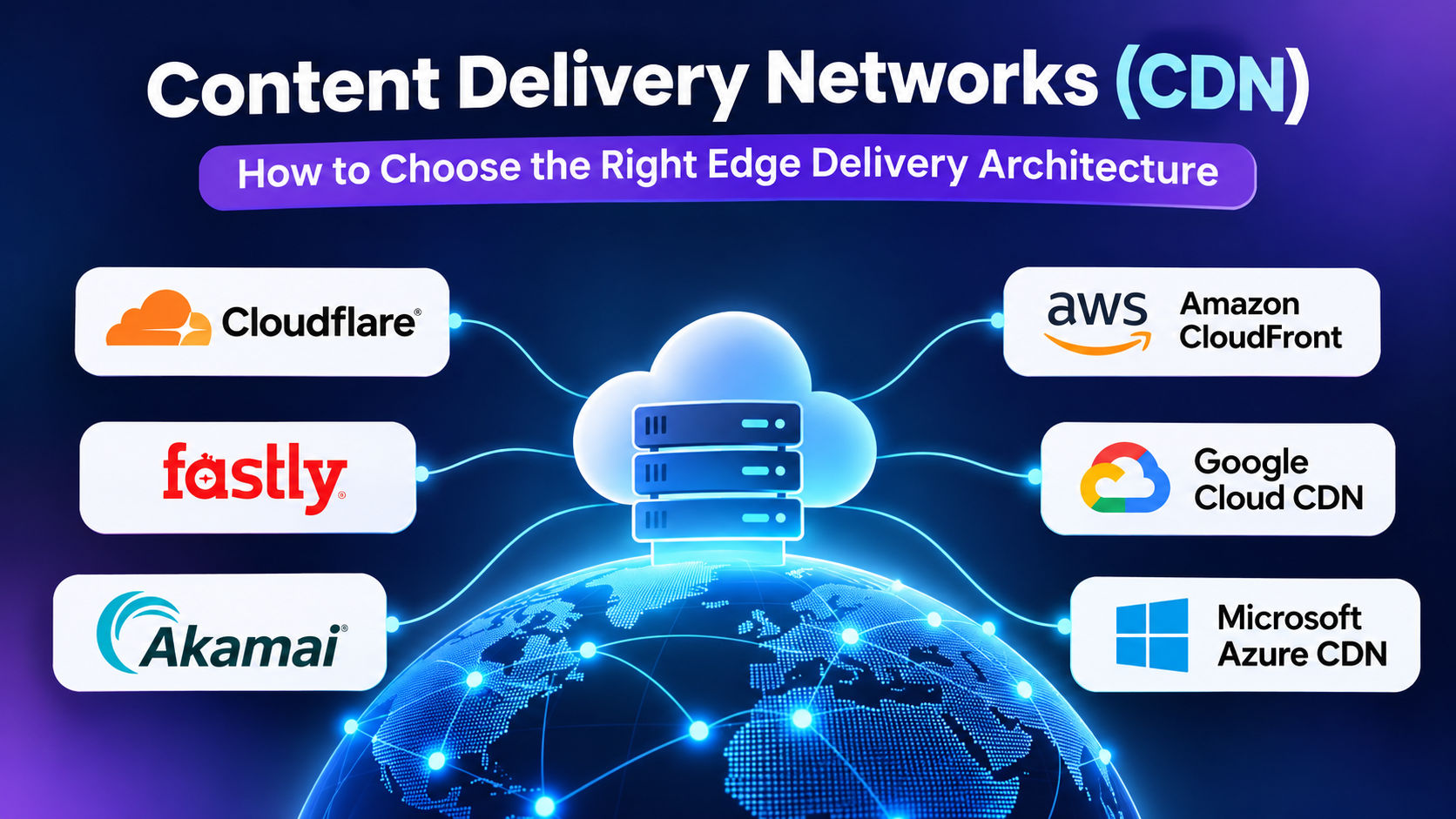
CDN Platforms Worth Evaluating
The following services represent different approaches to content delivery.
Cloudflare
Cloudflare combines CDN services with DNS, application security, traffic management, and edge computing capabilities.
Its integrated approach is useful for organizations seeking a common operational layer across performance and security.
Strengths: Broad edge-service ecosystem, integrated security options, and programmable edge capabilities.
Considerations: Advanced requirements may involve different products, plans, and configuration models. Teams should understand which controls are available for their intended deployment.
Suitable for: Websites, APIs, SaaS applications, and organizations consolidating edge services.
Amazon CloudFront
Amazon CloudFront is a CDN within Amazon Web Services.
It integrates with AWS services, including Amazon S3 and application origins hosted in AWS.
CloudFront Functions and Lambda@Edge support different forms of request processing.
Strengths: AWS ecosystem integration, infrastructure automation options, and established delivery features.
Considerations: Configuration complexity, request pricing, data transfer, and edge-compute costs require careful modeling.
Suitable for: Applications already operating within AWS.
Fastly
Fastly emphasizes programmable edge delivery, cache control, and developer-oriented infrastructure.
Its architecture appeals to engineering teams that need precise control over request handling and content invalidation.
Strengths: Flexible delivery configuration, programmable edge functionality, and detailed caching controls.
Considerations: Advanced implementations require technical expertise and careful configuration management.
Suitable for: Content-heavy applications, media services, and engineering-led organizations.
Akamai
Akamai provides distributed content delivery alongside application security and other edge services.
It is commonly considered for large-scale enterprise delivery and complex operational environments.
Strengths: Extensive delivery capabilities, enterprise-oriented services, and security integrations.
Considerations: Product selection and commercial arrangements can require substantial evaluation.
Suitable for: Large enterprises, digital media organizations, and complex global applications.
Google Cloud CDN
Google Cloud CDN integrates with Google’s cloud load-balancing infrastructure.
It is particularly relevant when applications already use Google Cloud networking and backend services.
Strengths: Integration with Google Cloud architecture and infrastructure management.
Considerations: Teams must understand the relationship between load balancing, caching, origin configuration, and associated charges.
Suitable for: Applications hosted in Google Cloud.
Bunny CDN
Bunny.net provides content delivery and related infrastructure services with an emphasis on accessible configuration and usage-based service models.
Strengths: Straightforward content delivery workflows and practical options for smaller organizations.
Considerations: Compare its service capabilities, regional delivery behavior, and operational controls against your specific needs.
Suitable for: Small businesses, content publishers, and projects prioritizing manageable CDN operations.
CDN Platform Comparison
| Platform | Main consideration | Particularly relevant for |
|---|---|---|
| Cloudflare | Integrated delivery and security | Websites and SaaS |
| Amazon CloudFront | AWS integration | AWS applications |
| Fastly | Programmable delivery | Engineering-led platforms |
| Akamai | Enterprise delivery requirements | Large global operations |
| Google Cloud CDN | Google Cloud networking | Google Cloud workloads |
| Bunny CDN | Straightforward delivery | Publishers and smaller teams |
This comparison identifies architectural fit rather than establishing an overall performance ranking.
Cache Strategy Matters More Than Most Buyers Expect
A CDN cannot compensate for an ineffective caching strategy.
Consider a product catalog that changes frequently. If every response bypasses the cache, the CDN may offer limited origin offloading.
If content is cached too aggressively, visitors may see outdated prices or unavailable products.
A practical policy should define:
Cache keys: Which request properties distinguish one cached response from another?
Time to live: How long may a response remain fresh?
Invalidation: How will content be removed or refreshed after changes?
Origin behavior: What happens when the origin is slow or unavailable?
Authentication: Which responses must never be shared?
Compression: Are suitable compression formats enabled for supported content?
Cache hit ratio is useful, but it should be interpreted alongside response latency, freshness, and origin traffic.
A high hit ratio is not a success if users receive incorrect content.
Understanding CDN Costs
CDN pricing is not always a simple monthly subscription.
Potential cost drivers include:
- Outbound data transfer
- Number of requests
- Geographic traffic distribution
- Edge function execution
- Security and bot-management services
- Logging and analytics
- Origin-to-edge traffic
- Support and service commitments
For example, a video platform may be primarily sensitive to bandwidth charges, while an API service may generate large request volumes with relatively small responses.
Estimate costs using actual traffic patterns rather than a single average monthly bandwidth figure.
Security and Reliability Considerations
CDNs can contribute to application protection, but they do not replace secure application design.
Evaluate TLS management, origin access restrictions, web application firewall capabilities, DDoS protections, access controls, and logging.
A common deployment mistake is protecting the public CDN endpoint while leaving the origin directly reachable.
Where supported, restrict origin access to authorized delivery infrastructure and use appropriate authentication or network controls.
Reliability also requires planning for cache misses, provider outages, configuration mistakes, and origin failures.
A multi-CDN architecture may improve resilience in some environments, but it introduces additional routing, monitoring, and operational complexity.
How to Evaluate a CDN Before Migration
A useful evaluation begins with a representative workload.
Establish a baseline
Measure response times, origin bandwidth, cacheable content, geographic traffic distribution, and application error rates.
Configure a controlled pilot
Move a limited set of assets or traffic through the candidate CDN.
Keep cache rules and origin behavior documented.
Test real user conditions
Compare performance from important geographic markets, mobile networks, and different content categories.
Include both warm-cache and cold-cache scenarios.
Validate security
Test authenticated content, cache key separation, origin protection, and invalidation behavior.
Model operational costs
Estimate normal traffic, seasonal peaks, and unexpected traffic spikes.
Plan rollback
Maintain a tested method for reverting DNS, routing, or application configuration if the deployment causes problems.
Common CDN Mistakes
Caching sensitive responses: Shared caches must not expose user-specific information.
Ignoring origin performance: A slow origin still affects cache misses and uncached requests.
Overlooking image optimization: Large images can remain expensive even when delivered through nearby infrastructure.
Measuring only synthetic speed: Real-user monitoring can reveal issues that controlled tests miss.
Selecting solely by price: Operational effort, security requirements, and support can outweigh a small difference in bandwidth rates.
Frequently Asked Questions
Does every website need a CDN?
Not necessarily. A small site serving a concentrated local audience may have modest CDN requirements. Global traffic, large assets, and high request volumes make CDN evaluation more compelling.
Can a CDN improve SEO?
A CDN can improve delivery performance, which may support a better user experience. It does not guarantee improved search rankings.
Is a CDN the same as web hosting?
No. Hosting provides the origin application or content, while a CDN distributes eligible content and processes requests closer to users.
Can multiple CDNs be used together?
Yes. Multi-CDN systems can route traffic across providers, but they require additional coordination, monitoring, and failure-management processes.
Final Thoughts
The most effective CDN is not necessarily the provider with the most features or the broadest marketing claims.
It is the service that delivers your actual content reliably, fits your security requirements, integrates with your infrastructure, and remains financially predictable.
Start with cache behavior, user geography, and operational requirements. Then compare providers through realistic testing.
That approach turns CDN selection from a vendor popularity contest into a measurable infrastructure decision.