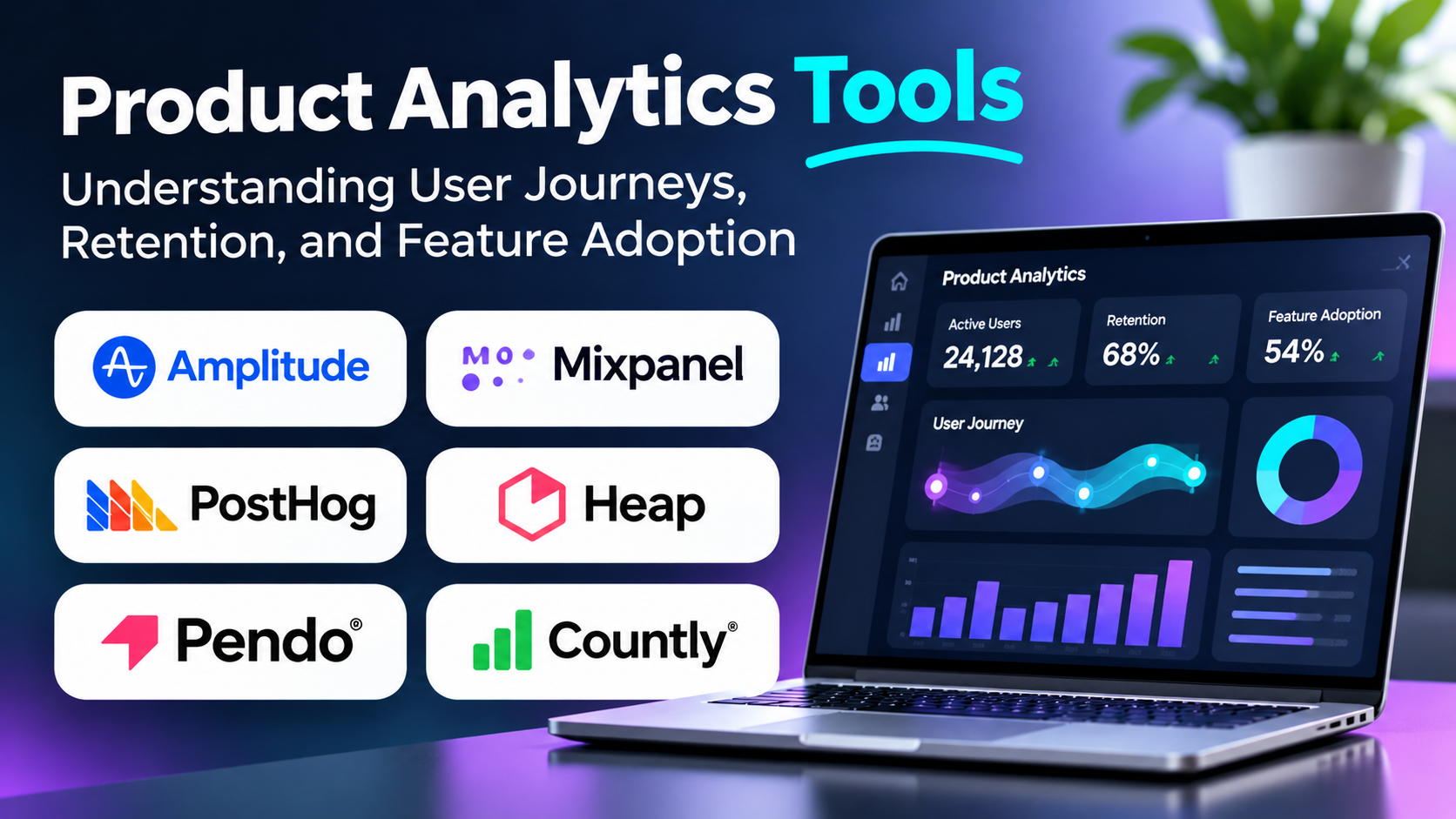
A software product may attract new users consistently while struggling to retain them. Another product may have strong retention but low adoption of its most valuable features.
Traditional traffic reports rarely explain these patterns in sufficient detail.
Product analytics tools help teams understand how people interact with applications over time. They connect events, user journeys, feature usage, and retention patterns to decisions about product development.
Their greatest value comes from helping teams distinguish what users actually do from what product teams assume they do.
What Is Product Analytics?
Product analytics is the measurement and analysis of user interactions within a digital product.
Instead of concentrating primarily on where visitors originate, product analytics examines what happens after users enter an application.
Typical questions include:
- Which features are used regularly?
- Where do users abandon onboarding?
- How long does it take to reach a meaningful first outcome?
- Which behaviors are associated with retention?
- How does feature adoption differ across customer segments?
These questions are particularly important for SaaS platforms, mobile applications, subscription services, and digital products.
The Foundation: A Reliable Event Model
Product analytics depends on well-defined events.
An event represents a meaningful action, such as creating a project, inviting a teammate, uploading a document, or completing a purchase.
Useful events often include properties that provide context.
For example, a project_created event might include the project type, account plan, and creation method.
The event should not include unnecessary sensitive information.
A consistent tracking plan defines event names, properties, ownership, and expected behavior.
Without this foundation, even advanced analytics software produces unreliable insights.
Product Analytics Platforms to Consider
Amplitude
Amplitude provides product analytics capabilities focused on user behavior, journeys, retention, and product performance.
It is relevant to organizations seeking structured analysis of how product experiences influence engagement.
Suitable for: Product-led businesses and teams conducting detailed behavioral analysis.
Trade-off: Effective use requires disciplined event instrumentation and analytical expertise.
Mixpanel
Mixpanel supports event-based analytics, funnel analysis, retention reporting, and user behavior exploration.
Its approach is useful for teams investigating specific product interactions and conversion paths.
Suitable for: SaaS and application teams that want accessible behavioral reporting.
Trade-off: Data quality and event governance remain essential, particularly as tracking expands.
PostHog
PostHog combines product analytics with related product development capabilities, including session replay, feature flags, and experimentation.
Its ecosystem can reduce the need to integrate several separate tools.
Suitable for: Engineering-led teams seeking a connected product development toolkit.
Trade-off: Teams should assess operational requirements, deployment options, and the suitability of individual components.
Heap
Heap focuses on digital behavior analysis and offers automatic interaction capture capabilities alongside other analytics features.
This can help teams explore user interactions that were not fully anticipated during initial instrumentation.
Suitable for: Organizations investigating complex digital journeys.
Trade-off: Automatically captured interactions still require interpretation, governance, and careful management of sensitive data.
Pendo
Pendo combines product analytics with digital adoption and in-application guidance capabilities.
This makes it relevant when organizations want to understand behavior and actively improve onboarding or feature discovery.
Suitable for: SaaS companies and enterprise application teams focused on adoption.
Trade-off: Evaluate the full platform against requirements rather than treating analytics and in-app guidance as interchangeable functions.
Countly
Countly offers product analytics capabilities with deployment and data-control options.
It may appeal to organizations that want greater control over analytics infrastructure.
Suitable for: Teams with specific hosting, governance, or customization requirements.
Trade-off: Deployment and administration choices can increase technical responsibility.
Comparing Product Analytics Tools
| Platform | Main emphasis | Relevant audience |
|---|---|---|
| Amplitude | Behavioral analysis | Product and growth teams |
| Mixpanel | Event and funnel analysis | SaaS teams |
| PostHog | Connected product tooling | Developers |
| Heap | Behavioral data capture | Digital experience teams |
| Pendo | Analytics and adoption | Enterprise product teams |
| Countly | Analytics and data control | Technical organizations |
Five Analyses That Matter
Activation analysis
Activation measures whether new users reach an initial experience that demonstrates the product’s value.
A collaboration platform might define activation as creating a workspace and successfully collaborating with another person.
Registration alone may be a poor activation metric.
Funnel analysis
Funnels show how users progress through a defined sequence.
They can reveal where people abandon onboarding, checkout, or feature configuration.
However, a funnel drop-off does not prove that a particular interface element caused the problem.
Retention analysis
Retention examines whether users return or continue performing meaningful actions over time.
Different products need different retention definitions.
Daily activity may matter for a messaging application, while monthly usage may be entirely appropriate for accounting software.
Cohort analysis
Cohorts group users according to shared characteristics or experiences.
For example, comparing customers who joined before and after an onboarding change may reveal useful differences.
Interpret results carefully because customer mix and external factors may also change.
Feature adoption analysis
Feature adoption measures whether relevant users discover and use functionality.
High adoption is not always desirable. A rarely used security recovery feature can still be essential.
Interpret usage according to the feature’s purpose.
Avoid Confusing Correlation With Causation
Suppose users who invite teammates have higher retention.
This does not automatically mean that encouraging invitations will improve retention.
Highly engaged customers may simply be more likely to invite teammates.
Controlled experiments and careful analysis are needed before claiming a causal relationship.
Product analytics identifies promising opportunities for investigation, not guaranteed solutions.
Choosing the Right Product Analytics Platform
Evaluate event tracking flexibility, identity management, cohort capabilities, reporting usability, integration options, and data governance.
For mobile applications, verify SDK compatibility and offline event handling.
For enterprise software, examine account-level analysis and the relationship between individual users and customer organizations.
For privacy-sensitive environments, review data residency, retention, access control, and collection policies.
Pricing should be modeled against realistic event volumes, users, and anticipated growth.
Implementation: Start Small
Begin with a limited set of product questions.
Instrument the events needed to answer them.
Validate the events against real application behavior and backend records.
Create shared definitions for activation, engagement, and retention.
Only then expand dashboards and advanced analysis.
This prevents teams from collecting enormous amounts of data without a clear analytical purpose.
Frequently Asked Questions
Can Google Analytics replace product analytics software?
It can answer some product-related questions, but specialized platforms may provide more convenient behavioral analysis and product workflows.
Are session recordings the same as product analytics?
No. Recordings help examine individual interactions, while product analytics generally emphasizes structured analysis across users and events.
Does product analytics require personally identifiable information?
Not always. Many analyses can use appropriately designed pseudonymous identifiers and minimized event properties.
Final Perspective
Product analytics is most valuable when it changes how teams make decisions.
The goal is not to maximize event collection or dashboard complexity. It is to understand meaningful user behavior, identify friction, and evaluate improvements responsibly.
A carefully designed event model and a small number of important questions often provide more value than an expensive platform with unreliable data.