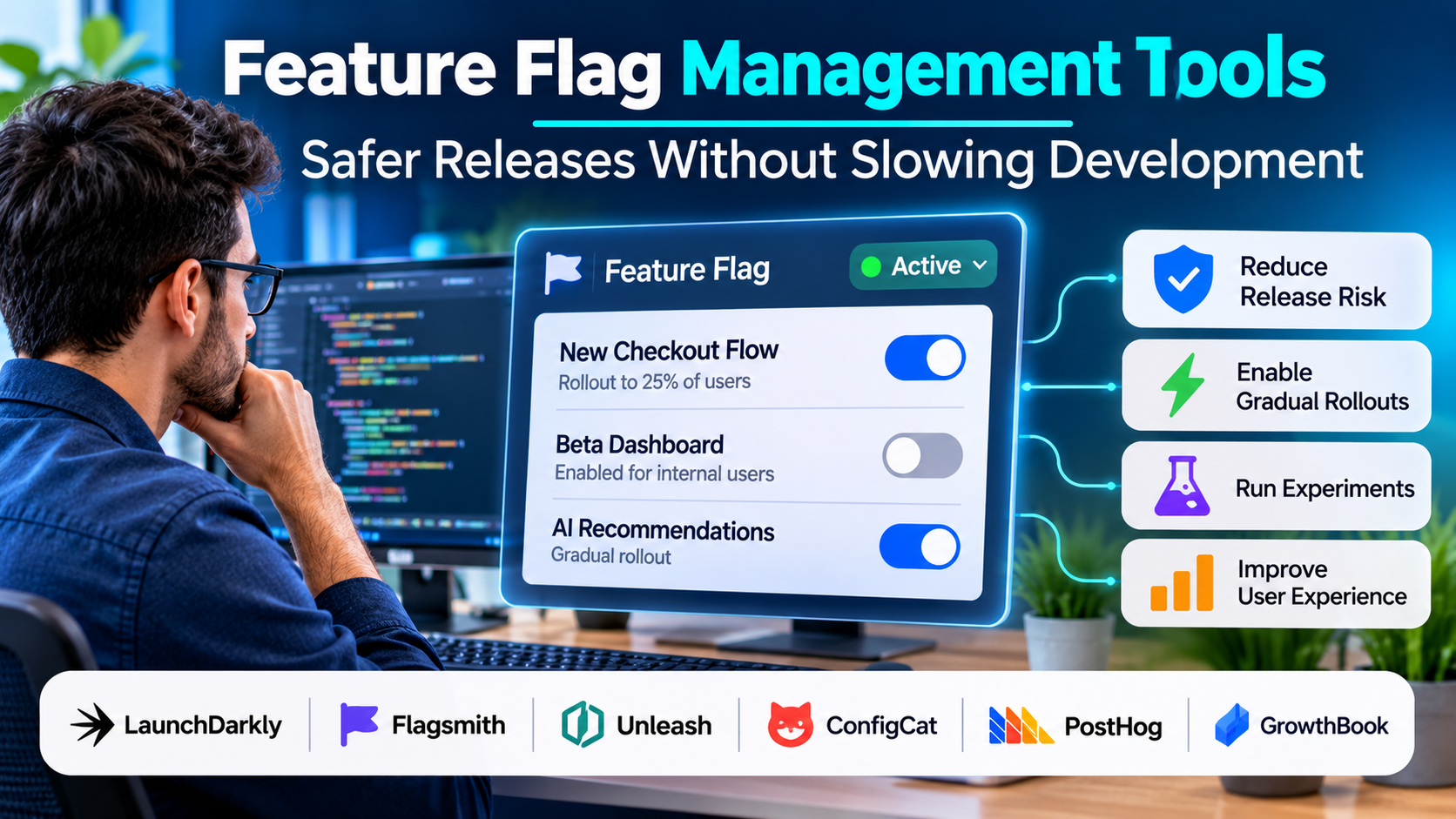
Deploying code and releasing functionality are not necessarily the same event.
A development team may want to deploy a new feature to production while keeping it hidden from most users. Another team may need to disable a problematic integration without waiting for a complete application redeployment.
Feature flag management tools make these workflows possible.
They allow developers and operators to control application behavior through configuration rather than relying exclusively on code deployments.
Used carefully, feature flags support gradual rollouts, operational recovery, and experimentation. Used poorly, they can introduce hidden complexity and long-lived technical debt.
What Is Feature Flag Management?
Feature flag management is the practice of controlling software functionality through configurable conditions.
An application evaluates a flag and decides which behavior to execute.
For example, a new search interface might be enabled for internal employees before being introduced to a small percentage of customers.
The underlying code can already exist in production, while the flag determines who experiences it.
This separation supports safer delivery but does not eliminate the need for testing.
Types of Feature Flags
Release flags
Release flags temporarily control newly developed functionality.
They are useful during staged deployment and gradual rollout.
Operational flags
Operational flags can disable optional or problematic functionality during incidents.
A flag might turn off a resource-intensive recommendation component when an upstream service becomes unavailable.
Experimentation flags
These flags assign users to different product experiences for controlled experiments.
Consistent assignment and reliable event measurement are essential.
Permission or entitlement flags
Some applications use flags to control access to capabilities.
However, feature flags alone should not be treated as a substitute for secure server-side authorization.
Long-lived configuration flags
These control application behavior over extended periods.
They require stronger governance because their lifecycle differs from temporary release flags.
Feature Flag Platforms Worth Considering
LaunchDarkly
LaunchDarkly provides feature management capabilities for controlled releases and application behavior.
It supports workflows such as targeting, gradual rollout, and flag administration.
Suitable for: Organizations managing complex software releases across teams.
Trade-off: Evaluate commercial costs, governance requirements, and operational dependencies.
Unleash
Unleash is a feature management platform with open-source and commercial offerings.
It supports controlled rollout strategies and can appeal to teams seeking deployment flexibility.
Suitable for: Engineering organizations that value control over feature management infrastructure.
Trade-off: Self-managed deployments require infrastructure and maintenance planning.
Flagsmith
Flagsmith offers feature flags and remote configuration capabilities.
Its deployment options and application integration approach make it relevant to teams seeking configurable feature delivery.
Suitable for: Developers looking for flexible feature management.
Trade-off: Assess hosting, SDK behavior, and operational requirements.
ConfigCat
ConfigCat provides hosted feature flag management with targeting and configuration capabilities.
It can be useful for teams seeking a dedicated feature flag service without building the control system themselves.
Suitable for: Application teams prioritizing straightforward feature configuration.
Trade-off: Evaluate limits, governance functionality, and dependencies on remote configuration delivery.
Split
Split, associated with Harness, combines feature delivery and experimentation-oriented capabilities.
It is relevant to organizations connecting controlled rollouts with product measurement.
Suitable for: Teams interested in feature management and experimentation workflows.
Trade-off: Review the current product offering and integration requirements carefully.
GrowthBook
GrowthBook combines feature flags and experimentation capabilities.
It can integrate with existing analytical infrastructure and offers flexible deployment approaches.
Suitable for: Technical teams connecting release control with experimentation.
Trade-off: The team must ensure correct assignment, event measurement, and operational management.
PostHog
PostHog provides feature flag capabilities within a broader product development platform.
It is useful when teams also need product analytics or related tools.
Suitable for: Engineering-led product teams.
Trade-off: Evaluate the platform as a whole and confirm that individual components meet production requirements.
Comparing Feature Flag Platforms
| Platform | Main appeal | Key evaluation concern |
|---|---|---|
| LaunchDarkly | Managed feature delivery | Cost and governance |
| Unleash | Deployment flexibility | Operational ownership |
| Flagsmith | Flags and remote configuration | Hosting and SDK requirements |
| ConfigCat | Dedicated hosted flag management | Service dependency |
| Split | Delivery and experimentation | Platform fit |
| GrowthBook | Experimentation integration | Data infrastructure |
| PostHog | Connected developer tooling | Scope and complexity |
Architecture: What Happens When the Flag Service Fails?
This is one of the most important questions in feature flag selection.
Applications may evaluate flags locally using downloaded configuration or through remote evaluation services.
The architecture influences latency, availability, data exposure, and failure behavior.
A production system should define what happens when fresh flag configuration cannot be retrieved.
Possible strategies include using a previously cached value, applying a documented default, or disabling optional functionality.
The appropriate choice depends on the feature.
For a cosmetic interface change, a fallback may be straightforward.
For payment processing or security-sensitive behavior, fallback decisions require more careful design.
Feature Flag Governance
A mature feature flag program needs clear ownership.
Every flag should have a purpose, an owner, and a documented lifecycle.
Temporary release flags should have removal criteria.
Otherwise, applications accumulate multiple conditional code paths that become increasingly difficult to understand and test.
Useful governance practices include:
- Consistent naming conventions
- Role-based access controls
- Approval requirements for sensitive changes
- Audit logs
- Environment separation
- Flag ownership
- Scheduled cleanup reviews
- Monitoring of important flag changes
Production flag modifications should be treated as operational changes, not casual dashboard edits.
Gradual Rollouts and Risk Management
A gradual rollout exposes a feature to an increasing portion of the eligible population.
For example, a team might begin with employees, expand to a limited customer group, and then increase exposure after monitoring performance.
The rollout should include predefined health indicators.
Relevant measures may include application errors, latency, conversion behavior, and support incidents.
Percentage rollout is not automatically random experimentation. A rollout intended to measure causal effects needs suitable assignment and analysis methods.
Avoiding Feature Flag Technical Debt
The largest long-term risk is not necessarily the feature flag platform itself.
It is the accumulation of unused flags and overlapping conditions.
A single feature may depend on several flags, permissions, and customer attributes.
This can make application behavior difficult to reproduce.
To reduce complexity, remove temporary flags after the rollout is complete, test important combinations, and document dependencies.
Frequently Asked Questions
Are feature flags the same as configuration management?
They overlap, but feature flag platforms typically emphasize dynamic control over application functionality, targeting, and rollout workflows.
Can feature flags replace CI/CD pipelines?
No. Feature flags complement deployment pipelines; they do not replace build, testing, and deployment processes.
Are feature flags secure access controls?
Not by themselves. Sensitive authorization decisions must be enforced through appropriate security mechanisms.
Final Thoughts
Feature flags can make software delivery more flexible and resilient.
Their real value comes from separating deployment from exposure while preserving operational control.
Choose a platform based on SDK reliability, evaluation architecture, governance, and integration needs.
Most importantly, treat every feature flag as a managed part of the application lifecycle—not a permanent shortcut around software design.