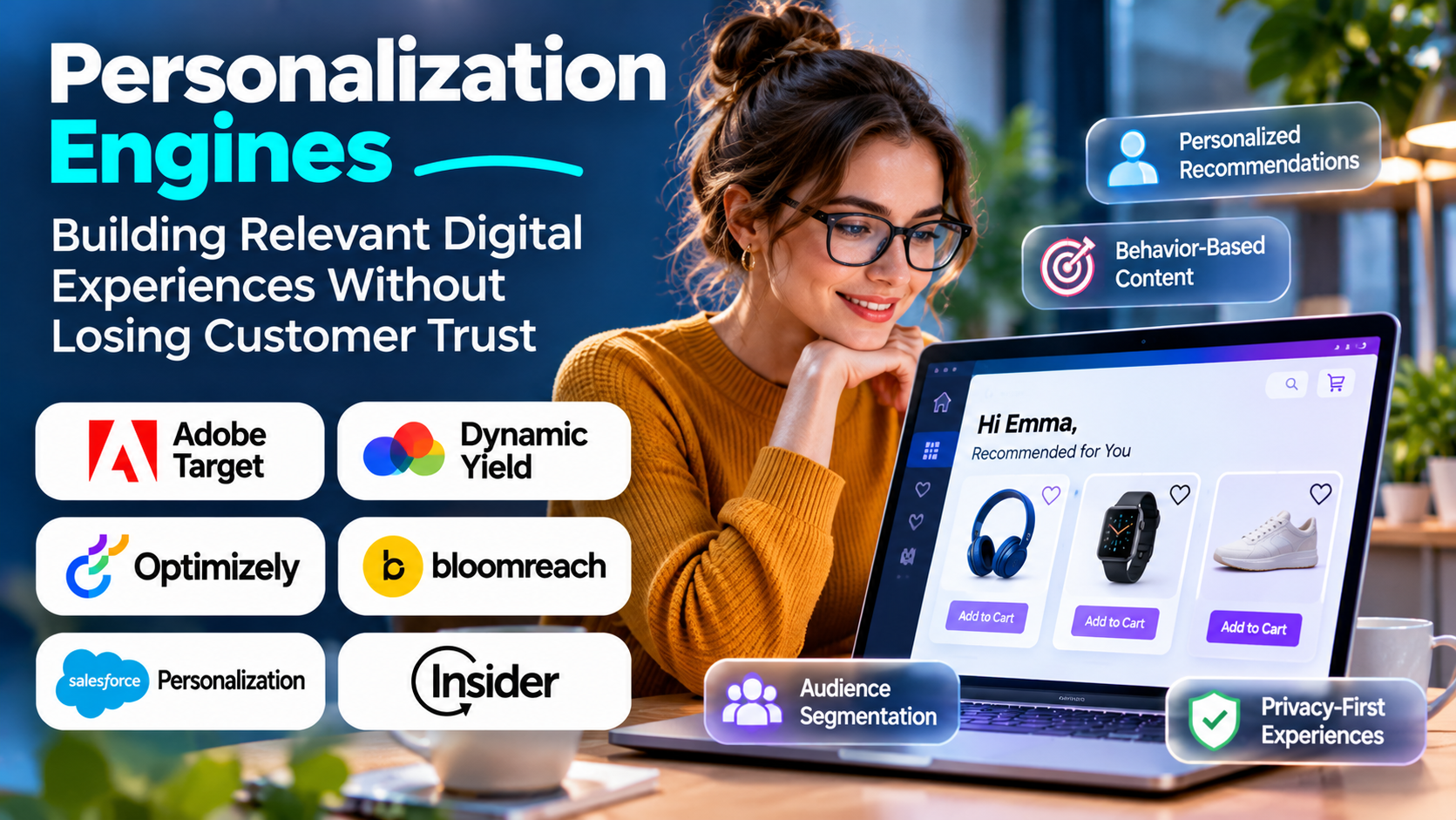
Two visitors can arrive at the same online store with entirely different intentions.
One knows exactly what they want. The other is exploring options. Showing both visitors an identical experience may be simple, but it may not be the most useful approach.
Personalization engines help businesses adapt digital experiences using information about user behavior, preferences, context, and customer relationships.
Yet effective personalization is not simply about collecting more customer data or applying artificial intelligence to every interaction.
It requires a balance between relevance, measurable value, operational complexity, and privacy.
What Is a Personalization Engine?
A personalization engine is a system that selects or adapts content, offers, interfaces, or experiences according to defined information about a user or audience.
Personalization can involve straightforward business rules or sophisticated predictive models.
For example, an ecommerce website might display different homepage content to new visitors and returning customers.
A subscription service might tailor onboarding guidance according to the user’s role.
A media platform might organize content according to expressed interests and previous engagement.
The underlying objective is to make an experience more relevant to the individual or context.
Personalization and Recommendation Engines Are Not Identical
The categories overlap, but they solve different problems.
A recommendation engine primarily selects items that may be relevant to a user.
A personalization engine can coordinate a broader experience, including content placement, messaging, offers, and customer journeys.
Recommendation systems may operate as components within a personalization platform.
Understanding this distinction helps prevent organizations from buying a large experience platform when they only need product recommendations.
How Personalization Works
Most personalization systems follow a recurring process.
First, they collect permitted signals from interactions, customer records, and contextual information.
Next, they organize these signals into profiles, segments, or features.
Then, decision logic selects an experience.
Finally, the system delivers that experience and measures its effect.
The decision logic might use predefined rules, machine learning, experimentation, or combinations of these methods.
Each approach has different requirements.
Rule-based personalization is often easier to explain and control.
Machine learning may help with complex patterns, but it requires suitable data, monitoring, and evaluation.
Personalization Platforms to Consider
Adobe Target
Adobe Target supports digital experience testing and personalization.
It is relevant to organizations working within Adobe’s broader digital experience ecosystem.
Suitable for: Enterprises with established digital experience programs.
Considerations: Integration, governance, and implementation effort should be evaluated carefully.
Dynamic Yield
Dynamic Yield provides personalization and experience optimization capabilities across digital commerce and related customer experiences.
Suitable for: Retailers and digital businesses seeking coordinated personalization.
Considerations: Evaluate implementation requirements and the data needed to support useful decisions.
Optimizely
Optimizely offers digital experience capabilities that include experimentation and personalization-related functionality.
Suitable for: Organizations connecting experience optimization with content and experimentation workflows.
Considerations: Confirm the capabilities available within the specific products being considered.
Bloomreach
Bloomreach offers commerce-oriented customer experience capabilities, including personalization-related products.
Suitable for: Ecommerce businesses seeking connections between customer data, product discovery, and engagement.
Considerations: Assess the required components and integration complexity.
Salesforce Personalization
Salesforce Personalization is part of Salesforce’s broader customer experience ecosystem.
It is relevant to organizations seeking to use customer context across digital interactions.
Suitable for: Enterprises with substantial Salesforce investments.
Considerations: Data architecture, product dependencies, and administration can influence total implementation effort.
Insider
Insider offers customer engagement and personalization capabilities across digital channels.
Suitable for: Marketing teams coordinating personalized customer journeys.
Considerations: Review channel support, data integrations, and operational requirements.
Comparing Personalization Platforms
| Platform | Main orientation | Typical evaluation priority |
|---|---|---|
| Adobe Target | Experience testing and personalization | Adobe ecosystem fit |
| Dynamic Yield | Digital experience personalization | Commerce use cases |
| Optimizely | Experience optimization | Experimentation integration |
| Bloomreach | Commerce experience | Product and customer data |
| Salesforce Personalization | Customer context | Salesforce integration |
| Insider | Cross-channel engagement | Journey coordination |
The Data Quality Problem
Personalization depends on trustworthy signals.
Incorrect customer profiles can produce irrelevant or uncomfortable experiences.
For example, a customer who purchases a gift may not want to receive recommendations for similar products indefinitely.
Likewise, a shared household device may not represent a single person’s preferences.
A personalization strategy should account for uncertain identity, temporary behavior, and changing interests.
It should also provide sensible default experiences when data is unavailable.
Rule-Based Versus AI-Driven Personalization
Rule-based systems are suitable when business logic is clear.
For example, a company might show region-specific delivery information based on the selected shipping destination.
Machine learning becomes more relevant when there are many potential experiences, complex behavioral signals, or large catalogs.
However, advanced models are not automatically more effective.
They may introduce additional costs, explainability challenges, and monitoring requirements.
The best approach is often a combination of clear business rules and carefully evaluated predictive methods.
Measuring Personalization Effectiveness
Personalization should be evaluated against outcomes that matter.
Relevant metrics might include:
- Purchase conversion
- Average order value
- Content engagement
- Customer retention
- Subscription activation
- Customer satisfaction
A common mistake is comparing personalized visitors with non-personalized visitors without accounting for existing differences between them.
Controlled experiments can provide stronger evidence about the impact of personalization.
Also monitor negative effects, such as excessive messaging, reduced diversity of content, or customer complaints.
Privacy and Customer Trust
Personalization often involves sensitive decisions about data use.
Organizations should define which signals are necessary, how long they are retained, and whether they may be used across channels.
Users should not be surprised by how their information influences the experience.
Applicable privacy obligations vary by location and implementation.
Technical controls, appropriate permissions, and transparent policies should be part of the design.
A Practical Adoption Strategy
Begin with one meaningful use case.
For example, a subscription service might personalize onboarding according to a user’s selected role.
Define the expected benefit and the data required.
Create a reliable default experience.
Test the personalized variation against an appropriate comparison.
Expand only when the results justify the added complexity.
This approach prevents personalization from becoming an expensive collection of disconnected campaigns.
Frequently Asked Questions
Does personalization require artificial intelligence?
No. Simple segmentation and business rules can provide useful personalization.
Is personalization only useful for ecommerce?
No. SaaS platforms, media services, education providers, and many other digital businesses can benefit.
Can personalization reduce customer trust?
Yes, particularly when data use feels intrusive, inaccurate, or difficult to understand.
Conclusion
Personalization works best when it helps customers accomplish their goals more easily.
The strongest strategy does not necessarily involve the most complex algorithm.
It combines reliable data, clear decisions, responsible governance, and evidence that the resulting experience is genuinely better.
Choose technology that supports those principles rather than personalization for its own sake.