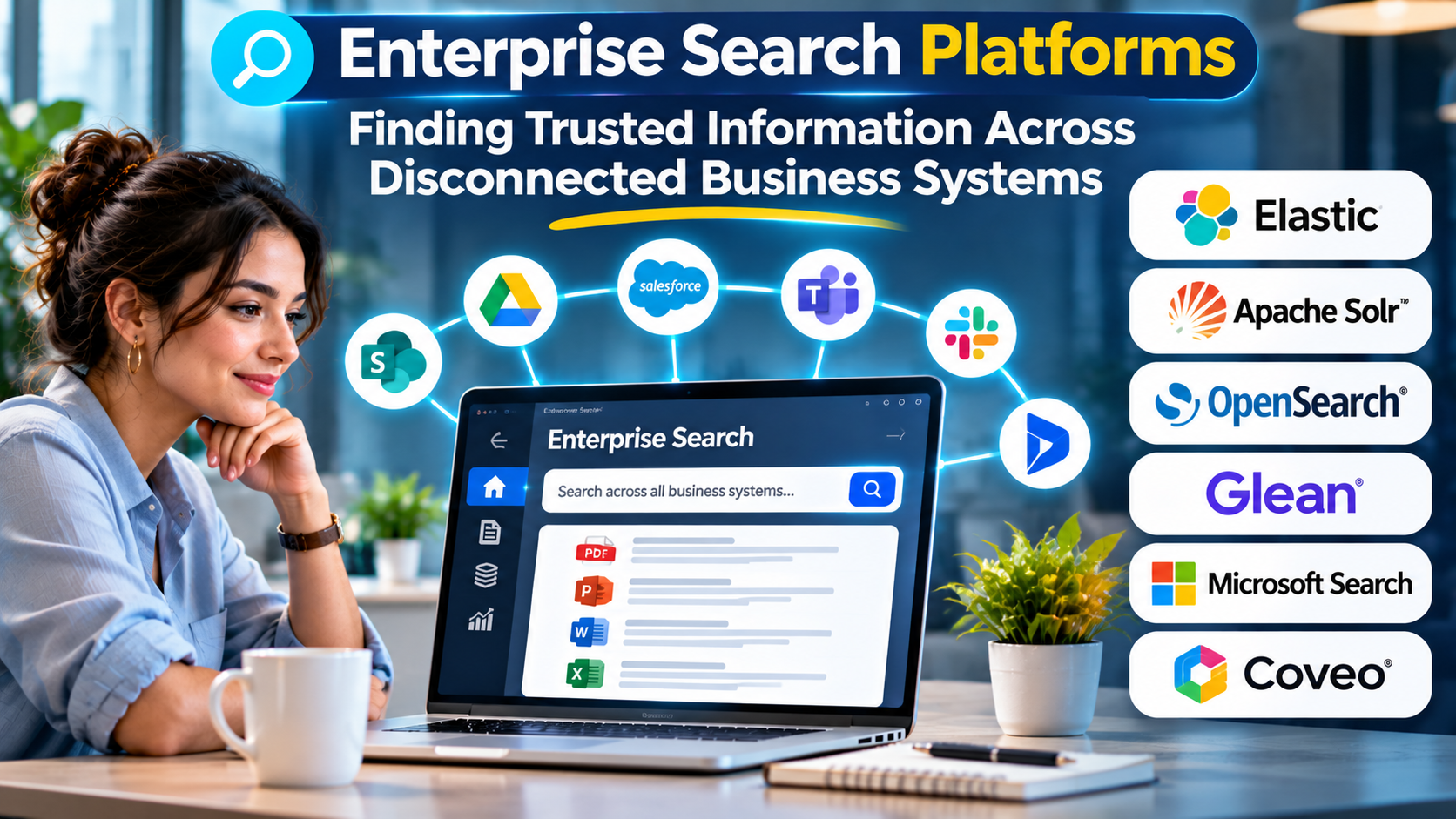
An employee searches for a customer agreement. One version exists in a document repository, another is attached to a CRM record, and an older copy appears in a shared workspace.
The employee finds three results but cannot determine which document is authoritative.
This illustrates the real challenge of enterprise search.
Organizations do not merely need faster keyword matching. They need reliable access to information distributed across systems, protected by different permissions, and maintained by different teams.
Enterprise search platforms attempt to solve this problem through indexing, retrieval, relevance ranking, and integration with organizational data sources.
What Is an Enterprise Search Platform?
An enterprise search platform helps users discover information across business applications, document repositories, databases, and other organizational sources.
Depending on the product, it may support full-text search, metadata filtering, semantic retrieval, access-aware results, and AI-assisted answers.
Unlike public web search, enterprise search must operate within organizational security boundaries.
A result should not become visible simply because the search engine has indexed it.
The platform must respect the permissions governing the underlying information.
How Enterprise Search Works
Most enterprise search architectures involve several stages.
Data connection
Connectors retrieve information from systems such as document repositories, collaboration platforms, databases, and business applications.
Content processing
The platform extracts text, metadata, and other searchable information.
This may include processing PDFs, office documents, and structured records.
Indexing
Processed information is organized into an index designed for efficient retrieval.
Query processing
The system interprets a user’s search and identifies potentially relevant content.
Ranking and presentation
Results are ranked and presented according to relevance signals, permissions, and other configured rules.
Modern platforms may also use semantic retrieval or generative AI to produce answers based on retrieved information.
The quality of the result depends on every stage, not just the search algorithm.
Major Enterprise Search Technologies
Elastic
Elastic provides search technologies used to build enterprise search applications and information retrieval systems.
Its platform offers substantial flexibility for organizations developing custom search experiences.
However, building a complete enterprise search solution requires careful design of connectors, permissions, relevance, and user interfaces.
Apache Solr
Apache Solr is an open-source search platform built on Apache Lucene.
It is relevant to organizations with engineering resources that want control over indexing, query behavior, and deployment.
Solr provides search infrastructure rather than a complete out-of-the-box organizational knowledge experience.
OpenSearch
OpenSearch is an open-source search and analytics platform.
It can support custom enterprise retrieval applications and related search workloads.
Teams should evaluate its indexing, security configuration, infrastructure requirements, and operational responsibilities.
Glean
Glean focuses on enterprise knowledge discovery and AI-assisted workplace search.
It is relevant to organizations seeking a search experience connected to workplace applications.
Evaluation should emphasize connector coverage, permissions, content freshness, and the quality of answers produced from organizational sources.
Microsoft Search
Microsoft Search provides search capabilities across supported Microsoft environments.
It is especially relevant to organizations that already rely heavily on Microsoft 365.
Its suitability depends on the information sources involved and the available connector and administration capabilities.
Coveo
Coveo provides search and relevance technologies for enterprise and digital experience use cases.
It is relevant to organizations seeking search capabilities connected to customer service, workplace knowledge, or digital experiences.
Buyers should evaluate the particular application and integration requirements.
Comparing Enterprise Search Approaches
| Approach | Strength | Responsibility |
|---|---|---|
| Search infrastructure | Customization and control | Application development |
| Managed enterprise search | Integrated discovery experience | Vendor and connector dependencies |
| Suite-native search | Familiar ecosystem integration | Potentially narrower source coverage |
| AI-assisted search | Natural-language answers | Grounding, verification, and governance |
A search engine and a complete enterprise search application are not the same thing.
An organization using OpenSearch or Solr may need to build much of the surrounding experience.
A managed search product may reduce that effort but introduce subscription and integration dependencies.
Permissions Are a Core Requirement
Enterprise search must respect source-system authorization.
If an employee cannot access a confidential document in its original repository, searching should not expose that document’s contents.
This sounds straightforward but becomes complicated when systems use different permission models.
Some repositories rely on groups. Others use document-level sharing, application roles, or custom access rules.
A search platform must interpret these rules correctly and update them when permissions change.
Security testing should include users with different roles and documents with restricted access.
Why Search Relevance Is Difficult
Employees rarely search using exactly the words stored in a document.
Someone might search for “remote working rules” while the relevant policy uses the phrase “telecommuting arrangements.”
Keyword search may miss that relationship.
Semantic search can help retrieve conceptually related information.
However, semantic similarity is not the same as business correctness.
An older policy may be semantically relevant but no longer valid.
Strong enterprise search therefore combines relevance with metadata, freshness, authority, and governance.
The Role of AI in Enterprise Search
Generative AI can turn retrieved passages into conversational answers.
This is often implemented through retrieval-augmented generation, or RAG.
The system retrieves potentially relevant information and supplies it as context to a language model.
The model then produces an answer.
This can make complex information easier to access, but it creates additional requirements.
Answers should be grounded in retrievable sources.
Users should be able to inspect supporting documents.
Permissions must remain enforced.
The system should handle conflicting or missing information without presenting unsupported certainty.
A confident answer is not necessarily a correct answer.
Evaluating Search Quality
A useful enterprise search pilot should use real employee tasks.
Collect representative queries from different departments.
Include exact document lookups, ambiguous terminology, policy questions, and searches requiring information from multiple systems.
Measure:
- Retrieval relevance.
- Permission enforcement.
- Content freshness.
- Search latency.
- Source coverage.
- Answer accuracy.
- User task completion.
For AI-generated answers, evaluate whether the cited sources actually support the response.
Testing only a handful of polished demonstration queries provides little evidence of production performance.
The Importance of Content Governance
Search technology cannot fully compensate for poor information management.
If an organization stores contradictory policies, duplicate documents, and outdated instructions, the search platform may retrieve all of them.
Content owners should identify authoritative sources, apply useful metadata, and archive obsolete information.
Enterprise search is most effective when combined with sound knowledge management practices.
Cost and Operational Considerations
Costs depend on architecture.
Search infrastructure may involve compute resources, storage, indexing pipelines, monitoring, and engineering effort.
Managed enterprise search may involve user subscriptions, indexed content, connector requirements, or other commercial arrangements.
AI-assisted search can introduce additional model processing and retrieval costs.
Organizations should evaluate total cost against measurable productivity improvements rather than relying on search volume alone.
Frequently Asked Questions
What is the difference between enterprise search and site search?
Enterprise search focuses on information distributed across organizational systems. Site search typically helps visitors find content within a website or digital property.
Can enterprise search access private documents?
It may index or retrieve authorized private content, but it must enforce the applicable access permissions.
Does AI replace traditional enterprise search?
No. AI-assisted answers still depend on reliable retrieval, indexing, permissions, and information quality.
Is open-source enterprise search suitable for large organizations?
It can be, particularly when the organization has the technical resources to build and operate the required integrations and security controls.
Final Perspective
Enterprise search succeeds when employees can find the right information, understand its source, and trust that access controls are respected.
Fast retrieval is useful, but reliability requires more than speed.
The strongest enterprise search implementations combine effective indexing, appropriate security, meaningful relevance signals, and well-maintained source information.
Without those foundations, adding AI may simply make unreliable information easier to consume.