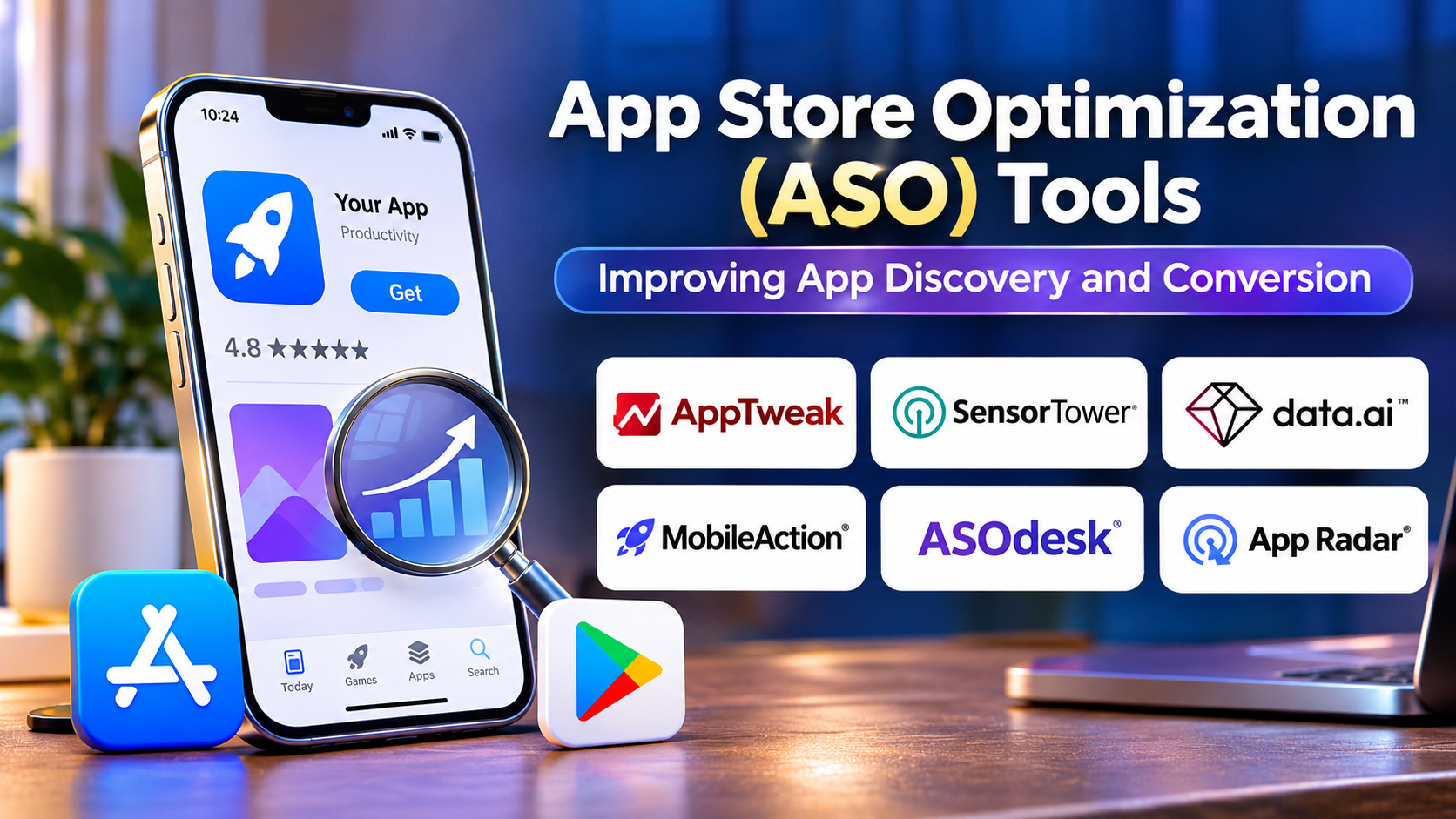
Publishing a mobile application does not guarantee that potential users will find it.
Even a well-designed app may struggle to attract downloads when its store listing is unclear, its screenshots fail to communicate value, or competing applications dominate relevant searches.
App Store Optimization, commonly called ASO, addresses these challenges.
ASO tools help mobile teams research search demand, monitor competitors, evaluate store listings, and understand how discovery and conversion change over time.
However, successful ASO requires more than selecting popular keywords. It involves understanding platform-specific rules, customer expectations, and the relationship between store visibility and product quality.
What Is App Store Optimization?
App Store Optimization is the practice of improving an application’s visibility and conversion performance within mobile app marketplaces.
Its primary environments include Apple’s App Store and Google Play.
Although the two stores share broad objectives, they differ in metadata requirements, listing features, experimentation options, and ranking systems.
A strategy that works on one marketplace should not automatically be copied to the other.
ASO typically involves keyword research, listing optimization, creative testing, localization, review analysis, and performance monitoring.
The Difference Between ASO and Traditional SEO
Search engine optimization focuses on visibility in web search engines.
ASO focuses on discovery and conversion within app marketplaces.
Both involve understanding search intent, but ASO places particular importance on app-specific metadata, icons, screenshots, ratings, reviews, and store conversion behavior.
App marketplace algorithms also consider signals that are not equivalent to traditional website ranking factors.
Therefore, ASO requires specialized research and measurement rather than treating an app listing like an ordinary webpage.
ASO Tools and Platforms to Evaluate
AppTweak
AppTweak provides app store intelligence and ASO-related research capabilities.
It is relevant to teams conducting keyword research, competitor analysis, and app marketplace performance monitoring.
Buyers should assess supported markets, data coverage, and reporting requirements.
Sensor Tower
Sensor Tower provides mobile market intelligence and app performance research capabilities.
It can be useful for organizations investigating app categories, competition, and broader mobile market trends.
Its market estimates should not be confused with direct access to every competitor’s internal performance data.
MobileAction
MobileAction offers mobile growth intelligence and ASO-related capabilities.
It may suit teams researching keywords, competitors, and mobile acquisition opportunities.
Feature availability and intended use cases should be verified before procurement.
App Radar
App Radar focuses on app store optimization workflows, including keyword research and listing management capabilities.
It is relevant to teams seeking operational support for ongoing ASO activities.
The evaluation should include workflow compatibility and marketplace support.
AppFollow
AppFollow provides app review management and app store-related analytics capabilities.
It can be useful when customer feedback, review analysis, and reputation management are important parts of an ASO program.
Native App Store Tools
Apple’s App Store Connect and Google Play Console provide first-party tools for managing applications and reviewing available performance information.
They are essential components of app publishing workflows, even when teams also purchase third-party ASO software.
Comparing ASO Tool Categories
| Tool | Main emphasis | Practical application |
|---|---|---|
| AppTweak | ASO research | Keywords and competitive analysis |
| Sensor Tower | Mobile market intelligence | Market and competitor research |
| MobileAction | Mobile growth intelligence | Acquisition and ASO research |
| App Radar | ASO workflows | Listing optimization and management |
| AppFollow | Review intelligence | Customer feedback and reputation |
| App Store Connect | Apple app management | Publishing and first-party reporting |
| Google Play Console | Android app management | Publishing, experiments, and reporting |
Different tools provide different levels of market intelligence, workflow automation, and first-party data.
Keyword Research for Mobile Applications
ASO keyword research begins with understanding how potential users describe their needs.
A meditation app, for example, may serve people searching for relaxation, guided meditation, sleep support, or mindfulness exercises.
These searches represent related but distinct intentions.
Keyword research should examine relevance, competition, localization, and the app’s actual functionality.
Third-party search volume and difficulty indicators are estimates. They should not be interpreted as guaranteed download opportunities.
Teams should prioritize terms that accurately describe the application.
Optimizing the Store Listing
An effective store listing communicates what the app does and why someone should install it.
Important elements may include the app name, subtitle or short description, full description, icon, screenshots, preview videos, and localized metadata.
Exact requirements differ by marketplace.
Screenshots deserve particular attention because they often communicate product value more quickly than written descriptions.
Instead of displaying attractive but unexplained interface screens, screenshots should demonstrate meaningful capabilities and benefits.
Claims should remain accurate and consistent with marketplace policies.
Creative Testing and Conversion
An app listing can receive substantial traffic but generate relatively few installs.
This may indicate that visitors do not understand the product, dislike the visual presentation, or perceive a mismatch between the listing and their needs.
Creative experimentation can help investigate these issues.
Google Play Console offers store listing experimentation capabilities, while Apple’s ecosystem provides product page optimization features subject to applicable requirements.
Experiments should use clearly defined outcomes and avoid drawing conclusions from insufficient evidence.
Changing several elements simultaneously can make it difficult to identify what influenced the result.
Ratings, Reviews, and Product Quality
User reviews provide valuable information about product expectations and recurring problems.
An app with confusing onboarding or frequent crashes may struggle even when its listing attracts attention.
ASO teams should therefore collaborate with product and engineering teams.
Review analysis can identify common complaints, missing features, and usability problems.
However, ratings should never be manipulated through misleading incentives or inappropriate review solicitation practices.
Localization and International Growth
App discovery differs across countries and languages.
Direct translation may fail to capture local search terminology or cultural expectations.
A localization strategy should consider regional vocabulary, screenshots, pricing presentation, and product availability.
Teams should validate localized listings with people familiar with the intended market.
How to Measure ASO Performance
Useful metrics include store impressions, product page views, conversion rates, installs, keyword visibility, and retention.
These metrics should be interpreted together.
An increase in installs may not create lasting value if newly acquired users abandon the application immediately.
Likewise, improved conversion rates may reflect changes in traffic quality rather than listing improvements alone.
A reliable evaluation combines store data, product analytics, and appropriate experimental methods.
Choosing the Right ASO Tool
A small development team may begin with first-party store consoles and manual competitor research.
As the app portfolio expands, dedicated keyword research and reporting tools may become more useful.
Mobile publishers operating across multiple countries may require advanced market intelligence, localization workflows, and competitive monitoring.
The selection should reflect the number of apps, supported markets, internal expertise, and decisions the team needs to make.
Final Thoughts
ASO tools can make app marketplace research more systematic, but they cannot compensate for an application that fails to meet user expectations.
Sustainable app growth depends on aligning discoverability, accurate store presentation, customer experience, and product quality.
The most effective ASO program treats optimization as an ongoing process of research, experimentation, and learning rather than a one-time keyword exercise.