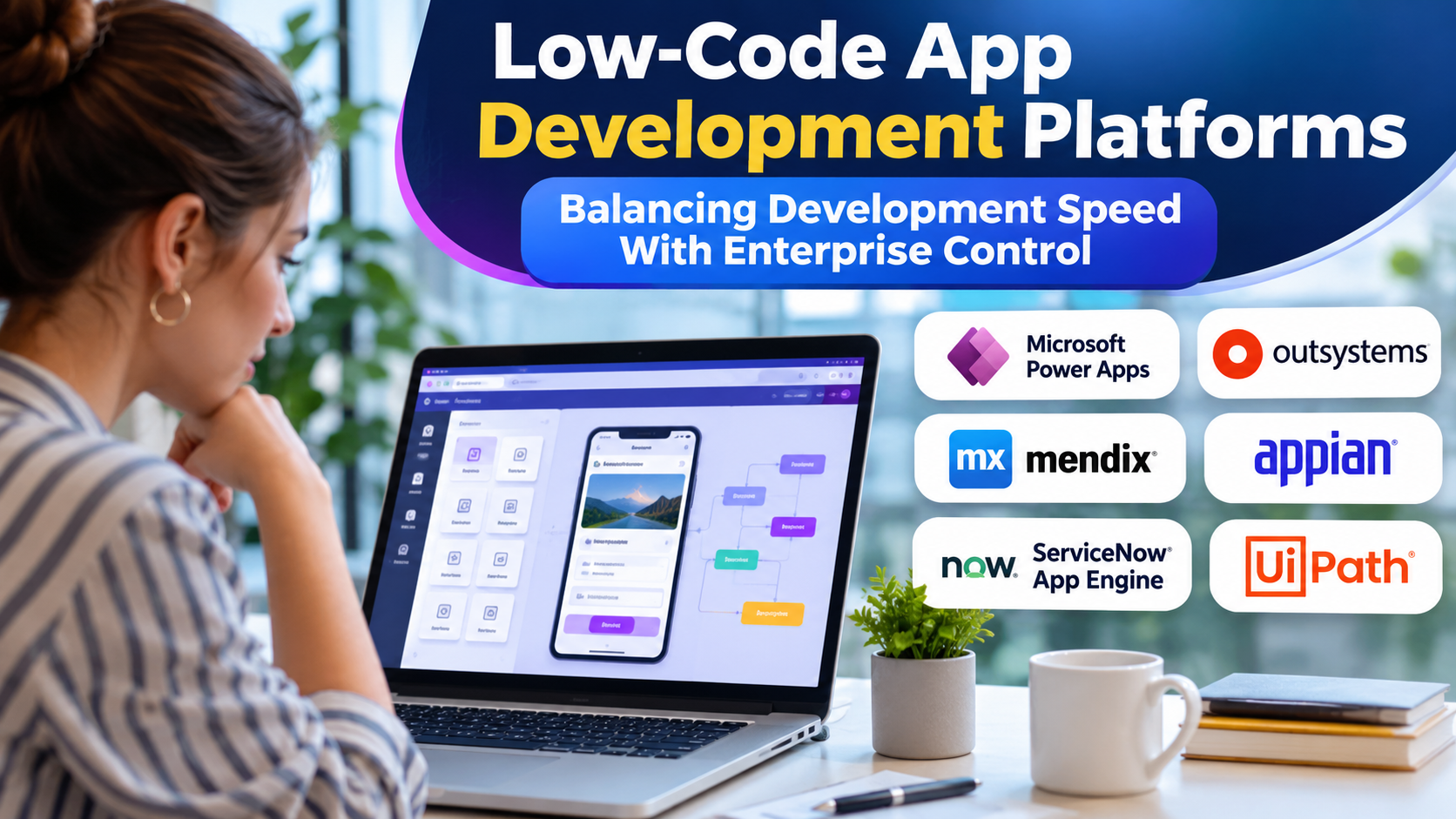
Businesses need software that can adapt to changing processes, customer expectations, and regulatory requirements.
Traditional development provides flexibility but can demand significant engineering resources. Packaged business software can be quicker to deploy but may not accommodate every workflow.
Low-code app development platforms occupy the space between these approaches.
They provide visual development tools, reusable components, integration capabilities, and deployment services while allowing varying degrees of custom programming.
For enterprise buyers, the most important question is not how quickly an application can be demonstrated. It is whether the platform can support secure, maintainable software throughout its lifecycle.
What Is a Low-Code App Development Platform?
A low-code development platform provides tools for creating applications using visual modeling, prebuilt components, and configuration, with the ability to extend functionality through code where supported.
Typical capabilities include:
- Visual interface development
- Workflow and business process modeling
- Data integration
- Reusable application components
- Custom logic and code extensions
- Deployment management
- Access control and governance
- Application monitoring
- Collaboration between business and IT teams
Low-code platforms vary considerably in their architecture and intended users.
Some emphasize enterprise application development. Others focus on business process automation or internal tools.
Where Low-Code Development Creates Value
Low-code can be useful when organizations need to build applications that are more specialized than standard business software but do not justify building every component from scratch.
Common use cases include employee portals, approval systems, customer service workflows, operational dashboards, and legacy application modernization.
A low-code platform can also help standardize development practices across departments.
However, organizations must avoid creating disconnected applications with inconsistent data and security policies.
Leading Platforms and Their Approaches
Microsoft Power Apps
Power Apps supports business application development within Microsoft’s broader enterprise ecosystem.
It is relevant for organizations using Microsoft 365, Dataverse, Power Automate, and Azure services.
Its integration capabilities can be useful, but licensing and connector requirements should be evaluated against realistic usage.
OutSystems
OutSystems focuses on enterprise application development using visual tooling and application lifecycle capabilities.
It can support organizations developing complex business applications with dedicated technical teams.
Buyers should assess architecture, extensibility, deployment options, and long-term commercial commitments.
Mendix
Mendix provides model-driven application development capabilities for enterprise environments.
It supports collaboration between business specialists and professional developers.
Organizations should evaluate integration requirements, deployment architecture, governance, and developer expertise.
Appian
Appian emphasizes process orchestration, automation, and enterprise workflow applications.
It is relevant where business processes span multiple systems, departments, and approval stages.
The platform should be evaluated in the context of process complexity and integration requirements.
Salesforce Platform
Salesforce provides application development capabilities around its CRM ecosystem.
Organizations can create custom business objects, interfaces, automations, and extensions.
It is particularly relevant when applications depend heavily on Salesforce data and workflows.
However, platform-specific development and licensing considerations can influence long-term costs.
Retool
Retool focuses on building internal applications that connect to databases, APIs, and business systems.
It can be useful for operational dashboards, administrative tools, and data-management interfaces.
Its emphasis differs from platforms intended for comprehensive customer-facing application development.
Low-Code Platform Comparison
| Platform | Primary emphasis | Evaluation priority |
|---|---|---|
| Power Apps | Microsoft business applications | Licensing and integrations |
| OutSystems | Enterprise application development | Architecture and lifecycle |
| Mendix | Model-driven development | Collaboration and deployment |
| Appian | Process automation | Workflow orchestration |
| Salesforce Platform | CRM-connected applications | Ecosystem dependency |
| Retool | Internal business tools | Data access and permissions |
Architecture Matters More Than Visual Development Speed
Low-code applications still require sound architecture.
Organizations need to understand where application data resides, how services communicate, and which systems own critical business records.
A platform may simplify interface creation while leaving complex integration work largely unchanged.
Before selecting a vendor, document the application’s architecture and identify technical constraints.
Integration With Existing Systems
Enterprise applications rarely operate independently.
They may need to communicate with ERP systems, CRM platforms, databases, identity providers, and external APIs.
Evaluate whether integrations use supported connectors, REST APIs, events, or custom services.
Also consider error handling, retries, data consistency, and monitoring.
A connector that works in a demonstration may not be sufficient for a high-volume production workflow.
Governance and Security
Low-code adoption can spread rapidly across departments.
Without governance, organizations risk duplicated applications, excessive permissions, and undocumented dependencies.
A sustainable program should establish development environments, approval processes, role-based access controls, and application ownership.
Security teams should review identity integration, audit capabilities, secrets management, and data protection responsibilities.
Governance should enable responsible development rather than block useful innovation.
The Real Cost of Low-Code
Low-code platforms may reduce certain development tasks, but their total cost includes more than subscription fees.
Important factors include developer licensing, application users, environment costs, integration charges, infrastructure, training, support, and migration complexity.
Some platforms price according to users or applications. Others use different capacity or consumption models.
A realistic financial evaluation should include expected growth and changing usage patterns.
Avoiding Vendor Lock-In
Low-code platforms often use proprietary application models, workflows, and deployment mechanisms.
This can improve development productivity while making migration more difficult.
Ask vendors what can be exported, which components rely on proprietary runtimes, and how application data can be recovered.
The goal is not necessarily to eliminate vendor dependency, but to understand and manage it.
How to Run a Low-Code Pilot
Choose a real application with moderate complexity and clear business value.
Include authentication, a representative integration, meaningful data volumes, and at least one workflow exception.
Measure development effort, application performance, maintenance requirements, and administrative overhead.
Involve both business users and technical stakeholders.
A pilot should test the platform’s operational limitations, not just its ability to produce attractive screens.
Frequently Asked Questions
Is low-code development suitable for enterprise applications?
It can be, provided the platform meets requirements for architecture, security, integrations, performance, and governance.
Does low-code eliminate developers?
No. Professional developers remain important for architecture, complex integrations, security, and advanced customization.
How is low-code different from no-code?
Low-code generally provides greater opportunities for custom programming, although many platforms combine both approaches.
Can low-code applications replace legacy systems?
They can replace or modernize certain workflows, but complex migrations require careful data and integration planning.
Final Thoughts
Low-code app development platforms can accelerate software delivery when they are introduced with clear technical and organizational boundaries.
Their long-term value comes from combining development efficiency with dependable architecture, governance, and maintainability.
Organizations should select platforms based on the applications they need to operate, not simply the speed of their initial demonstrations.