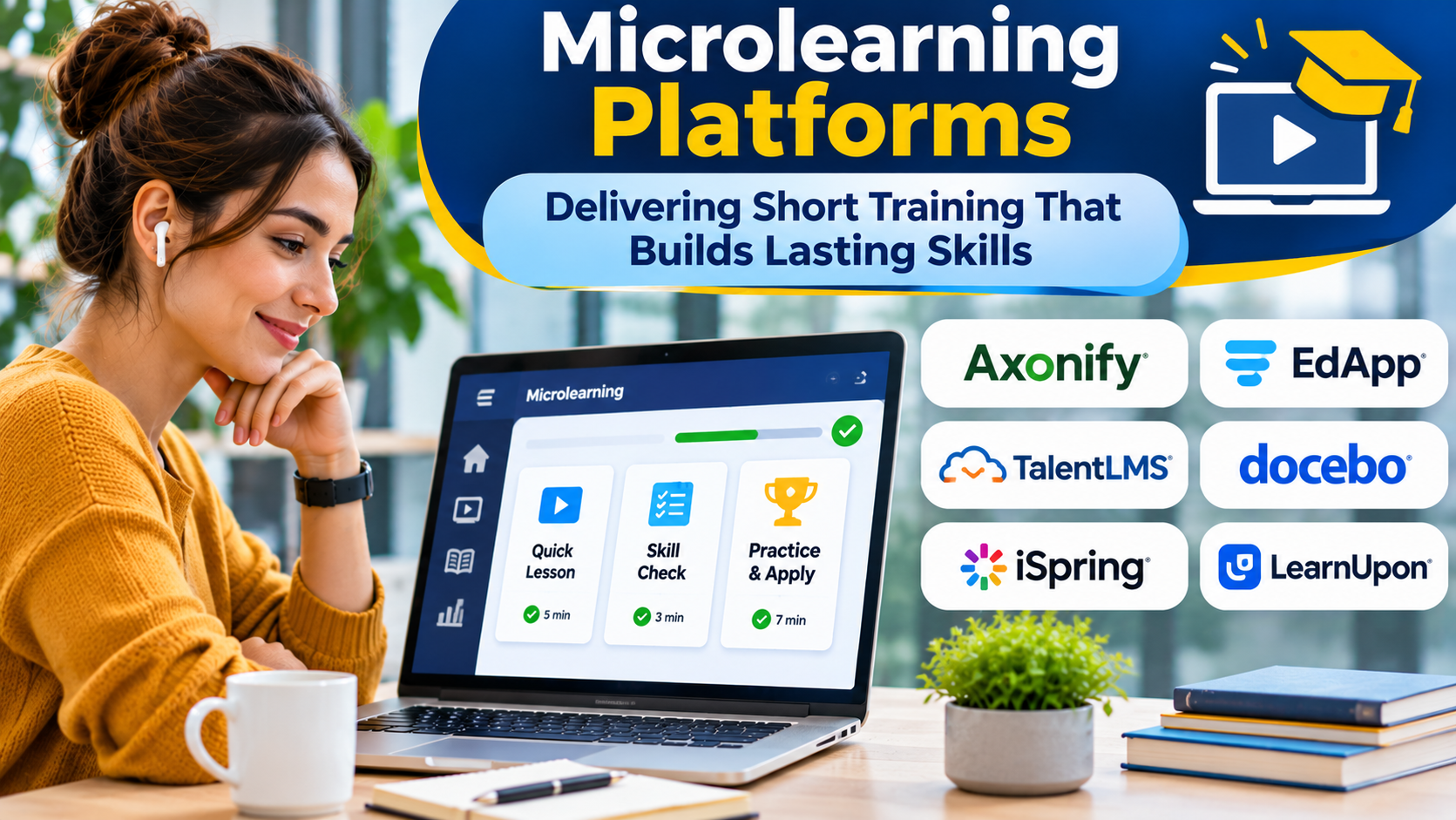
Employees rarely have unlimited time for training. Frontline workers may have only a few minutes between tasks, while office teams must balance learning with daily responsibilities.
Microlearning addresses this challenge by delivering focused learning activities in small units.
However, shorter content does not automatically produce better learning. The real value comes from helping people remember and apply important information.
What Is a Microlearning Platform?
A microlearning platform delivers short, focused learning experiences designed around specific knowledge or skills.
A lesson might include a brief video, interactive scenario, flashcard activity, or short assessment.
Microlearning works particularly well when the learner needs to understand or practice one clearly defined concept.
For example, a retail employee might complete a short lesson on handling a customer complaint before beginning a shift.
A healthcare organization might use brief refresher activities to reinforce an established procedure.
Complex professional skills usually require additional instruction and supervised practice.
How Microlearning Differs From Traditional Training
Traditional courses often group several learning objectives into longer sessions.
Microlearning breaks suitable topics into smaller activities that learners can complete individually.
| Traditional training | Microlearning |
|---|---|
| Longer structured sessions | Short focused activities |
| Multiple learning objectives | Usually one primary objective |
| Scheduled learning periods | Flexible access |
| Comprehensive instruction | Targeted instruction and reinforcement |
| Formal course completion | Frequent learning interactions |
These approaches are complementary rather than competing.
An organization might deliver a comprehensive onboarding course and then use microlearning to reinforce important concepts.
Microlearning Platforms to Evaluate
SC Training (formerly EdApp)
SC Training focuses on mobile-friendly workplace learning and short training experiences.
It is worth exploring for organizations with distributed employees who need accessible training.
Evaluate lesson creation, learner access, reporting, and content administration.
Axonify
Axonify focuses on frontline workforce learning and reinforcement.
Its approach is relevant when organizations want employees to revisit important knowledge over time.
Buyers should examine how learning activities fit into daily operational workflows.
7taps
7taps emphasizes simple creation and distribution of short learning content.
It may suit teams seeking lightweight training experiences without complex course development.
Organizations requiring extensive compliance reporting should carefully evaluate its fit.
TalentCards
TalentCards focuses on mobile microlearning through short, card-based training experiences.
It may be relevant for employees who need quick access to focused learning material.
Qstream
Qstream focuses on knowledge reinforcement and learning activities that support retention.
It is worth considering when the primary challenge is helping learners remember previously taught information.
Features That Support Effective Microlearning
Mobile usability
Learners should be able to access content comfortably on smaller screens.
Test navigation, text size, media playback, and accessibility across representative devices.
Spaced reinforcement
Revisiting important knowledge over time can help support retention.
Platforms may provide scheduled review activities, repeated questions, or adaptive reinforcement workflows.
Short assessments
Assessments should measure meaningful understanding.
A quick question that requires a learner to apply knowledge is often more useful than a simple recall prompt.
Reporting
Completion rates show participation but do not establish workplace improvement.
Organizations should also evaluate assessment performance and relevant operational outcomes.
Content management
Training teams need efficient ways to update lessons when procedures or policies change.
Version control and content ownership become important as the library grows.
When Microlearning Works Best
Microlearning is particularly suitable for product updates, policy reminders, sales knowledge, customer service techniques, and refresher training.
It is less suitable as the only method for teaching complex technical procedures or high-risk tasks requiring supervised practice.
For these situations, short lessons should support a broader learning program.
How to Measure Success
Begin by identifying a business or learning problem.
For example, a support team may want to reduce errors in a specific customer service process.
Deliver focused learning activities and measure whether employees understand the procedure.
Then examine whether the relevant operational metric improves.
Consider other factors that might influence the result, including changes in staffing, processes, or technology.
Final Thoughts
Microlearning platforms can make training easier to access and reinforce.
Their greatest benefit comes from delivering the right information at the right moment.
Choose a platform that supports clear learning objectives, practical reinforcement, and reliable measurement rather than focusing only on short content formats.