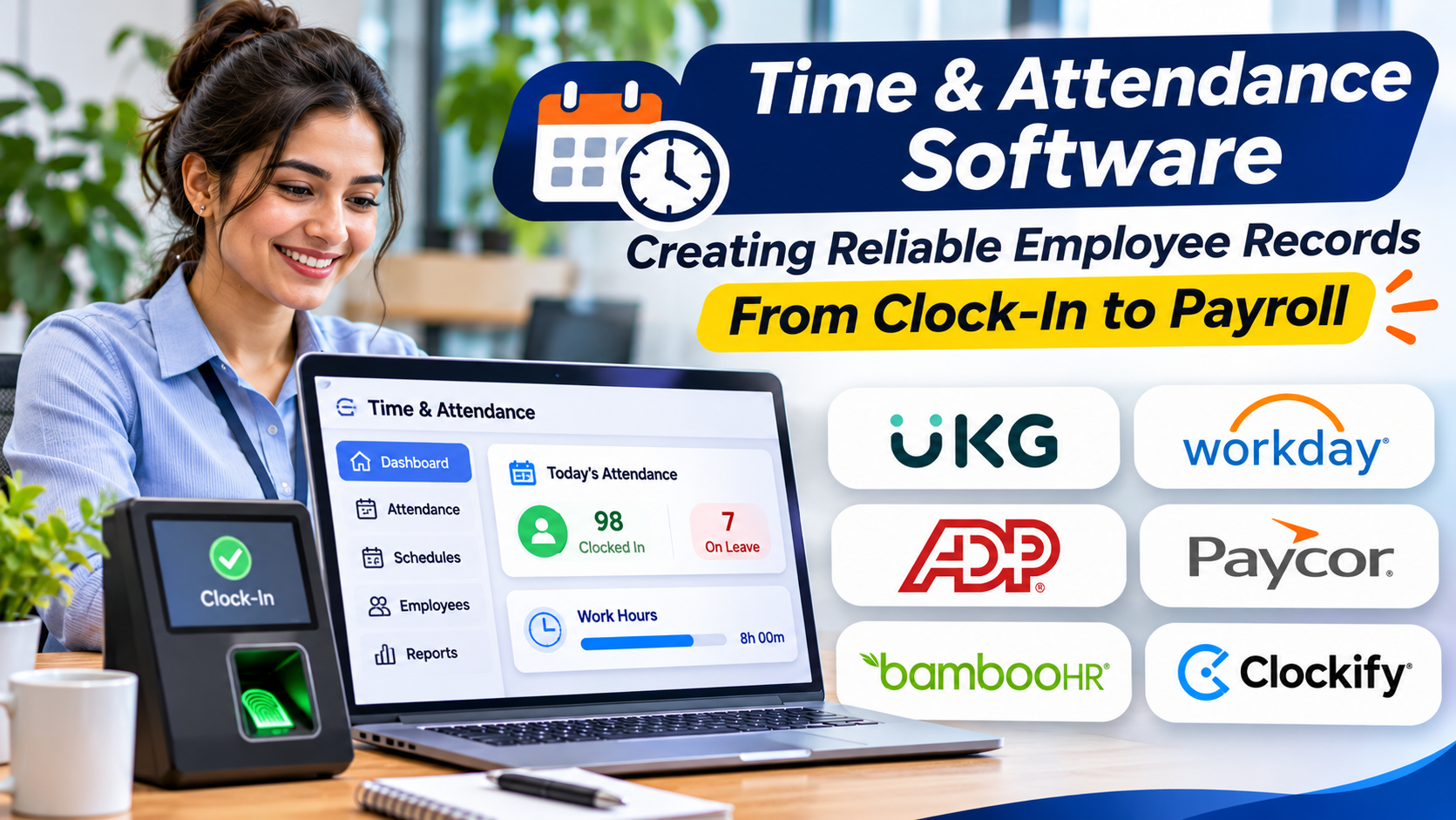
Employee attendance information affects far more than a daily register.
It influences payroll, overtime calculations, absence management, staffing coverage, and the organization’s ability to maintain accurate employment records.
When attendance is recorded through disconnected spreadsheets, paper registers, or unreliable devices, errors can move through several departments before anyone notices.
Time and attendance software helps establish a more consistent record of when employees work.
What Is Time and Attendance Software?
Time and attendance software records employee working time, attendance events, and related exceptions.
Common functions include clock-in and clock-out recording, shift comparisons, break tracking, absence information, and reporting.
Some systems connect directly with payroll or workforce management platforms.
Unlike project time tracking, which records time against tasks or clients, attendance software primarily establishes when employees were working and how those hours relate to organizational rules.
Common Attendance Recording Methods
Web and Mobile Clock-In
Employees record attendance through a browser or mobile application.
This can suit office, remote, and distributed teams, although organizations must consider device access and identity verification.
Physical Time Clocks
Shared terminals allow employees to record attendance at designated locations.
These may be useful in factories, warehouses, and other workplaces where employees do not routinely use computers.
Badge and Biometric Systems
Some organizations use identification cards or biometric technologies.
Biometric information requires particular care because it can create significant privacy, security, and legal obligations.
Organizations should assess whether less intrusive alternatives can meet their needs.
Time and Attendance Software Options
UKG
UKG provides workforce management solutions that include timekeeping capabilities.
Its offerings deserve consideration in organizations managing complex employee groups and scheduling rules.
QuickBooks Time
QuickBooks Time supports employee time recording and related workforce workflows.
It is relevant to businesses seeking connections between working-time records and accounting or payroll processes.
Jibble
Jibble focuses on time and attendance tracking, including mobile-oriented workflows.
It is worth considering for teams looking for relatively accessible attendance recording.
Connecteam
Connecteam provides employee management capabilities for deskless and operational teams, including time-related workflows.
Its broader employee operations approach may appeal to businesses managing staff across multiple locations.
Deputy
Deputy combines scheduling and timesheet-related functionality.
It is especially relevant when attendance records need to be compared with planned shifts.
What to Look for in Attendance Software
Accurate recording is the foundation, but several additional features influence usability.
A suitable system should make missed punches easy to identify, support authorized corrections, and preserve appropriate records of changes.
It should also handle overnight shifts, breaks, leave, holidays, and different employee categories.
Where payroll integration is required, test the actual transfer of approved hours rather than relying on a general integration claim.
Avoiding Payroll Errors
Attendance software does not automatically guarantee correct pay.
Payroll calculations may depend on employment contracts, local laws, overtime rules, allowances, and other factors.
Organizations should determine whether calculations occur inside the attendance system or the payroll platform.
They should also define how exceptions are approved and how corrections made after payroll processing are handled.
Privacy and Security Considerations
Attendance records reveal information about employee routines and locations.
Access should be restricted according to job responsibilities, and retention periods should reflect legitimate requirements.
Mobile location tracking and biometric collection deserve additional scrutiny.
Employees should understand what information is collected and why.
A Practical Implementation Approach
Begin by documenting current attendance policies and identifying recurring errors.
Configure a pilot involving different shift patterns and employee groups.
Test missed punches, overnight work, overtime, leave, and payroll exports.
Train employees and managers before replacing the existing process.
Finally, monitor correction rates and payroll discrepancies after implementation.
Final Thoughts
Time and attendance software is most useful when it produces dependable working-time records that employees and administrators can understand.
UKG, QuickBooks Time, Jibble, Connecteam, and Deputy offer different approaches to attendance and workforce operations.
The right choice depends on working patterns, payroll requirements, employee accessibility, and privacy expectations.
A reliable attendance process should make accurate recording easier—not introduce unnecessary complexity into everyday work.