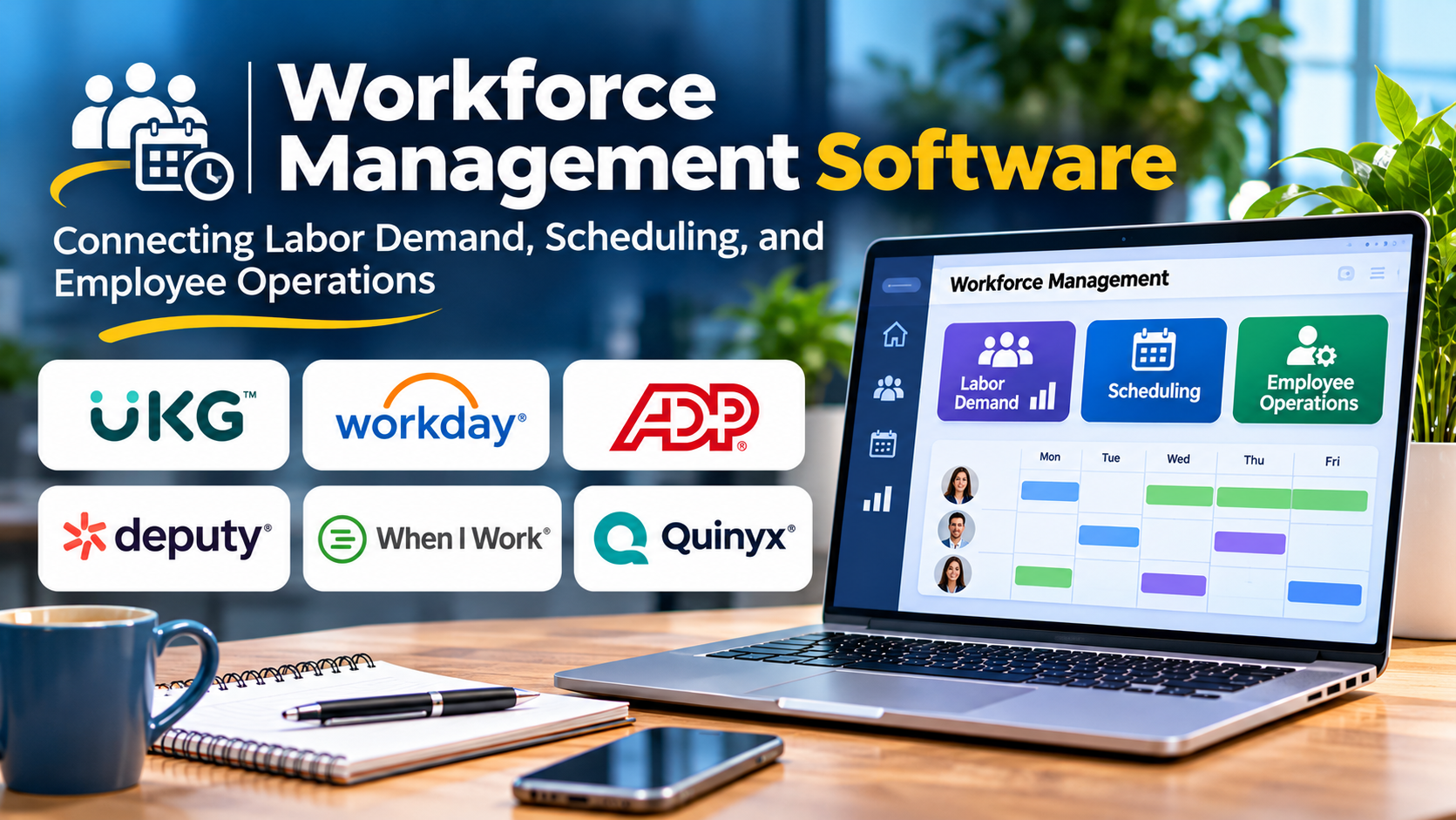
Workforce planning becomes complicated when staffing demand changes faster than managers can adjust schedules.
A retailer may need additional employees during busy periods. A healthcare organization must maintain appropriate staffing coverage. A contact center must balance customer demand with employee availability.
These organizations share a common challenge: having the right people available at the right time without creating unnecessary labor costs or unsustainable workloads.
Workforce management software helps coordinate those decisions.
What Is Workforce Management Software?
Workforce management software, often called WFM software, supports the planning, scheduling, tracking, and administration of employees.
Depending on the platform, capabilities may include demand forecasting, shift scheduling, attendance management, leave administration, labor analytics, and workforce compliance.
Workforce management is different from human capital management.
HCM covers a broader range of employee lifecycle activities, including recruitment, compensation, talent development, and HR administration. WFM concentrates more directly on operational staffing requirements.
How Workforce Management Systems Work
A typical workforce management process begins with an estimate of labor demand.
The system may use historical workloads, business forecasts, or operational requirements to support staffing plans.
Managers then create schedules based on employee availability, qualifications, contractual arrangements, and applicable rules.
Actual attendance information can subsequently be compared with planned schedules.
The resulting data helps organizations understand staffing gaps, overtime, and labor utilization.
Workforce Management Platforms to Consider
UKG
UKG provides workforce management and HR technology.
Its workforce management offerings are relevant to organizations with complex scheduling, timekeeping, and labor administration requirements.
Businesses should assess which UKG product fits their size, geography, and existing HR environment.
ADP
ADP offers payroll, HR, and workforce-related solutions.
Its ecosystem can be attractive when organizations want to connect time and attendance information with payroll administration.
Specific capabilities depend on the selected offering and location.
Dayforce
Dayforce combines workforce management with broader human capital management capabilities.
It is relevant to organizations seeking tighter connections between employee records, scheduling, time information, and payroll.
Quinyx
Quinyx focuses on workforce management for organizations with substantial frontline staffing requirements.
Its positioning makes it worth investigating for shift-intensive environments where scheduling and workforce engagement are closely connected.
Deputy
Deputy emphasizes employee scheduling, timesheets, and workforce operations.
It can be a practical candidate for businesses that need accessible scheduling and attendance workflows.
Features That Influence Operational Results
| Capability | Operational purpose |
|---|---|
| Demand forecasting | Estimate required staffing levels |
| Employee scheduling | Assign shifts based on availability |
| Time and attendance | Record actual working time |
| Leave management | Account for planned absences |
| Labor analytics | Understand staffing costs and patterns |
| Employee self-service | Support availability updates and shift requests |
| Rules configuration | Apply relevant scheduling and labor policies |
Not every organization needs sophisticated forecasting.
A small business with predictable shifts may benefit more from straightforward scheduling and attendance management.
The Importance of Forecasting Quality
Forecasting features deserve careful evaluation because inaccurate demand estimates can undermine the entire scheduling process.
Historical demand may not reflect future requirements during promotions, unusual events, or operational changes.
Managers should understand what inputs drive forecasts and how they can override assumptions when business conditions change.
A useful platform should support human judgment rather than treating automated forecasts as unquestionable instructions.
Balancing Efficiency and Employee Experience
Labor optimization should not focus exclusively on minimizing scheduled hours.
Unpredictable schedules can make employees’ personal lives difficult and may increase operational instability.
Organizations should consider advance notice, employee preferences, fairness, rest periods, and opportunities for schedule adjustments.
Workforce management systems can help expose these trade-offs, but organizational policy determines how they are handled.
Implementation Considerations
Before deployment, document scheduling rules, employee categories, locations, payroll periods, and approval responsibilities.
Test difficult scenarios such as overnight shifts, overtime, public holidays, unexpected absences, and transfers between locations.
Integrations also require attention. A scheduling system and payroll platform must agree on employee identifiers, working hours, and relevant pay codes.
Final Thoughts
Workforce management software can improve staffing visibility and reduce manual coordination, but its value depends on accurate operational data and practical scheduling rules.
UKG, ADP, Dayforce, Quinyx, and Deputy address different levels of workforce complexity.
The best solution is not necessarily the one with the most automation. It is the one that helps managers meet operational demand while maintaining accurate records and reasonable working conditions.