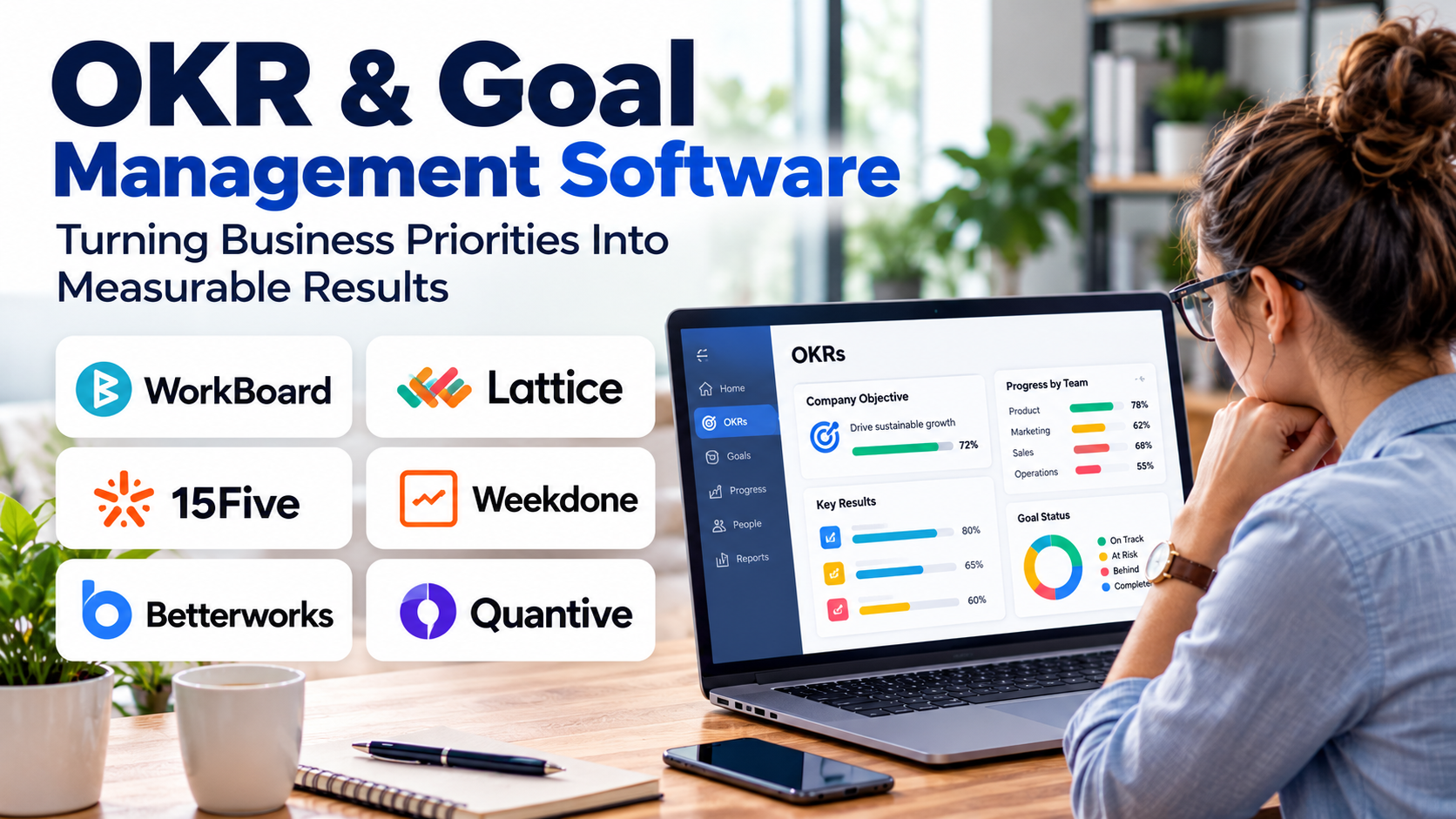
A company can have ambitious plans and still struggle to make progress. Teams may work hard, complete tasks, and meet deadlines without moving the business toward its most important goals.
OKR and goal management software helps solve this problem. It connects company priorities with team objectives, measurable results, and regular progress reviews.
The challenge is choosing a system that improves focus rather than creating another reporting burden.
What Is OKR & Goal Management Software?
OKR stands for Objectives and Key Results. An objective describes what an organization wants to achieve. Key results define how it will measure progress.
For example, a software company might set this objective:
Objective: Improve the customer onboarding experience.
Its key results could include:
- Reduce average onboarding time from 14 days to 7 days.
- Increase onboarding completion from 70% to 90%.
- Raise the percentage of new customers reaching their first successful outcome from 60% to 80%.
These results measure outcomes rather than activities.
OKR software provides a shared place to create objectives, assign ownership, track results, and review performance.
How OKRs Differ From Tasks and KPIs
These three concepts work together, but they serve different purposes.
| Concept | Main purpose | Example |
|---|---|---|
| Objective | Define a desired outcome | Improve customer retention |
| Key result | Measure progress toward the objective | Increase retention from 85% to 92% |
| KPI | Monitor ongoing performance | Monthly customer retention rate |
| Task | Describe work to complete | Launch a new onboarding checklist |
An organization might monitor a KPI for years while using a quarterly OKR to improve that metric.
Confusing tasks with key results is a common implementation problem. Completing a project does not automatically mean the project delivered its intended benefit.
OKR and Goal Management Platforms Worth Evaluating
Quantive StrategyAI
Quantive focuses on strategy execution, goal alignment, and organizational performance management.
It is worth evaluating when a company needs to connect strategic objectives with operational performance information.
The main consideration is implementation complexity. Organizations should determine whether they need a dedicated strategy execution environment or a simpler goal-tracking tool.
Betterworks
Betterworks combines goal management with performance-related workflows.
Its approach may suit organizations that want employees and managers to discuss objectives alongside continuous feedback and development.
Buyers should examine how the platform separates ambitious organizational goals from formal employee evaluations.
WorkBoard
WorkBoard focuses on enterprise OKR management and strategy execution.
It may be relevant to larger organizations coordinating objectives across departments and leadership teams.
Evaluation should include executive reporting, organizational alignment, administrative effort, and the process for maintaining accurate results.
Profit.co
Profit.co offers OKR management alongside related performance and execution workflows.
It is an option for organizations seeking structured goal-setting processes with supporting management capabilities.
Teams should test whether the available configuration supports their preferred review cadence without excessive administration.
Microsoft Viva Goals
Microsoft Viva Goals was an OKR management product, but Microsoft retired the service. It should not be treated as an active option for a new implementation.
Its retirement illustrates why product availability and migration planning matter when selecting strategic management software.
Essential Features to Evaluate
Goal alignment
A useful system should show how team objectives contribute to broader organizational priorities.
Alignment should not force every individual task into a complex hierarchy. The goal is to make meaningful relationships visible.
Measurable progress
Teams need clear starting values, targets, owners, and reporting periods.
Progress updates should distinguish actual measured results from subjective confidence ratings.
Integrations
Organizations may want to connect goals with project management, CRM, analytics, or HR systems.
An integration is valuable only when it reduces manual work and preserves reliable data.
Reporting and reviews
Managers should be able to identify stalled objectives, missing updates, and results requiring intervention.
Dashboards must support decisions, not simply display attractive progress indicators.
Access controls
Sensitive organizational objectives may require restricted visibility.
Evaluate administrative permissions, identity management, audit capabilities, and data export options.
A Practical Implementation Approach
Begin with a small number of important objectives.
For each objective, define two to four measurable key results. Assign an accountable owner and document how each result will be measured.
Run a pilot with one department or cross-functional initiative.
During the pilot, assess whether employees understand the objectives, whether updates are accurate, and whether review meetings produce useful decisions.
Expand only after the process works.
Common Mistakes to Avoid
Tracking too many objectives: Excessive goals weaken prioritization.
Treating OKRs as task lists: Activity is not the same as measurable improvement.
Using every OKR as an employee rating: This can discourage ambitious goals and transparent reporting.
Automating poor data: Connected dashboards cannot fix unreliable source information.
Skipping regular reviews: Goals lose value when nobody uses them to guide decisions.
How to Choose the Right Platform
Smaller organizations may prefer straightforward goal tracking with minimal setup.
Growing companies may benefit from structured ownership, alignment, and reporting.
Large enterprises may require more advanced governance, cross-department visibility, and strategy execution capabilities.
Before purchasing, ask vendors to demonstrate a complete workflow using realistic organizational objectives.
Final Thoughts
Effective OKR management begins with clear priorities and measurable outcomes.
Software supports that process by making ownership, progress, and dependencies visible.
The best platform is the one employees can use consistently to make better decisions, not the one with the largest collection of features.