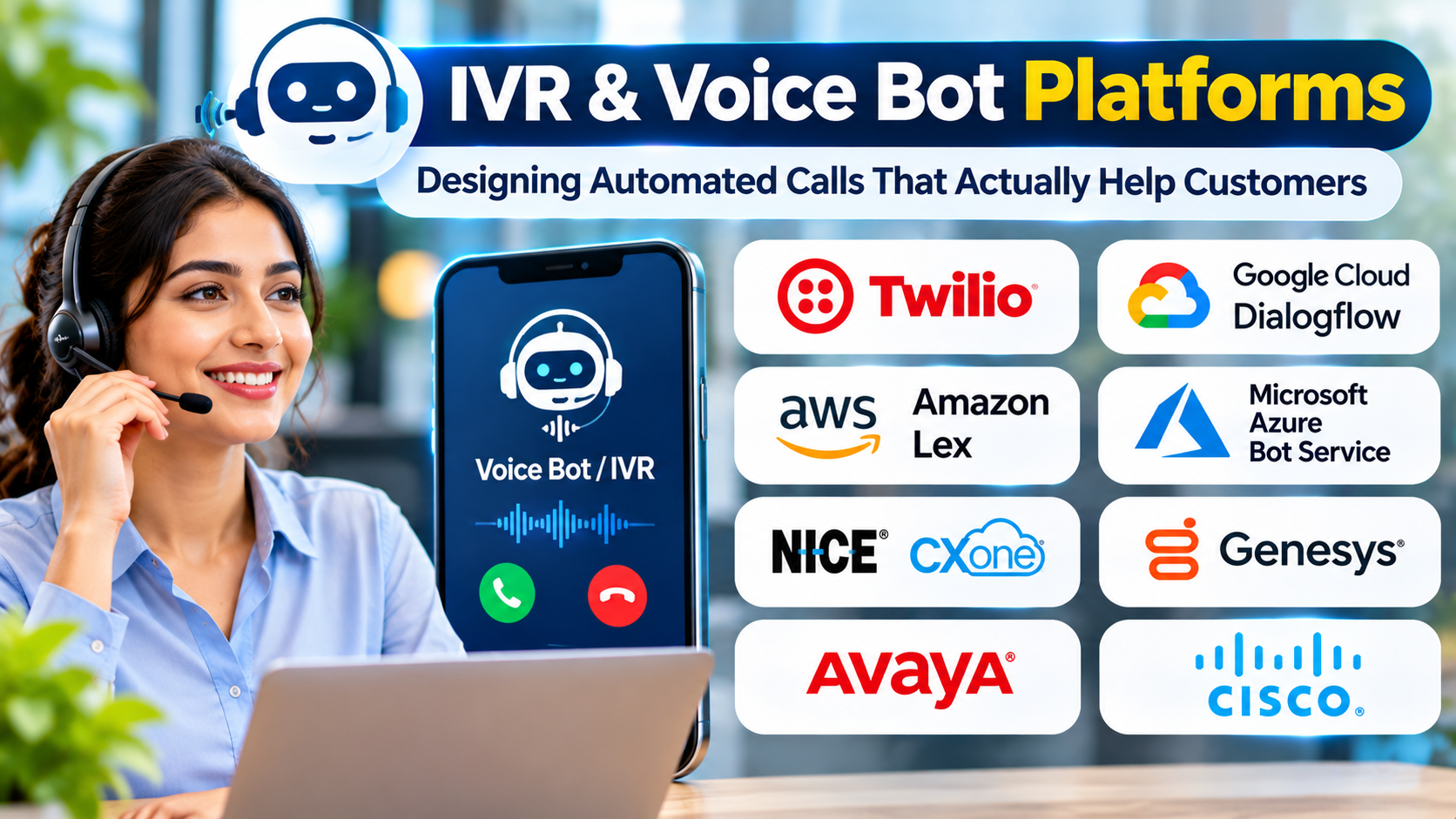
Few customer experiences are more frustrating than navigating a telephone menu that never reaches the right department.
Interactive voice response systems were created to organize incoming calls and reduce repetitive work. Modern voice bots extend that idea by allowing customers to speak naturally instead of selecting numbered menu options.
Yet better technology does not automatically produce better conversations.
The success of an IVR or voice bot depends on how well it understands customer needs, handles exceptions, and transfers difficult requests to people.
What Are IVR and Voice Bot Platforms?
Interactive Voice Response, or IVR, is technology that interacts with callers through telephone menus, keypad input, and sometimes speech recognition.
A traditional IVR might ask customers to press one for billing or two for technical support.
A voice bot uses speech technologies and conversational software to interpret spoken requests and provide automated responses.
Modern systems may combine:
- Automatic speech recognition
- Natural language understanding
- Text-to-speech generation
- Conversation management
- Business application integrations
- Customer authentication
- Call routing
- Analytics and monitoring
- Human-agent escalation
The distinction matters because a voice bot is not simply an IVR with a more natural-sounding voice.
It must also manage conversation context and uncertainty.
Traditional IVR Versus Conversational Voice Bots
Traditional IVR systems work best when customer requests are predictable.
Checking business hours, choosing a department, or entering an account number may require only a simple menu.
Voice bots become more useful when customers describe requests in different ways.
For example, a customer might say:
“I need to change the delivery address for my order.”
A conversational system can attempt to identify the request, verify relevant information, and guide the next step.
However, speech recognition errors, accents, background noise, and unexpected requests can affect performance.
The correct approach is not always to replace IVR menus with artificial intelligence.
Sometimes a simple menu is faster and more reliable.
Platforms to Consider
Amazon Connect
Amazon Connect provides cloud contact center services and supports conversational experiences through AWS services such as Amazon Lex.
It is relevant to organizations building voice workflows within the AWS ecosystem.
The main consideration is the technical effort required to design, integrate, and maintain the experience.
Google Cloud Dialogflow CX
Dialogflow CX supports conversational agent development with structured conversation flows.
It can be used to build voice experiences connected to telephony and contact center systems.
Organizations should assess integration architecture, usage costs, and conversation testing requirements.
Twilio
Twilio provides programmable communications services that developers can use to build voice applications.
Its voice APIs and related services support custom call flows and integrations.
Twilio can be attractive when an organization wants detailed control over its communications architecture.
That flexibility also creates development and operational responsibilities.
Genesys Cloud CX
Genesys Cloud CX supports voice interaction workflows within a broader contact center environment.
It is worth considering when automation must connect with agent routing, customer context, and enterprise contact center operations.
NICE CXone
NICE CXone provides customer experience capabilities that can support automated interactions and agent-assisted service.
It is particularly relevant when organizations want automation integrated with contact center management.
Cognigy
Cognigy focuses on conversational AI and customer service automation.
It is relevant to businesses evaluating sophisticated voice and digital conversation workflows.
Buyers should verify integration, deployment, governance, and language requirements against their own environment.
The Most Important Design Decision: When Should Automation Stop?
Many organizations measure voice automation by containment rate.
Containment measures how often a conversation remains within automation rather than reaching an agent.
But high containment does not always indicate success.
A customer who abandons a confusing conversation may count differently across reporting systems, even though the experience failed.
Better measures include:
- Successful task completion
- Customer effort
- Repeat contact rate
- Transfer accuracy
- Authentication success
- Conversation abandonment
- Time to resolution
- Customer satisfaction
A voice bot should transfer a conversation when it cannot reliably complete the task.
Human escalation is a feature of a good automation system, not evidence of failure.
Essential Features to Evaluate
Speech Recognition
Test the system with actual customer accents, speaking speeds, and environmental conditions.
A demonstration recorded in a quiet room is not enough.
Conversation Management
The platform should maintain relevant context across multiple turns.
Customers should not have to repeat information unnecessarily.
Integration Capabilities
A useful voice bot often needs access to order systems, account information, appointment scheduling, or support records.
Integrations must use appropriate authentication and access controls.
Multilingual Support
Language availability does not guarantee equal recognition quality.
Test each required language using realistic conversations.
Privacy and Security
Voice interactions can contain sensitive personal information.
Review recording controls, data retention, encryption, access permissions, and vendor data-processing practices.
Human Handoff
Agents should receive useful conversation context when a caller is transferred.
Otherwise, customers may have to repeat the entire request.
How to Implement a Voice Bot Successfully
Begin with a narrow use case.
Appointment confirmations, order status checks, and straightforward account inquiries may be suitable starting points.
Document the complete customer journey, including unexpected responses.
Build clear recovery paths for misunderstood speech and missing information.
Test with diverse callers rather than relying entirely on scripted internal demonstrations.
Launch gradually and monitor unsuccessful conversations.
Use real interaction patterns to improve prompts, routing, and system integrations.
Common Mistakes
One common mistake is introducing conversational AI without defining the tasks it should complete.
Another is creating long automated conversations when a direct transfer would be faster.
Organizations also underestimate the effort required to maintain integrations and update business information.
Finally, some teams evaluate automation solely through labor savings.
Customer experience and task completion deserve equal attention.
Frequently Asked Questions
Can a voice bot replace an IVR?
A voice bot can replace or supplement some IVR functions, but traditional menus may remain useful for simple routing.
Do voice bots require AI?
Conversational voice bots commonly use speech recognition and language-processing technologies. Traditional IVR systems do not necessarily require conversational AI.
Can voice bots transfer calls to human agents?
Many platforms support transfers, although the quality of context sharing varies.
What is the best first use case?
A repetitive, well-defined task with clear success conditions is usually a practical starting point.
Final Thoughts
The purpose of voice automation is not to prevent customers from speaking to people.
It is to resolve straightforward requests quickly and connect complex problems with the right support.
Organizations should evaluate IVR and voice bot platforms according to customer outcomes, integration reliability, and their ability to handle uncertainty.
The strongest automated calling experiences make technology almost invisible to the customer.