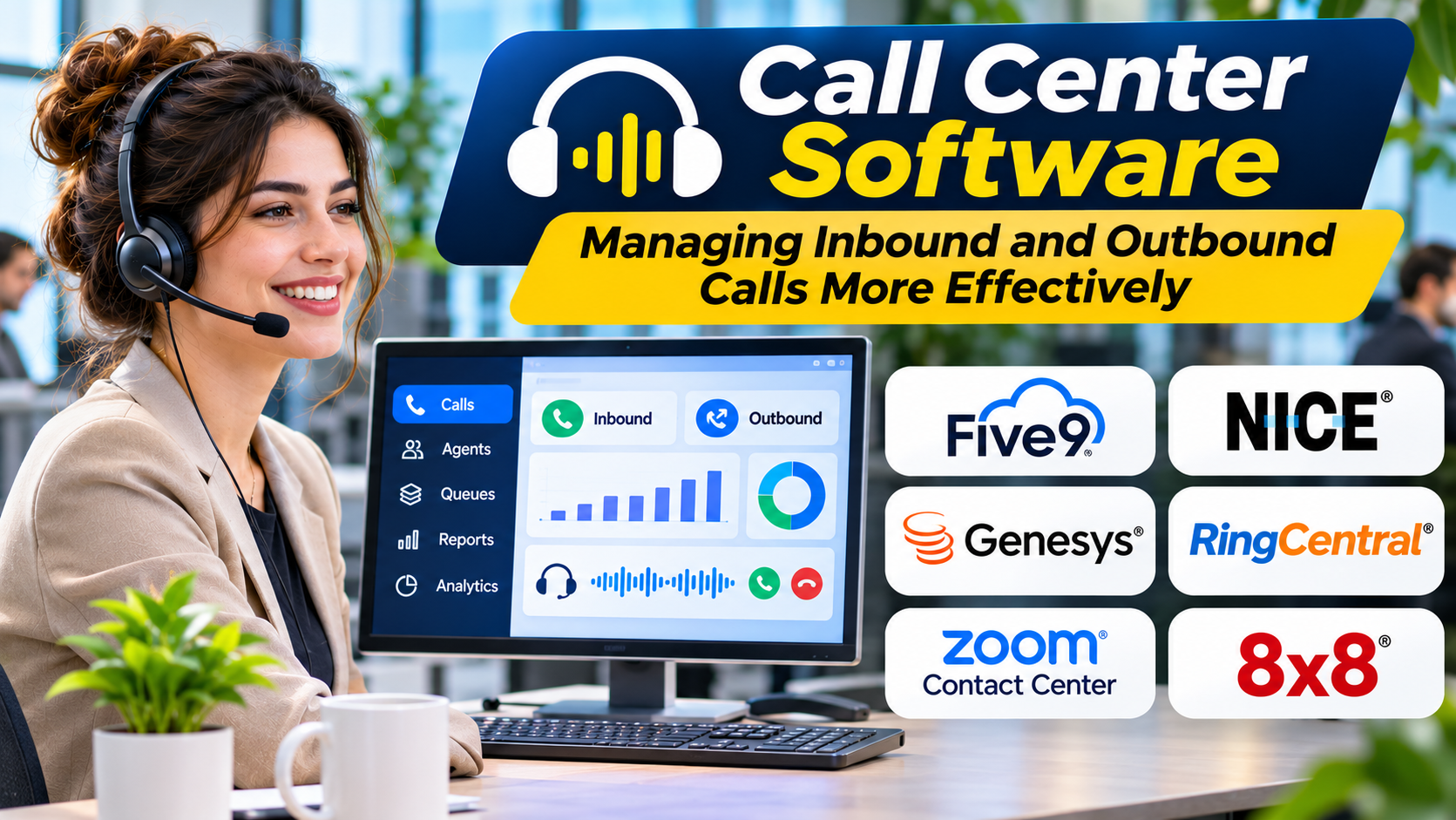
Telephone conversations remain essential for many customer-facing businesses.
Support teams handle urgent problems. Sales representatives contact potential customers. Service departments manage appointments, billing questions, and account requests.
Without the right systems, managing these calls can become difficult.
Call center software helps organizations organize telephone interactions, distribute workloads, and monitor operational performance.
The best choice depends on call volume, business objectives, staffing, and the level of automation required.
What Is Call Center Software?
Call center software is technology used to manage inbound and outbound telephone operations.
It helps businesses route calls, connect customers with agents, manage queues, and maintain relevant interaction records.
Some systems focus on basic calling and call distribution.
Others provide advanced capabilities for workforce management, quality assurance, analytics, and automated dialing.
Modern call center products may also support additional digital channels, although voice remains the central focus.
Inbound vs. Outbound Call Centers
Inbound call centers
Inbound teams respond to calls initiated by customers.
Common use cases include technical support, customer service, appointment scheduling, and account assistance.
Important capabilities include call routing, queues, interactive voice response, and customer history.
Outbound call centers
Outbound teams initiate calls for activities such as sales outreach, customer follow-up, surveys, and appointment reminders.
These operations may require campaign management, dialing tools, and outcome tracking.
Outbound calling must follow applicable consent, privacy, and telecommunications regulations.
Blended call centers
Blended operations handle both inbound and outbound calls.
These environments need careful workload management so outbound activity does not interfere with incoming customer service.
Call Center Software Worth Evaluating
Aircall
Aircall provides cloud-based business calling and call management capabilities.
It may suit teams seeking straightforward call workflows and integrations with business applications.
CloudTalk
CloudTalk offers cloud calling and call center-related capabilities.
It is relevant to businesses managing customer service or sales calling workflows.
Dialpad
Dialpad provides cloud communications and customer interaction products.
Organizations should evaluate the specific calling or contact center offering that matches their operational needs.
Five9
Five9 offers cloud contact center capabilities that include voice operations and related management tools.
It may be relevant to organizations requiring more advanced call handling and operational controls.
RingCentral
RingCentral provides business communications and contact center-related offerings.
Buyers should distinguish between its business phone services and dedicated contact center capabilities.
3CX
3CX provides a software-based phone system with call handling capabilities.
It may suit organizations seeking configurable telephony infrastructure.
Businesses requiring sophisticated workforce management or large-scale outbound campaigns should evaluate those needs separately.
Essential Call Center Features
Automatic Call Distribution
Automatic Call Distribution, or ACD, routes incoming calls according to configured rules.
Routing may consider agent availability, queues, or other operational criteria.
Interactive Voice Response
IVR allows callers to interact with automated menus.
A well-designed IVR helps customers reach the right destination without unnecessary steps.
Call recording
Recording can support quality assurance, training, and dispute review.
Organizations must apply appropriate consent, access, and retention policies.
Call monitoring
Supervisors may need tools to review service quality and support agents.
Monitoring practices should be transparent and consistent with applicable laws.
CRM integration
CRM integration helps agents access relevant customer information during conversations.
It can reduce repeated questions and improve continuity.
Reporting
Call reports help managers understand demand, staffing requirements, and operational performance.
How to Evaluate Call Center Software
| Requirement | What to examine |
|---|---|
| Call routing | Queue and distribution flexibility |
| Agent experience | Ease of handling calls and customer records |
| Reliability | Service continuity and recovery options |
| Reporting | Accuracy and operational usefulness |
| Integrations | CRM and business application compatibility |
| Security | Access controls and data protection |
| Cost | Licensing, calling charges, and add-ons |
Important Call Center Metrics
Average Handle Time
Average Handle Time measures the time agents spend handling interactions, including relevant follow-up work.
It helps with capacity planning but should not become the only measure of agent performance.
First Call Resolution
First Call Resolution measures whether customer issues are resolved without additional calls, according to the organization’s defined measurement method.
It can provide useful insight into service effectiveness.
Abandonment Rate
Abandonment rate measures the proportion of callers who disconnect before receiving the intended service.
Interpretation depends on queue design and how short abandoned calls are handled.
Service Level
Service level measures performance against a defined response target.
For example, an organization may aim to answer a specified percentage of calls within a particular period.
Targets should reflect customer expectations and operational realities.
Understanding Call Center Costs
Total cost may include software subscriptions, telephone usage, numbers, implementation, integrations, recording storage, and support.
Some platforms charge per user, while others include usage-based components.
Outbound operations may introduce additional dialing and campaign management expenses.
Compare providers using realistic monthly call volumes and staffing requirements.
How to Improve Call Center Operations
Start by reviewing why customers call.
Identify recurring issues that could be resolved through clearer information or improved business processes.
Configure routing to reduce unnecessary transfers.
Provide agents with accessible knowledge and customer context.
Use quality reviews to identify training opportunities.
Monitor performance without encouraging employees to rush customers through conversations.
Common Mistakes to Avoid
Choosing a platform based only on dialing features can overlook customer service requirements.
Poor IVR design can frustrate callers.
Excessive automation may make it difficult to reach human assistance.
Unclear performance targets can encourage speed at the expense of resolution quality.
Insufficient network planning can reduce voice reliability.
Call Center Software vs. Contact Center Platforms
Call center software is generally the more appropriate category when telephone operations are the main requirement.
Contact center platforms become more relevant when businesses need coordinated customer interactions across voice, email, chat, and other channels.
The categories overlap, so organizations should compare actual capabilities rather than relying only on vendor terminology.
Final Thoughts
Call center software can help organizations handle calls more efficiently while improving visibility into customer service operations.
The most effective system supports reliable routing, useful customer information, clear reporting, and manageable administration.
Choose a platform that helps agents solve customer problems effectively while supporting the organization’s operational goals.