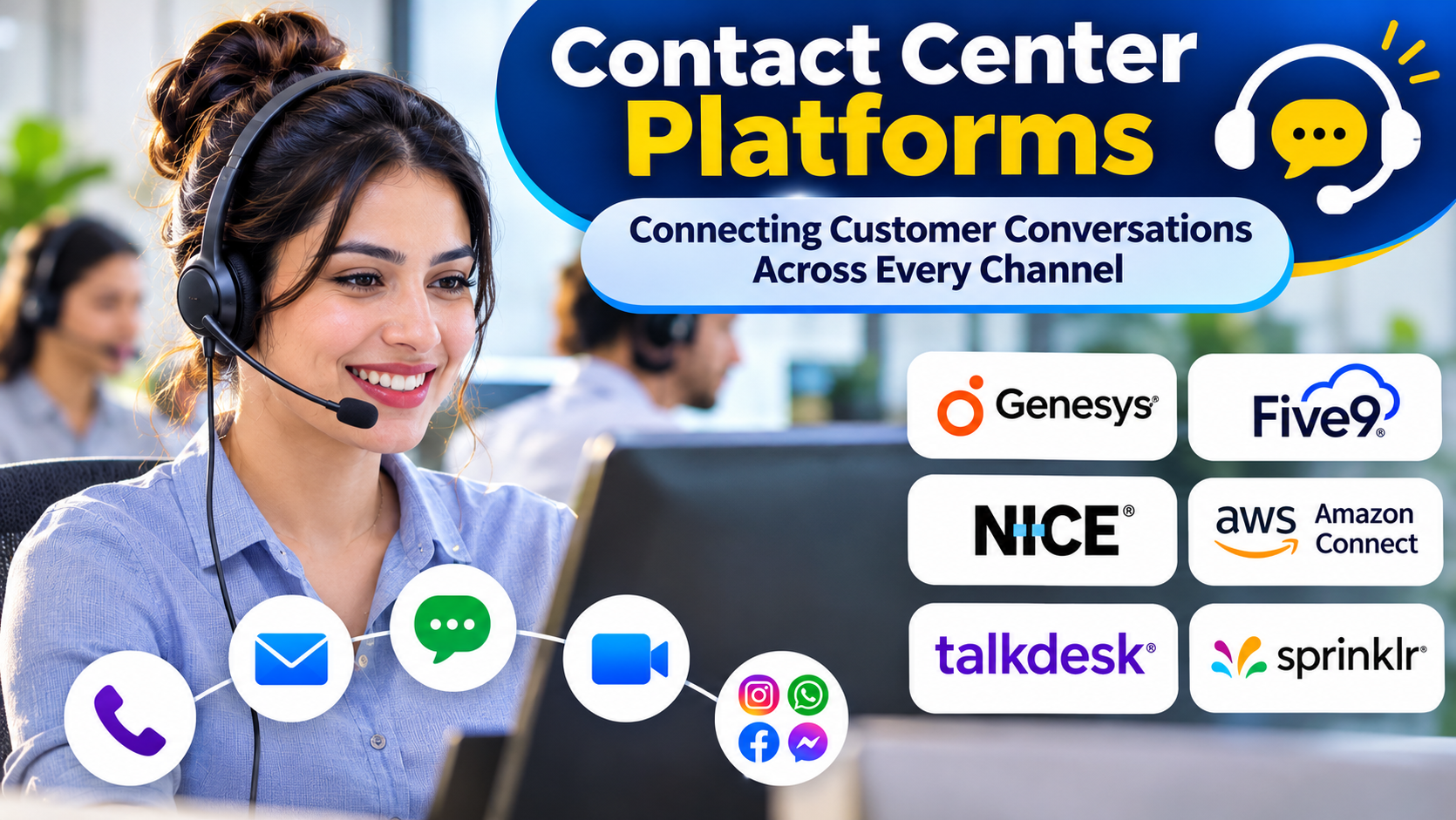
Customers rarely communicate with businesses through only one channel.
A customer may begin with a website message, continue through email, and eventually call for assistance.
When these interactions are disconnected, support representatives may lack the information needed to resolve the issue efficiently.
Contact center platforms help organizations coordinate customer conversations, route work, and manage service operations across supported channels.
The right platform should improve the customer experience while giving employees the information and tools they need.
What Is a Contact Center Platform?
A contact center platform is software used to manage customer interactions across communication channels.
Depending on the product, these channels may include voice, email, chat, SMS, and social messaging.
Contact center platforms typically combine interaction routing, agent workspaces, reporting, and administrative controls.
More advanced systems may support workforce management, quality assurance, automation, and customer journey analysis.
Contact Center vs. Call Center
A call center primarily focuses on telephone interactions.
A contact center supports a broader range of communication channels.
The categories overlap because many modern call center products have expanded beyond voice.
The important distinction is not the product label. It is whether the system supports the communication workflows an organization needs.
Understanding CCaaS
Contact Center as a Service, or CCaaS, refers to cloud-delivered contact center capabilities.
Organizations generally subscribe to the service rather than managing all contact center infrastructure themselves.
CCaaS can reduce certain infrastructure responsibilities and support distributed operations.
However, businesses must still manage integrations, security, operational policies, and employee training.
Contact Center Platforms Worth Evaluating
Genesys Cloud CX
Genesys Cloud CX provides cloud contact center capabilities for managing customer interactions and service operations.
It is relevant to organizations requiring sophisticated routing and customer engagement workflows.
NICE CXone
NICE CXone offers cloud contact center capabilities, including customer interaction management and related operational tools.
It may suit organizations with substantial contact center management requirements.
Five9
Five9 provides cloud contact center software for customer service and sales-related interactions.
Organizations should evaluate its routing, agent workflows, integrations, and operational capabilities.
Amazon Connect
Amazon Connect is a cloud contact center service from AWS.
It may be relevant to organizations seeking configurable contact center capabilities within an AWS-oriented technical environment.
Buyers should carefully assess implementation expertise, usage-based costs, and integration requirements.
Talkdesk
Talkdesk provides cloud contact center software with customer service and automation capabilities.
It is worth evaluating for organizations seeking a unified environment for customer interactions.
Cisco Webex Contact Center
Webex Contact Center provides cloud contact center capabilities within Cisco’s broader communications portfolio.
It may be relevant to businesses with existing Cisco collaboration or communications investments.
Essential Contact Center Features
| Feature | Main purpose |
|---|---|
| Omnichannel routing | Directs interactions across supported channels |
| Agent workspace | Consolidates customer interaction information |
| Interactive voice response | Helps callers navigate automated menus |
| Workforce management | Supports staffing and scheduling |
| Quality management | Helps evaluate service interactions |
| Analytics | Measures operational performance |
| Automation | Handles suitable repetitive activities |
| CRM integration | Connects interactions with customer records |
Why Omnichannel Support Matters
Simply offering multiple channels does not create an omnichannel experience.
A customer should not have to repeat the same information every time they switch channels.
Effective omnichannel operations require shared customer context, reliable interaction history, and coordinated routing.
Organizations should test complete customer journeys rather than individual channels in isolation.
Automation and AI in Contact Centers
Automation can assist with routine questions, information collection, call summaries, and interaction routing.
AI-supported tools may also help agents locate relevant knowledge.
However, automated systems can produce incorrect responses or misinterpret customer requests.
Businesses should establish monitoring, escalation, and human review procedures.
High-impact decisions should receive appropriate oversight.
Evaluating Contact Center Performance
Useful metrics include:
- First contact resolution.
- Average speed of answer.
- Customer satisfaction.
- Abandonment rate.
- Service level performance.
- Agent occupancy.
- Quality evaluation results.
These metrics require context.
For example, reducing average handling time may not improve service if customers must contact the business repeatedly.
Security and Compliance
Contact centers frequently process personal and commercially sensitive information.
Organizations should evaluate access controls, encryption, recording policies, data retention, and integration security.
Payment information and regulated customer data may introduce additional requirements.
Compliance capabilities should be verified against the organization’s actual obligations.
A Practical Implementation Plan
Document existing customer journeys and communication channels.
Identify routing requirements and important integrations.
Configure representative workflows and test them with real operational scenarios.
Train agents and supervisors before rollout.
Monitor service quality after deployment and adjust workflows based on observed problems.
Final Thoughts
Contact center platforms can improve customer service by connecting communication channels, employees, and customer information.
The strongest implementations focus on effective resolution rather than simply increasing automation.
Choose a platform that supports the complexity of your customer operations without introducing unnecessary administrative burden.