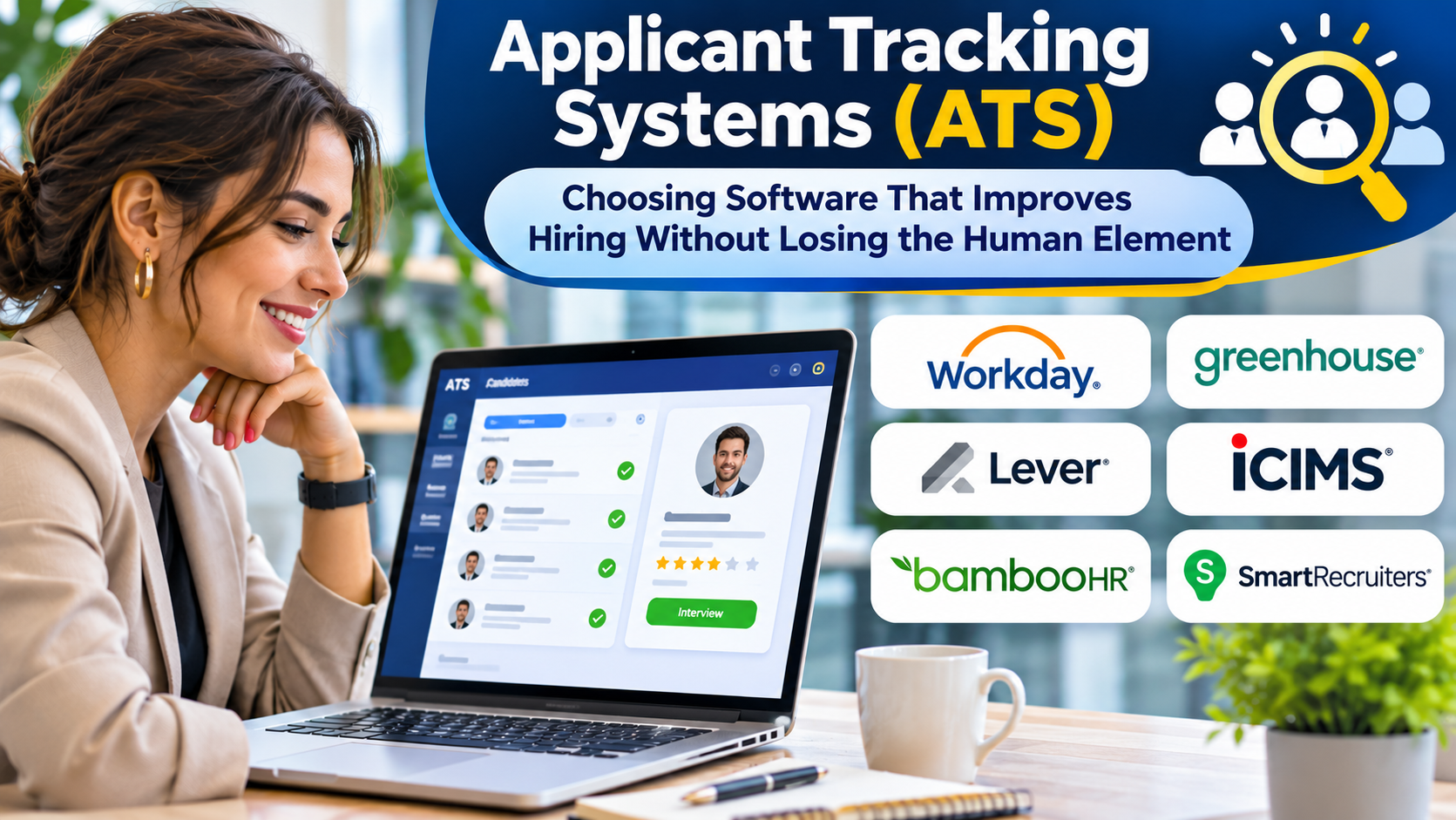
Recruitment becomes difficult to coordinate when candidate information is scattered across email inboxes, spreadsheets, job boards, and interview notes.
A promising applicant may wait too long for a response. Hiring managers may evaluate candidates using different criteria. Recruiters may struggle to understand which vacancies require attention.
Applicant tracking systems help organize these activities into a more consistent hiring process.
However, choosing an ATS requires more than comparing automation features. The software should improve hiring coordination while supporting fair, transparent candidate evaluation.
What Is an Applicant Tracking System?
An applicant tracking system is recruitment software used to manage job applications and coordinate candidates through the hiring process.
Typical capabilities include job posting, application collection, candidate records, interview scheduling, evaluation workflows, communication, and recruitment reporting.
An ATS differs from a general recruiting platform because it primarily manages the application and hiring workflow.
Recruiting platforms may also emphasize candidate sourcing, talent relationships, and recruitment marketing.
How an ATS Supports Recruitment
A typical hiring process begins when a vacancy is approved.
Recruiters publish the position and receive applications through a careers page or connected channels.
Candidates then move through stages such as initial review, screening, interviews, references, and offers.
The ATS provides a shared record of these activities.
This visibility helps reduce duplicated work and makes responsibilities clearer.
Applicant Tracking Systems Worth Evaluating
Greenhouse
Greenhouse provides recruiting software with an emphasis on structured hiring workflows.
It is relevant to organizations seeking consistent interview processes and coordinated candidate evaluation.
Lever
Lever combines applicant tracking with recruitment relationship management capabilities.
It is worth considering when teams want to coordinate active applications and broader candidate engagement.
Ashby
Ashby provides recruiting software covering applicant tracking and related hiring operations.
Its approach deserves attention from organizations that value integrated recruitment workflows and reporting.
Workable
Workable offers recruiting and hiring software for organizations managing job applications and candidate workflows.
It is a candidate for businesses seeking a relatively unified hiring environment.
SmartRecruiters
SmartRecruiters provides talent acquisition technology for organizations with varied recruiting requirements.
Businesses should assess its workflow flexibility, integration needs, and implementation scope.
Zoho Recruit
Zoho Recruit supports applicant tracking and recruitment management.
It may be relevant to organizations already using Zoho applications or managing recruitment agency workflows.
What Matters Most in ATS Selection?
| Requirement | What to test |
|---|---|
| Application experience | Ease of applying from mobile and desktop |
| Workflow configuration | Support for different hiring processes |
| Interview coordination | Scheduling and feedback collection |
| Candidate communication | Clear, timely status updates |
| Evaluation consistency | Structured criteria and scorecards |
| Integrations | HRIS, calendars, and recruitment channels |
| Reporting | Hiring stages, delays, and process effectiveness |
| Privacy | Candidate access, retention, and deletion controls |
Avoiding Overreliance on Automated Screening
Some recruitment products provide automated matching, scoring, or AI-assisted features.
These capabilities require careful evaluation.
An automated score may reflect assumptions about candidate suitability that are difficult to explain or validate.
Organizations should examine the information used, the relevance of evaluation criteria, and the possibility of discriminatory outcomes.
Human oversight remains important, especially where automated recommendations influence employment decisions.
Candidate Experience Is a Business Requirement
An ATS should make the application process straightforward.
Long forms, repeated information requests, inaccessible interfaces, and unclear communication can discourage applicants.
During evaluation, test the application journey as an actual candidate.
Complete the process on a mobile device and examine confirmation messages, scheduling interactions, and accessibility.
The candidate-facing experience deserves as much attention as the recruiter dashboard.
Implementing an ATS Successfully
Begin by defining hiring stages and approval responsibilities.
Standardize job requirements and evaluation criteria where appropriate.
Train recruiters and hiring managers on candidate feedback, data handling, and communication expectations.
Avoid creating unnecessary approval stages that slow decisions without improving quality.
After implementation, review process bottlenecks and candidate feedback rather than focusing exclusively on the number of applications received.
Final Thoughts
Applicant tracking systems can improve recruitment coordination, consistency, and visibility.
Greenhouse, Lever, Ashby, Workable, SmartRecruiters, and Zoho Recruit offer different approaches to hiring operations.
The best ATS should support the organization’s recruitment process without making applicants feel like records moving through a database.
Effective hiring technology creates more time for thoughtful evaluation and meaningful human interaction.