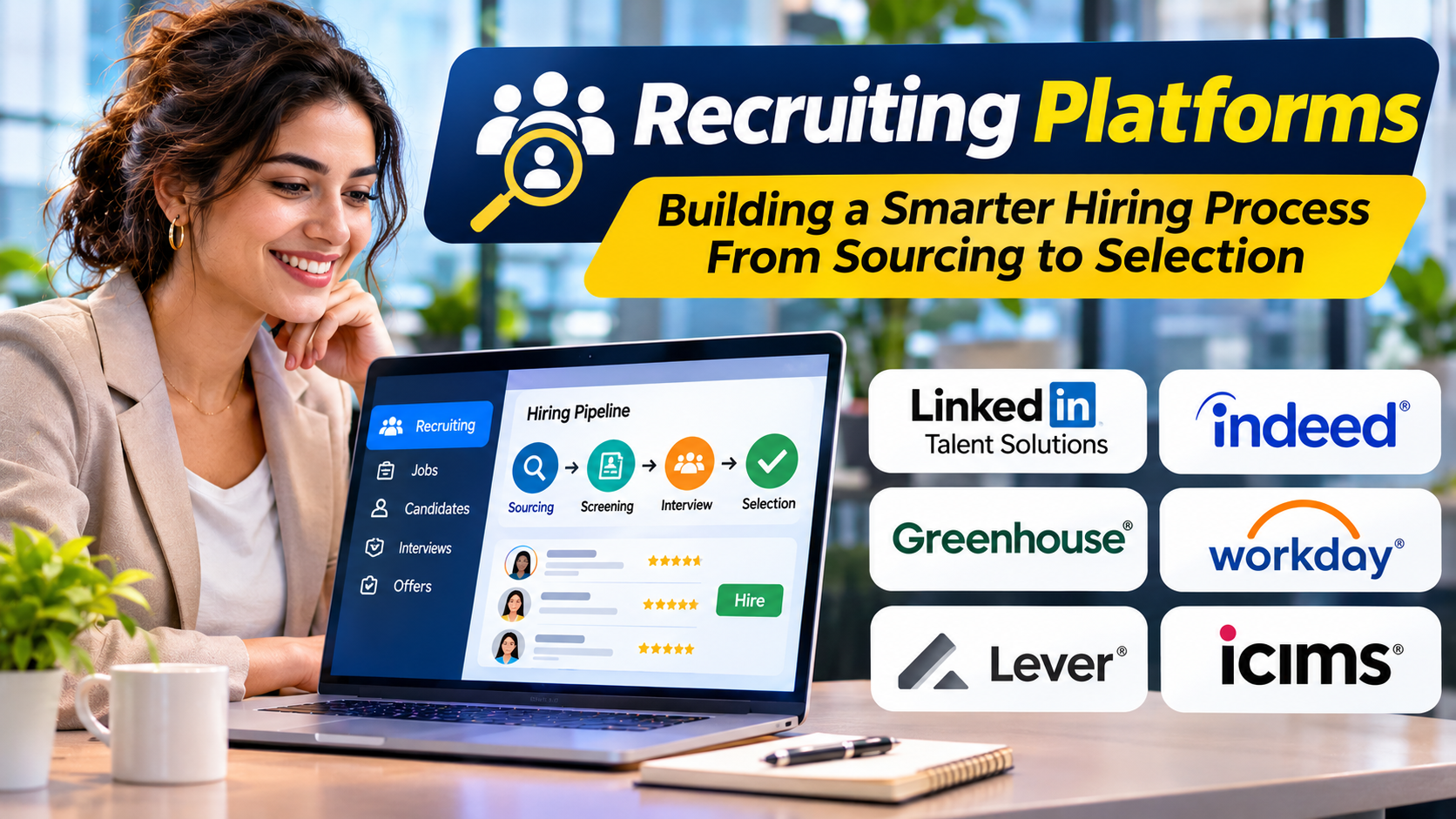
Finding qualified candidates is only one part of successful recruitment.
Organizations must also communicate with potential applicants, coordinate hiring teams, evaluate candidates consistently, and maintain relationships with people who may be suitable for future roles.
Recruiting platforms help connect these activities.
However, the recruitment technology market includes several different product categories. Understanding their differences is essential before selecting software.
What Are Recruiting Platforms?
Recruiting platforms are software systems that support the process of attracting, identifying, engaging, and hiring candidates.
Some focus on job advertising and candidate discovery. Others provide applicant tracking, talent relationship management, recruitment marketing, or end-to-end hiring workflows.
A recruiting platform may therefore be a specialist sourcing tool, a comprehensive talent acquisition suite, or a combination of several applications.
The Recruiting Technology Landscape
Candidate Sourcing Platforms
These tools help recruiters discover and approach potential candidates.
They are especially relevant when suitable applicants are unlikely to respond to conventional job advertisements.
Applicant Tracking Systems
ATS platforms organize applications and hiring workflows.
Their main purpose is to manage candidates who have entered a recruitment process.
Recruitment CRM Software
Candidate relationship management tools help organizations maintain contact with prospective candidates over time.
This can be valuable for recurring hiring requirements and specialized talent markets.
Recruitment Marketing Platforms
These systems support employer branding, recruitment campaigns, and candidate engagement.
Their value depends on how effectively organizations can connect marketing activity with actual hiring outcomes.
Recruiting Platforms to Consider
LinkedIn Talent Solutions
LinkedIn Talent Solutions provides recruiting products associated with professional networking and talent discovery.
It is relevant to organizations that need access to professional profiles and candidate sourcing workflows.
Indeed
Indeed provides job advertising and employer recruitment services.
It is useful to evaluate when attracting active job seekers is a central recruitment requirement.
Greenhouse
Greenhouse focuses on structured recruitment workflows and candidate management.
It deserves consideration when organizations need coordinated evaluation and hiring processes.
Lever
Lever combines applicant tracking with candidate relationship management.
Its approach is relevant to teams managing both current applicants and prospective candidates.
SmartRecruiters
SmartRecruiters provides talent acquisition software for managing recruitment operations.
Organizations should examine its workflow flexibility and integration requirements.
Gem
Gem offers recruiting technology associated with sourcing, candidate engagement, and talent acquisition workflows.
It is worth investigating when proactive recruitment and candidate relationship management are important.
How to Choose the Right Recruiting Platform
The first step is identifying where recruitment currently breaks down.
If the organization receives too few qualified applications, job advertising and sourcing capabilities may deserve priority.
If recruiters struggle to coordinate interviews, applicant tracking and workflow automation may provide greater value.
If candidates frequently disengage, communication and relationship management should receive attention.
| Recruitment problem | Technology priority |
|---|---|
| Limited candidate reach | Sourcing and job distribution |
| Disorganized applications | Applicant tracking |
| Slow interview coordination | Scheduling and workflow management |
| Weak candidate engagement | Recruitment CRM |
| Inconsistent hiring decisions | Structured evaluation |
| Poor recruitment visibility | Reporting and analytics |
Measuring Recruitment Effectiveness
Recruitment success should not be measured solely by application volume.
Useful indicators include qualified candidate conversion, time spent in hiring stages, candidate withdrawal, offer acceptance, and the effectiveness of different recruitment channels.
Hiring quality is more difficult to measure because performance depends on many factors beyond recruitment.
Organizations should avoid treating simplistic scores as definitive evidence of candidate quality.
Responsible Use of AI in Recruitment
AI-assisted recruiting features may support drafting, search, communication, and administrative tasks.
However, automated candidate evaluation introduces additional risks.
Organizations should examine whether recommendations are explainable, job-related, and subject to appropriate human review.
Privacy requirements and applicable employment laws must also be considered.
Recruitment technology should support fair evaluation rather than obscure the reasoning behind decisions.
Integration and Data Ownership
Recruiting platforms frequently connect with HRIS systems, calendars, communication tools, and assessment applications.
Before implementation, determine how candidate records will move between systems.
Pay particular attention to duplicate profiles, consent records, retention policies, and employee onboarding transitions.
A fragmented recruitment technology stack can create more administrative work than it removes.
Final Thoughts
Recruiting platforms should be selected according to the hiring problems an organization needs to solve.
LinkedIn Talent Solutions and Indeed address important candidate discovery and attraction needs. Greenhouse, Lever, SmartRecruiters, and Gem support different parts of recruitment operations and candidate engagement.
A successful recruiting technology strategy combines effective sourcing, consistent evaluation, timely communication, and responsible data management.
The objective is not simply to process more candidates. It is to make better hiring decisions while providing a respectful candidate experience.