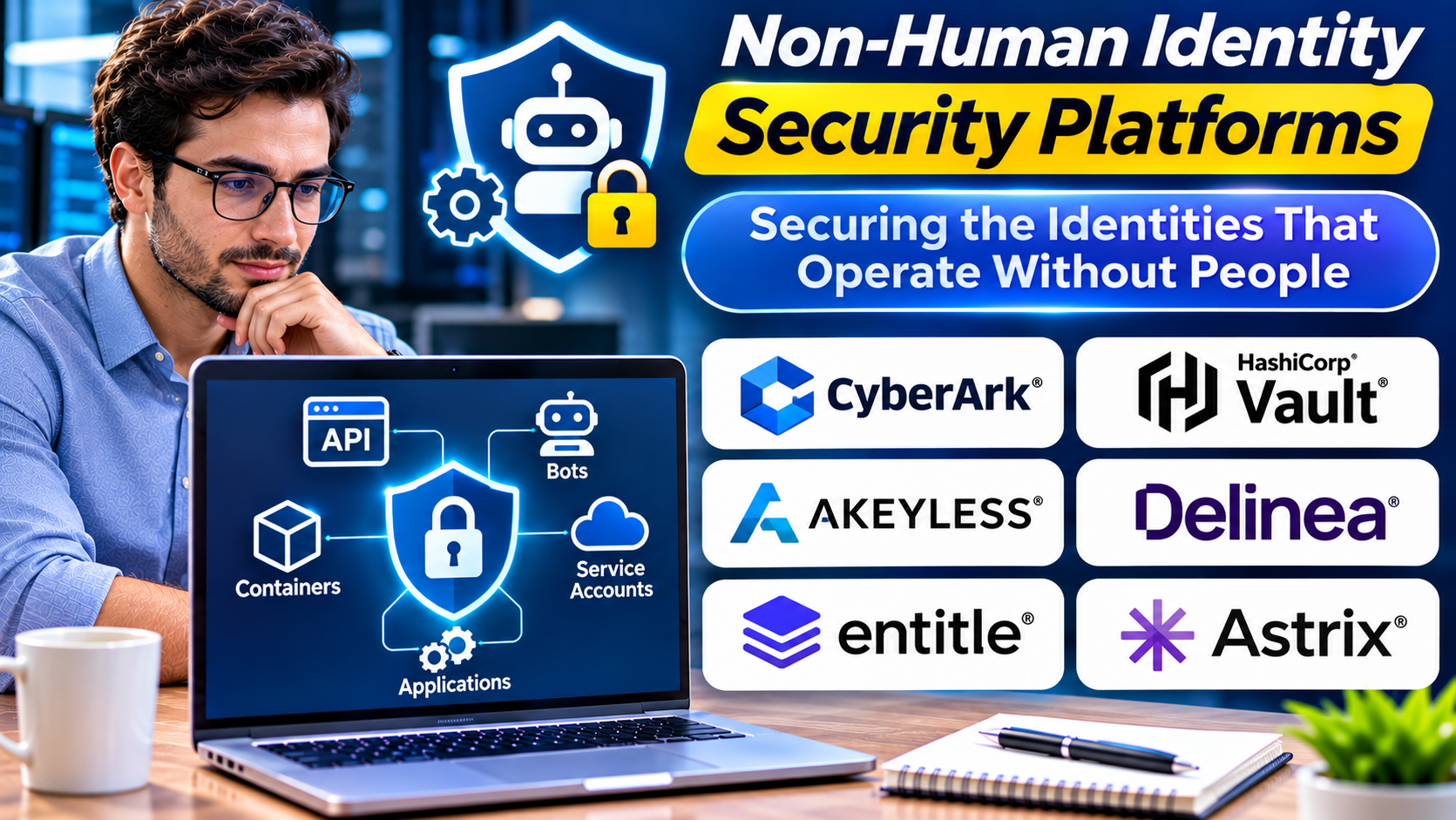
A cloud application retrieves information from a database. A CI/CD pipeline deploys new software. A monitoring agent collects operational metrics. An automated integration exchanges information between business platforms.
None of these activities requires a person to sign in interactively, but each requires an identity and some form of authorization.
These non-human identities are essential to modern infrastructure. They are also difficult to manage because they can be created automatically, operate continuously, and hold powerful permissions.
Non-Human Identity (NHI) security platforms help organizations discover, monitor, and control identities used by applications, services, workloads, and automated processes.
The central challenge is establishing accountability for identities that do not belong to individual employees.
What Is a Non-Human Identity?
A non-human identity is a digital identity assigned to software, infrastructure, an automated process, or another non-person entity.
Examples include:
- Cloud service accounts
- Application identities
- Kubernetes service accounts
- Workload identities
- CI/CD automation identities
- Managed identities
- Service principals
- Database service accounts
- Machine certificates used for authentication
- Automated integration accounts
API keys, passwords, tokens, and certificates are often associated with these identities, but an important distinction exists.
An identity is the entity being authenticated. A credential is evidence used to authenticate it.
A single identity may possess several credentials, and a credential may provide access to multiple resources depending on its permissions.
Understanding this relationship is essential for effective security.
Why Non-Human Identities Create Security Challenges
Rapid Identity Growth
Applications and cloud services can create new identities during deployment.
Without centralized visibility, security teams may not know which identities exist or who owns them.
Long-Lived Credentials
API keys and service account passwords may remain active long after their original purpose has disappeared.
These credentials can become attractive targets for attackers.
Excessive Permissions
Developers may grant broad permissions to avoid deployment failures.
An automation identity that only needs to read one resource might receive administrative access to an entire environment.
Limited Ownership
When an employee leaves, the organization usually has a defined offboarding process.
When an application is retired, its associated identities and credentials may remain active because ownership is unclear.
Difficult Behavioral Monitoring
Human identity monitoring often examines interactive sign-ins.
Non-human identities behave differently. They may authenticate frequently, operate continuously, and communicate with many services.
Security controls must understand those patterns.
Core Capabilities of NHI Security Platforms
Identity Discovery
Discovery identifies non-human identities across supported cloud services, applications, and infrastructure.
The goal is to build an inventory that includes identity type, permissions, ownership, and usage.
Credential Exposure Detection
Platforms may identify credentials exposed in code repositories, configuration files, or other monitored locations.
Exposure detection should be paired with secure revocation and replacement procedures.
Permission Analysis
Security teams need to understand what each identity can access.
Useful analysis distinguishes assigned permissions from permissions actually used.
Ownership Mapping
Every important non-human identity should have an accountable owner.
Ownership may be associated with an application team, service, infrastructure component, or business process.
Lifecycle Management
Identities should be created, modified, and retired through controlled processes.
Inactive identities and unnecessary credentials should be investigated and removed.
Risk Prioritization
An identity with broad permissions and an exposed credential presents a different risk from a tightly scoped identity using short-lived credentials.
Effective platforms help teams prioritize the most consequential exposures.
Non-Human Identity Security Platforms to Evaluate
The NHI security market includes specialized products and broader identity security platforms. Their capabilities are not identical.
Oasis Security
Oasis Security focuses on non-human identity security, including discovery, posture assessment, and lifecycle-related controls.
Relevant use cases: Organizations seeking visibility into service accounts, application identities, and related credentials.
Evaluation priorities: Discovery coverage, ownership mapping, remediation workflows, and supported integrations.
Entro Security
Entro Security focuses on securing non-human identities and associated secrets.
It is relevant to organizations investigating identity exposure and risks associated with machine credentials.
Relevant use cases: Credential visibility, risk analysis, and non-human identity security.
Evaluation priorities: Discovery methods, contextual risk information, and remediation integration.
Astrix Security
Astrix Security focuses on non-human identity and application-to-application access risks.
Its approach is relevant to organizations concerned about integrations, application permissions, and connected services.
Relevant use cases: SaaS integrations, application identities, and access exposure.
Evaluation priorities: Supported environments, integration discovery, and permission analysis.
Aembit
Aembit focuses on workload identity and access management.
Its approach emphasizes authenticating workloads and controlling access to services without relying on traditional long-lived secrets wherever supported.
Relevant use cases: Application-to-service authentication and workload access.
Evaluation priorities: Supported workloads, deployment architecture, identity federation, and integration requirements.
CyberArk
CyberArk provides broader identity security capabilities that include machine identity and secrets-related controls.
It is relevant to organizations seeking to coordinate non-human identity protection with existing privileged access security programs.
Relevant use cases: Enterprise identity security, privileged secrets, and machine access.
Evaluation priorities: Product scope, integration with existing CyberArk deployments, and coverage of specific NHI requirements.
HashiCorp Vault
HashiCorp Vault provides secrets management and identity-based access capabilities.
It is an important complementary technology for managing application credentials and dynamic secrets.
However, Vault should not automatically be treated as equivalent to a dedicated NHI discovery and security posture platform.
Relevant use cases: Centralized secrets management and controlled workload access.
Evaluation priorities: Secret engines, authentication methods, operational resilience, and the need for additional discovery tools.
Comparing NHI Security Approaches
| Platform | Main area to evaluate | Architectural consideration |
|---|---|---|
| Oasis Security | NHI visibility and lifecycle security | Discovery and remediation coverage |
| Entro Security | Non-human identity and secrets risk | Risk context and integrations |
| Astrix Security | Connected application identity risk | SaaS and integration coverage |
| Aembit | Workload identity and access | Authentication architecture |
| CyberArk | Enterprise machine and secrets security | Portfolio and deployment fit |
| HashiCorp Vault | Secrets and workload authentication | Operational management |
These solutions address overlapping but different problems.
A platform that discovers risky identities may not replace a secrets manager. A secrets manager may not independently discover every identity operating across an enterprise.
NHI Security vs. Machine Identity Management
Non-human identity security is a broad category covering identities associated with software, services, integrations, and automation.
Machine identity management often focuses more specifically on machine authentication, certificates, cryptographic credentials, and their lifecycles.
The categories overlap significantly.
For example, a workload authenticated using an X.509 certificate involves both a non-human identity and a machine credential.
Organizations should evaluate capabilities rather than assuming product categories represent mutually exclusive technologies.
How to Evaluate an NHI Security Platform
Start With Your Environment
Identify where non-human identities operate.
Common environments include cloud infrastructure, SaaS applications, Kubernetes clusters, CI/CD platforms, and on-premises systems.
Examine Discovery Coverage
Ask whether the platform discovers identities through APIs, configuration analysis, code scanning, activity logs, or other methods.
Determine which environments are not covered.
Assess Identity Ownership
A useful inventory should connect technical identities to accountable teams.
Without ownership, remediation becomes difficult.
Validate Risk Prioritization
Determine whether the platform considers permissions, credential exposure, actual usage, and business sensitivity.
Test Remediation Safety
Disabling a service account can interrupt production systems.
The platform should support controlled investigation and remediation rather than encouraging indiscriminate deletion.
Review Operational Dependencies
Examine API permissions, data access requirements, monitoring overhead, and integration maintenance.
Building a Practical NHI Security Program
Begin by inventorying non-human identities across critical environments.
Identify their owners and business purposes.
Map credentials and permissions to the identities that use them.
Prioritize identities with broad permissions, exposed secrets, or unclear ownership.
Replace embedded credentials with managed secrets or workload identity federation where practical.
Introduce short-lived credentials when supported.
Establish processes for credential rotation, identity retirement, and emergency recovery.
Finally, monitor changes and incorporate NHI security checks into development and infrastructure workflows.
Common NHI Security Mistakes
Treating credentials and identities as interchangeable: They are related but distinct security objects.
Focusing only on exposed secrets: Excessive permissions and abandoned identities also create risk.
Rotating credentials without dependency analysis: Poorly planned rotation can interrupt production services.
Ignoring ownership: Unowned identities are difficult to review or retire.
Assuming a secrets manager provides complete NHI governance: Additional discovery and access analysis may be necessary.
Frequently Asked Questions
What is a non-human identity?
It is a digital identity assigned to an application, service, workload, machine, or automated process rather than an individual person.
Are API keys non-human identities?
API keys are credentials. They may authenticate non-human identities, but the two concepts are not identical.
Why are NHIs difficult to secure?
They may be created automatically, operate continuously, and lack clear ownership or lifecycle controls.
Can NHI security replace PAM?
Not entirely. PAM focuses on privileged access, while NHI security addresses a broader set of automated identities and their risks.
Final Thoughts
Non-human identities are essential to cloud infrastructure, application integration, and modern software delivery.
Yet their security cannot depend on informal credential management or incomplete inventories.
Oasis Security, Entro Security, Astrix Security, Aembit, CyberArk, and HashiCorp Vault illustrate different approaches to discovering, authenticating, and protecting automated identities.
An effective NHI security program establishes visibility, ownership, least privilege, and controlled credential lifecycles.
The objective is to make automated access as accountable and manageable as human access without disrupting the systems that depend on it.