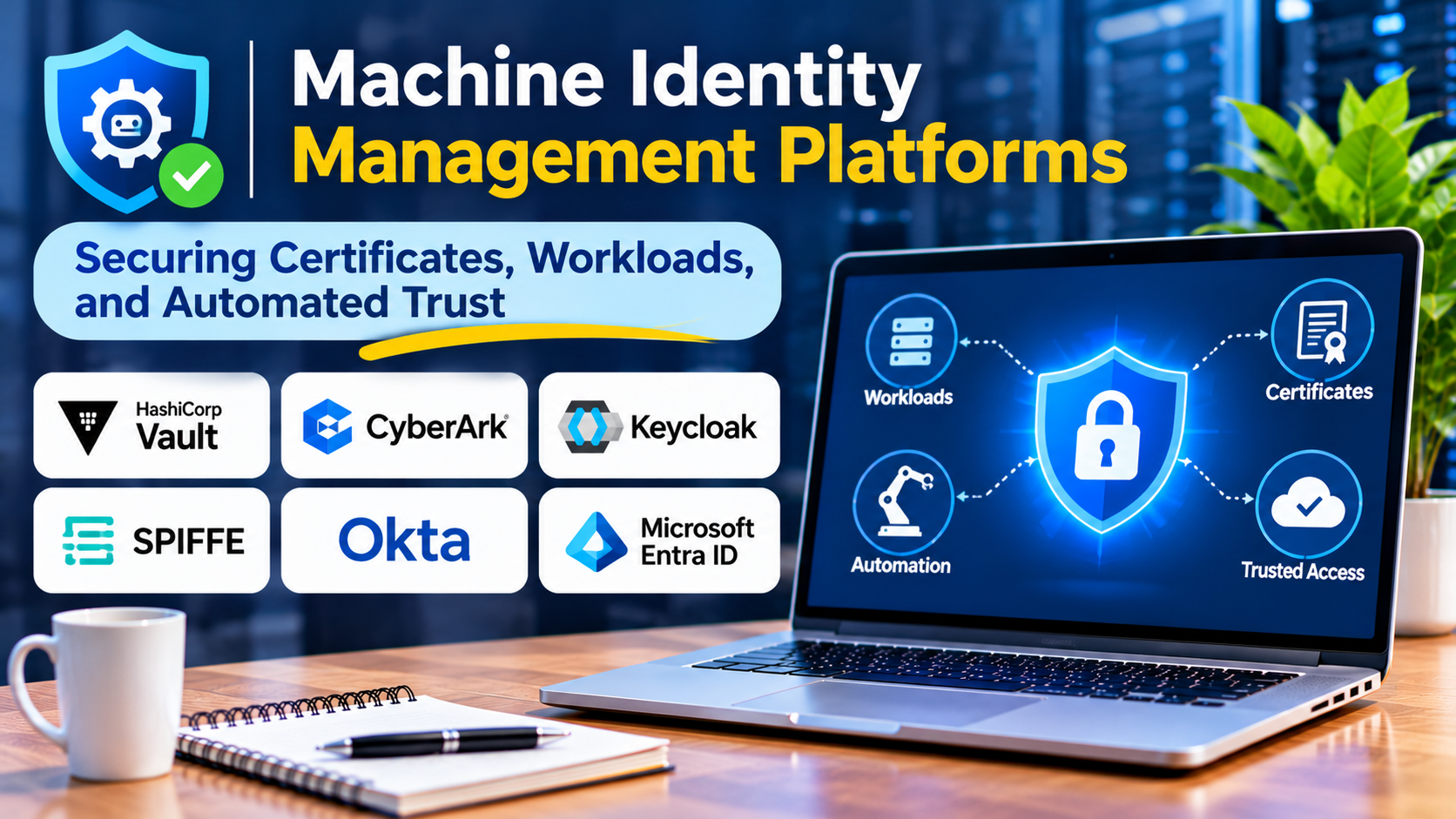
A web server establishes an encrypted connection with a browser. A Kubernetes workload authenticates to another service. An enterprise application uses a certificate to prove its identity to an internal system.
These interactions depend on machine identities.
Unlike employee identities, machine identities often operate without human involvement. They must authenticate reliably, protect sensitive credentials, and maintain trust across changing infrastructure.
As organizations expand their cloud services, containers, APIs, and automated deployments, managing machine identities becomes increasingly complex.
Machine Identity Management (MIM) platforms help organizations discover, issue, protect, renew, and revoke the credentials used to authenticate machines and workloads.
The most important consideration is not simply the number of certificates an organization possesses. It is whether those certificates and credentials can be managed reliably throughout their lifecycles.
What Is Machine Identity Management?
Machine identity management refers to the technologies and processes used to establish, maintain, and govern the digital identities of machines, applications, and workloads.
Machine identities may be associated with:
- Web servers
- Application servers
- Containers and Kubernetes workloads
- Network devices
- Cloud services
- IoT devices
- Automated deployment systems
- Internal microservices
- Enterprise applications
Machine authentication frequently relies on cryptographic credentials such as X.509 certificates and private keys.
However, machine identities can also use other authentication mechanisms, depending on the system architecture.
Why Machine Identity Security Matters
Certificate Expiration Can Cause Outages
An expired TLS certificate can interrupt secure connections.
When certificate inventories are incomplete, organizations may discover expiration problems only after services fail.
Private Key Compromise Creates Security Risk
A private key is sensitive cryptographic material.
If an attacker obtains a private key, the consequences depend on the certificate’s purpose and the systems that trust it.
Manual Renewal Does Not Scale
Manually tracking certificates across hundreds or thousands of systems creates administrative overhead and increases the chance of errors.
Cloud Infrastructure Changes Quickly
Containers and workloads may be created and removed automatically.
Static credential management processes are poorly suited to short-lived infrastructure.
Trust Relationships Are Difficult to Audit
Organizations need to understand which authorities issue certificates, where credentials are installed, and which systems trust them.
Core Components of Machine Identity Management
Certificate Discovery
Discovery identifies certificates across supported infrastructure.
Useful inventory information includes certificate owner, issuer, expiration date, associated services, and deployment location.
Certificate Lifecycle Management
Certificate Lifecycle Management (CLM) covers issuance, deployment, renewal, replacement, and revocation.
Automation reduces reliance on manual renewal processes.
Public Key Infrastructure
Public Key Infrastructure (PKI) establishes trust using certificate authorities, certificates, and cryptographic keys.
Organizations may rely on public certificate authorities, private PKI, or a combination of both.
Private Key Protection
Private keys should be protected according to their sensitivity.
Controls may include restricted access, hardware-backed key storage, and managed cryptographic services.
Workload Identity
Workload identity systems authenticate applications and services without requiring traditional human credentials.
These systems may use short-lived certificates or federated identity mechanisms.
Monitoring and Reporting
Security and infrastructure teams need visibility into certificate expiration, issuance activity, policy violations, and unusual credential changes.
Machine Identity Management Platforms Worth Evaluating
Venafi
Venafi, part of CyberArk, provides machine identity security capabilities, including certificate lifecycle management.
It is relevant to organizations managing complex certificate estates and automated machine authentication.
Relevant strengths: Enterprise certificate visibility, policy controls, and lifecycle automation.
Evaluation priorities: Integration coverage, deployment complexity, and operational requirements.
DigiCert Trust Lifecycle Manager
DigiCert Trust Lifecycle Manager provides capabilities for managing digital certificates and related trust requirements.
It is relevant to organizations seeking centralized certificate lifecycle processes.
Relevant strengths: Certificate inventory and lifecycle management within a broader digital trust ecosystem.
Evaluation priorities: Public and private certificate requirements, supported integrations, and automation workflows.
Keyfactor
Keyfactor provides PKI and certificate lifecycle management solutions.
It is relevant to enterprises seeking greater visibility and control over cryptographic identities.
Relevant strengths: Certificate management, PKI-related capabilities, and automation.
Evaluation priorities: PKI architecture, deployment options, and integration with existing infrastructure.
AppViewX CERT+
AppViewX CERT+ focuses on certificate lifecycle automation and management.
It is relevant to organizations seeking to reduce manual certificate administration.
Relevant strengths: Certificate discovery, lifecycle workflows, and automation.
Evaluation priorities: Device and application coverage, deployment requirements, and policy management.
Sectigo Certificate Manager
Sectigo Certificate Manager provides certificate lifecycle management capabilities.
It can be evaluated by organizations managing certificates across varied applications and infrastructure.
Relevant strengths: Centralized certificate management and renewal workflows.
Evaluation priorities: Certificate authority compatibility, automation support, and infrastructure integration.
SPIRE
SPIRE is an open-source implementation of the SPIFFE framework for workload identity.
It provides a different approach from traditional enterprise certificate inventory products.
SPIRE focuses on issuing and managing workload identities within supported environments.
Relevant strengths: Workload attestation and short-lived identity credentials.
Evaluation priorities: Infrastructure integration, trust-domain architecture, and operational expertise.
Comparing Machine Identity Management Approaches
| Platform | Primary focus | Important evaluation factor |
|---|---|---|
| Venafi | Enterprise machine identity security | Automation and enterprise integration |
| DigiCert Trust Lifecycle Manager | Digital certificate lifecycle | Certificate estate coverage |
| Keyfactor | PKI and certificate lifecycle management | PKI architecture and automation |
| AppViewX CERT+ | Certificate lifecycle automation | Discovery and deployment integration |
| Sectigo Certificate Manager | Certificate management | CA compatibility and renewal |
| SPIRE | Workload identity | Attestation and trust-domain design |
Traditional certificate lifecycle management and workload identity systems address related but different requirements.
A large enterprise may need both.
Machine Identity Management vs. Secrets Management
Secrets management systems protect sensitive information such as API keys, passwords, tokens, and certificates.
Machine identity management focuses more specifically on establishing and maintaining trusted machine identities.
For example, a secrets manager may store a private key, while a certificate lifecycle platform handles certificate discovery, renewal, and deployment.
Workload identity platforms may reduce the need to distribute long-lived secrets by issuing short-lived credentials.
These capabilities are complementary rather than interchangeable.
What to Look for in a Machine Identity Platform
Complete Certificate Visibility
The platform should identify certificates across the environments that matter to the organization.
A partial inventory may leave critical systems exposed to unexpected expiration.
Reliable Automation
Automated issuance and renewal should include appropriate validation, monitoring, and error handling.
Automation that fails silently can be more dangerous than a clearly managed manual process.
Certificate Authority Compatibility
Determine whether the platform supports the required public and private certificate authorities.
Workload and Infrastructure Integration
Evaluate support for cloud infrastructure, Kubernetes, web servers, load balancers, and network equipment.
Policy Enforcement
Organizations should define acceptable certificate characteristics, key protection requirements, and lifecycle policies.
Recovery Procedures
A certificate management failure can affect business-critical services.
Test renewal failures, certificate replacement, and emergency revocation procedures.
Implementing Machine Identity Management
Step 1: Discover Existing Certificates
Create an inventory of certificates and associated systems.
Identify unknown owners and certificates nearing expiration.
Step 2: Establish Ownership
Assign responsibility for certificate-dependent applications and infrastructure.
Step 3: Standardize Issuance Policies
Define approved certificate authorities, cryptographic requirements, and validity policies.
Step 4: Automate Renewal
Begin with a limited set of systems.
Verify that renewed certificates are correctly deployed and that services continue operating.
Step 5: Protect Private Keys
Apply appropriate access controls and key storage protections.
Step 6: Introduce Workload Identity Where Appropriate
For dynamic infrastructure, evaluate short-lived credentials and automated workload authentication.
Step 7: Monitor Continuously
Track expiration, renewal failures, unauthorized issuance, and configuration changes.
Common Machine Identity Management Mistakes
Maintaining incomplete inventories: Unknown certificates can become unexpected outage risks.
Automating issuance but not deployment: A renewed certificate is ineffective if the application continues using an expired one.
Ignoring private key protection: Certificate management must include protection of associated keys.
Using long-lived credentials unnecessarily: Dynamic infrastructure may benefit from shorter credential lifetimes.
Treating all machine identities as certificates: Some workloads authenticate through other mechanisms.
Failing to test recovery: Certificate and trust failures can disrupt critical services.
Frequently Asked Questions
What is a machine identity?
A machine identity is a digital identity used by a device, application, service, or workload to authenticate itself.
Is a TLS certificate a machine identity?
A TLS certificate can bind a public key to an identity and support machine authentication. The certificate is a credential associated with that identity.
What is certificate lifecycle management?
It is the process of discovering, issuing, deploying, renewing, replacing, and revoking digital certificates.
Is SPIRE a replacement for certificate lifecycle management?
Not universally. SPIRE focuses on workload identity, while enterprise certificate lifecycle platforms may manage a broader certificate estate.
Can machine identity management prevent outages?
It can reduce certificate-related outage risks through discovery, monitoring, and renewal automation, but effectiveness depends on deployment and operational reliability.
Final Thoughts
Machine identity management is increasingly important because modern applications depend on automated authentication and cryptographic trust.
Venafi, DigiCert Trust Lifecycle Manager, Keyfactor, AppViewX CERT+, Sectigo Certificate Manager, and SPIRE illustrate different approaches to managing machine credentials and workload identities.
The right architecture depends on whether an organization primarily needs enterprise certificate lifecycle management, private PKI, dynamic workload identity, or a combination.
Successful machine identity management creates reliable visibility, protects cryptographic credentials, automates routine lifecycle operations, and prepares organizations for failures before they affect production services.