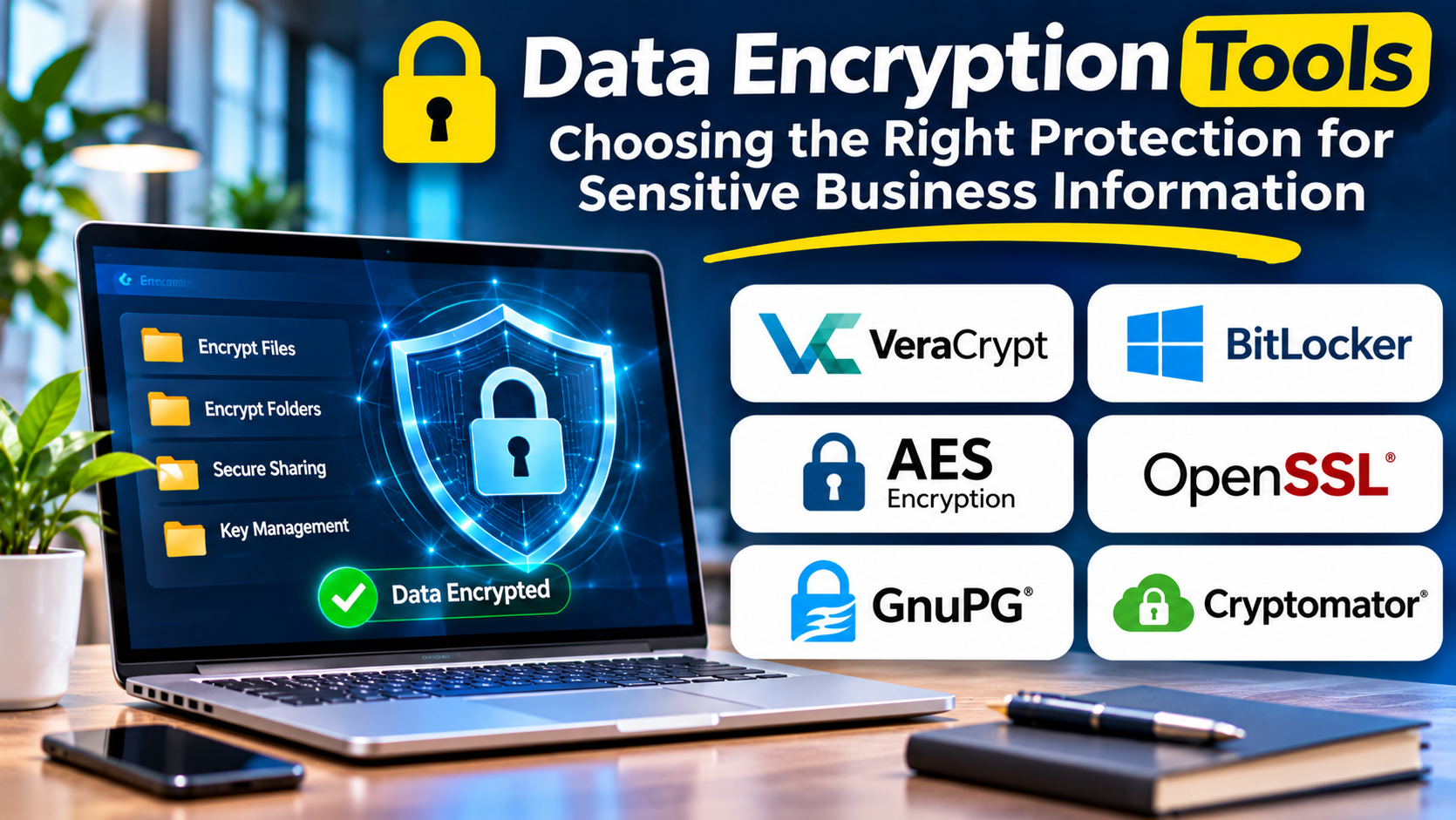
Data encryption is one of the most important safeguards for information that organizations cannot afford to expose. Customer records, financial documents, intellectual property, employee information, and application data all require protection. Yet selecting encryption software involves more than choosing a product that promises strong security.
The difficult questions concern where encryption happens, who controls the keys, what happens when authorized users need access, and how the organization recovers when systems fail.
A well-designed encryption strategy protects information without making everyday business operations unnecessarily difficult.
What Are Data Encryption Tools?
Data encryption tools are software applications, services, or integrated security capabilities that transform readable information into encrypted data using cryptographic algorithms and keys.
Authorized systems can decrypt that information when they possess the required keys and permissions.
Encryption protects confidentiality. It does not automatically prevent someone from deleting data, stealing credentials, or accessing information through an already authorized application.
That distinction matters because organizations sometimes expect encryption software to solve problems that actually require identity management, monitoring, backups, or application security.
Understanding the Main Types of Encryption
Different encryption technologies protect information at different points in its lifecycle.
Full-Disk Encryption
Full-disk encryption protects information stored on a computer’s drive or storage volume.
Microsoft BitLocker and Apple FileVault are familiar examples of operating-system-integrated encryption.
These technologies are particularly useful for protecting lost or stolen devices.
However, full-disk encryption generally does not prevent an attacker from reading files after successfully gaining access to an unlocked system.
File and Folder Encryption
File-level encryption protects selected documents or directories rather than an entire storage device.
This approach can be useful when employees need to exchange sensitive files or retain encrypted archives.
Tools such as VeraCrypt and Cryptomator address different aspects of encrypted storage.
VeraCrypt supports encrypted containers and volumes. Cryptomator focuses on encrypting files, including files stored through cloud synchronization services.
Their suitability depends on whether the primary requirement involves local storage, portable encrypted volumes, or synchronized files.
Database Encryption
Database encryption protects information stored inside database systems.
Transparent Data Encryption, commonly called TDE, can encrypt database files while allowing authorized database applications to operate normally.
Application-level or column-level encryption can provide more targeted protection for sensitive fields.
The important distinction is that database storage encryption does not necessarily prevent privileged database users from reading decrypted information.
Encryption in Transit
Encryption in transit protects information moving between systems.
Transport Layer Security, or TLS, is widely used to secure web connections, APIs, and other network communications.
TLS protects communications between endpoints, but data may still be exposed after reaching a compromised endpoint.
Application-Level Encryption
Application-level encryption allows software to encrypt selected information before it reaches a database or storage service.
This can reduce exposure to infrastructure administrators and other parties that do not need access to plaintext.
However, application-level encryption introduces additional responsibilities involving key distribution, search functionality, error handling, and recovery.
Symmetric and Asymmetric Encryption
Encryption systems commonly use two broad cryptographic approaches.
Symmetric encryption uses the same secret key for encryption and decryption. AES is a widely used symmetric encryption algorithm.
Symmetric encryption is generally suitable for protecting large amounts of information efficiently.
Asymmetric cryptography uses a public and private key pair. It supports applications such as key establishment, authentication, and digital signatures.
Many practical security systems combine symmetric and asymmetric techniques.
For example, a system may encrypt data using a symmetric key and protect that key using another cryptographic mechanism.
The security of the resulting system depends on more than the algorithm. Key generation, storage, access control, and implementation quality are equally important.
Data Encryption Tools Worth Evaluating
Different products serve different requirements, so they should not all be treated as interchangeable alternatives.
Microsoft BitLocker
BitLocker is a Windows drive-encryption capability designed to protect data stored on supported devices.
It is particularly relevant to organizations managing Windows laptops and workstations.
Strengths: Integration with Windows, support for enterprise device-management workflows, and compatibility with hardware-backed protection mechanisms on supported devices.
Considerations: Availability and management features depend on Windows editions and the organization’s device-management environment.
BitLocker is a practical starting point for organizations that primarily need endpoint drive encryption.
Apple FileVault
FileVault provides built-in encryption for supported Mac computers.
It works within Apple’s operating-system security architecture and can be managed through compatible enterprise device-management solutions.
Strengths: Native macOS integration and a relatively straightforward user experience.
Considerations: Recovery-key management and organizational access procedures require careful planning.
FileVault is most relevant to organizations operating Apple devices.
VeraCrypt
VeraCrypt is an open-source encryption tool supporting encrypted containers, partitions, and volumes.
It is useful for individuals and organizations that need flexible encrypted storage without depending entirely on a proprietary cloud service.
Strengths: Open-source availability, encrypted containers, and multiple supported operating systems.
Considerations: Users must manage passwords, recovery procedures, and operational workflows carefully.
VeraCrypt is not a replacement for centralized enterprise key governance.
Cryptomator
Cryptomator provides client-side encryption for files, including files synchronized through supported cloud-storage workflows.
It is useful when users want to encrypt file contents before storing them with a cloud provider.
Strengths: File-oriented encryption and compatibility with common synchronization approaches.
Considerations: Collaboration, file sharing, recovery, and metadata protection need evaluation for each deployment.
Cryptomator is especially relevant to smaller teams and individuals protecting cloud-synchronized documents.
Enterprise Encryption Platforms
Organizations with broader requirements may evaluate enterprise products from vendors such as Thales and IBM.
These platforms can address encryption, key management, and related data-security requirements across selected environments.
Their exact capabilities depend on the product, deployment model, and licensing arrangement.
Enterprise buyers should distinguish storage encryption, application encryption, tokenization, and centralized key management rather than assuming a single product handles every requirement.
The Most Important Encryption Software Features
Strong, Established Cryptography
Prioritize products using established cryptographic algorithms and well-maintained implementations.
Avoid products that rely on secret or proprietary algorithms as their main security argument.
Key Management
Encryption keys determine who can decrypt protected information.
Organizations need procedures for generating, storing, rotating, revoking, backing up, and recovering keys.
A technically strong encryption algorithm cannot compensate for poorly protected keys.
Access Control
Encryption should work alongside identity and access management.
Administrators, applications, and users should receive only the permissions necessary for their responsibilities.
Recovery Capabilities
Lost encryption keys can make legitimate business information permanently inaccessible.
Organizations should test recovery procedures before deploying encryption widely.
Auditability
Enterprise systems may require logs showing key operations, administrative changes, and access-related events.
Logs should be protected against unauthorized modification and reviewed according to organizational risk.
Performance and Compatibility
Encryption introduces computational work and can affect application behavior.
Actual impact depends on hardware, software architecture, workload, and encryption design.
Evaluate performance using representative workloads rather than relying on general vendor claims.
How to Choose the Right Data Encryption Tool
Begin by identifying the information that needs protection.
A company protecting employee laptops has different requirements from a financial institution encrypting database fields or a development team protecting application secrets.
Next, identify the threats.
Are you protecting against stolen devices, unauthorized cloud access, malicious insiders, compromised backups, or network interception?
Different threats require different controls.
Then determine where encryption should happen.
Device-level encryption may be sufficient for lost-device protection. Highly sensitive application data may require encryption before reaching shared infrastructure.
Finally, evaluate how the organization will operate the system.
The best encryption product is not necessarily the one with the longest feature list. It is the one that can be configured correctly, maintained consistently, and recovered safely.
Common Encryption Mistakes
One frequent mistake is assuming encrypted data remains protected under every circumstance.
When an authorized application decrypts information, attackers who compromise that application may be able to access plaintext.
Another mistake is storing encryption keys beside the data they protect without meaningful separation of access.
Organizations also underestimate recovery requirements.
A backup that cannot be decrypted after a disaster may be operationally useless.
Finally, encryption should not replace software updates, endpoint protection, identity security, or reliable backups.
It belongs within a broader security architecture.
Frequently Asked Questions
What is the best data encryption tool?
There is no universally best option. BitLocker and FileVault address device encryption, while VeraCrypt and Cryptomator serve different file and storage encryption needs.
Is AES-256 secure?
AES-256 is a widely accepted encryption algorithm when implemented and managed correctly. Security also depends on keys, software implementation, and operational controls.
Can encrypted data be hacked?
Attackers may bypass encryption by stealing keys, compromising authorized systems, exploiting implementation weaknesses, or obtaining data after decryption.
Is encryption enough for regulatory compliance?
No. Encryption can support compliance obligations, but regulations may also require access controls, retention policies, monitoring, incident response, and other safeguards.
Final Thoughts
Effective data encryption starts with understanding the information, systems, and threats involved.
Organizations should choose tools based on where protection is required, how encryption keys will be controlled, and whether legitimate users can recover their information when necessary.
The strongest strategy combines appropriate encryption with disciplined key management, identity security, monitoring, and tested recovery procedures.
Encryption is most valuable when it remains dependable throughout the entire information lifecycle.