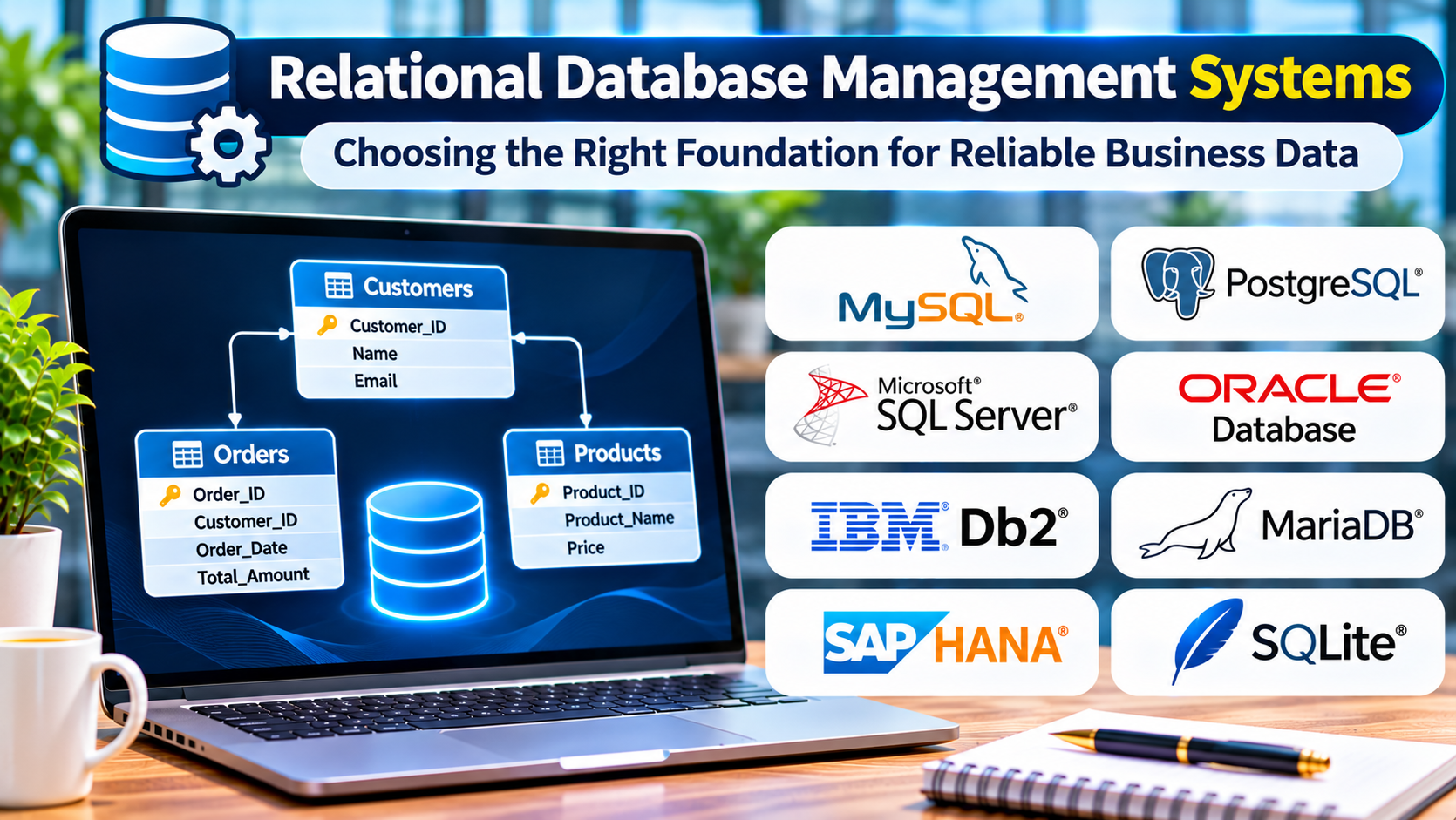
Every business application depends on information being stored, updated, and retrieved correctly. A payment system must prevent duplicate transactions. An inventory application needs accurate stock levels. A customer platform must connect accounts, orders, and support records without losing consistency.
Relational Database Management Systems, commonly called RDBMS, provide a structured foundation for these requirements.
Despite the growth of document databases, cloud-native storage services, and specialized data platforms, relational databases remain central to business software.
Their continued relevance comes from a practical combination of structured data models, transactional reliability, query capabilities, and mature development ecosystems.
However, choosing an RDBMS is not simply a matter of selecting the most familiar database engine.
Different platforms offer different approaches to scalability, administration, licensing, deployment, and application integration.
The right decision depends on the workload, the team’s expertise, and the long-term responsibilities associated with operating the database.
What Is a Relational Database Management System?
A Relational Database Management System is software that stores and manages data using the relational model.
Data is typically organized into tables containing rows and columns.
Tables represent entities such as customers, products, orders, or employees.
Relationships between these entities are represented through keys and constraints.
For example, an online store may use separate tables for customers, orders, and order items.
A customer identifier connects each order to the customer who placed it.
This structure allows applications to retrieve related information without duplicating every customer detail inside each order record.
Most relational database platforms use SQL, or Structured Query Language, to define, retrieve, and modify data.
Although SQL is standardized, individual database engines provide different extensions, functions, and administrative capabilities.
Why Relational Databases Remain Important
Relational databases are particularly valuable when information must remain accurate across multiple operations.
Consider a banking transfer.
The system needs to reduce one account balance and increase another.
If only one operation succeeds, the records become inconsistent.
A transactional database can coordinate these changes so they succeed or fail according to defined transaction rules.
Relational databases also provide mechanisms for enforcing data integrity.
Primary keys identify records. Foreign keys help preserve relationships. Unique constraints prevent selected forms of duplication.
These capabilities reduce dependence on application code for every consistency rule.
However, relational databases are not automatically the best solution for every workload.
Applications involving massive graph traversals, specialized vector retrieval, or unusual access patterns may benefit from other database technologies.
Understanding ACID Transactions
One of the most important concepts in relational database design is ACID.
ACID describes four transaction properties.
Atomicity
A transaction is treated as a unit of work.
Its changes are committed according to the transaction’s rules or rolled back when the operation cannot complete.
Consistency
Transactions preserve the database’s defined integrity rules when those rules and operations are correctly designed.
Consistency does not mean the database automatically understands every business requirement.
Isolation
Isolation controls how concurrent transactions interact.
Different isolation levels provide different trade-offs between concurrency, visibility, and consistency guarantees.
Durability
Once a transaction is committed, the database is expected to preserve it according to its durability guarantees, including relevant failure-recovery mechanisms.
Understanding ACID is important because business applications often depend on these properties without explicitly discussing them.
Major Relational Database Platforms
PostgreSQL
PostgreSQL is an open-source relational database known for its extensive SQL capabilities, extensibility, and support for complex workloads.
It supports features such as transactional operations, indexing, JSON data types, advanced queries, and extensions.
PostgreSQL is relevant to startups, enterprise applications, analytics systems, and developer-focused platforms.
Strengths: Rich SQL functionality, extensibility, a mature ecosystem, and flexibility across deployment environments.
Considerations: Performance tuning, replication architecture, connection management, and operational maintenance require appropriate expertise.
PostgreSQL is a strong candidate when organizations want a capable general-purpose relational database without depending on a proprietary database license.
MySQL
MySQL is a widely used relational database associated with web applications and transactional systems.
It has a large developer ecosystem and supports multiple deployment approaches.
MySQL is frequently used with popular application frameworks and content-management platforms.
Strengths: Broad ecosystem support, familiarity among developers, and suitability for many web application workloads.
Considerations: Features and operational behavior depend on the version, storage engine, configuration, and deployment model.
Organizations should evaluate MySQL using representative application queries rather than relying on assumptions about its relative speed.
Microsoft SQL Server
Microsoft SQL Server is a commercial relational database platform with strong integration into Microsoft’s enterprise software ecosystem.
It supports transactional applications, SQL development, security administration, and analytical workloads through associated capabilities and services.
Strengths: Enterprise tooling, Microsoft ecosystem integration, and established administration workflows.
Considerations: Licensing, edition-specific features, deployment architecture, and long-term operating costs require careful evaluation.
SQL Server can be particularly relevant to organizations with established Microsoft development and infrastructure environments.
Oracle Database
Oracle Database is an enterprise relational database platform used in demanding transactional and business-critical environments.
It offers extensive capabilities involving transactions, availability, security, performance, and database administration.
Strengths: Broad enterprise functionality and support for complex operational requirements.
Considerations: Licensing, architectural complexity, specialist administration, and infrastructure costs may be significant.
Oracle Database is often evaluated where existing enterprise applications or advanced operational requirements justify its capabilities.
SQLite
SQLite is an embedded relational database engine.
Unlike traditional client-server database platforms, SQLite typically operates directly within an application process and stores its database in a local file.
It is commonly used in mobile applications, desktop software, embedded systems, and local application storage.
Strengths: Small deployment footprint, minimal administration, and straightforward integration.
Considerations: Its concurrency and deployment model differ from server-based relational databases.
SQLite is highly effective for suitable embedded workloads but is not a direct replacement for every centralized enterprise database.
Comparing Relational Database Systems
| Platform | Common Fit | Important Trade-Off |
|---|---|---|
| PostgreSQL | General-purpose applications and advanced SQL workloads | Requires appropriate operational expertise |
| MySQL | Web applications and transactional systems | Capabilities vary by version and configuration |
| SQL Server | Microsoft-centered enterprise environments | Licensing and edition considerations |
| Oracle Database | Complex enterprise and mission-critical applications | Cost and administration complexity |
| SQLite | Embedded and local application storage | Different concurrency and deployment model |
This comparison describes architectural fit rather than a universal performance ranking.
Real performance depends on workload characteristics, indexing, hardware, configuration, and application design.
How Relational Databases Store and Retrieve Information
Relational database performance depends heavily on how data is organized and accessed.
A query that retrieves a few records may complete quickly when an appropriate index exists.
The same query may require scanning a large table when the database cannot use an effective access path.
Database engines use query optimizers to select execution strategies.
These strategies may involve index scans, table scans, joins, sorting, and aggregation.
The optimizer makes decisions based on available statistics, query structure, and database capabilities.
Administrators can inspect execution plans to understand how queries operate.
However, adding indexes indiscriminately is not a reliable optimization strategy.
Indexes consume storage and introduce maintenance overhead during data modifications.
Good database design balances read performance, write efficiency, and operational requirements.
Choosing Between Self-Managed and Managed RDBMS
Organizations can operate relational databases directly or use managed database services.
Self-Managed Databases
Self-managed deployments provide greater responsibility for configuration, patching, backups, monitoring, and recovery.
They may be appropriate when organizations require specialized control over infrastructure or database configuration.
However, they also require sufficient operational expertise.
Managed Database Services
Managed services can handle selected infrastructure and maintenance responsibilities.
Examples include Amazon RDS, Azure SQL Database, and Google Cloud SQL for their supported database engines.
Managed services can reduce operational work, but they do not eliminate application-level responsibilities.
Teams must still design schemas, manage access, optimize queries, and understand recovery requirements.
Service restrictions, pricing, and available database features should be evaluated before migration.
Scalability and High Availability
Relational databases can scale through several approaches.
Vertical scaling increases resources available to a database instance.
Read replicas can distribute suitable read workloads.
Partitioning divides data into manageable structures.
Sharding distributes data across separate database partitions or systems.
Each approach introduces trade-offs.
Read replicas may not provide immediate consistency with the primary database.
Sharding can complicate transactions and application queries.
High-availability architectures also require careful failure detection, recovery, and consistency planning.
A database platform should be evaluated against realistic growth expectations rather than theoretical maximum scale.
Security Considerations
Relational databases frequently store sensitive business information.
Security should begin with individual identities, restricted permissions, and secure network access.
Use encrypted connections where appropriate.
Protect database backups and encryption keys.
Review privileged accounts regularly.
Database administrators should also monitor security updates and maintain reliable recovery procedures.
An RDBMS provides security features, but organizations remain responsible for configuring them correctly.
Common RDBMS Selection Mistakes
Choosing Based Only on Popularity
A popular database may have a strong ecosystem but still be unsuitable for a particular workload.
Evaluate application requirements first.
Ignoring Licensing and Operational Costs
Infrastructure costs are only part of the total expense.
Consider administration, support, backups, monitoring, training, and potential licensing obligations.
Overlooking Database Portability
SQL dialects and proprietary features can create migration challenges.
Organizations should understand which application components depend on database-specific behavior.
Assuming More Hardware Fixes Poor Queries
Additional resources may temporarily reduce performance problems.
They cannot replace effective schema design, indexing, and query optimization.
Neglecting Recovery Testing
A database is not adequately protected merely because backups exist.
Restore procedures should be tested against business recovery objectives.
How to Choose the Right RDBMS
Start with the data model.
Identify the entities, relationships, consistency requirements, and query patterns.
Next, estimate workload characteristics.
Consider transaction volume, concurrency, data growth, reporting requirements, and acceptable response times.
Then evaluate operational capabilities.
A small team may benefit from a managed service or a database technology it already understands.
A larger organization may prioritize integration with established enterprise systems and governance processes.
Finally, conduct realistic testing.
Use representative queries, data volumes, and concurrency patterns.
Measure the behavior that matters to the application rather than relying on generic benchmark claims.
Frequently Asked Questions
What is the difference between SQL and RDBMS?
SQL is a language used to interact with many relational databases. An RDBMS is the software system that stores and manages relational data.
Which relational database is best?
There is no universal winner. PostgreSQL, MySQL, SQL Server, Oracle Database, and SQLite serve different requirements.
Are relational databases suitable for large applications?
Yes. Relational databases support many large and demanding applications, although architecture and operational design become increasingly important at scale.
Can relational databases store JSON?
Several relational databases support JSON storage and querying. The available features vary by platform.
Is PostgreSQL better than MySQL?
Neither is universally better. The appropriate choice depends on SQL requirements, application compatibility, operational expertise, and workload characteristics.
Final Thoughts
Relational Database Management Systems remain essential because they solve a fundamental business problem: maintaining trustworthy information while applications read and modify it.
The strongest choice is not necessarily the platform with the most features.
It is the database that meets transactional requirements, supports expected workloads, fits the team’s capabilities, and remains manageable as the application grows.
A thoughtful RDBMS decision creates a reliable foundation for years of software development and business operations.