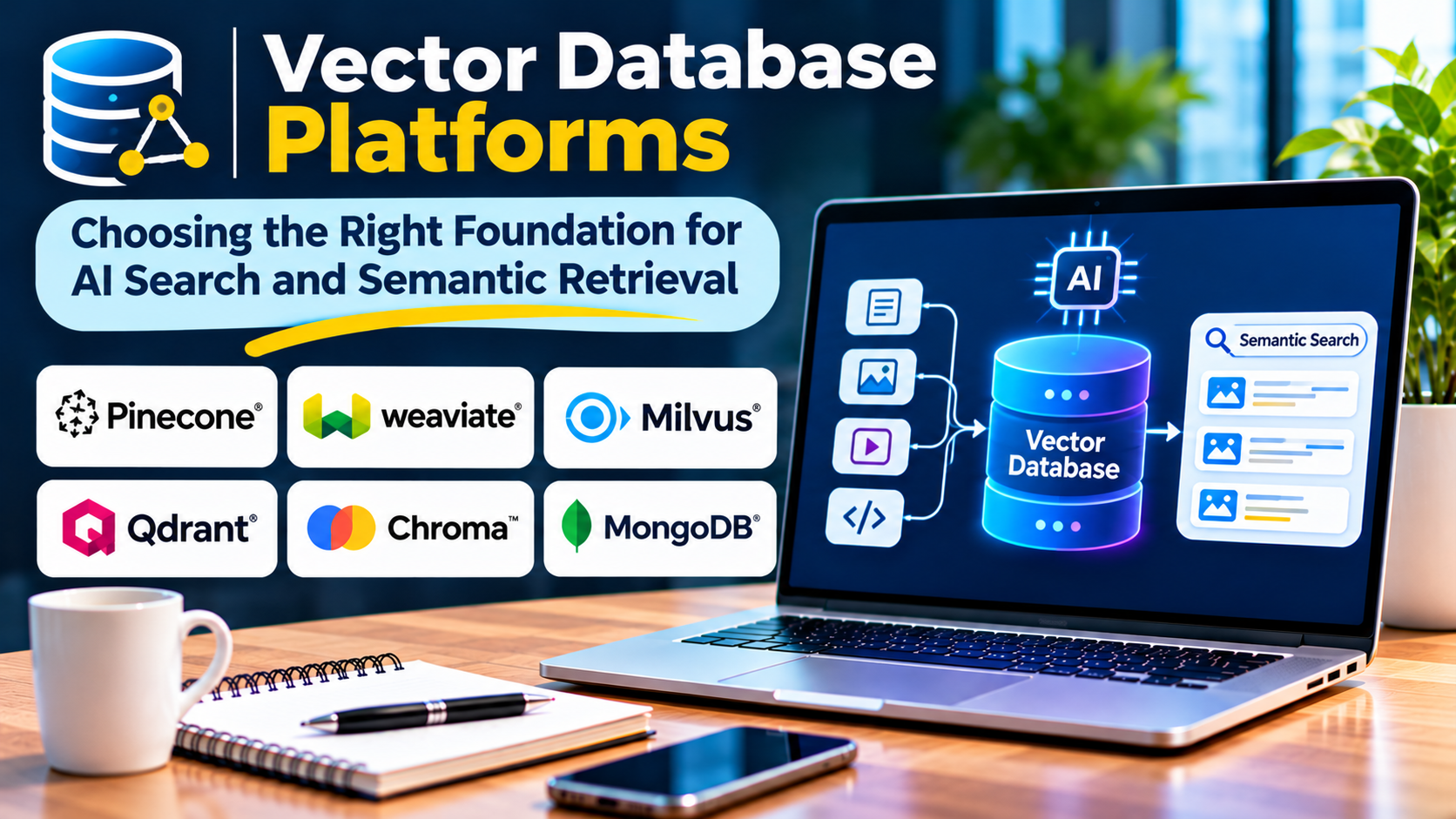
Traditional databases are excellent at finding information when applications know exactly what to search for.
A relational database can retrieve an order using its identifier. A search engine can locate documents containing specific words.
Artificial intelligence applications often require a different kind of retrieval.
A user might search for “ways to reduce cloud infrastructure costs” and expect documents discussing resource optimization, unused virtual machines, and storage efficiency—even when those documents do not contain the exact search phrase.
Vector database platforms help support this form of similarity-based retrieval.
They have become important components of semantic search, recommendation systems, and retrieval-augmented generation applications.
However, selecting a vector database requires more than comparing search speed.
Organizations must evaluate retrieval quality, filtering, data updates, operational costs, security, and how the system fits their existing data architecture.
What Is a Vector Database?
A vector database is a database system or specialized data platform designed to store, index, and search numerical vectors.
A vector is an ordered collection of numbers.
In machine learning applications, vectors often represent embeddings generated from text, images, audio, or other information.
An embedding model converts input data into numerical representations intended to capture useful patterns or relationships.
Items with similar meanings or characteristics may have embeddings that are close to each other according to a chosen similarity measure.
A vector database helps applications find nearby vectors efficiently.
The database does not independently understand language or meaning.
The quality of the results depends heavily on the embedding model, data preparation, indexing strategy, and retrieval workflow.
How Vector Search Works
Consider a company building an internal knowledge assistant.
The organization has thousands of policy documents, technical guides, and support articles.
A typical retrieval process works as follows:
- Documents are collected from approved information sources.
- Large documents are divided into smaller sections.
- An embedding model converts each section into a vector.
- The vectors are stored with identifiers and relevant metadata.
- A user submits a question.
- The same compatible embedding model converts the question into a vector.
- The system searches for similar stored vectors.
- Relevant document sections are returned to the application.
The application may then display the retrieved information or provide it to a language model.
This process supports semantic retrieval, but it does not guarantee that every returned result is correct or relevant.
Vector Databases and Retrieval-Augmented Generation
Retrieval-Augmented Generation, or RAG, combines information retrieval with language-model generation.
Instead of relying only on information learned during model training, a RAG application retrieves selected external content and provides it as context.
Vector databases are frequently used in these systems.
However, they are only one component.
A reliable RAG application also needs document ingestion, chunking, access controls, retrieval evaluation, prompt construction, and answer verification.
A vector database cannot compensate for inaccurate source documents or poor retrieval design.
Organizations should evaluate the entire information pipeline rather than assuming that changing databases will solve every AI quality problem.
Vector Database Platforms Worth Evaluating
Pinecone
Pinecone is a managed vector database platform designed for similarity search and AI retrieval workloads.
It provides services for storing and querying vectors without requiring customers to operate the underlying database infrastructure directly.
Strengths: Managed operations, developer-oriented APIs, and a focus on vector retrieval.
Considerations: Pricing, service limits, metadata filtering, deployment options, and data-location requirements should be evaluated.
Pinecone may be suitable for teams prioritizing managed infrastructure and application development speed.
Milvus
Milvus is an open-source vector database designed for similarity search across large vector collections.
It supports vector indexing and retrieval capabilities intended for demanding workloads.
Strengths: Open-source ecosystem, multiple indexing approaches, and architecture options for larger deployments.
Considerations: Self-managed deployments can introduce operational complexity involving infrastructure, scaling, monitoring, and maintenance.
Milvus is relevant to teams seeking a dedicated vector database with flexible deployment possibilities.
Qdrant
Qdrant is a vector search platform that combines similarity retrieval with structured payload filtering.
It supports vector-oriented application workflows and provides managed and self-hosted deployment options.
Strengths: Vector search, payload filtering, and developer-focused interfaces.
Considerations: Teams should evaluate indexing behavior, filtering requirements, collection management, and deployment costs.
Qdrant is particularly relevant when semantic similarity must be combined with structured metadata conditions.
Weaviate
Weaviate is an open-source vector database platform with capabilities for vector search and hybrid retrieval.
It provides integrations and features designed for AI-oriented applications.
Strengths: Vector retrieval, hybrid search capabilities, and a developer ecosystem focused on AI applications.
Considerations: Integration choices, data modeling, resource requirements, and operational complexity depend on the deployment.
Weaviate may appeal to teams seeking an integrated approach to semantic retrieval and related AI workflows.
PostgreSQL with pgvector
pgvector is an open-source PostgreSQL extension that adds vector similarity search capabilities.
It supports exact and approximate nearest-neighbor search and can store vectors alongside ordinary relational information.
Strengths: PostgreSQL integration, SQL-based querying, and the ability to combine vector retrieval with relational data.
Considerations: Performance and scalability depend on PostgreSQL architecture, index configuration, data volume, and workload requirements.
pgvector is especially attractive when an organization already uses PostgreSQL and wants to avoid introducing a separate database service unnecessarily.
Comparing Vector Database Platforms
| Platform | Architecture Approach | Common Fit |
|---|---|---|
| Pinecone | Managed vector database | Teams prioritizing managed vector infrastructure |
| Milvus | Dedicated open-source vector database | Large or specialized vector workloads |
| Qdrant | Vector search with payload filtering | Metadata-aware semantic retrieval |
| Weaviate | Vector database with hybrid retrieval | AI search applications |
| pgvector | PostgreSQL extension | Existing PostgreSQL applications |
These distinctions describe product positioning, not independent performance rankings.
A platform’s suitability must be established through workload-specific testing.
Understanding Similarity Metrics
Vector databases compare embeddings using mathematical measures.
Common approaches include cosine similarity, Euclidean distance, and dot product.
Cosine Similarity
Cosine similarity compares vector direction.
It is frequently used with text embeddings.
Euclidean Distance
Euclidean distance measures geometric distance between vectors.
Its suitability depends on the embedding model and application.
Dot Product
Dot product is another method for comparing vectors.
Its interpretation depends partly on whether vectors are normalized.
Organizations should follow the recommendations associated with their embedding model rather than selecting a metric arbitrarily.
The same database can produce different retrieval results depending on the similarity measure.
Exact vs. Approximate Nearest-Neighbor Search
Exact nearest-neighbor search evaluates candidates according to the selected distance calculation and returns the closest results.
It can become expensive as datasets grow.
Approximate nearest-neighbor search, commonly called ANN, uses indexing strategies to find likely nearest neighbors more efficiently.
Approximate methods trade some retrieval accuracy for improved performance or resource efficiency.
Two commonly encountered indexing approaches are HNSW and IVF-based methods.
HNSW
Hierarchical Navigable Small World indexing uses graph-based structures to support approximate similarity search.
It can provide effective retrieval performance, but index construction and memory requirements must be considered.
IVF
Inverted-file approaches organize vectors into groups and search selected groups during retrieval.
Their performance depends on configuration and data distribution.
Neither approach is universally superior.
The appropriate choice depends on dataset size, query patterns, update frequency, memory availability, and acceptable recall.
Recall, Latency, and Throughput
Vector database evaluation requires several measurements.
Recall describes how many relevant nearest neighbors are recovered compared with a reference set.
Latency measures how long queries take.
Throughput measures the number of queries processed over time.
These metrics interact.
A configuration that improves recall may increase latency or resource consumption.
A configuration that produces extremely fast responses may omit useful results.
Organizations should evaluate these trade-offs using representative datasets and realistic concurrency.
Why Metadata Filtering Matters
Semantic similarity alone is rarely sufficient for business applications.
Consider a company knowledge assistant serving employees from multiple departments.
A document may be semantically relevant but restricted to another department.
The retrieval system must enforce access permissions before returning protected information.
Metadata filters can help restrict results according to department, tenant, document type, or other attributes.
However, metadata filtering should not be treated as a complete authorization system by itself.
Applications must enforce access policies consistently across ingestion, retrieval, and downstream processing.
Filtering behavior can also affect vector search performance and recall.
This makes metadata-aware retrieval an important evaluation criterion.
Hybrid Search: Combining Keywords and Vectors
Vector search is effective at finding semantically related information.
Traditional keyword search remains valuable for exact terms, identifiers, error messages, and product names.
Hybrid search combines these approaches.
For example, a user searching for a specific software error code may benefit from exact keyword matching.
Another user asking a conceptual question may benefit from semantic retrieval.
A hybrid system can combine both result sets.
Techniques such as Reciprocal Rank Fusion can help merge rankings from different retrieval methods.
Some applications also use reranking models to improve the ordering of candidate results.
The best approach depends on the content and user queries.
Choosing Between a Dedicated Vector Database and pgvector
One of the most consequential decisions is whether a separate vector database is necessary.
If an application already uses PostgreSQL, pgvector may offer a practical way to add similarity search.
This can simplify data synchronization and operational management.
However, a dedicated vector database may be appropriate when vector retrieval becomes a major workload with specialized scaling or indexing requirements.
The decision should account for:
- Existing database infrastructure
- Vector collection size
- Query frequency and concurrency
- Metadata filtering requirements
- Update and deletion patterns
- Availability and recovery expectations
- Operational expertise
- Total infrastructure cost
Introducing another database adds synchronization, monitoring, access-control, and recovery responsibilities.
A dedicated platform should provide enough value to justify that complexity.
Embedding Models and Data Quality
A vector database stores and searches embeddings, but it does not determine whether those embeddings represent the information well.
Embedding quality depends on the selected model and input data.
Document preparation is equally important.
If long documents are divided into poorly chosen sections, retrieval may return incomplete context.
If important metadata is missing, filtering may become unreliable.
If outdated documents remain indexed, the application may retrieve obsolete information.
Organizations should establish ingestion and update procedures before scaling their vector infrastructure.
Security and Privacy Considerations
Embeddings should not automatically be treated as anonymous or harmless data.
They may encode information derived from sensitive source material.
Vector databases should therefore be included in the organization’s security and data-governance program.
Important controls include authentication, authorization, encryption, logging, data retention, and secure deletion procedures.
Multi-tenant applications require particular attention to tenant isolation.
Organizations should also evaluate whether external embedding services receive sensitive content during processing.
The complete data flow matters more than the security features of the vector database alone.
Understanding Vector Database Costs
Vector database costs may involve storage, memory, compute resources, indexing, query operations, and managed service charges.
The embedding pipeline can introduce additional costs.
For example, converting documents into embeddings may require paid model inference or dedicated infrastructure.
Frequent document updates can increase processing and indexing work.
A realistic cost estimate should include ingestion, storage, retrieval, monitoring, backups, and application integration.
Organizations should avoid assuming that the cheapest initial deployment will remain the cheapest at scale.
Common Vector Database Mistakes
Choosing a Database Before Testing Retrieval Quality
A technically fast database cannot fix poor embeddings or irrelevant document chunks.
Evaluate retrieval quality first.
Ignoring Metadata Filtering
Applications often need to restrict results according to permissions, categories, or business context.
Filtering requirements should influence database selection.
Comparing Only Vendor Benchmarks
Benchmarks may use different datasets, hardware, configurations, and measurement methods.
Conduct representative tests.
Treating Vector Search as a Complete RAG Solution
A vector database does not automatically provide trustworthy answers.
Source quality, retrieval design, and application controls remain essential.
Forgetting About Data Updates
Documents change, users lose permissions, and records are deleted.
The retrieval system must keep indexed information synchronized with authoritative sources.
How to Evaluate a Vector Database
Begin with a representative dataset.
Include the kinds of documents, embeddings, and metadata the application will use.
Create a set of realistic user queries.
For each query, identify relevant documents or passages.
Then compare retrieval quality across candidate platforms.
Measure recall, latency, throughput, and filtering behavior.
Repeat the evaluation under realistic concurrent workloads.
Test updates, deletions, failures, backups, and recovery.
Finally, estimate the total operational cost.
A successful proof of concept should demonstrate not only that the database can return similar vectors, but that it can support the application’s actual reliability and governance requirements.
Frequently Asked Questions
What is the best vector database for AI applications?
There is no universal best choice. Pinecone, Milvus, Qdrant, Weaviate, and pgvector support different architectural and operational requirements.
Is a vector database required for RAG?
No. RAG requires information retrieval, but retrieval can be implemented using different storage and search technologies.
Can PostgreSQL work as a vector database?
Yes. Extensions such as pgvector add vector storage and similarity search capabilities to PostgreSQL.
What is the difference between vector search and keyword search?
Keyword search focuses on matching terms or related text signals. Vector search compares numerical representations intended to capture semantic or other similarities.
Are vector databases only useful for text?
No. Vector retrieval can support images, audio, recommendations, and other data represented through embeddings.
Can vector databases replace relational databases?
They generally address different primary requirements. Some applications benefit from combining relational storage with vector search.
Final Thoughts
Vector database platforms provide important infrastructure for semantic search and AI-powered applications.
Their value comes from helping systems retrieve relevant information using numerical representations rather than relying entirely on exact text matching.
However, successful deployment depends on more than vector indexing.
Organizations must evaluate embedding quality, retrieval accuracy, filtering, security, data updates, and operational costs.
For some applications, extending an existing database with vector capabilities is the most practical choice.
For others, a dedicated vector platform provides useful specialization.
The strongest decision is the one supported by realistic testing and a clear understanding of the application’s information-retrieval requirements.