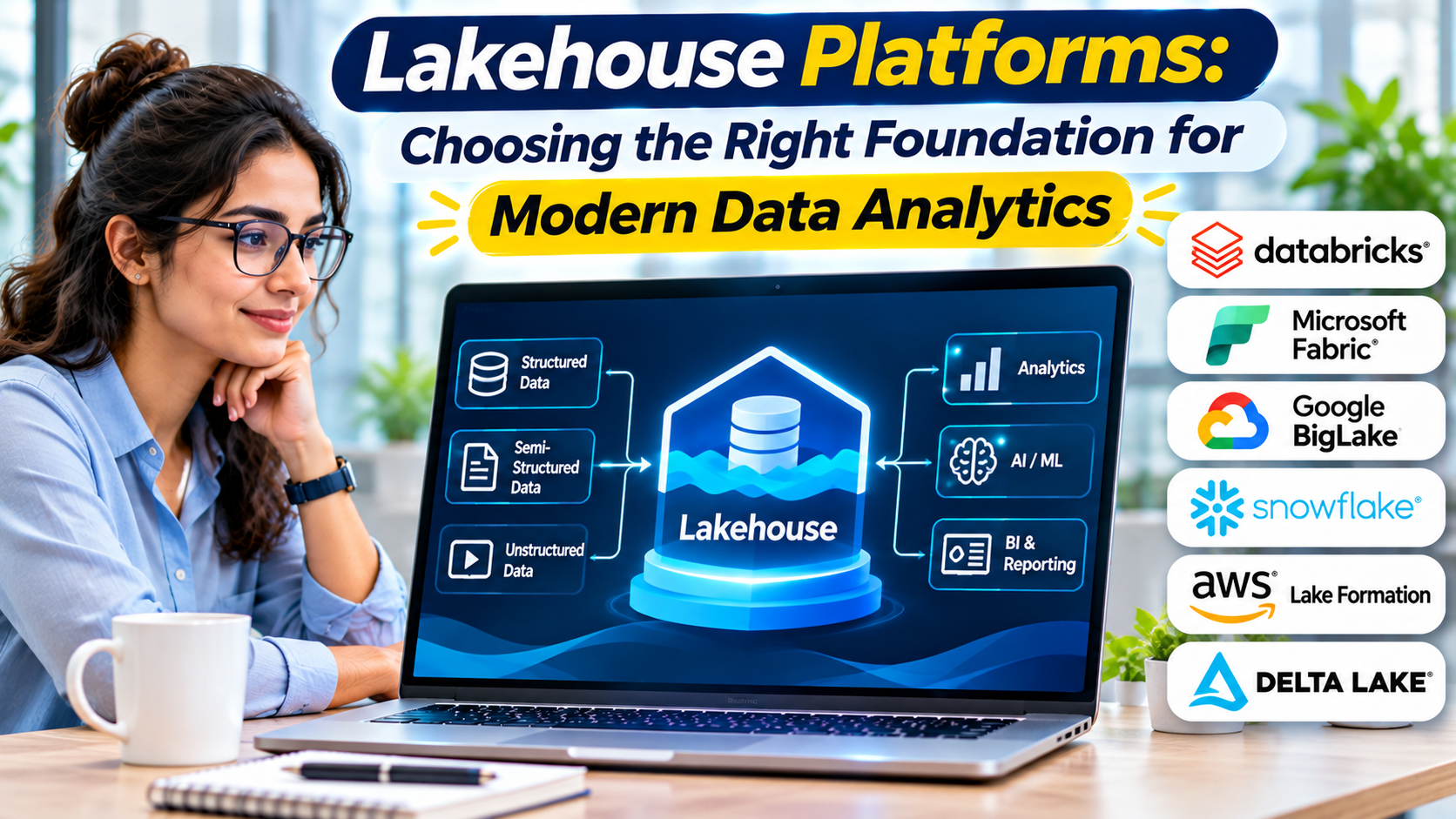
Modern organizations collect data from more sources than ever before.
Customer applications generate transactions. Websites produce behavioral events. Business systems contain structured records. Connected devices generate telemetry, while artificial intelligence applications require access to documents, images, and other forms of information.
Managing these datasets across separate storage and analytics systems can become expensive and complicated.
Traditional data warehouses provide reliable analytical processing but may not be the ideal destination for every kind of raw or unstructured data.
Data lakes offer flexible storage but require additional capabilities to deliver consistent governance, transactional reliability, and dependable analytical performance.
Lakehouse platforms aim to bring these strengths together.
They combine flexible data storage with selected database-management capabilities, allowing organizations to support analytics, data engineering, and machine learning using a more integrated architecture.
However, the lakehouse model is not a universal replacement for data warehouses or data lakes.
Its value depends on how well the architecture supports real workloads, governance requirements, and existing systems.
What Is a Lakehouse Platform?
A lakehouse platform is a data architecture or technology platform that combines characteristics of data lakes and data warehouses.
It commonly uses scalable object storage and open or widely adopted data formats while adding capabilities associated with managed analytical databases.
These capabilities may include:
- Transactional data updates
- Schema enforcement and evolution
- SQL analytics
- Metadata management
- Data governance
- Reliable concurrent reads and writes
- Support for data engineering and machine learning
- Integration with business intelligence tools
Many lakehouse architectures use table formats that manage metadata and transaction behavior over files stored in object storage.
This makes it possible to organize large datasets without requiring all information to reside inside a conventional proprietary warehouse storage layer.
Why the Lakehouse Architecture Emerged
Organizations historically separated operational data, analytical data, and raw data into different systems.
A data warehouse might contain curated financial and sales information.
A data lake might store raw logs, images, and historical datasets.
Machine learning teams might create additional copies for model development.
This separation can lead to duplicated storage, inconsistent definitions, and complex pipelines.
Lakehouse architectures seek to reduce some of this fragmentation.
For example, a retailer could store customer activity events in a shared analytical environment.
Data engineers could prepare the information.
Analysts could query curated tables.
Machine learning teams could use relevant datasets for forecasting or recommendations.
These activities may share underlying storage and governance capabilities.
However, a common storage layer does not automatically eliminate all data copies or integration challenges.
Different workloads may still require specialized serving systems.
The Core Components of a Lakehouse
Object Storage
Many lakehouse systems use cloud object storage such as Amazon S3, Azure Data Lake Storage, or Google Cloud Storage.
Object storage provides a scalable foundation for storing files.
Table Formats
Lakehouse table formats manage information about datasets, including file organization, schema, and transactional state.
Common technologies include Delta Lake, Apache Iceberg, and Apache Hudi.
These formats provide different capabilities and interoperability characteristics.
Compute Engines
Compute engines process data stored in lakehouse tables.
They may execute SQL queries, transformations, batch jobs, or machine learning workloads.
Examples include Apache Spark and compatible analytical query engines.
Metadata and Catalog Services
Catalogs help systems discover tables and understand their structure.
Governance services may control access, record lineage, and support data management.
Data Pipelines
Pipelines ingest and transform information from source systems.
Reliable pipeline design remains essential even when storage and analytics are integrated.
Lakehouse Platforms Worth Evaluating
Databricks Data Intelligence Platform
Databricks provides an integrated environment for data engineering, analytics, and AI workloads.
Its ecosystem is closely associated with Apache Spark and Delta Lake.
Databricks also provides governance and SQL analytics capabilities.
Strengths: Integration across data engineering, lakehouse analytics, and AI workflows.
Considerations: Compute costs, governance configuration, workload management, and platform-specific services require evaluation.
Databricks is relevant to organizations seeking a shared environment for substantial data processing and analytical workloads.
Microsoft Fabric
Microsoft Fabric provides an integrated analytics environment with lakehouse capabilities.
It includes OneLake as a shared storage foundation and connects lakehouse workflows with other Fabric experiences.
Strengths: Integration with Microsoft analytics services, Power BI, and shared data-management workflows.
Considerations: Capacity requirements, supported features, licensing, and integration constraints should be reviewed.
Fabric may be especially relevant to organizations with substantial investments in Microsoft analytics technologies.
Snowflake
Snowflake is a cloud data platform that supports analytical workloads and capabilities involving open table formats and external data.
Its architecture differs from platforms built primarily around Spark-based lakehouse processing.
Strengths: Managed SQL analytics, governance capabilities, and support for selected lakehouse-oriented architectures.
Considerations: Organizations should verify support for required table formats, write operations, external catalogs, and workload patterns.
Snowflake should be evaluated according to the specific lakehouse capabilities needed rather than treated as architecturally identical to Databricks.
Dremio
Dremio provides SQL analytics capabilities for data lake and lakehouse environments.
It emphasizes querying data stored in open formats and supporting analytical access across data sources.
Strengths: SQL-oriented lakehouse analytics and integration with open data architectures.
Considerations: Query performance, catalog compatibility, deployment requirements, and supported data operations should be tested.
Dremio is relevant when organizations want analytical access to lakehouse data without moving every dataset into a separate warehouse.
Open Lakehouse Technologies
Organizations can also build lakehouse architectures using technologies such as Apache Iceberg, Delta Lake, Apache Spark, and Trino.
This approach offers flexibility and potentially greater control over components.
However, integration, maintenance, security, and operational responsibility become more complex.
A collection of open-source components is not automatically a complete managed lakehouse platform.
Comparing Lakehouse Approaches
| Platform or Approach | Primary Strength | Key Consideration |
|---|---|---|
| Databricks | Integrated data engineering, analytics, and AI | Platform usage and governance |
| Microsoft Fabric | Integrated Microsoft analytics ecosystem | Capacity and service compatibility |
| Snowflake | Managed analytics with open-data capabilities | Specific table-format and catalog support |
| Dremio | SQL analytics over lakehouse data | Query and deployment requirements |
| Open-source architecture | Component flexibility and control | Integration and operational complexity |
The best choice depends on the organization’s preferred architecture and workload requirements.
Understanding Lakehouse Table Formats
Table formats are central to many lakehouse architectures.
They help manage datasets stored as files while supporting database-like behavior.
Delta Lake
Delta Lake provides a transactional storage layer for supported data processing environments.
It supports features such as schema enforcement and versioned table operations.
Apache Iceberg
Apache Iceberg is an open table format designed for large analytical datasets.
It supports metadata management, schema evolution, and transactional table operations.
Apache Hudi
Apache Hudi provides capabilities for managing data changes and analytical datasets stored in data lakes.
It is often considered for ingestion and update-oriented data pipelines.
These technologies are not interchangeable in every environment.
Organizations should evaluate engine compatibility, update behavior, maintenance, and ecosystem support.
Lakehouse vs. Data Warehouse
A traditional data warehouse focuses on structured analytical workloads and managed query processing.
A lakehouse emphasizes flexible storage combined with analytical table management.
However, modern platforms increasingly support overlapping features.
Some warehouses can query open table formats.
Some lakehouse platforms provide highly managed SQL analytics.
The choice should not depend only on category labels.
Organizations should compare workload performance, data access patterns, governance, costs, and operational complexity.
Lakehouse vs. Data Lake
A data lake provides flexible storage for different data types.
A lakehouse adds capabilities intended to make stored datasets more reliable and accessible for analytical workloads.
For example, raw files in object storage do not automatically provide transaction management or consistent table metadata.
A lakehouse table format can add these capabilities.
However, lakehouse functionality depends on the selected table format, processing engine, and catalog architecture.
Common Lakehouse Use Cases
Enterprise Analytics
Organizations can prepare and query large datasets for reporting and business intelligence.
Data Engineering
Engineering teams can ingest, clean, and transform information through shared pipelines.
Machine Learning
Lakehouse architectures can support datasets used in feature engineering, model development, and evaluation.
Historical Data Analysis
Object storage can provide a foundation for retaining substantial historical datasets.
Multi-Source Data Integration
Lakehouse environments can combine information from applications, databases, events, and external sources.
Data Governance in Lakehouse Platforms
A shared analytical environment requires consistent governance.
Organizations need to control who can discover, read, modify, and share datasets.
Important capabilities include identity integration, access policies, auditing, data classification, and lineage.
Governance becomes particularly challenging when multiple processing engines access the same storage.
Permissions enforced by one engine may not automatically apply to every other access path.
Organizations should evaluate security across storage, catalog, and compute layers.
A centralized governance interface is useful only when it protects the actual routes through which users access data.
Performance and Storage Optimization
Lakehouse performance depends on file organization, table metadata, query engines, and compute resources.
Small files can create unnecessary metadata and processing overhead.
Large scans may consume significant resources.
Partitioning and clustering can improve selected workloads, but poor design can reduce efficiency.
Table maintenance operations may be necessary to optimize file layouts and manage obsolete data.
These operations have costs.
Organizations should test representative analytical queries and account for ongoing table maintenance.
Understanding Lakehouse Costs
Lakehouse costs may include object storage, compute resources, catalog services, data ingestion, and maintenance operations.
Open storage formats do not guarantee low total costs.
A poorly optimized processing pipeline can consume substantial compute resources.
Repeatedly scanning large datasets may also increase expenses.
Organizations should monitor workload efficiency, storage growth, and unnecessary data duplication.
Total cost should include operational staffing and platform administration.
Common Lakehouse Implementation Mistakes
Treating Object Storage as a Complete Lakehouse
Files alone do not provide transactional management, governance, or reliable analytical access.
Ignoring Table Format Compatibility
Different engines may support different versions and features of open table formats.
Creating Uncontrolled Data Copies
A lakehouse architecture can still suffer from duplicated and inconsistent datasets.
Underestimating Governance
Multiple processing engines and access paths create security challenges.
Assuming One Platform Fits Every Workload
Low-latency operational applications may still require specialized databases.
How to Choose a Lakehouse Platform
Begin with the workloads the organization wants to support.
Identify requirements for SQL analytics, data engineering, machine learning, and data sharing.
Next, evaluate existing infrastructure.
Organizations already using Microsoft or Databricks technologies may benefit from related ecosystem integration.
Review table-format interoperability and catalog architecture.
Then assess governance, security, and operational responsibilities.
Finally, conduct realistic tests.
Use representative datasets, transformation pipelines, and analytical queries.
Measure performance, reliability, and total cost.
A lakehouse platform should simplify the overall architecture rather than merely introduce another layer of technology.
Frequently Asked Questions
What is a lakehouse platform?
A lakehouse platform combines flexible data lake storage with selected database-management and analytical capabilities.
Is Databricks a lakehouse platform?
Yes. Databricks is closely associated with lakehouse architectures and Delta Lake.
Is a lakehouse better than a data warehouse?
Not universally. The best architecture depends on analytical requirements, data types, governance, and operational costs.
What is the difference between Delta Lake and Apache Iceberg?
Both are lakehouse table formats, but they differ in architecture, metadata handling, ecosystem integration, and supported operations.
Can lakehouse platforms support AI workloads?
Yes. Many lakehouse platforms support data preparation and analytical workflows used in AI development.
Final Thoughts
Lakehouse platforms offer a practical approach to combining flexible data storage with reliable analytical processing.
Their greatest value comes from reducing unnecessary fragmentation between data engineering, analytics, and AI workflows.
However, the architecture succeeds only when table formats, compute engines, governance, and data pipelines work together effectively.
Organizations should evaluate real workloads, interoperability, security, and total cost before choosing a platform.
The right lakehouse architecture creates a dependable foundation for data use without introducing unnecessary operational complexity.