A supermarket carries hundreds of snack products, yet customers regularly struggle to find their preferred options.
A pharmacy expands its personal care assortment, but the additional products create shelf congestion without improving category performance.
A department store gives more space to a high-revenue category, only to discover that its profitability per unit of space is disappointing.
These problems highlight a central retail challenge: individual product decisions do not always produce the best overall category result.
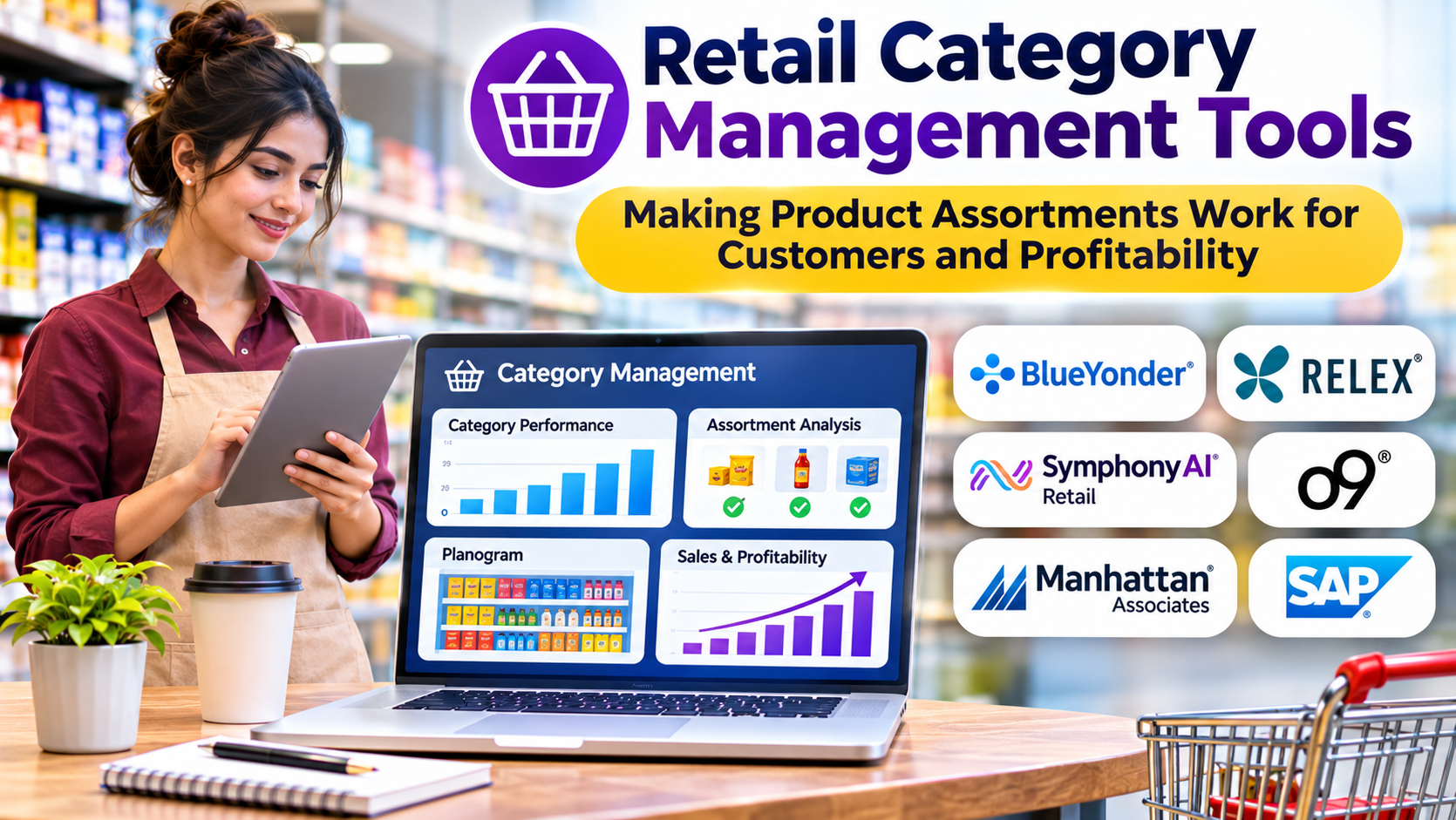
Retail category management tools help organizations evaluate groups of related products as business units.
They support decisions about assortment, pricing, promotions, shelf space, and performance.
The objective is to understand how products work together to meet customer needs while supporting the retailer’s commercial strategy.
Category management software is most valuable when it connects customer behavior, financial performance, and practical store constraints.
What Is Retail Category Management?
Retail category management is a structured approach to managing groups of related products according to customer needs and business objectives.
A category might include breakfast cereals, household cleaning products, pet food, or personal care items.
Rather than evaluating each product independently, a category manager considers how the assortment performs as a whole.
Important questions include:
- Does the category meet customer expectations?
- Which products are essential to the assortment?
- Are there unnecessary duplicates?
- How should shelf space be distributed?
- Which promotions create meaningful value?
- What role does the category play in the retailer’s strategy?
- How does performance vary between stores?
Category management can influence purchasing, pricing, inventory, merchandising, and supplier relationships.
It is therefore broader than simply creating product hierarchies.
Category Management Versus Merchandising
Category management and retail merchandising overlap significantly.
Merchandising encompasses decisions about products, inventory, presentation, and selling execution.
Category management focuses more specifically on managing related products as a coordinated business portfolio.
For example, merchandising software may help a retailer distribute products across stores and maintain shelf layouts.
Category management software may help determine which products belong in the assortment, how the category should be positioned, and whether its overall performance supports business goals.
The distinction is not absolute.
Many platforms offer capabilities across both categories.
Buyers should evaluate the actual workflows rather than rely solely on software labels.
Why Category-Level Decisions Matter
Consider a retailer selling five brands of bottled water.
One brand generates the highest unit sales.
Another produces a higher margin.
A third attracts customers seeking a particular package size.
A fourth performs well during promotions.
The fifth has limited sales but serves a distinct customer preference.
Removing every product except the highest-selling brand might improve short-term inventory simplicity.
However, it could reduce customer choice and weaken the category’s overall appeal.
Category management helps retailers consider these interactions.
The objective is not necessarily to maximize the performance of every individual item.
It is to build a category that meets customer needs while using inventory investment and selling space effectively.
The Main Functions of Category Management Software
Category performance analysis
Category analysis brings together sales, margin, inventory, and other relevant measures.
It helps managers understand performance at category, subcategory, brand, and product levels.
A useful system should make it possible to identify both strong-performing products and structural weaknesses.
Assortment optimization
Assortment tools help retailers evaluate which products should be included in a category.
They may support decisions about product breadth, depth, duplication, and store-specific differences.
The objective is to maintain a relevant assortment without unnecessary complexity.
Space planning
Space planning helps determine how shelf and fixture space should be allocated.
This may include planograms and product capacity analysis.
Pricing and promotion analysis
Category managers need to understand how pricing decisions affect related products.
A discount on one brand may shift purchases away from another brand rather than increase overall category demand.
Supplier collaboration
Retailers often work with suppliers on product introductions, category insights, and promotional plans.
Software may help organize relevant information and planning activities.
However, retailers should maintain independent decision-making and appropriate governance.
Retail Category Management Platforms Worth Evaluating
NielsenIQ Spaceman
NielsenIQ Spaceman is associated with retail space planning and category merchandising workflows.
It is relevant to retailers and consumer goods organizations that need to analyze and organize shelf layouts.
A category manager may use space planning capabilities to examine product placement and fixture capacity.
Potential fit: Retailers and suppliers with substantial planogram requirements.
Key consideration: Space planning depth, data integration, and store execution workflows.
Blue Yonder Category Management
Blue Yonder offers retail planning capabilities relevant to category and assortment decisions.
Its broader retail portfolio may support organizations seeking connections between category planning, demand, and inventory processes.
Potential fit: Larger retailers managing complex assortment and planning activities.
Key consideration: Relevant module coverage and integration with the retailer’s existing planning systems.
RELEX Solutions
RELEX provides retail planning capabilities that include assortment and space-related workflows.
Its approach may be relevant to organizations seeking to coordinate demand planning with product availability and merchandising decisions.
Potential fit: Retailers wanting closer connections between assortment, space, and replenishment planning.
Key consideration: Data requirements, planning workflow fit, and the ability to validate recommendations.
SymphonyAI Retail CPG
SymphonyAI offers retail and consumer packaged goods solutions that address analytical and merchandising-related business problems.
Its capabilities may be relevant to organizations seeking more structured insights into category and retail performance.
Potential fit: Retailers and consumer goods organizations with complex analytical requirements.
Key consideration: The specific product modules available and their relevance to category workflows.
Oracle Retail
Oracle Retail provides enterprise retail applications supporting merchandising and planning activities.
Organizations with extensive retail operations may evaluate Oracle when category decisions need to connect with broader product, inventory, and financial processes.
Potential fit: Enterprise retailers seeking coordinated merchandise planning and management.
Key consideration: Whether the selected applications support the desired category management workflow without excessive implementation complexity.
Comparing Category Management Approaches
| Platform | General orientation | Evaluation focus |
|---|---|---|
| NielsenIQ Spaceman | Space and planogram management | Shelf planning and execution |
| Blue Yonder | Retail planning and assortment | Category and inventory coordination |
| RELEX Solutions | Assortment and retail planning | Demand-informed assortment decisions |
| SymphonyAI | Retail and CPG analytics | Category insights and decision support |
| Oracle Retail | Enterprise merchandising and planning | Integrated retail operations |
These products differ in scope.
Some emphasize physical shelf planning, while others provide broader retail planning or analytical capabilities.
Retailers should evaluate the specific modules and supported workflows rather than assume they are interchangeable.
Building a Useful Category Structure
Category management begins with how products are grouped.
A poorly designed hierarchy can distort analysis and create inconsistent decisions.
For example, a retailer might organize beverages into categories such as water, juice, carbonated drinks, and energy drinks.
Within each category, additional attributes may distinguish brands, package sizes, flavors, or customer needs.
The structure should be understandable to customers and useful for business analysis.
However, product hierarchies are not always simple.
A product may serve more than one customer need.
A protein drink, for example, might be considered a beverage, sports nutrition product, or meal replacement.
The retailer should establish consistent classification rules and understand how those decisions affect reporting.
Defining the Role of Each Category
Not every category serves the same business purpose.
Some categories attract customers to the store.
Others support routine purchases or provide convenience.
Some differentiate the retailer from competitors.
Others contribute important margins.
A category’s role should influence assortment, pricing, promotion, and space decisions.
For example, a retailer may prioritize competitive pricing and availability for products customers frequently use to judge overall value.
A specialty category may emphasize differentiation and product expertise instead.
Category roles should be grounded in the retailer’s strategy and customer evidence.
They should not become labels that are assigned once and never reviewed.
Assortment Rationalization Without Losing Customer Choice
Assortment rationalization involves evaluating which products should remain in the category.
It can reduce unnecessary duplication and improve operational efficiency.
However, removing low-volume products without understanding their purpose can be risky.
A product may have limited sales because it serves a small but loyal customer group.
Another product may be important because it complements more popular items.
A third may be underperforming because it is frequently out of stock.
Category managers should consider product substitution, customer segments, availability, margins, and assortment gaps.
The goal is a better assortment, not simply a smaller one.
Shelf Space Is a Limited Resource
Physical retail space creates constraints that online assortments do not face in the same way.
A shelf can hold only a limited number of products.
Giving more space to one item reduces the space available for others.
Space planning tools help retailers model these trade-offs.
Relevant considerations include product dimensions, sales patterns, replenishment frequency, and fixture characteristics.
For example, a high-volume product may need additional shelf capacity to reduce frequent restocking.
However, space allocation should not rely on sales volume alone.
Profitability, customer expectations, and category strategy may also matter.
Category Performance Metrics
Sales and revenue
Sales indicate the value of products purchased within the category.
However, revenue does not establish profitability.
Gross margin
Gross margin helps evaluate financial contribution after product costs.
Category managers should understand how discounts and product mix affect margins.
Inventory turnover
Turnover provides insight into how quickly stock is sold and replaced.
The appropriate level depends on the category.
Product availability
Availability measures whether customers can purchase expected products.
Poor availability can undermine otherwise effective assortment decisions.
Sales per unit of space
This measure helps evaluate how effectively physical selling space generates revenue.
It should be interpreted alongside margin and strategic importance.
Gross margin return on inventory investment
This measure relates gross margin to inventory investment.
It can help category managers evaluate how effectively capital tied up in stock contributes to profitability.
Category penetration
Category penetration can describe the proportion of customers or transactions purchasing from a category, depending on the chosen definition.
Teams should use consistent definitions when comparing results.
Understanding Product Substitution
Products within a category often compete with each other.
If a retailer discounts one cereal brand, some customers may switch from another brand rather than purchase additional cereal.
This matters because a promotion can increase sales for one product while providing limited benefit to the overall category.
Category management analysis should examine substitution where reliable data permits.
However, identifying substitution effects can be difficult.
Changes in availability, seasonality, marketing, and customer preferences may influence purchasing behavior.
Controlled tests and careful analysis can provide stronger evidence than simple before-and-after comparisons.
Localizing Categories Across Stores
A retailer operating multiple locations may encounter different customer preferences.
Urban stores may require different package sizes or product mixes from suburban stores.
Regional preferences can influence flavors, brands, and seasonal demand.
Category management tools may support clustering stores with similar characteristics.
However, historical sales alone may not reveal unmet demand.
A product absent from the assortment cannot generate sales history.
Retailers should combine transaction data with customer research, local knowledge, and controlled assortment experiments.
Supplier Collaboration and Governance
Suppliers can provide valuable product knowledge and market insights.
They may help retailers understand emerging trends, product attributes, and category performance.
However, supplier recommendations may also reflect commercial interests.
Retailers should maintain clear governance over assortment, pricing, and shelf allocation decisions.
Category plans should be evaluated against customer needs and the retailer’s objectives.
Sensitive commercial information must also be handled appropriately.
Data-sharing arrangements should reflect contractual and legal obligations.
A Practical Category Review Workflow
A disciplined category review can follow several stages.
Step 1: Define the category
Establish which products belong in the analysis and why.
Step 2: Clarify the category objective
Determine whether the priority is customer traffic, profitability, differentiation, convenience, or another outcome.
Step 3: Review performance
Examine sales, margins, inventory, availability, and relevant customer behavior.
Step 4: Identify assortment gaps
Look for unmet customer needs, unnecessary duplication, and products that may not justify their current space or investment.
Step 5: Evaluate alternative plans
Consider changes to assortment, pricing, promotion, and shelf allocation.
Step 6: Test changes
Where practical, pilot changes in a representative set of stores.
Step 7: Measure outcomes
Evaluate whether the changes improved the category’s intended performance.
Step 8: Update the plan
Category management should be a recurring process rather than an occasional large-scale exercise.
How to Evaluate Category Management Software
Start with a real category that contains enough complexity to test the software meaningfully.
Provide product attributes, sales information, margins, inventory records, and relevant store data.
Ask the vendor to demonstrate how the platform supports a category review.
Can analysts identify weak assortment coverage?
Can they compare alternative product mixes?
Can they model shelf space constraints?
Can they understand the effect of proposed changes?
Can the results be communicated to store teams?
Evaluate how much preparation and manual data correction the process requires.
A platform that produces impressive visualizations but depends on extensive spreadsheet work may offer limited operational benefit.
Common Category Management Mistakes
Optimizing individual products instead of the category
Improving one product’s sales may simply shift demand away from another.
Evaluate the category as a whole.
Ignoring customer needs
Financial analysis is important, but customers may value products that do not lead every sales ranking.
Relying on outdated planograms
Store layouts and product dimensions change.
Space plans must reflect current conditions.
Treating every location identically
Local demand and store constraints may justify different assortments.
Overcomplicating the process
A highly detailed category model is not useful if employees cannot maintain it or act on its recommendations.
Choosing the Right Category Management Tools
A smaller retailer may manage categories effectively through reliable POS reporting, inventory data, and structured assortment reviews.
A larger retailer may need dedicated category analytics, planogram software, and assortment optimization.
An enterprise may require coordinated systems connecting category decisions with merchandise planning, replenishment, pricing, and store execution.
The appropriate investment depends on the number of products, store complexity, analytical maturity, and importance of physical selling space.
Before purchasing, identify which category decisions are currently difficult or inconsistent.
Then test whether the software can improve those decisions using realistic data.
Building Categories Around Real Customer Demand
Retail category management tools help organizations move beyond isolated product decisions.
They provide a structured way to evaluate assortment quality, shelf allocation, pricing, and overall category performance.
But effective category management requires more than analytical software.
It depends on consistent product data, customer understanding, disciplined review, and coordination between commercial and store teams.
The best platform makes category trade-offs easier to understand and supports decisions that employees can execute.
A successful category strategy gives customers a relevant selection while making responsible use of inventory, shelf space, and financial resources.
That is the lasting value of retail category management: building product assortments that work as a complete customer experience rather than a disconnected collection of individual items.