A retailer lowers prices to compete with a nearby store.
Sales increase, but profit declines.
Another retailer raises prices on products with strong demand, only to discover that customers begin purchasing alternatives.
A third business delays seasonal markdowns until too much inventory remains to sell at a reasonable margin.
These examples illustrate why pricing is one of retail’s most difficult decisions.
Price influences demand, customer perception, competitive positioning, inventory movement, and profitability.
Retail pricing optimization tools help organizations analyze these relationships and develop more informed pricing decisions.
Some platforms focus on everyday pricing. Others specialize in promotions, competitive intelligence, markdowns, or broader revenue optimization.
The software can improve decision-making, but it cannot eliminate uncertainty or replace responsible pricing policies.
The most useful approach combines reliable data, clear commercial objectives, appropriate analytical methods, and human oversight.
What Is Retail Pricing Optimization?
Retail pricing optimization is the process of selecting and adjusting selling prices to support defined business objectives while respecting operational and commercial constraints.
Those objectives may include revenue, gross margin, inventory turnover, market positioning, or customer retention.
The word optimization can be misleading.
There is rarely one universally correct price.
A price that maximizes short-term gross profit may reduce customer loyalty.
A price that increases unit sales may create inventory shortages.
A price that helps clear seasonal stock may be unsuitable for a product expected to remain in the assortment.
Pricing decisions therefore depend on the objective and the context.
Retail pricing software can help evaluate alternatives, estimate outcomes, and apply consistent rules.
The Main Types of Pricing Optimization Tools
Everyday price optimization
Everyday pricing systems help retailers establish regular selling prices.
They may consider product costs, demand patterns, competition, business rules, and margin objectives.
These tools are particularly relevant to retailers managing large assortments where manual price review becomes difficult.
Promotional pricing
Promotional pricing tools support temporary discounts, campaigns, and special offers.
The challenge is understanding whether a promotion generates additional profitable demand or merely shifts purchases that would have occurred anyway.
For example, a discount may increase sales during a promotional week while reducing purchases in the following week.
Markdown optimization
Markdown tools help retailers manage price reductions for inventory that must be sold within a limited period.
Fashion, seasonal goods, and perishable products can create particularly difficult markdown decisions.
The goal may be to recover as much value as possible while reducing leftover inventory.
Competitive price intelligence
Competitive pricing systems monitor or analyze relevant market prices.
They can help retailers understand their price position.
However, competitor prices may not be directly comparable when products, services, shipping conditions, or availability differ.
Dynamic pricing
Dynamic pricing involves adjusting prices in response to changing conditions.
This approach may use demand signals, inventory, competition, or predefined business rules.
Dynamic pricing is not appropriate for every retail context.
Frequent unexplained changes can create customer confusion and trust concerns.
Retail Pricing Optimization Platforms Worth Evaluating
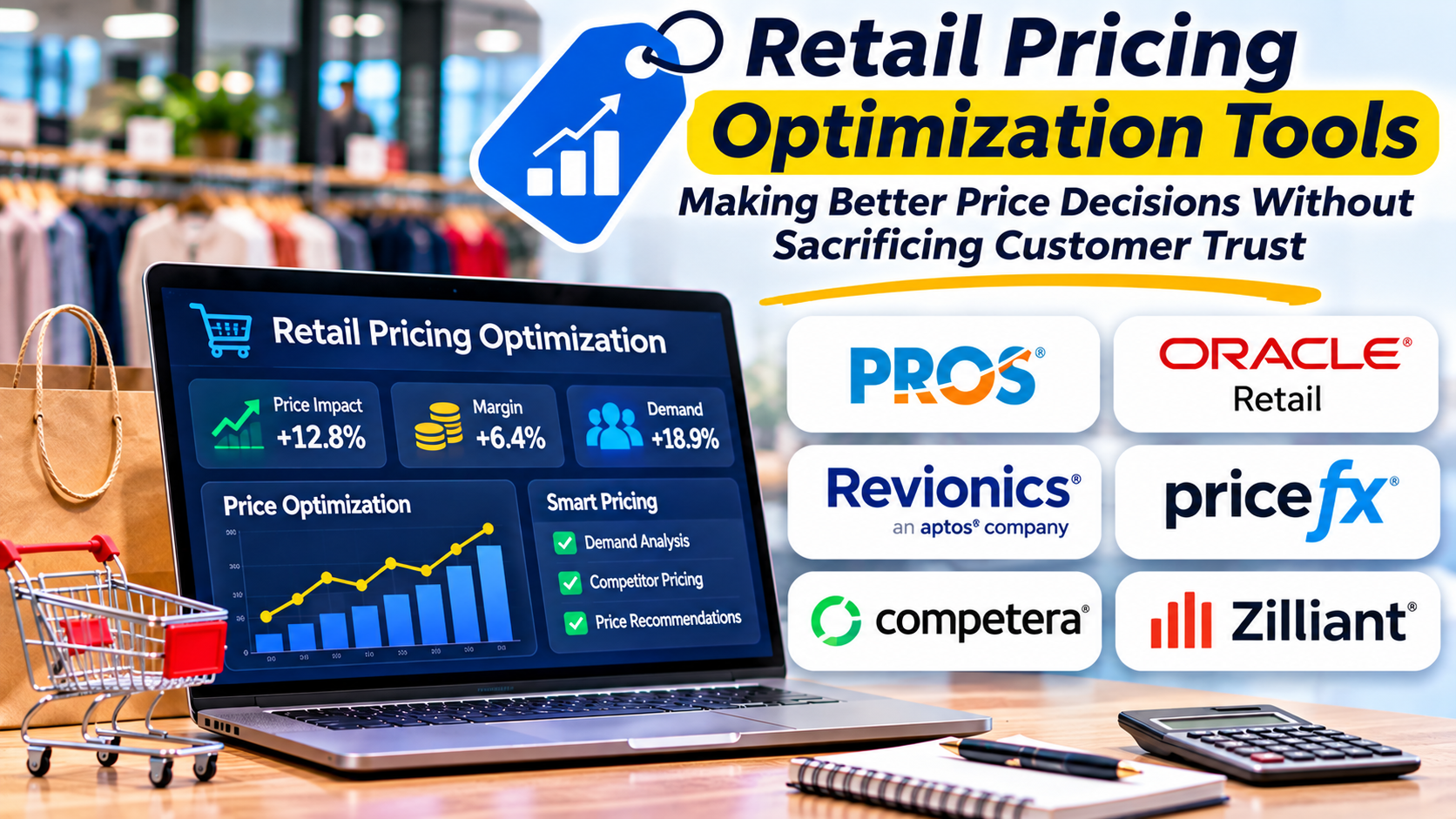
Revionics
Revionics provides retail price, promotion, and markdown optimization capabilities.
Its software is relevant to retailers managing large assortments and seeking analytical support for pricing decisions.
An enterprise retailer may evaluate how the platform incorporates pricing rules, demand patterns, and commercial objectives.
Potential fit: Large retailers requiring structured pricing optimization.
Evaluation priority: Model transparency, business constraints, integration, and measurable financial outcomes.
Competera
Competera offers retail pricing software with capabilities relevant to competitive pricing and price optimization.
It is relevant to retailers seeking to combine market information with internal pricing decisions.
The important question is whether the system supports the organization’s actual pricing strategy rather than encouraging automatic reactions to every competitor change.
Potential fit: Retailers with significant competitive pricing requirements.
Evaluation priority: Data coverage, pricing logic, control mechanisms, and reporting.
Pricefx
Pricefx provides pricing software across several commercial pricing workflows.
Its broader capabilities may be relevant to retailers or businesses requiring structured price management and optimization.
Because pricing needs differ between retail and other commercial models, buyers should evaluate the modules and workflows that apply to their business.
Potential fit: Organizations with complex pricing processes and governance requirements.
Evaluation priority: Retail-specific suitability, configuration, integrations, and operational complexity.
Blue Yonder
Blue Yonder provides retail planning capabilities that include pricing and promotion-related solutions.
It may be relevant to retailers seeking closer coordination between pricing, demand, and inventory planning.
Potential fit: Retailers evaluating pricing within a wider planning environment.
Evaluation priority: How pricing decisions interact with demand forecasts, inventory, and merchandise plans.
Omnia Retail
Omnia Retail provides pricing automation and related capabilities for retailers.
Its approach is relevant to businesses managing competitive price information and rule-based pricing workflows.
Potential fit: Retailers seeking more systematic price monitoring and automation.
Evaluation priority: Product matching, rule flexibility, approval controls, and the consequences of automated price changes.
Comparing Pricing Software Approaches
| Platform | General orientation | Key evaluation area |
|---|---|---|
| Revionics | Retail price and markdown optimization | Financial objectives and pricing models |
| Competera | Competitive and optimized retail pricing | Market data and recommendation quality |
| Pricefx | Broad pricing management and optimization | Workflow and business-model fit |
| Blue Yonder | Pricing within retail planning | Demand and inventory coordination |
| Omnia Retail | Price monitoring and automation | Rules and competitive data quality |
The platforms differ in scope.
A retailer should compare relevant capabilities rather than assuming that every product offers equivalent optimization models.
Price Elasticity: A Useful Concept With Important Limits
Price elasticity describes how demand responds to a change in price.
A product is relatively price-sensitive when a price change produces a substantial change in demand.
A product is less price-sensitive when demand changes comparatively little.
For example, customers may respond strongly to price differences for widely available household products.
Demand for a specialized product with few substitutes may behave differently.
However, observed sales changes cannot always be attributed to price alone.
Promotions, weather, seasonality, availability, competitor actions, and customer preferences may also influence demand.
Pricing models must account for these factors where possible.
Even then, estimates remain uncertain.
Retailers should avoid treating elasticity calculations as exact predictions.
Why Price Optimization Requires Product Context
Products do not exist independently.
A retailer may sell a popular item at a relatively low margin because customers associate it with the store’s overall price competitiveness.
Other products may provide greater margins.
Some products complement each other.
For example, lowering the price of a printer may influence sales of compatible supplies.
Pricing systems that optimize each product independently may miss these relationships.
A useful pricing strategy considers categories, customer expectations, complementary purchases, and long-term commercial objectives.
The level of sophistication required depends on the business.
A small retailer may benefit from consistent margin rules and regular competitor reviews.
A large retailer may require more advanced analytical models.
Promotions: Measuring Incremental Value
Promotions are common in retail, but their financial effect can be difficult to evaluate.
Consider a product that normally sells 100 units per week.
During a promotion, it sells 160 units.
The additional 60 units do not necessarily represent entirely new demand.
Some customers may have purchased earlier than planned.
Others may have switched from a similar product.
The retailer may also have reduced its margin on units that would have sold at the regular price.
A proper promotional evaluation should consider incremental sales, margin changes, inventory effects, and the relevant comparison period.
Pricing optimization software can support this analysis when appropriate data is available.
However, organizations should understand the assumptions behind the results.
Markdown Optimization for Seasonal Inventory
Markdown decisions involve a trade-off between selling products quickly and preserving margin.
Imagine a clothing retailer with substantial winter inventory remaining near the end of the season.
A small discount may preserve margin but fail to clear enough stock.
A large discount may increase sell-through while unnecessarily sacrificing revenue.
Markdown planning can consider remaining inventory, selling time, expected demand, and business constraints.
The objective may be to maximize recovery from stock that has limited future selling value.
However, optimization depends on reliable inventory and demand information.
If stock records are inaccurate, the resulting recommendations may be misleading.
Competitive Pricing Data Must Be Reliable
Competitive intelligence is useful only when products are compared appropriately.
A retailer may discover that a competitor offers an apparently identical product at a lower price.
But the competing listing may differ in package size, warranty, delivery charges, availability, or included services.
Automated product matching can introduce errors.
Retailers should establish procedures for reviewing uncertain matches and excluding unsuitable comparisons.
They should also consider whether the competitor is relevant to their customer segment.
Matching every competitor’s lowest advertised price can create unnecessary margin pressure.
Pricing Governance and Customer Trust
Pricing decisions can have legal, ethical, and reputational consequences.
Retailers should establish clear policies for discounts, price changes, promotions, and customer communication.
Applicable consumer protection, advertising, and competition laws vary by jurisdiction.
Organizations should review relevant obligations before deploying automated pricing.
Particular care is needed when pricing systems use customer-related information.
A pricing model should not be assumed acceptable merely because it is technically possible.
Retailers should consider fairness, transparency, privacy, and the potential effect on customer trust.
Human review may be appropriate for unusual or high-impact price recommendations.
The Data Required for Pricing Optimization
A pricing platform may depend on several data sources.
These include:
- Product identifiers and attributes.
- Current and historical prices.
- Sales transactions.
- Product costs.
- Inventory availability.
- Promotional calendars.
- Competitor prices.
- Store and channel information.
- Relevant demand factors.
Data quality is essential.
Incorrect costs can produce misleading margin calculations.
Missing stock information can make low sales appear to indicate weak demand when the product was unavailable.
Inconsistent product identifiers can distort competitive comparisons.
Before investing in advanced optimization, retailers should examine whether their underlying data supports reliable analysis.
How to Test a Pricing Optimization Platform
A meaningful evaluation should use historical data and realistic business constraints.
Select a representative category containing products with different sales patterns and margins.
Ask the platform to generate pricing recommendations.
Then examine the assumptions behind those recommendations.
Can analysts understand why a particular price is suggested?
Can the retailer enforce minimum margins or other business rules?
Does the system identify uncertain recommendations?
Can pricing managers review and approve changes?
How does the platform handle incomplete data?
Where feasible, conduct controlled pilots rather than changing prices across the entire business immediately.
Measure outcomes using appropriate comparisons and consider possible external influences.
Metrics for Pricing Performance
Gross margin
Gross margin helps evaluate the financial contribution of sales after product costs.
However, it does not account for every operating expense.
Revenue
Revenue indicates total sales value but does not establish profitability.
Unit sales
Unit sales help assess demand response, although higher volume is not always beneficial.
Inventory turnover
Turnover can reveal whether pricing supports appropriate inventory movement.
Markdown recovery
Markdown performance helps evaluate the value recovered from discounted inventory.
Customer retention
Longer-term customer behavior can help identify whether pricing practices support sustainable relationships.
A balanced evaluation uses several measures rather than optimizing one number in isolation.
Common Pricing Optimization Mistakes
Automating before establishing pricing policies
Software needs clear objectives and constraints.
Without them, automated recommendations may conflict with the retailer’s strategy.
Treating historical correlations as causal proof
A price change and a sales change occurring together do not establish that one caused the other.
Ignoring inventory availability
A product cannot generate sales when it is out of stock.
Demand models should account for this limitation where possible.
Reacting to every competitor movement
Frequent price changes may reduce margins and confuse customers.
Not every competitor price requires a response.
Overlooking operational execution
A recommended price must be applied consistently across relevant channels, labels, and checkout systems.
Errors can create customer disputes and compliance concerns.
Choosing the Right Pricing Optimization Approach
A smaller retailer may need disciplined cost-based pricing, competitor monitoring, and straightforward approval rules.
A mid-sized retailer may benefit from promotion analysis and automated price management.
A large enterprise may require advanced demand modeling, markdown optimization, and category-level pricing controls.
The correct approach depends on product complexity, data quality, competitive conditions, and available expertise.
Before purchasing, define the decisions the organization wants to improve.
Then evaluate whether the platform can produce understandable recommendations within appropriate business constraints.
Retail pricing optimization succeeds when it helps businesses make better trade-offs between customer value, demand, inventory, and profitability.
The goal is not to change prices as often as possible.
It is to make pricing decisions that remain commercially sound, operationally practical, and worthy of customer trust.