Introduction
A restaurant can have empty tables and still turn away guests.
That sounds contradictory, but it happens when the right table is unavailable at the right moment. A party of two may be waiting while a six-seat table remains unoccupied. Another reservation may be delayed because a previous party has not finished dining. Meanwhile, the host is juggling phone calls, walk-ins, special requests, and an incomplete picture of the dining room.
These problems are not simply scheduling mistakes. They reflect the challenge of coordinating limited seating capacity with unpredictable guest behavior.
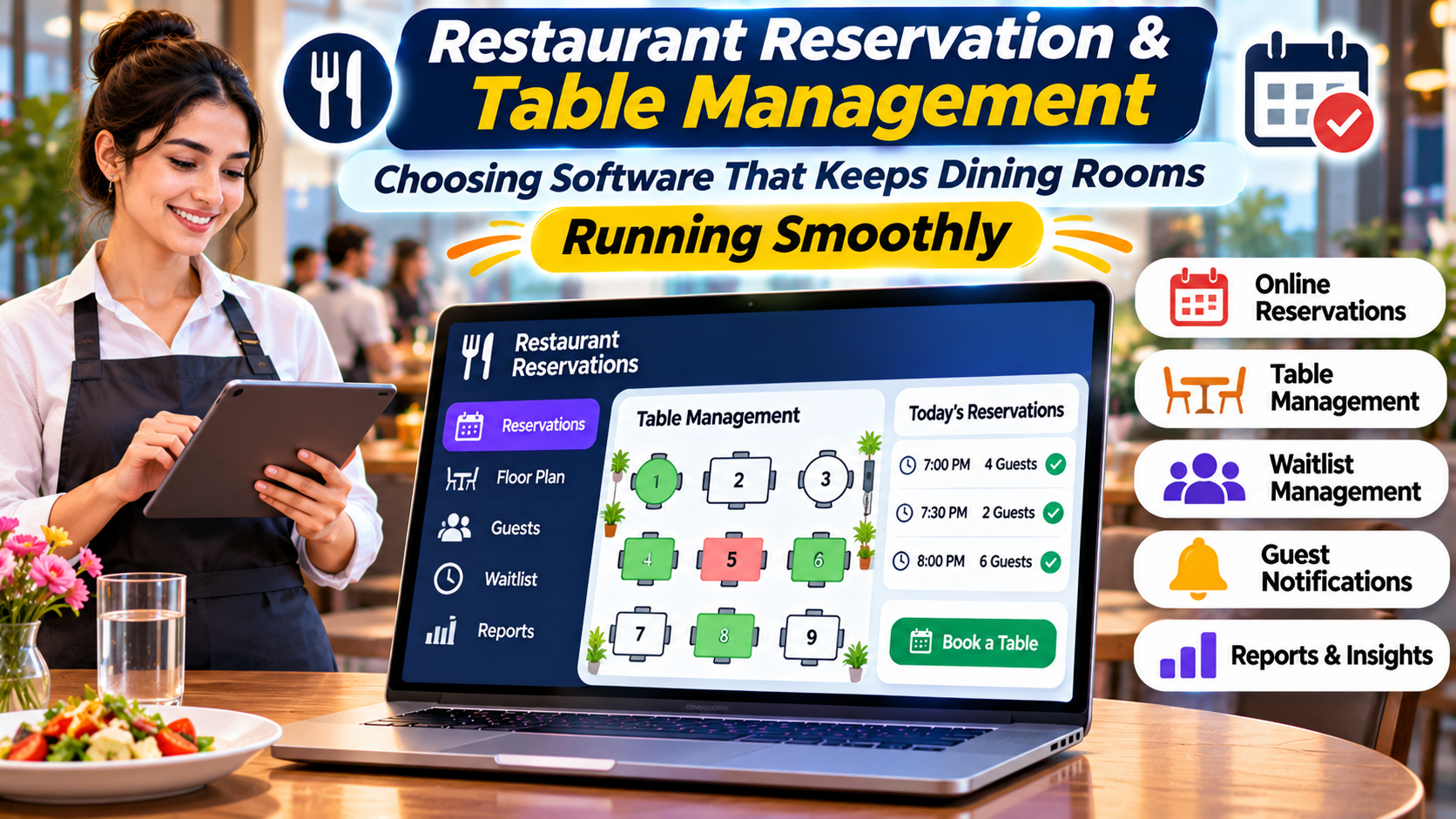
Restaurant reservation and table management software helps operators organize bookings, assign tables, manage waitlists, and coordinate the flow of guests through the dining room.
The best system does more than collect reservations. It helps restaurants make realistic seating promises and deliver a consistent guest experience.
What Is Restaurant Reservation and Table Management Software?
Restaurant reservation and table management software coordinates guest bookings with the restaurant’s physical seating capacity.
A reservation system records when guests plan to arrive, how many people are in their party, and any relevant booking details.
Table management adds another operational layer. It connects those reservations with actual tables, seating configurations, dining durations, and the current status of the dining room.
Some platforms also support:
- Online reservation booking
- Walk-in guest registration
- Digital waitlists
- Table assignments
- Seating charts and floor plans
- Guest profiles and visit history
- Booking confirmations and reminders
- Cancellation and no-show controls
- Restaurant discovery and reservation distribution
- Reporting and operational analytics
- Point-of-sale integrations
- Multi-location administration
Not every product offers all these capabilities.
Some are primarily reservation marketplaces that help restaurants attract diners. Others emphasize operational control, guest relationships, or enterprise hospitality workflows.
Understanding these differences is the starting point for selecting software.
The Difference Between Taking Reservations and Managing Capacity
A basic booking calendar answers one question: Is there an opening at the requested time?
A sophisticated table management system must answer several additional questions.
Can the restaurant accommodate the party size?
Which table or combination of tables will be available?
How long is the party likely to occupy the table?
Will seating this reservation interfere with a larger booking later?
Can the kitchen and service team handle the expected arrival volume?
These questions show why reservation availability is not the same as a simple count of empty tables.
Consider a restaurant with twelve tables.
At 7:00 p.m., three tables may be physically empty. However, two might be reserved for guests arriving at 7:15 p.m., and the remaining table may not accommodate the waiting party.
The restaurant has open seats but no appropriate seating opportunity.
Software can help hosts visualize these constraints and make better decisions.
It cannot eliminate the uncertainty of guest arrival times or meal durations, but it can make the available information easier to use.
How a Restaurant Reservation Workflow Operates
A typical reservation passes through several stages.
Booking Request
A guest requests a date, time, and party size through the restaurant’s website, a reservation platform, or another supported channel.
The system evaluates configured availability.
Confirmation
The restaurant accepts the booking according to its rules.
Some systems send automated confirmations and reminders.
Restaurants should make cancellation terms and any deposit requirements clear before the guest commits.
Pre-Arrival Planning
The host team reviews upcoming bookings and prepares table assignments.
Special requests may include accessible seating, high chairs, or other arrangements.
A request should not automatically be treated as a guaranteed accommodation unless the restaurant confirms it.
Guest Arrival
The host checks in the party and assigns an appropriate table.
If the table is not ready, the system may record a waiting status.
Dining Room Updates
Staff update table statuses as parties are seated, finish dining, and leave.
These updates help the host estimate future availability.
Departure and Turnover
After guests leave, the table becomes available once it is ready for another party.
The restaurant can then seat waiting guests or prepare for the next reservation.
The accuracy of this workflow depends on employees updating information consistently.
Even advanced software cannot produce dependable seating estimates from outdated table statuses.
Features That Matter in Daily Restaurant Operations
Visual Table Management
A digital floor plan gives staff a practical overview of the dining room.
Tables may be displayed by size, section, assignment, and current status.
A useful interface should help hosts understand seating options quickly, especially during busy periods.
Restaurants with flexible seating arrangements should verify whether the system supports combining or separating tables.
Reservation Rules
Restaurants may need different booking rules for lunch, dinner, weekends, holidays, and special events.
Relevant settings can include party-size limits, booking windows, seating durations, and reservation pacing.
The system should support realistic operating policies without forcing staff to manage every exception manually.
Waitlist Management
Walk-in guests are an important part of many restaurant businesses.
Waitlist tools can record party size, arrival order, contact details, and estimated seating availability.
Some platforms support notifications when a table becomes ready.
Wait estimates should be presented carefully because they can change as dining conditions evolve.
Guest Profiles
Guest profiles may record previous visits, preferences, and relevant service notes.
This information can help staff recognize returning guests and provide more consistent service.
However, restaurants should avoid collecting unnecessary personal information or making assumptions about guests.
Access to guest records should be controlled according to employee responsibilities.
Booking Reminders
Automated confirmations and reminders can help guests remember reservations and provide an opportunity to cancel when plans change.
Restaurants should verify which communication channels the platform supports and whether messaging creates additional costs.
Deposits and Cancellation Policies
Some restaurants use deposits or card guarantees for high-demand bookings, large parties, or special dining experiences.
Software may help administer these policies.
The terms should be clear, proportionate, and consistent with applicable consumer requirements.
Reporting
Useful reports may include reservation volume, cancellations, no-shows, walk-in activity, table utilization, and guest visit patterns.
The goal is to identify operational constraints rather than simply count bookings.
Restaurant Reservation Platforms Worth Evaluating
Different products offer different combinations of booking distribution, table management, and guest engagement.
The following examples illustrate relevant approaches rather than an independently tested ranking.
OpenTable
OpenTable provides restaurant reservation and guest management technology alongside a consumer-facing restaurant discovery and booking service.
Its combination of diner discovery and restaurant operations may be relevant to businesses seeking both reservation distribution and table management.
Consider it when: The restaurant values reservation acquisition as well as operational tools.
Evaluate carefully: Market availability, booking-related commercial terms, guest data access, integrations, and table management functionality.
Resy
Resy provides restaurant reservation and guest experience technology.
It is associated with a consumer reservation ecosystem and restaurant-facing tools.
Consider it when: The restaurant wants to participate in its supported reservation network while managing bookings and guest relationships.
Evaluate carefully: Geographic coverage, onboarding eligibility, operational features, and commercial arrangements.
SevenRooms
SevenRooms offers hospitality guest experience and operational technology, including reservation and guest management capabilities.
Its emphasis on guest relationships may be relevant to restaurants and hospitality groups seeking a connected view of guest interactions.
Consider it when: Guest profiles, direct relationships, and hospitality workflows are major priorities.
Evaluate carefully: Integration requirements, customer data practices, deployment complexity, and the specific modules included.
Tock
Tock supports reservation and hospitality booking workflows, including experiences that may require different booking arrangements from conventional restaurant tables.
Its approach may be relevant to tasting menus, ticketed dining, and other structured hospitality experiences.
Consider it when: The restaurant sells experiences or needs booking policies beyond ordinary table reservations.
Evaluate carefully: Supported booking models, payment arrangements, integrations, and current product availability.
Eat App
Eat App provides restaurant reservation, table management, and guest relationship tools.
Its offering is relevant to restaurants looking for operational reservation functionality and guest management.
Consider it when: A restaurant wants a focused platform for reservations, seating, and guest records.
Evaluate carefully: Geographic support, integration coverage, reporting, and staff workflows.
These products should be assessed using current vendor documentation. Features, regional availability, and commercial terms can change.
Reservation Marketplace or Direct Booking System?
One of the most important purchasing decisions is whether the restaurant needs external booking demand, direct reservation management, or both.
A reservation marketplace can help guests discover restaurants and make bookings through an established consumer platform.
That distribution may be valuable, particularly for restaurants seeking new diners.
However, marketplace participation may introduce additional commercial terms and dependencies.
A direct booking system focuses on reservations made through the restaurant’s own channels.
This can provide more control over the guest journey, although the restaurant remains responsible for attracting traffic.
Some platforms support both approaches.
The right decision depends on how the restaurant acquires guests and how much operational independence it requires.
Understanding Table Turnover Without Rushing Guests
Table turnover describes how frequently tables serve different parties during a defined period.
Higher turnover can increase seating opportunities, but it should not become the only objective.
Guests need appropriate time to enjoy their meals.
A restaurant that aggressively shortens dining durations may damage its reputation and discourage repeat visits.
A better approach is to examine where avoidable delays occur.
For example, a table may remain unavailable because staff were not notified that guests had departed.
Another delay may arise because the host cannot see that a table has been cleaned.
Software can improve coordination around these transitions.
The objective should be efficient service rather than unnecessary pressure on diners.
How Reservation Pacing Affects the Kitchen
A dining room may have enough seats for thirty guests arriving at the same time.
That does not mean the kitchen can serve thirty new orders efficiently.
Reservation pacing controls how many bookings are accepted within particular time intervals.
For example, a restaurant might distribute arrivals across several booking times instead of concentrating everyone at 7:00 p.m.
The appropriate pacing depends on staffing, menu complexity, service style, and kitchen capacity.
Reservation software should allow operators to configure rules that reflect those constraints.
Pacing decisions should be reviewed when the menu, staffing, or operating model changes.
A Practical Evaluation Scenario
Imagine a restaurant with forty seats and a combination of reservations and walk-ins.
During a vendor demonstration, ask the provider to show how the system handles the following situation:
A party of four arrives ten minutes early.
A party of two is fifteen minutes late.
A table scheduled to become available remains occupied.
A walk-in group of six requests seating.
A reservation for eight guests is expected within the next hour.
The host needs to make decisions without losing track of commitments.
A useful system should make the relevant constraints visible.
It should also allow staff to adjust assignments and communicate realistic expectations.
This scenario reveals more about operational suitability than a demonstration of the booking calendar alone.
Data Privacy and Guest Information
Reservation systems may store names, contact details, dining history, and service preferences.
Some may also process payment-related information for deposits or guarantees.
Restaurants should evaluate:
- Role-based access permissions
- Data retention controls
- Secure integrations
- Audit records
- Guest communication preferences
- Data export capabilities
- Relevant privacy compliance responsibilities
A guest profile can improve hospitality, but it should not become an unrestricted repository of personal information.
Restaurants should establish clear internal policies for recording and using guest notes.
Costs Beyond the Software Subscription
Reservation software expenses may include subscription charges, booking-related fees, messaging, payment processing, implementation, and integrations.
Some arrangements may involve different charges for reservations acquired through different channels.
Restaurants should request a written breakdown of the full commercial model.
A low subscription price does not necessarily indicate the lowest total operating cost.
Likewise, a higher-priced platform may be worthwhile if its capabilities solve meaningful operational problems.
The evaluation should connect software expense with measurable business outcomes.
Common Implementation Mistakes
A frequent mistake is importing existing reservation rules without checking whether they reflect current operations.
Another is setting unrealistic dining durations to increase apparent availability.
Restaurants may also fail to train hosts on exception handling.
If employees do not understand how to manage late arrivals, combined tables, or walk-in priorities, the system may create confusion rather than reduce it.
Finally, operators sometimes rely on guest counts without considering kitchen capacity.
Seating and service planning should work together.
Frequently Asked Questions
What is the difference between reservation software and table management software?
Reservation software records and administers bookings. Table management software coordinates those bookings with actual seating capacity, table assignments, and dining room activity. Many products combine both.
Can reservation software reduce no-shows?
Confirmations, reminders, cancellation options, and appropriate booking policies may help reduce avoidable no-shows. Results depend on the restaurant and its guests.
Do small restaurants need reservation software?
Not always. Restaurants with limited booking volume may manage reservations manually. Dedicated software becomes more valuable when bookings, walk-ins, and seating constraints become difficult to coordinate.
Can these systems manage multiple restaurant locations?
Some platforms support multi-location operations. Businesses should verify centralized reporting, location permissions, and booking configuration.
Is a reservation marketplace necessary?
No. Some restaurants prioritize direct reservations. Others benefit from marketplace discovery. The best approach depends on customer acquisition and operational needs.
Final Thoughts
Restaurant reservation and table management software should help operators make better seating decisions while preserving the guest experience.
The strongest platform is not necessarily the one offering the most booking channels or the longest feature list.
It is the system that reflects the restaurant’s actual floor plan, service pace, staffing, and customer expectations.
Before choosing software, restaurants should test realistic seating conflicts, review the full commercial arrangement, and involve the employees who manage the dining room every day.
When the technology supports those workflows, reservations become easier to coordinate, service becomes more predictable, and guests receive a more consistent welcome.