Introduction
Someone looking for mental health support may encounter dozens of applications promising to improve mood, reduce stress, or connect them with a therapist.
At first glance, these services can appear similar. They may offer daily check-ins, guided exercises, messaging, video appointments, or conversational interfaces.
Yet the differences are substantial.
One application may connect users with licensed mental health professionals. Another may provide educational exercises based on psychological techniques. A third may function primarily as a mood journal.
These products should not be treated as equivalent forms of care.
Mental health therapy apps can make support more accessible and convenient, but choosing one requires careful attention to clinical purpose, professional qualifications, privacy, cost, and safety.
The most useful question is not which app has the most attractive interface. It is what kind of help the person needs and whether the application can appropriately provide it.
What Counts as a Mental Health Therapy App?
The term mental health therapy app is often used broadly.
It can describe several distinct categories of digital services.
Online Therapy Platforms
Online therapy platforms connect users with mental health professionals through video sessions, messaging, or other supported communication methods.
These services may provide psychotherapy or counseling, depending on the clinician’s qualifications, the platform’s model, and the user’s location.
The application itself is not the therapist.
Its role is to facilitate access, communication, scheduling, payment, and related administrative activities.
Guided Self-Help Applications
Guided self-help apps provide structured exercises intended to support emotional well-being.
Some draw on approaches such as cognitive behavioral therapy, commonly called CBT.
These applications may help users reflect on thoughts, behaviors, or emotional patterns.
However, using CBT-inspired exercises does not mean an app provides the same service as psychotherapy delivered by a qualified clinician.
Mood and Symptom Tracking Apps
Mood trackers allow users to record feelings, experiences, symptoms, or daily patterns.
Their main purpose is observation and reflection.
Some provide charts or summaries that users can discuss with a healthcare professional.
A tracking application should not be assumed to diagnose a mental health condition.
Meditation and Stress Management Apps
Meditation and relaxation applications may offer breathing exercises, guided meditation, sleep content, or mindfulness activities.
These tools can support general well-being.
They should not automatically be described as clinical treatment for mental health conditions.
AI-Based Conversational Tools
Some applications use automated conversational systems to provide reflections, prompts, or structured exercises.
These tools may be convenient and available at any hour.
However, their responses can be inaccurate, inappropriate, or poorly suited to a user’s circumstances.
An automated conversation should not be confused with a therapeutic relationship involving a qualified professional.
The Most Important Distinction: Treatment Versus Support
The word therapy carries clinical meaning.
A platform offering professional psychotherapy should make it possible to understand who provides the service, what qualifications they hold, and which professional rules apply.
A self-help application may offer useful exercises without providing clinical treatment.
The difference affects expectations.
For example, a person seeking help with ordinary stress may find guided relaxation exercises useful.
Someone seeking assessment or treatment for a significant mental health concern may need a qualified clinician.
An application should not encourage users to substitute generic self-help content for appropriate professional care.
How Online Therapy Platforms Work
Online therapy services generally begin with registration and intake.
Users may answer questions about their goals, preferences, and circumstances.
The service may then offer access to an available clinician or a matching process.
Sessions can take place through video or other supported channels.
The exact arrangement varies by provider.
Video Therapy
Video sessions can offer a familiar appointment structure while removing the need to travel.
However, privacy, internet reliability, and the availability of an appropriate space still matter.
A person may not have a quiet location where they can speak comfortably.
Video therapy also requires suitable professional arrangements, including attention to the clinician’s authorization to provide care in the user’s location.
Messaging-Based Support
Some platforms offer asynchronous messaging.
This can make communication more flexible.
However, messaging is not necessarily equivalent to a scheduled therapy session.
Users should understand response expectations, availability, boundaries, and what happens when urgent assistance is needed.
Matching With a Therapist
Matching systems may consider preferences, areas of concern, or clinician availability.
A good match involves more than selecting a preferred communication style.
Professional qualifications, relevant experience, therapeutic approach, and the quality of the working relationship are important.
Users should know how to request a different clinician if the initial arrangement is unsuitable.
Mental Health Therapy Apps Worth Understanding
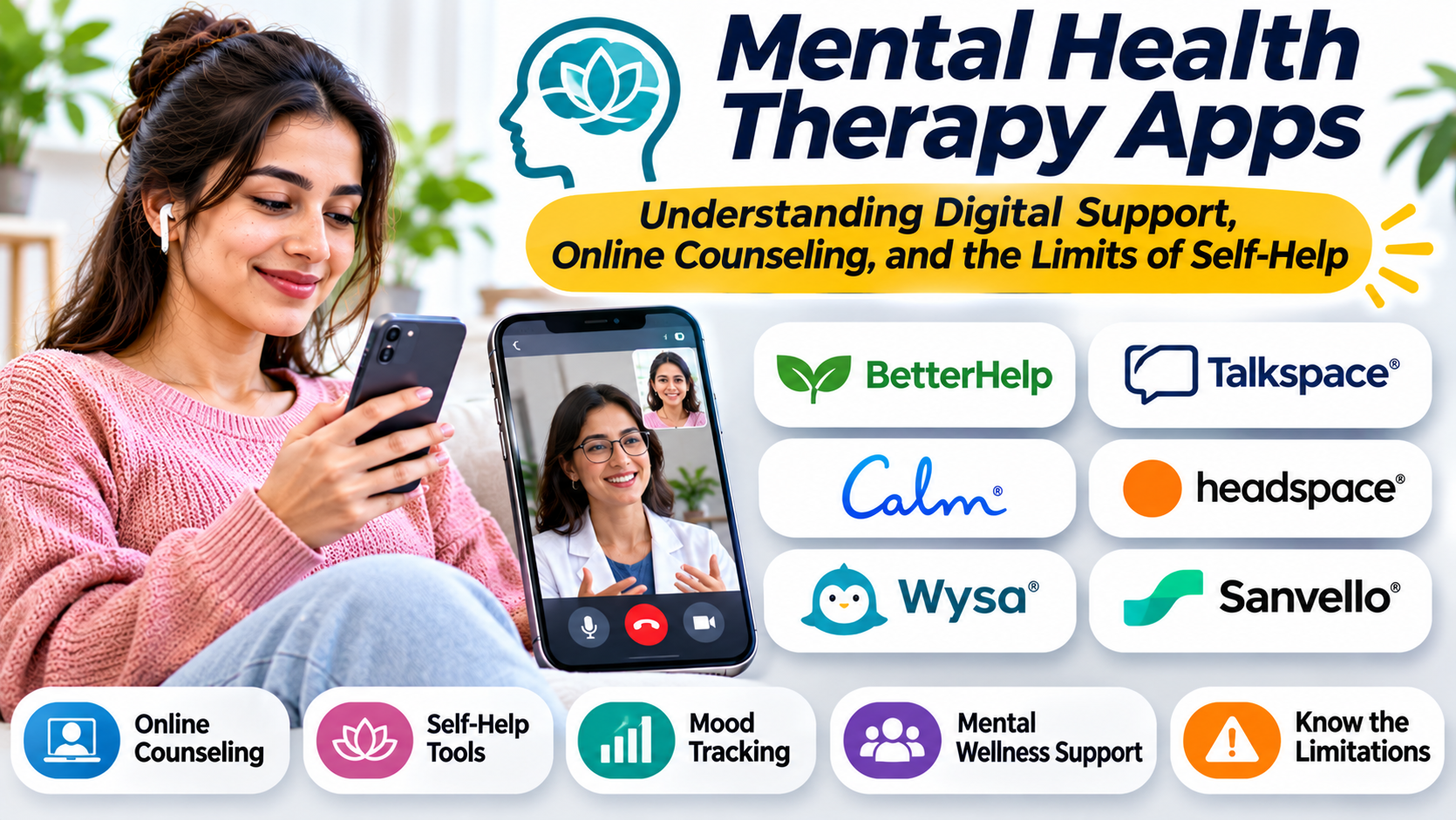
The following products illustrate different approaches to digital mental health support. They are not interchangeable or ranked.
BetterHelp
BetterHelp is an online therapy service connecting users with mental health professionals.
Its model centers on remote counseling rather than a library of self-guided wellness exercises alone.
It may appeal to users seeking professional support without attending an in-person clinic.
Important evaluation questions include clinician qualifications, geographic availability, communication arrangements, subscription terms, and the process for changing therapists.
Users should verify current service details and whether the offering meets their clinical and financial needs.
Talkspace
Talkspace provides digital mental health services, including therapy offerings delivered through supported remote communication methods.
Its service model and payment arrangements may differ from those of other online therapy providers.
Depending on location and eligibility, users may need to investigate insurance-related options or other coverage arrangements.
Before enrolling, confirm the specific service, clinician access, communication format, and financial terms.
Headspace
Headspace is primarily associated with meditation, mindfulness, sleep, and mental wellness content, although its broader offerings can vary by market and arrangement.
It illustrates the difference between a general mental wellness application and a platform centered on psychotherapy.
For someone seeking guided relaxation or mindfulness practice, this type of service may be relevant.
It should not automatically be treated as a substitute for professional assessment or treatment.
Daylio
Daylio is a mood and activity tracking application.
Its value lies in helping users record experiences and identify patterns over time.
It is not equivalent to a therapy platform connecting users with clinicians.
People considering it should focus on ease of logging, data controls, and whether tracking feels useful rather than burdensome.
CBT-Informed Self-Help Apps
Some apps provide structured exercises based on CBT concepts, such as identifying thought patterns or reflecting on behavior.
The quality, evidence, and intended audience of these applications vary.
Users should examine who developed the content, whether qualified professionals contributed, and what claims the provider makes.
A clinical-sounding description alone is not evidence that an application is effective.
Comparing Different App Categories
| Type of application | Primary purpose | Main limitation |
|---|---|---|
| Online therapy service | Access to qualified mental health professionals | Availability, fit, and cost vary |
| Guided self-help app | Structured psychological exercises | Does not necessarily provide clinical treatment |
| Mood tracking app | Record feelings and patterns | Self-reported data may be incomplete |
| Meditation app | Relaxation and mindfulness practice | Not a replacement for indicated clinical care |
| AI conversation app | Automated prompts and interaction | May provide inaccurate or unsuitable responses |
This comparison is more useful than ranking all mental health apps together.
A meditation application and a licensed therapy service solve different problems.
How to Evaluate Therapist Qualifications
When an application advertises professional therapy, users should be able to identify the clinician’s credentials.
Qualifications and professional titles vary across countries.
In the United States, relevant professionals may include licensed psychologists, clinical social workers, professional counselors, and marriage and family therapists.
Other jurisdictions use different registration and licensing systems.
Users should verify qualifications through appropriate professional sources when possible.
Location Matters
Professional authorization to deliver remote care can depend on where the clinician and client are located.
An application operating internationally does not necessarily provide the same clinical services in every country.
Users should confirm that the clinician is permitted to provide the relevant service in their location.
The Therapeutic Relationship Still Matters
Even when credentials are appropriate, the first therapist may not be the best fit.
Users should consider whether they feel understood, whether treatment goals are clear, and whether communication expectations are reasonable.
A platform should explain how users can raise concerns or request changes.
Privacy Is a Core Selection Criterion
Mental health applications can collect highly sensitive information.
This may include mood entries, personal histories, session communications, and payment details.
Users should examine what the provider collects and how it uses that information.
Important questions include:
- Is information shared with advertising or analytics partners?
- Can users delete their account and associated data?
- How long are records retained?
- Who can access conversations or journal entries?
- Are professional therapy records handled differently from general app activity?
- Does the service explain its security practices?
- What happens when a user stops paying?
A privacy policy should be understandable enough for users to make an informed decision.
Healthcare Privacy Rules Are Not Universal
A consumer wellness application may operate under different legal obligations from a healthcare provider.
The fact that an app addresses mental health does not automatically mean it is covered by every healthcare privacy law.
Protections depend on the organization, services, jurisdiction, and data involved.
Users should not rely solely on broad statements such as secure or confidential.
Evidence and Clinical Claims
Mental health applications frequently refer to research.
However, the strength of evidence can differ.
An application may use techniques associated with an established therapeutic approach without having been evaluated as a complete product.
This distinction matters.
Evidence supporting CBT as a therapeutic approach does not automatically prove that every app using CBT terminology is effective.
When assessing research claims, consider whether the study evaluated the actual application, who participated, what outcomes were measured, and how long the effects were observed.
Also examine whether findings come from independent research or studies connected to the product provider.
Evidence should inform expectations rather than be reduced to a marketing label.
Safety Features and Crisis Limitations
Mental health apps should clearly explain what happens when users need urgent assistance.
An online therapy service may not provide immediate responses outside scheduled sessions.
A self-help application may not monitor users continuously.
An AI chatbot should not be relied upon to assess or manage a mental health emergency.
Users should look for clear information about emergency limitations and appropriate support channels.
If someone is in immediate danger or may harm themselves or another person, they should contact local emergency services or an appropriate crisis service rather than wait for an app response.
The availability and contact details of crisis services vary by country.
Costs, Subscriptions, and Insurance
Mental health applications use different payment models.
A meditation app may charge for content access.
An online therapy service may charge a recurring subscription or fees associated with appointments.
Some services may support eligible insurance arrangements in certain markets.
Users should confirm:
- What the payment covers.
- Whether sessions are limited.
- How cancellations work.
- Whether the subscription renews automatically.
- What happens when a therapist is unavailable.
- Whether insurance coverage applies to the specific service.
- How refunds and billing disputes are handled.
A low advertised price does not establish the total cost of receiving the support someone needs.
Accessibility and Everyday Usability
A useful mental health application should not create additional stress through complicated navigation.
Consider text readability, screen reader support, language availability, and the number of steps required to access essential functions.
For therapy services, users should also test the appointment process and communication tools.
For mood tracking, the app should make it easy to record information without demanding extensive daily input.
The best interface is one that supports the intended activity without making engagement feel compulsory.
When Tracking Becomes Counterproductive
Mood tracking can help some people identify patterns.
For others, frequent prompts may encourage excessive monitoring or worry.
An app should allow users to adjust reminders or reduce tracking frequency.
The goal is to support useful reflection, not to create pressure to record every emotional change.
If tracking increases distress, discussing the approach with a qualified professional may be appropriate.
A Practical App Selection Process
Begin by identifying the purpose.
Is the goal to speak with a qualified therapist, learn coping exercises, practice relaxation, or maintain a personal journal?
Next, narrow the options to applications that genuinely provide that function.
For a professional therapy service, verify clinician qualifications, availability, communication methods, and cost.
For self-help software, examine the quality of content, privacy practices, and the strength of evidence behind any clinical claims.
Then test the interface.
Consider whether the application fits ordinary daily life and whether its notifications feel manageable.
Finally, review how to stop using the service, export information, or delete data.
These exit arrangements matter because personal mental health information may remain sensitive long after an app is no longer useful.
Common Mistakes to Avoid
One mistake is assuming that all mental health apps provide therapy.
Another is selecting a service based only on advertising claims or a matching questionnaire.
Users may also overlook subscription terms, clinician qualifications, or privacy policies.
A further risk is expecting immediate support from a service that does not provide crisis care.
Clear expectations are essential.
Digital convenience should never obscure the limits of the service.
Frequently Asked Questions
Are mental health therapy apps the same as seeing a therapist?
Only some applications connect users with qualified professionals. Many provide self-help exercises, meditation, or mood tracking rather than psychotherapy.
Can an app diagnose a mental health condition?
Most general wellness and self-help applications should not be treated as diagnostic services. Appropriate assessment depends on qualified professionals and the relevant clinical process.
Are online therapy services suitable for everyone?
Not necessarily. Suitability depends on individual needs, the service offered, professional judgment, and practical considerations.
Can mental health apps replace medication or existing treatment?
Users should not change prescribed treatment solely because of app content. Treatment decisions should be discussed with the relevant healthcare professional.
How can someone tell whether an app protects privacy?
Review the provider’s data practices, permissions, retention policies, account deletion options, and applicable legal protections.
Choosing Support That Matches the Need
Mental health therapy apps can improve access to information, structured exercises, and professional services.
Their usefulness depends on understanding what they actually provide.
A therapy platform should be evaluated as a route to qualified care. A mood tracker should be judged by how well it supports reflection. A meditation app should be assessed as a wellness tool.
Choosing the correct category first prevents many of the most consequential mistakes.
Digital mental health support works best when the application’s purpose, evidence, privacy protections, and limitations are clear to the person using it.