Introduction
A hotel receives reservations from its website, Booking.com, Expedia, and several other travel booking channels.
At first, this looks like a commercial advantage. More channels create more opportunities for travelers to discover and book the property.
But every additional sales channel introduces another place where room availability, prices, and booking restrictions must remain accurate.
Imagine a small hotel with one room left for Saturday night.
A traveler books that room through an online travel agency. Before the hotel’s employee updates the other booking platforms, another traveler reserves the same room elsewhere.
The property now has two confirmed reservations for one available room.
This is the problem hospitality channel managers are designed to reduce.
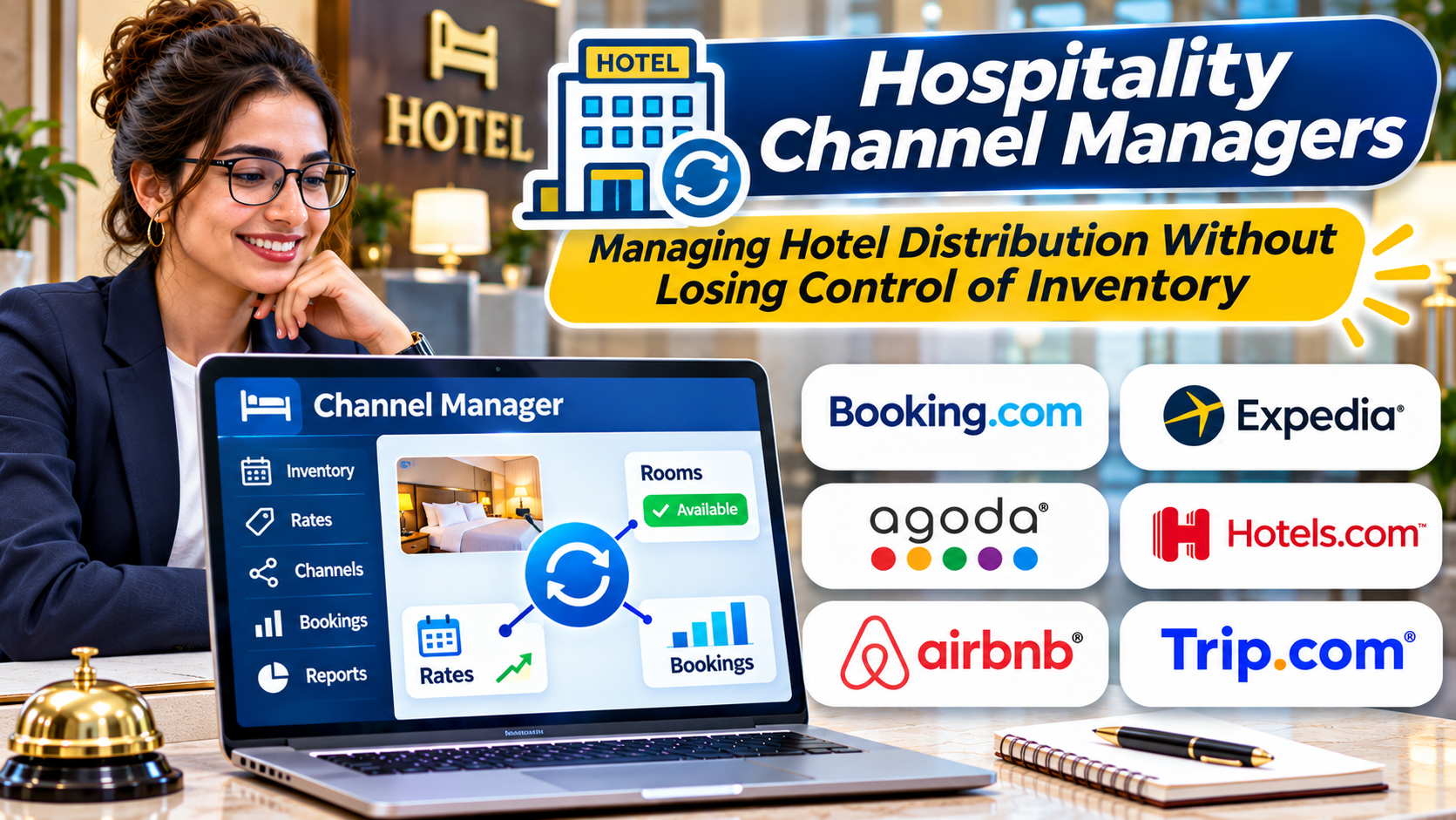
A channel manager connects a property’s room inventory and pricing information with multiple booking channels. It distributes updates and retrieves reservation information through supported integrations.
However, effective hotel distribution requires more than connecting as many channels as possible.
Hotels must understand inventory synchronization, rate plans, reservation delivery, commission costs, and the commercial consequences of their distribution strategy.
The right channel manager helps operators expand their reach without sacrificing control over their inventory.
What Is a Hospitality Channel Manager?
A hospitality channel manager is software that helps accommodation providers distribute and synchronize room availability, rates, and booking information across multiple online sales channels.
These channels may include online travel agencies, regional booking platforms, and other supported distribution partners.
A channel manager typically works with a property management system, booking engine, or another central inventory source.
Its main purpose is to reduce manual updates and keep connected channels aligned.
Depending on the product, channel management capabilities may include:
- Room availability synchronization
- Rate distribution
- Reservation retrieval
- Booking modifications and cancellations
- Minimum-stay restrictions
- Stop-sell controls
- Channel-specific pricing
- Inventory allocation
- Connection monitoring
- Distribution reporting
- PMS and booking engine integrations
- Multi-property administration
Not every integration supports every feature.
For example, one channel may accept room rates and availability but handle certain restrictions differently.
Hotels should verify the capabilities of each important connection.
Why Hotels Use Multiple Booking Channels
Travelers discover accommodation through different platforms.
Some prefer booking directly with hotels.
Others compare properties through online travel agencies.
Certain regional platforms may be particularly relevant to specific markets or traveler segments.
Using several distribution channels can help hotels reach a broader audience.
However, greater exposure does not guarantee greater profitability.
Each channel may involve different commissions, customer acquisition costs, payment arrangements, and cancellation behavior.
A hotel needs to understand the value of each channel rather than measuring success solely by reservation volume.
Channel management software supports this process by making distribution easier to administer.
It does not replace the need for a deliberate commercial strategy.
How Hotel Channel Management Works
A typical channel management workflow involves several connected systems.
1. The Hotel Maintains Room Inventory
The property defines its available room types and relevant inventory.
This information may originate in the PMS or another designated inventory management system.
2. Rates and Restrictions Are Configured
The hotel establishes prices and applicable booking conditions.
These may include minimum stays, maximum stays, closed arrival dates, or stop-sell restrictions.
The exact controls depend on the property’s distribution strategy.
3. The Channel Manager Sends Updates
The channel manager communicates supported information to connected booking platforms.
Each channel processes the update according to its integration.
4. A Guest Makes a Reservation
A traveler books a room through one of the connected channels.
The booking platform sends reservation information through the supported connection.
5. Inventory Is Updated
The reservation reduces the relevant available inventory.
The updated availability is distributed to other connected channels.
6. Changes Are Synchronized
If a reservation is modified or canceled, the affected systems should receive the appropriate update.
The precise workflow depends on the integration and the source of the change.
This process reduces manual administration, but it is not necessarily instantaneous under every condition.
Network delays, channel processing times, mapping errors, and outages can still affect synchronization.
Channel Managers Versus Property Management Systems
A PMS and a channel manager perform related but different jobs.
The PMS primarily manages the hotel’s operational records.
These include reservations, guest stays, room assignments, folios, and front desk activity.
The channel manager primarily coordinates the distribution of availability, rates, restrictions, and booking information across supported sales channels.
The systems often exchange information.
For example, a reservation received through a channel manager may create or update a reservation in the PMS.
When the PMS records a relevant inventory change, that information may be sent back through the channel manager.
Some hospitality vendors combine PMS and channel management capabilities in one platform.
Others offer separate products.
Neither approach is universally superior.
The important question is whether the complete workflow is reliable and suitable for the property.
Channel Manager Versus Central Reservation System
A central reservation system, or CRS, provides centralized reservation and distribution functions.
It is often associated with hotel groups and more complex hospitality distribution environments.
A channel manager usually focuses on connectivity with external booking channels.
However, product boundaries can overlap.
Some vendors provide channel management, CRS, booking engine, and PMS functionality within a connected technology ecosystem.
Hotels should examine responsibilities rather than relying exclusively on product labels.
Essential Features of Hospitality Channel Management Software
Two-Way Reservation Synchronization
A channel manager should support the relevant flow of reservation information between booking platforms and the property’s operational systems.
This may include new bookings, modifications, and cancellations.
Hotels should verify whether the integration supports each workflow.
A connection that receives new reservations but does not reliably handle changes may create operational problems.
Rate Distribution
Hotels need to update room prices across supported channels.
The system should allow the property to manage relevant rate plans without repeated manual entry.
However, not every rate plan should necessarily be identical.
Some channels may have distinct commercial arrangements or supported promotions.
The software should provide appropriate control while respecting contractual requirements.
Room and Rate Mapping
Mapping connects room types and rate plans in one system with their corresponding records in another.
For example, a hotel’s internal room category may have a different name on an OTA.
Incorrect mapping can cause the wrong room or rate to be sold.
Mapping is therefore a critical implementation task.
Hotels should test it carefully before activating live distribution.
Inventory Controls
Channel managers may support pooled inventory, allocation rules, or other distribution arrangements.
The appropriate model depends on the property and the connected systems.
A hotel should understand how available inventory is calculated and which system is authoritative.
Booking Restrictions
Hotels may use restrictions such as minimum length of stay, closed-to-arrival dates, and stop-sell conditions.
The channel manager should distribute supported restrictions accurately.
Operators should verify how each channel interprets them.
Connection Monitoring
A useful system should make integration problems visible.
If a channel stops receiving updates, the hotel needs to know.
Connection status, error messages, and support procedures are important operational features.
Reporting
Distribution reports may help hotels compare reservation volume, revenue, and channel performance.
Some platforms provide more extensive analytics than others.
Hotels should verify whether reporting reflects gross booking value, net revenue, or another measure.
Hospitality Channel Manager Platforms Worth Evaluating
Several hospitality technology providers offer channel management products.
The following examples illustrate different approaches and are not an independently tested ranking.
SiteMinder
SiteMinder provides hotel distribution technology, including channel management capabilities.
Its offering is relevant to accommodation businesses seeking connections with online booking channels.
Potential fit: Independent hotels and hotel groups requiring established distribution connectivity.
Evaluate: Supported channels, PMS integrations, rate controls, reporting, and commercial terms.
Cloudbeds
Cloudbeds offers hospitality management technology that includes distribution-related functionality.
Its connected approach may appeal to properties seeking PMS and channel management capabilities within a broader platform.
Potential fit: Accommodation businesses considering integrated hospitality operations and distribution.
Evaluate: Channel connectivity, reservation synchronization, booking engine integration, and product configuration.
RateGain
RateGain provides hospitality distribution and commercial technology.
Its channel management offerings are relevant to hotels seeking structured distribution connectivity.
Potential fit: Hotels and hospitality organizations with substantial distribution requirements.
Evaluate: Integration coverage, implementation scope, reporting, and enterprise administration.
STAAH
STAAH provides hotel distribution and booking technology, including channel management capabilities.
Its offering may be relevant to independent accommodation providers and hotel groups.
Potential fit: Properties seeking OTA connectivity and related distribution tools.
Evaluate: Regional channel coverage, PMS compatibility, support, and pricing arrangements.
eZee Centrix
eZee Centrix is a hotel channel management product within the broader eZee hospitality technology ecosystem.
It supports distribution-related workflows for accommodation businesses.
Potential fit: Hotels seeking channel management with compatible hospitality systems.
Evaluate: Supported booking channels, rate mapping, integration reliability, and local support.
Beds24
Beds24 provides accommodation management and distribution technology with channel management capabilities.
Its configurable approach may be relevant to independent accommodation operators and businesses with varied property structures.
Potential fit: Smaller accommodation businesses and operators requiring flexible distribution configuration.
Evaluate: Setup complexity, supported integrations, automation, and administrative usability.
Product functionality, geographic availability, and channel partnerships can change. Hotels should verify current details before purchasing.
Comparing Channel Management Approaches
| Approach | Main advantage | Main consideration |
|---|---|---|
| Standalone channel manager | Focused distribution functionality | PMS integration requirements |
| PMS with integrated channel management | Connected operational workflow | Dependence on one vendor |
| Enterprise distribution platform | Broad administration and integration options | Implementation complexity |
| Configurable accommodation platform | Flexibility for varied property models | Setup and maintenance demands |
| Manual OTA administration | Minimal dedicated software expense | Higher risk of errors and duplicated work |
The right approach depends on the number of rooms, distribution channels, properties, and available administrative resources.
Why Two-Way Synchronization Matters
Two-way synchronization is one of the most important channel management capabilities.
Consider a hotel selling the same room category through three booking platforms.
A reservation arrives through Channel A.
The system must update the hotel’s inventory and distribute the resulting availability to Channels B and C.
Now imagine the guest cancels the reservation.
The cancellation should update the relevant operational record and make inventory available again according to the property’s policies.
If the integration handles only new bookings, employees may need to manage cancellations manually.
This increases the risk of inaccurate availability.
Hotels should test both directions of data flow and all important reservation events.
Understanding Overbooking Risk
Channel managers can reduce overbooking caused by delayed or inconsistent manual inventory updates.
They cannot eliminate every overbooking scenario.
Potential causes include:
- Integration outages
- Delayed channel processing
- Incorrect room mapping
- Manual inventory adjustments
- Duplicate reservations
- Inconsistent inventory allocation
- Booking modifications that fail to synchronize
Hotels should establish procedures for identifying and resolving discrepancies.
A system that clearly reports failed updates may be more operationally useful than one that hides errors behind a simple connected status.
Rate Parity and Channel Pricing
Rate parity refers to pricing relationships across distribution channels.
Some hotels attempt to maintain consistent public prices.
Others use differentiated rates or promotions according to their commercial strategy and applicable agreements.
The legal and contractual treatment of rate parity varies by jurisdiction and channel.
Hotels should not assume that one pricing policy is appropriate everywhere.
A channel manager should support the property’s lawful and contractually permitted pricing strategy.
The software should also help prevent accidental rate differences caused by mapping or configuration errors.
The Importance of Channel Mix
A hotel may receive many bookings from one OTA.
That channel may provide valuable demand, but it may also carry substantial acquisition costs.
Another channel may generate fewer reservations while contributing more favorable net revenue.
A direct booking may have different acquisition and processing expenses.
Channel performance should therefore be evaluated using more than gross booking value.
Relevant measures may include:
- Room nights booked
- Gross booking revenue
- Channel commissions
- Cancellation rates
- Average daily rate
- Length of stay
- Net revenue after relevant distribution costs
- Customer acquisition costs
The objective is not necessarily to eliminate third-party channels.
It is to build a sustainable mix of distribution sources.
Calculating the Economics of Distribution
Consider two hypothetical bookings for the same room.
Both have a gross room price of $150.
Booking A arrives through a channel with an illustrative 15% commission.
The commission is $22.50, leaving $127.50 before other relevant expenses.
Booking B arrives directly and incurs an illustrative $8 in attributable booking and processing costs.
That leaves $142 before other relevant expenses.
The direct booking has a more favorable result under these assumptions.
However, this comparison does not prove that direct bookings are always cheaper.
Direct demand may require advertising, loyalty benefits, website investment, and other expenses.
The analysis must use comparable cost definitions.
Hotels should evaluate distribution profitability rather than assuming every reservation channel creates equal value.
Channel Management for Different Accommodation Types
Independent Hotels
Independent hotels often need straightforward OTA connectivity and dependable PMS integration.
Ease of use and support can be especially important when administrative teams are small.
Boutique Hotels
Boutique properties may require flexible rate plans, packages, and distribution strategies.
They should evaluate whether the software supports their distinctive room categories and offers.
Resorts
Resorts may sell packages, longer stays, and complex room arrangements.
They may require additional integration with revenue management and reservation systems.
Hostels
Hostels may sell beds rather than only private rooms.
Operators should verify whether the channel manager supports their inventory structure and relevant booking platforms.
Vacation Rental Operators
Vacation rentals have related but distinct distribution requirements.
Some hospitality channel managers support vacation rentals, while others focus on hotels.
Operators should examine property-level inventory, cleaning coordination, and supported channels.
Hotel Groups
Multi-property businesses may require centralized configuration, reporting, permissions, and distribution oversight.
They should also verify how local property teams retain appropriate operational control.
Integration Architecture and Data Ownership
Before implementing a channel manager, a hotel should identify which system controls inventory and rate information.
In some configurations, the PMS is the main operational source.
In others, a CRS or another platform may control important distribution data.
Conflicting sources can create problems.
For example, if employees independently change availability in the PMS and an OTA extranet, the systems may no longer agree.
Hotels should establish clear rules for where changes are made.
They should also understand how the channel manager handles rejected updates, duplicate records, and synchronization failures.
This is particularly important when several vendors are involved.
How to Evaluate Channel Connectivity
A vendor may advertise hundreds of channel connections.
That number alone does not establish suitability.
A hotel may depend heavily on only a few booking platforms.
The quality of those specific connections matters more than the total number of advertised integrations.
For each important channel, verify:
- Availability synchronization
- Rate plan support
- Reservation delivery
- Modification handling
- Cancellation handling
- Restrictions
- Error reporting
- Support responsibilities
Ask the vendor to demonstrate the actual connection wherever possible.
The hotel should also confirm whether important regional booking platforms are supported.
Understanding Channel Manager Pricing
Channel manager costs may depend on property size, room count, subscription level, integration requirements, or other commercial arrangements.
Additional expenses may include onboarding, implementation, premium connections, and support.
Hotels should request a complete written proposal.
They should also consider the cost of the PMS integration and any related booking engine.
A standalone channel manager may appear inexpensive until the full technology stack is considered.
Conversely, a bundled hospitality platform may include functions the hotel does not need.
The appropriate comparison is total cost relative to required functionality.
A Practical Implementation Process
Step 1: Audit Existing Channels
List every booking channel and identify its current contribution to reservations and revenue.
Determine which connections are essential.
Step 2: Review Room Types and Rate Plans
Check that room categories, occupancy rules, and rates are consistently defined.
Resolve outdated or duplicate records before mapping.
Step 3: Identify the Authoritative System
Decide where inventory and rate changes should originate.
Document responsibilities for employees and vendors.
Step 4: Configure Channel Mapping
Connect the appropriate room types and rate plans across systems.
Review every mapping carefully.
Step 5: Test Reservation Events
Test new reservations, modifications, and cancellations.
Confirm that the PMS and connected channels receive the correct updates.
Step 6: Test Exceptions
Simulate connection interruptions, unavailable rooms, and rejected updates.
Verify how employees are notified.
Step 7: Train Staff
Employees should understand where to make changes and how to respond to synchronization errors.
Step 8: Monitor the Initial Rollout
Review reservations, rates, and inventory frequently during the transition.
Investigate discrepancies promptly.
Common Channel Manager Selection Mistakes
Choosing Based on the Number of Integrations
Connection count is less important than reliable support for the hotel’s essential channels.
Ignoring Room Mapping
Incorrect mapping can create pricing errors and inventory discrepancies.
Assuming Updates Are Always Instant
Synchronization can be affected by networks, processing delays, and external systems.
Using Multiple Uncontrolled Inventory Sources
Independent changes across systems can create conflicting records.
Focusing Only on Booking Volume
Hotels should evaluate distribution costs and net revenue.
Neglecting Cancellation Testing
Cancellations and modifications are critical parts of the reservation lifecycle.
Overlooking Vendor Support
Distribution problems can affect active sales.
Hotels should understand escalation procedures and support availability.
Frequently Asked Questions
What is a hospitality channel manager?
A hospitality channel manager is software that synchronizes accommodation availability, rates, restrictions, and reservation information across supported booking channels.
Is a channel manager the same as a PMS?
No. A PMS manages hotel operations and guest stays. A channel manager focuses on distribution connectivity. Some platforms combine both functions.
Can a channel manager prevent overbooking?
It can reduce overbooking caused by manual updates and inconsistent inventory information, but it cannot eliminate every risk.
Do small hotels need channel management software?
Hotels selling through several online booking channels may benefit from automated synchronization. The need depends on reservation volume and operational complexity.
Does a channel manager include a direct booking engine?
Some products include or integrate with booking engines. Others focus on external channel connectivity.
Can hotels set different prices on different channels?
Some platforms support channel-specific pricing. Hotels must consider applicable laws, contractual arrangements, and their distribution strategy.
What is the most important feature of a channel manager?
Reliable synchronization with the hotel’s essential booking channels is fundamental. Reservation modifications, cancellations, mapping, and error visibility are also critical.
Final Thoughts
Hospitality channel managers help accommodation businesses manage the complexity of selling rooms across multiple booking platforms.
The right system should keep availability accurate, distribute rates consistently, and deliver reservation information reliably.
It should also make failures visible and provide employees with clear procedures for resolving problems.
A small independent hotel may prioritize simple setup and dependable OTA connectivity.
A larger hospitality group may need centralized administration, advanced integration, and detailed distribution reporting.
The most important buying decision is not how many channels a vendor advertises.
It is whether the platform can support the property’s actual distribution strategy without creating avoidable operational risks.
When channel management works reliably, hotels can spend less time updating booking platforms and more time improving pricing decisions, managing demand, and serving guests.