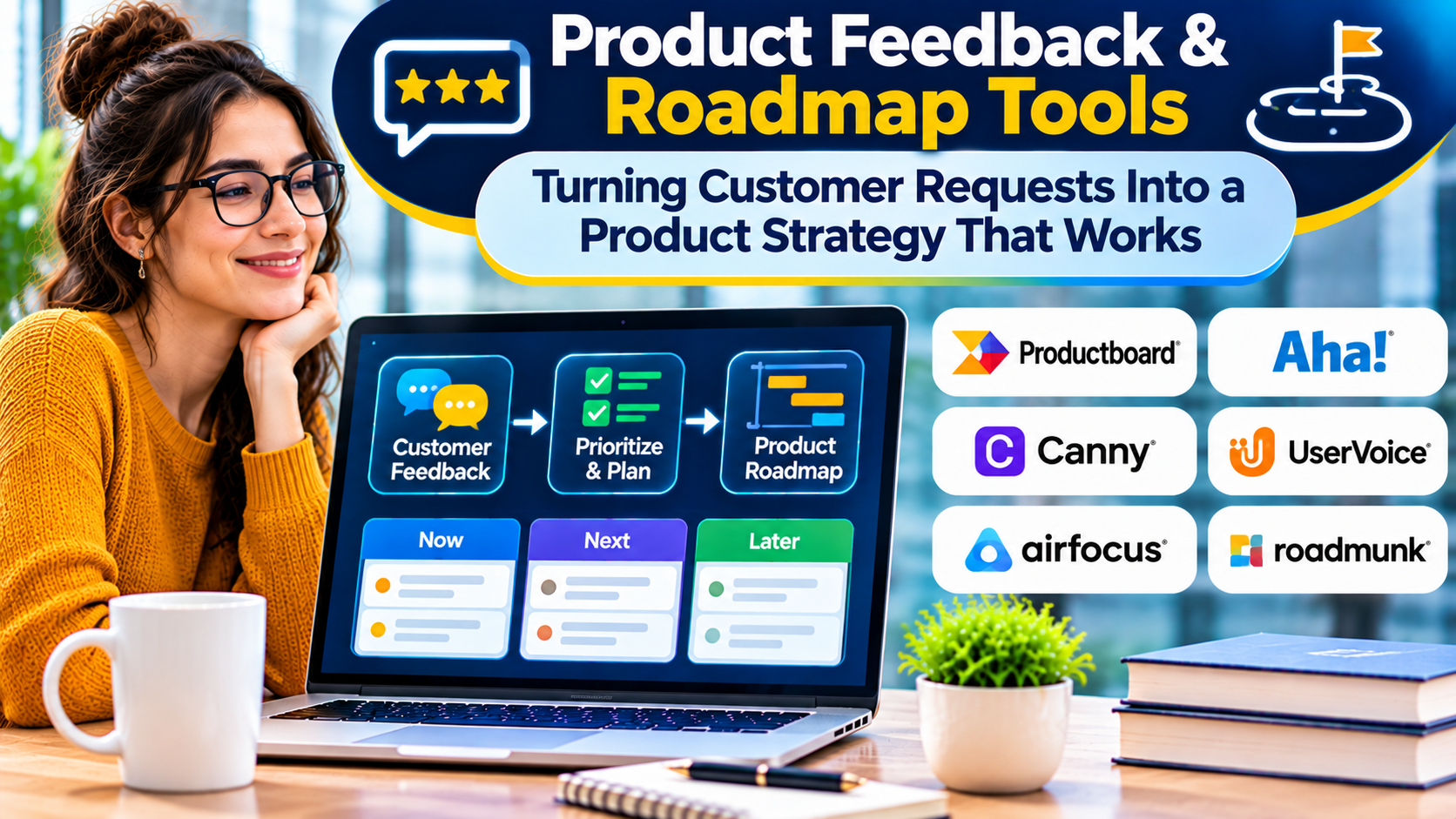
A customer asks for a new integration. Another wants a simpler dashboard. The sales team needs a feature to close an important deal, while engineering argues that technical improvements cannot wait.
Every request may be reasonable. But a product team cannot build everything.
The difficult part is not collecting ideas. It is deciding which problems deserve attention, understanding their business impact, and explaining those decisions to stakeholders.
Product feedback and roadmap tools help teams organize this process.
They bring customer requests, product insights, priorities, and planned improvements into a more structured environment.
However, the software itself cannot determine which features should be built.
Effective product management still requires research, strategic judgment, technical understanding, and clear communication.
The right platform makes these decisions more transparent and easier to manage.
The Real Problem With Product Feedback
Customer feedback rarely arrives through one channel.
A software company might receive requests through support tickets, sales conversations, customer interviews, surveys, emails, community discussions, and in-product feedback forms.
Each channel captures a different perspective.
Support teams often hear from customers experiencing immediate problems.
Sales teams may focus on capabilities requested by prospective buyers.
Customer success teams understand recurring adoption challenges.
Product analytics reveals behavior that customers may never describe directly.
When these sources remain disconnected, product managers struggle to understand which problems are widespread and which requests represent isolated preferences.
Duplicate requests may appear as separate issues.
Important customer context may disappear.
Teams may prioritize whichever stakeholder communicates most forcefully rather than whichever opportunity creates the greatest value.
Product feedback software helps consolidate this information, while roadmap tools help connect the resulting decisions to future work.
Product Feedback Tools and Roadmap Tools Are Not Identical
Although these capabilities frequently appear together, they solve different problems.
Product feedback management
Feedback management focuses on collecting, organizing, and interpreting information from customers and stakeholders.
Typical activities include recording feature requests, grouping related ideas, identifying affected customer segments, and tracking the status of feedback.
The goal is to understand customer needs.
Product roadmapping
Roadmapping focuses on communicating product direction, priorities, and planned outcomes.
A roadmap may organize initiatives by business objective, product area, development stage, or expected delivery period.
The goal is to explain what the organization intends to improve and why.
Why the connection matters
A feedback portal can become a collection of popular requests without strategic direction.
A roadmap can become a list of internal commitments without a clear connection to customer needs.
The most effective workflow connects evidence with decisions.
Customer feedback informs product opportunities. Product strategy determines priorities. Roadmaps communicate those priorities. Delivery and subsequent research reveal whether the changes achieved their intended outcomes.
The Main Types of Product Feedback and Roadmap Platforms
Different organizations require different levels of structure.
Feedback portals and feature request boards
These tools allow customers to submit ideas, review existing requests, and sometimes vote on suggestions.
They are useful when a company wants to create a visible channel for collecting product feedback.
The main advantage is accessibility.
Customers can communicate needs without relying entirely on support conversations.
However, popularity should not automatically determine priority.
A request with many votes may have limited strategic value, while a critical problem affecting a small customer segment may deserve immediate attention.
Product discovery and insight management platforms
These platforms focus on organizing customer evidence and connecting it with product opportunities.
They may help product teams bring together interview findings, feedback records, customer context, and strategic initiatives.
This approach is particularly useful for organizations conducting continuous product discovery.
Roadmap planning platforms
Roadmap-focused products help teams structure initiatives, communicate priorities, and coordinate planning.
They may support different roadmap views for executives, customers, and internal teams.
The central challenge is keeping the roadmap useful without turning every planned item into a fixed delivery promise.
Integrated product management platforms
Some products combine feedback, discovery, roadmapping, and delivery coordination.
These platforms may reduce fragmentation across tools.
However, broader functionality can introduce additional configuration, training, and administrative requirements.
Organizations should evaluate whether they need an integrated system or a smaller collection of specialized tools.
Product Feedback and Roadmap Tools Worth Evaluating
Several established products approach these workflows differently.
The right choice depends on how feedback enters the organization, how product decisions are made, and how teams communicate plans.
Productboard: Connecting Customer Insights With Product Priorities
Productboard focuses on product management workflows that connect customer insights, feature opportunities, and roadmaps.
Its approach is relevant to teams that need to organize feedback from multiple sources and relate that evidence to product decisions.
For example, a B2B software company might receive similar requests from customer success, sales, and direct user research.
A structured product management environment can help the team connect those observations with the underlying product opportunity.
Best suited to: Product organizations that want customer evidence to play a visible role in prioritization and planning.
Important evaluation point: Determine how easily the platform fits existing customer research, delivery tracking, and stakeholder communication workflows.
Aha! Roadmaps and Aha! Ideas: Structured Product Planning
Aha! provides product management capabilities through products that address roadmapping and idea management.
This approach is relevant to organizations that need structured product planning across multiple teams or product lines.
A company managing several products may need to connect strategic objectives, initiatives, and planned releases while maintaining a consistent planning framework.
Idea management can complement this process by creating a structured channel for capturing and reviewing suggestions.
Best suited to: Product teams requiring detailed planning processes and organized stakeholder communication.
Important evaluation point: Consider configuration effort, licensing structure, workflow complexity, and the level of process discipline required.
Canny: Customer Feedback and Feature Request Management
Canny focuses on collecting product feedback and communicating updates about requested improvements.
Its feedback-board approach is relevant to software companies that want customers to submit ideas and follow their progress.
For example, a SaaS company may want to reduce duplicate feature requests and give customers visibility into product improvements.
A dedicated feedback environment can make this communication easier to manage.
Best suited to: Software businesses that want a straightforward customer feedback workflow with visible product updates.
Important evaluation point: Evaluate how feedback connects to internal prioritization, customer segmentation, and development systems.
UserVoice: Customer Feedback and Product Decision Support
UserVoice provides capabilities centered on collecting and managing customer feedback.
It is relevant to organizations seeking a more structured way to understand requests from different customer groups.
For companies serving enterprise customers, the ability to connect feedback with customer context can be important.
A request from a large account may have commercial significance, but that significance must still be considered alongside broader product strategy.
Best suited to: Organizations that need structured feedback collection and customer-informed product planning.
Important evaluation point: Examine feedback organization, account context, permissions, reporting, and integration requirements.
Jira Product Discovery: Connecting Discovery With Delivery
Jira Product Discovery supports product discovery workflows within the Atlassian ecosystem.
It is relevant to teams that want to organize opportunities and ideas while maintaining connections with engineering delivery work.
For example, a product manager may evaluate several potential improvements before passing selected initiatives into an established development process.
The value of this approach depends on whether the organization benefits from a closer connection between discovery and execution.
Best suited to: Product teams already working within Jira-centered development environments.
Important evaluation point: Determine whether its discovery workflow is sufficiently flexible and whether additional tools are needed for external customer feedback collection.
Comparing Product Feedback and Roadmap Approaches
| Platform | Primary emphasis | Useful evaluation scenario |
|---|---|---|
| Productboard | Product insights and prioritization | Connecting customer evidence to product decisions |
| Aha! | Structured product planning and ideas | Coordinating strategy and roadmaps |
| Canny | Customer feedback boards and updates | Managing visible feature requests |
| UserVoice | Customer feedback management | Organizing requests with customer context |
| Jira Product Discovery | Discovery and delivery alignment | Connecting product ideas with Jira workflows |
These distinctions describe the products’ general orientations rather than exclusive capabilities.
Before purchasing, organizations should verify current features, integrations, subscription requirements, and deployment options.
Why Customer Voting Should Not Control the Roadmap
Feature voting can be useful, but it is easy to misuse.
A highly requested feature may represent a genuine unmet need.
It may also reflect the preferences of a vocal customer group rather than the needs of the wider market.
Some customers may not participate in voting at all.
Others may request a specific feature when the underlying problem could be solved more effectively in another way.
Consider a project management application receiving many requests for additional dashboard filters.
Customers may be asking for filters because they struggle to find relevant work.
The deeper problem could involve navigation, information organization, or insufficient search functionality.
Building more filters might address the immediate request without resolving the underlying issue.
Product teams should therefore treat votes as one signal among several.
Useful evidence may include customer interviews, product analytics, support volume, revenue exposure, strategic alignment, and technical feasibility.
A Better Framework for Prioritizing Product Feedback
Effective prioritization begins by distinguishing problems from proposed solutions.
A customer saying “add an export button” has suggested a solution.
The underlying need might be to share information with external stakeholders.
Understanding that need may reveal alternatives such as scheduled reports, shareable views, or integrations.
A practical prioritization process can examine five dimensions.
Customer impact
How important is the problem to affected customers?
Does it prevent a critical task, create recurring inconvenience, or limit product adoption?
Frequency and reach
How many customers experience the problem?
Does it affect a specific segment or a broad portion of the customer base?
Frequency matters, but it should not override severity.
Strategic alignment
Does the opportunity support the organization’s product direction?
A feature may attract requests while moving the product away from its intended market.
Business impact
Could addressing the problem improve retention, adoption, expansion, operational efficiency, or another meaningful business outcome?
Avoid assigning precise financial value without credible evidence.
Implementation effort and risk
What engineering, design, operational, security, and maintenance work would the change require?
A seemingly small feature can introduce substantial long-term complexity.
These dimensions can support prioritization frameworks, but no scoring formula should replace thoughtful product judgment.
Building a Feedback-to-Roadmap Workflow
A reliable workflow needs clear stages and responsibilities.
Stage 1: Capture feedback consistently
Establish a shared process for recording customer observations.
Include the source, customer context, affected workflow, and description of the problem.
Avoid requiring every employee to use complicated forms that discourage useful submissions.
Stage 2: Consolidate related requests
Group duplicate and closely related feedback.
Ten requests for similar functionality should not automatically become ten separate roadmap items.
Identify the common underlying need.
Stage 3: Validate the problem
Use interviews, analytics, support records, and other evidence to determine whether the problem is meaningful.
Where possible, identify which customer groups are affected.
Stage 4: Evaluate potential solutions
Explore multiple ways to address the problem.
Do not assume that the customer’s proposed feature is the only reasonable answer.
Stage 5: Prioritize against strategy
Compare the opportunity with other initiatives.
Consider customer value, business impact, technical effort, and strategic fit.
Stage 6: Communicate the decision
Explain whether the opportunity is being explored, planned, developed, released, or declined.
Clear communication helps maintain trust even when a request is not prioritized.
Stage 7: Measure results
After delivering an improvement, evaluate whether it solved the original problem.
A released feature is not automatically a successful product outcome.
Internal and Public Roadmaps Serve Different Audiences
One roadmap rarely communicates equally well to executives, engineers, sales teams, and customers.
Internal roadmaps
Internal roadmaps may contain detailed priorities, dependencies, technical constraints, and planning assumptions.
They support coordination and resource allocation.
Executive roadmaps
Executive stakeholders often need a view of strategic objectives, investment areas, expected outcomes, and major risks.
Excessive task-level detail can distract from these decisions.
Customer-facing roadmaps
Public roadmaps help customers understand product direction.
However, they require careful communication.
Publishing exact delivery dates for uncertain work can create expectations the organization cannot reliably meet.
A status-based or outcome-oriented roadmap may be more appropriate when delivery timing remains uncertain.
Features That Matter Most When Choosing Software
Multi-channel feedback capture
Determine whether feedback can enter the system from the channels your organization already uses.
A platform that requires employees to copy information manually may create unnecessary work.
Duplicate detection and organization
Similar requests should be easy to group and review.
Poor organization can inflate apparent demand and complicate prioritization.
Customer context
For B2B products, account and customer segment information may be important.
For consumer products, behavior patterns and user segments may provide more useful context.
Flexible prioritization
The platform should support the organization’s decision process without forcing every opportunity into a rigid scoring model.
Roadmap views
Different stakeholders need different levels of detail.
Evaluate whether the software can communicate relevant information without duplicating planning work.
Development integrations
Product decisions eventually connect with engineering work.
Consider how the platform exchanges information with issue tracking and delivery systems.
Permissions and governance
Organizations may need to restrict sensitive customer information, strategic plans, or commercial discussions.
Evaluate role-based access, administrative controls, and audit requirements.
Reporting and measurement
Useful reporting should help teams understand feedback themes, product priorities, and progress toward meaningful outcomes.
Avoid choosing a platform solely because it offers attractive dashboards.
Common Product Roadmap Mistakes
Treating the roadmap as a promise
A roadmap communicates direction and priorities.
Some work may have firm commitments, but exploratory initiatives should not be presented with unjustified certainty.
Prioritizing the loudest customer
Important customers deserve attention, but individual requests should be evaluated within the broader product strategy.
Collecting feedback without closing the loop
Customers may stop contributing when they never hear what happened to their suggestions.
Clear status updates can improve transparency.
Confusing delivery output with customer value
Shipping more features does not necessarily create a better product.
Measure whether delivered improvements solve meaningful problems.
Using too many disconnected tools
A company may collect feedback in one system, prioritize work in spreadsheets, maintain roadmaps in presentations, and track delivery elsewhere.
This fragmentation creates duplication and inconsistent information.
Integration and ownership matter as much as individual product features.
Evaluating the Total Cost of a Product Management Platform
Subscription pricing is only one consideration.
Organizations should also evaluate implementation time, employee training, integration maintenance, administration, and data migration.
A simple feedback tool may be sufficient for a small software company.
A larger product organization may benefit from more structured planning capabilities.
However, purchasing an extensive platform before establishing a reliable product decision process can create unnecessary complexity.
Start with the workflow.
Identify who collects feedback, who validates it, who makes prioritization decisions, and who communicates outcomes.
Then evaluate which software supports those responsibilities most effectively.
A Practical Example: Prioritizing Requests for a Reporting Feature
Consider a B2B software company receiving repeated requests for customizable reports.
The feedback arrives through support tickets, sales discussions, and customer interviews.
Initially, the requests appear to describe different features.
Some customers want scheduled exports. Others want additional filters. Several want to share reports with colleagues.
The product team groups these requests around a broader problem: customers struggle to distribute useful information to the right people.
Further research reveals that the problem affects several customer segments, but their needs differ.
Rather than immediately building every requested feature, the team evaluates potential solutions.
It may discover that scheduled report delivery addresses a substantial portion of the problem with less complexity than a fully customizable reporting system.
The team documents the evidence, compares the opportunity with other priorities, and communicates the selected direction.
After release, it measures adoption and collects additional feedback.
The software supports the process by preserving context and connecting decisions.
The value comes from solving the right problem.
Choosing the Right Product Feedback and Roadmap Tool
The best platform depends on the organization’s product management maturity and operational needs.
A company primarily seeking a public feature request board may find a focused feedback product appropriate.
A team conducting continuous discovery may need stronger insight management.
An organization coordinating several product lines may benefit from structured roadmapping and governance.
Teams already using Jira should examine how discovery capabilities connect with their existing delivery workflows.
Before purchasing, conduct a pilot involving a real product opportunity.
Capture feedback from several sources, consolidate duplicate requests, evaluate the underlying problem, prioritize a potential solution, and communicate the decision.
The exercise should reveal whether the platform supports actual work or merely creates another place to store information.
Building a Roadmap Customers Can Trust
Product feedback and roadmap tools are valuable because they create continuity between customer needs and product decisions.
They help organizations preserve feedback, understand recurring problems, communicate priorities, and maintain visibility into planned improvements.
But a feature request is not automatically a product requirement.
A popular idea is not automatically a strategic priority.
And a completed development task is not automatically a successful customer outcome.
Strong product organizations connect customer evidence with strategic judgment, disciplined delivery, and ongoing measurement.
The right software makes that process easier to sustain.
Choose a platform that helps teams understand why an improvement matters, decide when to pursue it, and explain what happened afterward.
That creates a product roadmap built on informed decisions rather than an ever-growing list of requests.