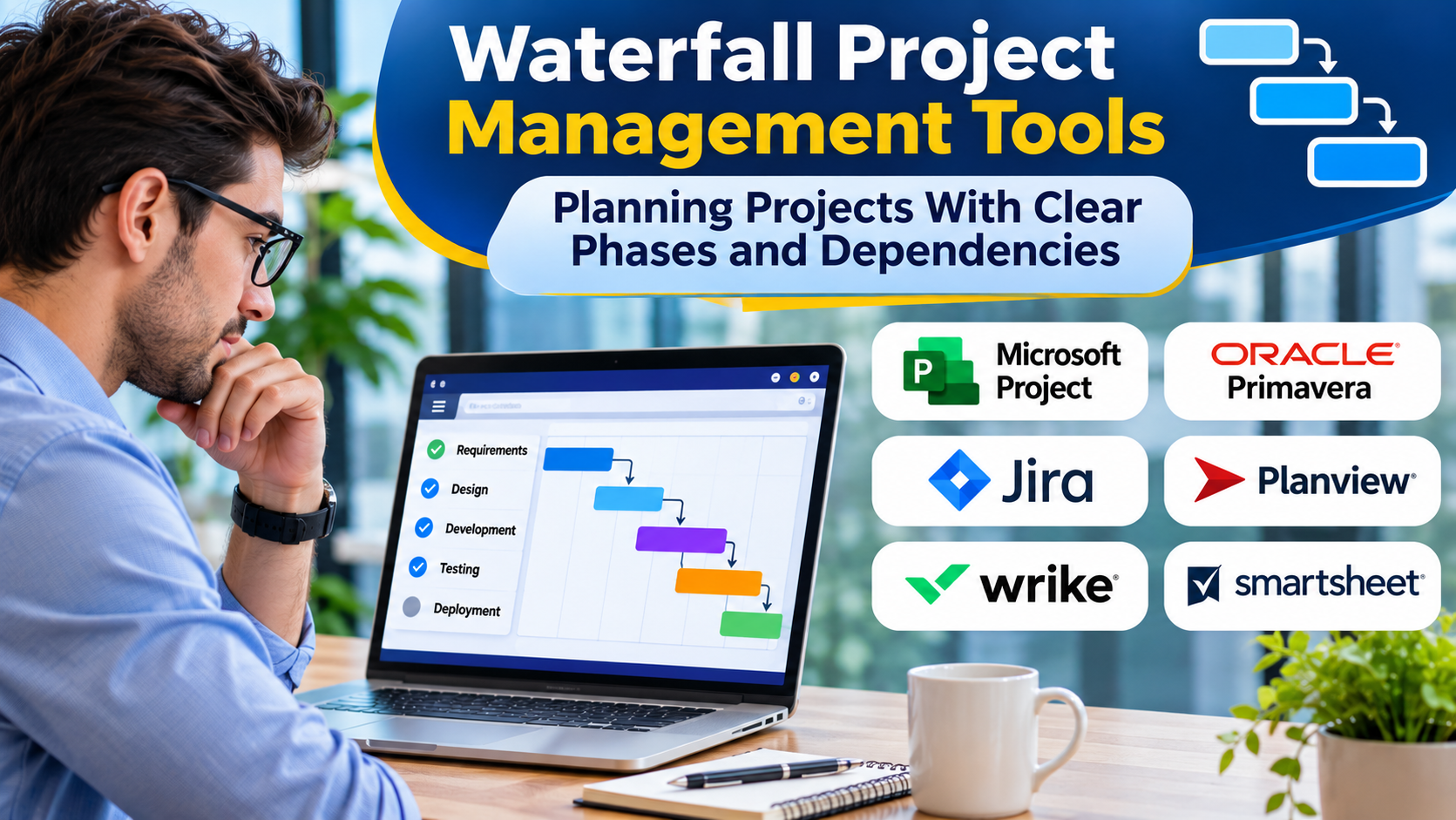
Some projects operate in environments where requirements, approvals, and delivery stages must be carefully controlled.
Construction, infrastructure, engineering, and regulated initiatives may involve contractual milestones, formal documentation, and dependencies that cannot be easily rearranged.
Waterfall project management provides a structured approach to planning and executing such work.
Waterfall project management tools support this approach through scheduling, dependency tracking, resource planning, and progress reporting.
The challenge is using structured planning without creating unrealistic assumptions about certainty.
What Is Waterfall Project Management?
Waterfall project management is a sequential approach in which work progresses through defined phases.
A typical project may include requirements, design, implementation, testing, and delivery.
Each phase produces outputs that inform subsequent activities.
Although real projects may involve revisions and overlapping work, Waterfall emphasizes upfront planning and controlled progression.
It is often associated with projects where scope, dependencies, and approval requirements are relatively well understood.
Why Waterfall Tools Matter
Structured projects require more than basic task lists.
Managers need to understand how activities depend on one another, which resources are required, and how delays affect the overall schedule.
Waterfall tools provide mechanisms for building these relationships.
They also support documentation and reporting that may be important for contracts, governance, and regulatory obligations.
Core Waterfall Project Management Features
Gantt charts
Gantt charts display project activities along a timeline.
They help managers visualize task duration, sequencing, milestones, and dependencies.
Dependency management
Dependencies define relationships between activities.
For example, equipment installation may depend on the completion of site preparation.
Critical path analysis
Critical path analysis identifies the sequence of activities that determines the project’s earliest possible completion under the modeled schedule.
Delays to critical activities can affect the overall project deadline.
Baseline management
A project baseline records an approved plan against which actual performance can be compared.
Resource planning
Managers need to assess the availability of people, equipment, and other resources.
Progress reporting
Reports should show schedule changes, milestone status, and emerging risks.
Waterfall Project Management Tools to Consider
Microsoft Project
Microsoft Project is associated with structured scheduling, dependencies, resource management, and Gantt-based planning.
It is relevant to organizations managing formal project schedules.
Buyers should verify the current product offerings and licensing arrangements.
Oracle Primavera P6
Oracle Primavera P6 supports complex project scheduling and control.
It is particularly relevant to large engineering, construction, and infrastructure initiatives.
Implementation and specialist scheduling expertise can be significant considerations.
Smartsheet
Smartsheet combines spreadsheet-style work management with scheduling and collaboration features.
It can appeal to teams seeking a familiar interface for structured project coordination.
ProjectLibre
ProjectLibre provides project management software with scheduling capabilities.
It is an alternative worth evaluating for teams interested in traditional project planning without committing immediately to a large enterprise platform.
GanttProject
GanttProject is a project scheduling application focused on Gantt charts, dependencies, and related planning functions.
It can be suitable for smaller structured projects with relatively straightforward requirements.
OpenProject
OpenProject provides project management capabilities including planning and scheduling features.
It is relevant to organizations evaluating an open-source-oriented project management environment.
Choosing Tools Based on Project Complexity
| Project requirement | Important capability |
|---|---|
| Small structured project | Basic Gantt scheduling |
| Multiple dependent activities | Dependency management |
| Resource-intensive project | Resource planning |
| Large infrastructure program | Advanced scheduling and controls |
| Formal governance | Baselines and auditability |
| Cross-functional collaboration | Shared reporting and permissions |
The right tool depends on the complexity of the project rather than the prestige of the software.
Understanding the Critical Path
The critical path is one of the most important concepts in structured project scheduling.
Consider a project involving design approval, procurement, installation, and testing.
If these activities must occur sequentially, their combined durations may determine the project completion date.
A delay in a critical activity can delay the entire project unless corrective action is taken.
However, a schedule is only as reliable as its assumptions.
Unrealistic task durations and missing dependencies can produce misleading critical path calculations.
Waterfall vs. Agile Project Management
Waterfall emphasizes structured planning and controlled phase progression.
Agile approaches emphasize iterative delivery and adaptation.
Waterfall may be appropriate when requirements are stable, regulatory documentation is substantial, or physical dependencies constrain the work.
Agile may be more suitable when requirements are uncertain and frequent feedback is necessary.
Some organizations combine structured milestones with iterative execution.
The choice should reflect project characteristics rather than a preference for one methodology.
Common Waterfall Planning Mistakes
Overly optimistic schedules
Teams may underestimate activity durations or ignore realistic constraints.
Missing dependencies
An incomplete dependency model can hide risks until they affect delivery.
Excessive planning detail
Schedules containing unnecessary detail can become difficult to maintain.
Weak change control
Changes to scope, resources, or requirements should be assessed for their impact on the approved plan.
Treating baselines as guarantees
A baseline is a reference point, not proof that the original assumptions remain valid.
How to Implement Waterfall Software Effectively
Begin by defining the project’s objectives and deliverables.
Break the work into manageable activities and identify dependencies.
Estimate durations using available evidence and relevant expertise.
Assign resources, establish milestones, and review schedule feasibility.
Once the plan is approved, create a baseline and define how changes will be managed.
During execution, update actual progress and investigate meaningful deviations.
Evaluating Total Cost
Software costs may include licenses, hosting, integrations, training, and support.
Complex scheduling platforms may also require specialist project controls personnel.
A smaller organization should not assume that advanced enterprise functionality will automatically improve its planning.
The value of additional features must justify the effort required to use them.
Frequently Asked Questions
Is Waterfall project management outdated?
No. It remains useful for projects requiring structured sequencing, documentation, and formal control.
Are Gantt charts necessary for Waterfall projects?
They are common and useful, but a project can apply structured planning without depending exclusively on Gantt charts.
Can Waterfall tools support hybrid projects?
Some platforms support hybrid planning, although capabilities vary.
Conclusion
Waterfall project management tools provide valuable structure for projects with defined phases, dependencies, and governance requirements.
Their effectiveness depends on realistic schedules, accurate progress information, and disciplined change management.
The right platform should make planning more reliable while helping teams respond intelligently when reality differs from the original plan.