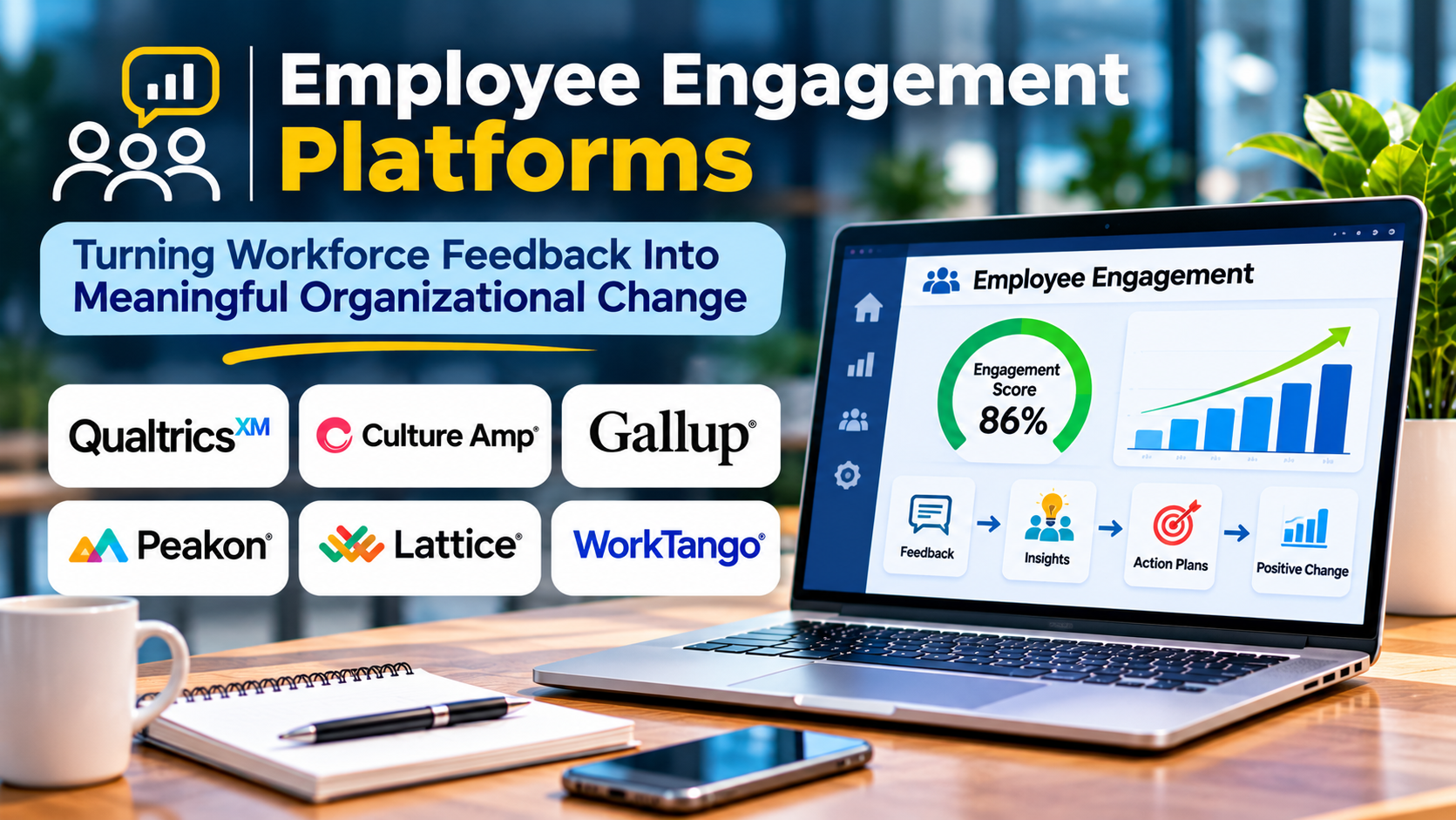
Employee surveys are easy to distribute. Acting on the results is considerably more difficult.
Organizations may collect large amounts of feedback about leadership, communication, workload, recognition, and workplace experience without establishing clear responsibility for improvements.
When employees repeatedly share concerns but see little action, participation and trust may decline.
Employee engagement platforms can help organizations collect feedback, identify patterns, and coordinate follow-up actions.
Their effectiveness, however, depends on what leaders do with the information.
What Are Employee Engagement Platforms?
Employee engagement platforms are software applications designed to help organizations understand and improve employee experiences.
Common capabilities include engagement surveys, pulse checks, employee feedback, recognition programs, analytics, and action planning.
Some platforms also support performance management, goal setting, and organizational development.
Employee engagement software should not be confused with employee monitoring technology.
Engagement platforms generally focus on understanding employee perceptions and workplace conditions rather than measuring individual computer activity.
Why Employee Engagement Is Difficult to Measure
Employee engagement is a complex concept involving attitudes, experiences, and relationships with work.
Survey responses can provide useful information, but they do not explain every cause of employee behavior.
For example, declining survey participation might indicate frustration, survey fatigue, communication problems, or concerns about confidentiality.
Organizations should avoid treating a single engagement score as a complete representation of workforce health.
Trends, qualitative feedback, and organizational context often matter more than isolated numbers.
Employee Engagement Platforms to Consider
Culture Amp
Culture Amp provides employee experience and people development software.
It is relevant to organizations seeking structured feedback and tools for supporting workplace improvement.
Qualtrics Employee Experience
Qualtrics provides employee experience technology for collecting and analyzing workforce feedback.
It deserves consideration when organizations need configurable feedback programs and related analytics.
Workday Peakon Employee Voice
Workday Peakon Employee Voice provides employee listening capabilities within the Workday ecosystem.
It is relevant to organizations exploring connections between workforce feedback and broader HR information.
Lattice
Lattice provides people management software that includes engagement-related functionality.
Its broader approach may appeal to organizations connecting employee feedback with performance and development processes.
15Five
15Five offers employee performance and engagement-related capabilities.
It is worth evaluating when manager effectiveness and ongoing employee conversations are important priorities.
Leapsome
Leapsome combines employee engagement with performance and development workflows.
Organizations should examine how its different modules fit their existing HR processes.
Core Engagement Platform Features
| Capability | Practical purpose |
|---|---|
| Engagement surveys | Collect structured employee feedback |
| Pulse surveys | Monitor selected topics more frequently |
| Anonymous or confidential feedback | Encourage participation where appropriate |
| Reporting | Identify patterns across teams |
| Action planning | Assign responsibility for improvements |
| Recognition | Support employee appreciation |
| Manager tools | Help leaders respond to feedback |
| Integrations | Connect relevant HR information |
Survey Design Matters
A poorly designed survey can produce misleading results regardless of the software used.
Questions should be clear, relevant, and consistent with the organization’s objectives.
Avoid combining multiple issues into a single question.
For example, asking whether employees are satisfied with compensation, leadership, and career development in one question makes the answer difficult to interpret.
Organizations should also avoid excessive survey frequency.
Repeated requests for feedback without visible action can create fatigue.
Protecting Employee Confidentiality
Employees may hesitate to provide candid feedback if they believe their responses can be traced back to them.
Organizations should clearly explain whether surveys are anonymous, confidential, or identifiable.
These terms are not interchangeable.
Even when names are removed, small reporting groups or combinations of demographic characteristics may make individuals recognizable.
Reporting thresholds and access controls should therefore be evaluated carefully.
Turning Feedback Into Action
Collecting employee feedback is only the beginning.
A useful engagement process includes reviewing results, identifying priorities, assigning ownership, and communicating progress.
Managers should be supported in interpreting results without automatically treating every low score as evidence of personal failure.
Some problems require organization-wide changes rather than local management action.
For example, employees may identify workload problems caused by unrealistic staffing assumptions or conflicting business priorities.
A survey platform cannot solve these issues independently.
Measuring Whether Engagement Initiatives Work
Organizations should monitor whether specific improvements produce meaningful changes over time.
Useful measures may include participation, feedback themes, action completion, and employee perceptions of progress.
Retention and absence trends may provide additional context, but they should not be attributed solely to engagement initiatives without supporting evidence.
The objective is to understand whether workplace conditions are improving.
Final Thoughts
Employee engagement platforms are most valuable when they help organizations move from listening to action.
Culture Amp, Qualtrics, Workday Peakon Employee Voice, Lattice, 15Five, and Leapsome offer different approaches to workforce feedback and people management.
The right choice depends on organizational size, reporting needs, employee trust, and the ability to act on results.
Technology can make employee feedback more visible. Leadership commitment determines whether that feedback creates meaningful change.