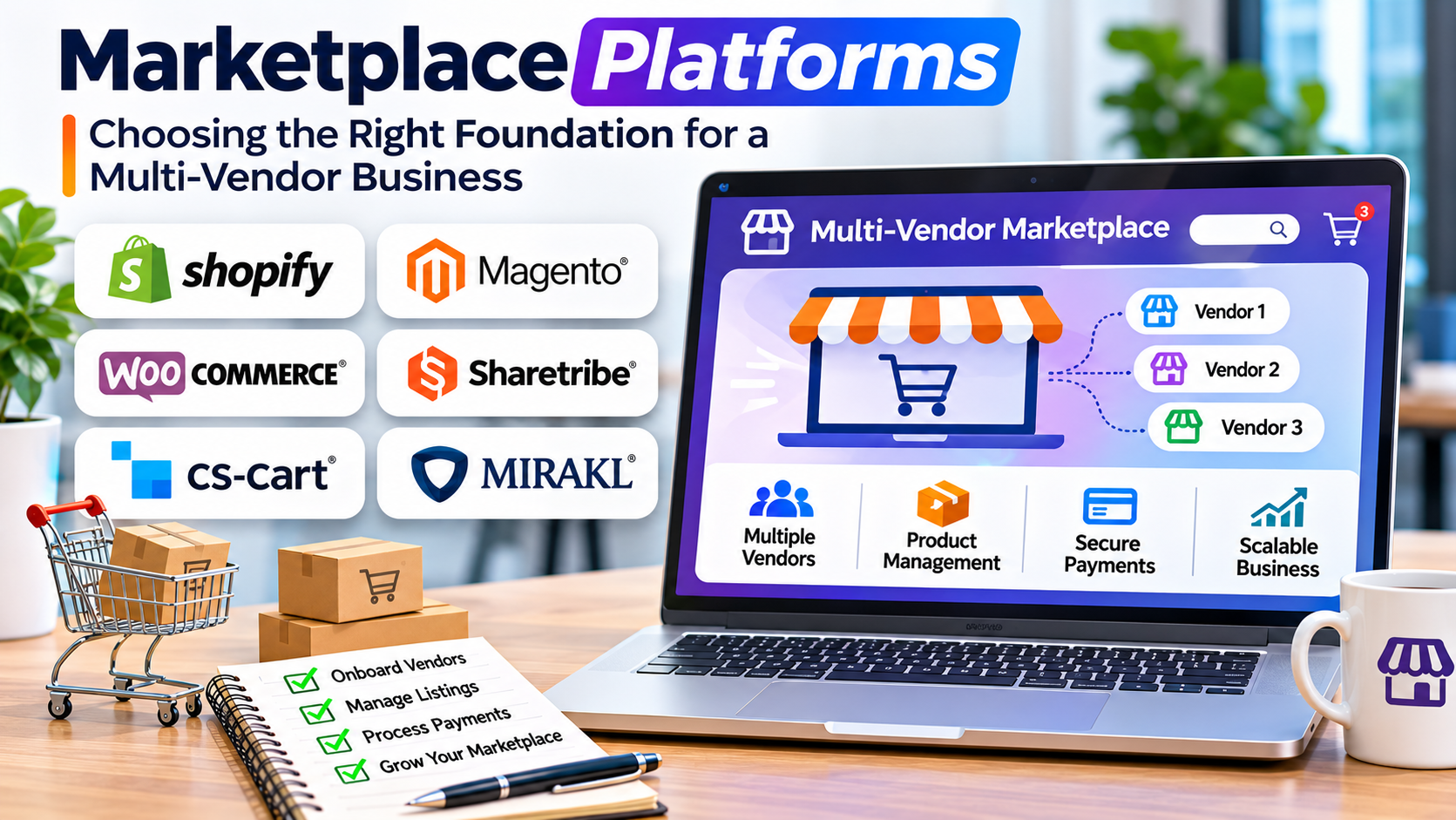
Introduction
An online marketplace is more than a website where different sellers list products. It is a business system that must coordinate buyers, sellers, payments, transactions, disputes, and trust.
That distinction matters when choosing marketplace software.
A conventional online store primarily manages transactions between one merchant and its customers. A marketplace introduces another participant: the independent seller or service provider. Each additional seller creates new operational responsibilities, from verifying identities to calculating commissions and resolving customer complaints.
Marketplace platforms help businesses manage these relationships through shared technology.
However, the right platform depends heavily on the marketplace’s business model. Software designed for a large retailer expanding its product catalog may be unsuitable for a startup connecting local service providers with customers.
This guide explains how marketplace platforms work, the main software approaches available, and the decisions that determine whether a marketplace can operate reliably as it grows.
What Is a Marketplace Platform?
A marketplace platform is software that enables multiple independent providers to offer products, services, rentals, or other transactions through a shared digital environment.
The marketplace operator manages the environment, while participating sellers provide the goods or services.
A typical marketplace includes three groups:
- Operators: The organization responsible for marketplace rules, technology, commercial arrangements, and customer experience.
- Sellers: Businesses or individuals offering products or services.
- Buyers: Customers who discover, compare, purchase, or book those offerings.
The software coordinates interactions between these groups.
For example, a marketplace selling handmade furniture may allow independent workshops to create listings, update inventory, receive orders, and manage fulfillment.
Customers browse products from different workshops through one website.
The marketplace operator establishes commission rules, reviews seller performance, and manages the overall shopping experience.
Unlike a conventional e-commerce store, the operator may never physically handle the products being sold.
Marketplace Platforms Versus Traditional E-commerce Software
Traditional e-commerce platforms focus on helping merchants sell their own products.
Marketplace software adds capabilities for managing multiple independent sellers.
| Capability | Traditional E-commerce | Marketplace Platform |
|---|---|---|
| Primary selling model | One merchant | Multiple independent sellers |
| Product management | Merchant-controlled catalog | Seller-contributed listings |
| Order processing | Single merchant workflow | Potentially multiple seller workflows |
| Payments | Merchant receives payment | Funds may require allocation among parties |
| Commissions | Usually unnecessary | Often central to monetization |
| Seller onboarding | Not typically required | Essential |
| Dispute handling | Merchant-customer relationship | Operator, seller, and buyer relationships |
Some commerce platforms support marketplace functionality through extensions or integrations.
Nevertheless, adding seller accounts does not automatically create a complete marketplace operating system.
The important question is whether the software supports the actual commercial relationships involved.
The Four Main Types of Marketplace Platforms
Marketplace businesses differ significantly in their transaction models.
Understanding these differences helps narrow the software selection process.
1. Product Marketplaces
Product marketplaces connect buyers with merchants selling physical or digital goods.
Examples include marketplaces for electronics, fashion, handmade products, and specialist equipment.
These platforms typically require:
- Seller-managed product catalogs
- Inventory availability
- Product categorization and search
- Order routing
- Shipping information
- Returns and refunds
- Commission calculations
Inventory accuracy becomes particularly important when sellers also operate independent stores.
A product shown as available on the marketplace may already have sold elsewhere.
Without dependable synchronization, the operator risks overselling and disappointing customers.
2. Service Marketplaces
Service marketplaces connect customers with professionals or businesses offering services.
Examples include tutoring, home repairs, consulting, and personal care.
Their workflows differ from product commerce.
A customer may need to describe a problem, request a quotation, schedule an appointment, or communicate with a provider before purchasing.
Useful capabilities include availability calendars, booking management, messaging, provider profiles, and service-specific transaction rules.
A marketplace that handles complex quotations may require a different system from one selling fixed-price appointments.
3. Rental Marketplaces
Rental marketplaces allow providers to offer temporary access to assets.
These assets may include vehicles, equipment, properties, event spaces, or recreational products.
Availability management is central to this model.
A booking must reserve the correct asset for a defined period while accounting for preparation, cleaning, delivery, or inspection time.
Rental businesses may also require deposits, damage claims, cancellation rules, and identity verification.
A basic product catalog cannot reliably manage these requirements without additional functionality.
4. Business-to-Business Marketplaces
B2B marketplaces connect commercial buyers with suppliers, manufacturers, distributors, or service providers.
Transactions may involve negotiated prices, purchase orders, approval workflows, and contractual payment terms.
A B2B marketplace may need to support multiple users under one corporate account.
For example, a purchasing manager might create an order while a finance manager approves payment.
Other important requirements include bulk pricing, minimum order quantities, supplier documentation, and integration with enterprise resource planning systems.
The complexity of these workflows often makes B2B marketplace selection more demanding than standard consumer commerce.
How Marketplace Platforms Work
A marketplace platform connects several operational processes.
Although implementations differ, most transaction-based marketplaces follow a similar sequence.
Seller Registration and Approval
A seller creates an account and submits relevant business information.
Depending on the marketplace, the operator may verify identity, business registration, tax information, professional qualifications, or banking details.
Not every marketplace requires the same checks.
A marketplace for regulated professional services may need substantially stronger verification than a local community exchange.
The platform should support approval procedures appropriate to the business model.
Listing Creation and Discovery
Approved sellers create listings.
These listings contain information such as descriptions, images, prices, availability, and delivery conditions.
Customers discover offerings through search, filters, categories, or recommendations.
Good discovery depends on consistent listing information.
If one seller describes a product by size while another omits dimensions, customers cannot compare products effectively.
Marketplace operators therefore need rules governing listing quality and required attributes.
Transaction Processing
Customers initiate purchases, bookings, or other transactions.
The platform records the transaction and communicates the relevant information to the seller.
Some marketplaces collect payments immediately.
Others authorize payments, accept deposits, or facilitate transactions completed outside the platform.
The correct approach depends on the marketplace’s commercial and regulatory requirements.
Fulfillment and Completion
The seller delivers the product or performs the service.
The marketplace tracks progress and communicates updates to the buyer.
For physical goods, fulfillment may involve shipment tracking.
For services, completion may require appointment confirmation or customer acceptance.
The operator also needs procedures for cancellations, delays, and failed transactions.
Settlement and Reporting
The platform calculates the financial obligations associated with completed transactions.
These may include seller proceeds, operator commissions, refunds, taxes, and payment-processing charges.
Settlement arrangements must align with the payment provider’s capabilities and applicable regulations.
Accurate reconciliation is essential because transaction revenue and the marketplace operator’s own revenue are not necessarily the same amount.
Essential Features to Evaluate
Marketplace software should be evaluated against operational requirements rather than the number of features advertised.
Several capabilities deserve particular attention.
Seller Management
Seller management should provide a reliable way to approve, monitor, suspend, and support participating providers.
Useful capabilities include:
- Seller registration and onboarding
- Permission management
- Business information collection
- Seller performance reporting
- Listing approval
- Account suspension
- Communication tools
A marketplace with hundreds of sellers needs a different administrative workflow from one with ten carefully selected providers.
The goal is to reduce repetitive administrative work without weakening oversight.
Catalog and Listing Management
Product marketplaces need consistent catalog structures.
Operators should examine how software handles duplicate listings, product variations, categories, and seller-specific inventory.
Service marketplaces may instead prioritize provider profiles, geographic availability, and booking rules.
The most suitable listing model is the one that reflects how customers actually search.
Payment Processing and Commissions
Payment architecture is one of the most consequential marketplace decisions.
The system may need to support:
- Marketplace commissions
- Seller payouts
- Partial refunds
- Multiple currencies
- Payment disputes
- Transaction reconciliation
- Tax-related reporting
Payment support must be checked for the countries where sellers and buyers operate.
A platform supporting payments in one market may not provide equivalent functionality elsewhere.
Businesses should also confirm which party is legally responsible for collecting funds and processing payouts.
Order and Booking Management
Operators need visibility into transaction progress.
For physical products, this includes orders, shipments, cancellations, and returns.
For services and rentals, the system may need booking calendars, scheduling rules, and appointment status.
The administrative interface should help teams identify exceptions without manually reviewing every transaction.
Trust and Safety
Marketplaces depend on participants trusting people or businesses they may never have encountered.
Relevant controls include identity verification, moderation, reviews, dispute procedures, and suspicious-activity monitoring.
Software can support these controls, but it cannot replace clear policies and responsible enforcement.
A marketplace should define what happens when sellers misrepresent offerings, customers dispute charges, or transactions violate platform rules.
Marketplace Software Approaches Worth Comparing
Marketplace technology can be acquired through specialized software, extensions, or custom development.
The following products illustrate different approaches rather than a universal ranking.
Sharetribe: Marketplace Creation for Founders
Sharetribe focuses on helping entrepreneurs build marketplace businesses.
Its software supports marketplace models involving products, services, and rentals.
It offers a no-code approach alongside developer capabilities for customization.
This makes it relevant for founders who want to validate a marketplace concept before investing heavily in custom development.
Its marketplace functionality includes listings, transactions, booking options, messaging, and administrative controls.
Where it fits: Startups and smaller teams building focused marketplace experiences.
What to examine: Whether the intended transaction model requires custom development, additional integrations, or functionality beyond the standard configuration.
Mirakl: Marketplace Operations for Established Businesses
Mirakl focuses on enterprise marketplace operations.
Its marketplace technology addresses seller onboarding, catalog management, order processing, and marketplace administration.
The platform is particularly relevant to established retailers and larger organizations introducing third-party sellers.
Its architecture is designed to work with broader commerce environments rather than treating every marketplace as a standalone startup website.
Where it fits: Enterprises expanding their product assortment through third-party sellers.
What to examine: Implementation complexity, integration requirements, operating responsibilities, and total cost.
Marketplacer: Marketplace Expansion Through Existing Commerce Systems
Marketplacer provides technology for integrating third-party sellers and inventory into digital commerce operations.
Its approach is relevant to businesses that already have an established online storefront.
Rather than replacing every existing commerce component, an organization may connect marketplace functionality with its current environment.
Where it fits: Retailers and commerce businesses seeking marketplace expansion.
What to examine: Compatibility with existing commerce systems, seller workflows, catalog synchronization, and operational integration.
Custom Marketplace Development
Custom development offers greater control over marketplace architecture and business workflows.
It may be appropriate when a business has unusual transaction requirements or needs specialized integrations.
However, ownership of the software also creates responsibility for development, hosting, security, maintenance, and ongoing improvements.
A custom marketplace is not automatically more flexible in practice.
A business without sufficient engineering resources may struggle to adapt its platform as requirements change.
Custom development makes the most sense when unique requirements justify its continuing operational cost.
How to Choose the Right Marketplace Platform
The selection process should begin with the marketplace’s operating model.
Step 1: Define the Transaction
Write down exactly what happens between a buyer and seller.
Does the customer purchase a product immediately?
Do they book a time slot?
Must they request a quotation?
Can multiple sellers contribute to one order?
These questions determine the transaction engine the marketplace needs.
Step 2: Identify the Most Difficult Workflow
Every marketplace has an operational bottleneck.
For a product marketplace, it may be inventory synchronization.
For a rental marketplace, it may be availability management.
For a service marketplace, it may be scheduling and cancellation rules.
For a B2B marketplace, it may be negotiated pricing and purchasing approvals.
Evaluate software against that bottleneck before comparing secondary features.
Step 3: Map Existing Systems
Established businesses should document their current technology.
Relevant systems may include:
- E-commerce platforms
- Inventory management
- ERP software
- Customer relationship management
- Payment processing
- Shipping systems
- Analytics tools
Determine which system owns each important record.
For example, decide whether the marketplace or an existing inventory system is responsible for stock availability.
Unclear data ownership often causes synchronization problems.
Step 4: Test Realistic Transactions
A software demonstration should include representative operating scenarios.
Ask the vendor to show how the platform handles a seller registration, listing approval, customer purchase, cancellation, refund, and payout.
For a multi-seller product marketplace, test an order containing items from different merchants.
For a service marketplace, test a booking that must be rescheduled.
These scenarios reveal more than a general feature presentation.
Step 5: Calculate Total Operating Cost
Marketplace expenses extend beyond software subscriptions.
Potential costs include implementation, integrations, hosting, payment processing, support, maintenance, and internal administration.
Some pricing models also depend on transaction volume or marketplace activity.
Compare costs using realistic assumptions about seller numbers, order volume, and operational complexity.
A lower initial software price may not produce a lower long-term cost.
Common Marketplace Implementation Mistakes
Launching Before Establishing Seller Supply
A marketplace needs enough relevant supply to attract buyers.
Launching a technically complete platform with few useful listings creates a poor customer experience.
Operators should recruit an initial seller group before investing heavily in customer acquisition.
Building Too Many Features
Founders sometimes attempt to reproduce every capability of a mature marketplace.
This increases development cost without proving customer demand.
A focused marketplace with dependable core transactions may provide a better starting point.
Ignoring Seller Experience
Sellers are essential marketplace participants.
Complicated onboarding, confusing inventory controls, and unreliable payouts discourage participation.
Operators should test seller workflows as carefully as buyer experiences.
Treating Trust as a Secondary Feature
Poor-quality listings, fraudulent behavior, and unresolved disputes can undermine marketplace credibility.
Clear policies and consistent enforcement should be established early.
Overlooking Financial Reconciliation
Marketplace payments can involve multiple sellers, commissions, refunds, and payment-provider fees.
Operators need dependable records showing how every transaction affects each participant.
Financial reconciliation should be designed into operations rather than added after problems appear.
Measuring Marketplace Performance
Marketplace success should not be measured only by website traffic.
Operators need to understand whether buyers and sellers are completing useful transactions.
Important measures include:
Gross merchandise value (GMV): The total value of transactions processed through the marketplace, using a clearly defined calculation.
Marketplace revenue: The income retained by the operator through commissions, subscriptions, fees, or other monetization methods.
Transaction conversion: The proportion of relevant customer visits or purchase attempts that become completed transactions.
Active sellers: Providers who maintain usable listings or complete transactions within a defined period.
Fulfillment performance: The reliability with which sellers deliver products or services.
Dispute and refund rates: Indicators of transaction quality and operational friction.
These metrics should be examined together.
For example, rising GMV alongside increasing refunds may indicate growth accompanied by declining transaction quality.
Similarly, adding sellers does not necessarily improve marketplace performance if most sellers receive no meaningful demand.
Frequently Asked Questions
Can a marketplace platform support both products and services?
Some platforms support multiple transaction types. However, businesses should verify whether the software can manage the different workflows within one marketplace.
Do marketplace platforms process seller payments automatically?
Some provide payment and payout functionality directly or through integrations. Availability and capabilities depend on the payment provider, marketplace configuration, and operating countries.
Is custom development necessary to launch a marketplace?
Not always. Specialized marketplace software can support many common business models without building every component from scratch.
What is the difference between a marketplace and dropshipping?
In a marketplace, independent sellers generally participate visibly in the transaction. In a dropshipping model, the retailer typically sells to the customer while a supplier fulfills the order.
The commercial responsibilities can differ significantly.
What is the biggest challenge in operating a marketplace?
The central challenge is coordinating supply, demand, and trust. Technology helps manage transactions, but a marketplace also needs enough participating sellers and customers to remain useful.
Final Thoughts
Choosing a marketplace platform is fundamentally a decision about how a multi-party business will operate.
The best software is not necessarily the product with the longest feature list or the most elaborate interface.
It is the system that reliably supports the marketplace’s actual transactions, seller relationships, financial responsibilities, and customer expectations.
A startup connecting local professionals may benefit from a focused marketplace builder. An established retailer expanding through third-party sellers may require enterprise marketplace operations and deeper integrations.
Before selecting software, document one complete transaction from seller onboarding through final settlement. Identify where the process could fail, who is responsible, and what the technology must control.
That exercise provides a far more dependable foundation for marketplace platform selection than comparing features in isolation.