Introduction
A customer returning a product may appear to be a simple transaction. Behind the scenes, however, that return can involve customer service, payment processing, shipping, warehouse operations, inventory updates, and financial reconciliation.
When these activities are handled separately, even a straightforward return can become expensive and frustrating.
A customer might receive a refund before the warehouse confirms the returned item’s condition. Another customer may request an exchange only to discover that the replacement product is unavailable. Meanwhile, support teams spend time searching for order information across multiple systems.
Returns management software helps businesses coordinate these activities through a more structured process.
The goal is not simply to make returning products easier. It is to ensure that every return follows the correct policy, reaches the appropriate destination, and produces an accurate financial and inventory outcome.
For retailers, e-commerce brands, and omnichannel businesses, the right returns management system can turn a fragmented operational process into a controlled workflow.
What Is Returns Management Software?
Returns management software is a category of business applications designed to manage customer product returns, exchanges, refunds, and related reverse logistics activities.
Reverse logistics refers to the movement of products backward through the supply chain, typically from customers toward retailers, warehouses, manufacturers, or recovery facilities.
A returns management system may coordinate the process from the initial return request through final resolution.
Depending on the product, its capabilities can include:
- Customer self-service return portals
- Return eligibility checks
- Return merchandise authorization (RMA)
- Exchange and replacement workflows
- Shipping label generation
- Return shipment tracking
- Refund processing
- Warehouse inspection records
- Inventory updates
- Returns analytics
Not every product supports the complete reverse logistics lifecycle.
Some focus primarily on customer-facing returns and exchanges. Others emphasize warehouse processing, enterprise logistics, or financial controls.
Understanding these differences is essential when selecting software.
Why Returns Become Difficult as a Business Grows
A small retailer may initially manage returns through email, spreadsheets, and manual refunds.
That approach can work when order volumes are limited.
As the business expands, the number of possible return scenarios increases.
Customers may purchase through a website, mobile application, marketplace, or physical store. Products may ship from different warehouses. Some items may qualify for exchanges, while others require inspection before refunds.
International transactions introduce additional complications involving shipping costs, customs procedures, currencies, and local consumer protection rules.
The business must also determine what happens to returned merchandise.
An unopened product might return directly to available inventory. A damaged product may require repair, liquidation, recycling, or disposal.
Without coordinated systems, these decisions become inconsistent.
Returns management software addresses this problem by connecting customer requests with operational rules and fulfillment processes.
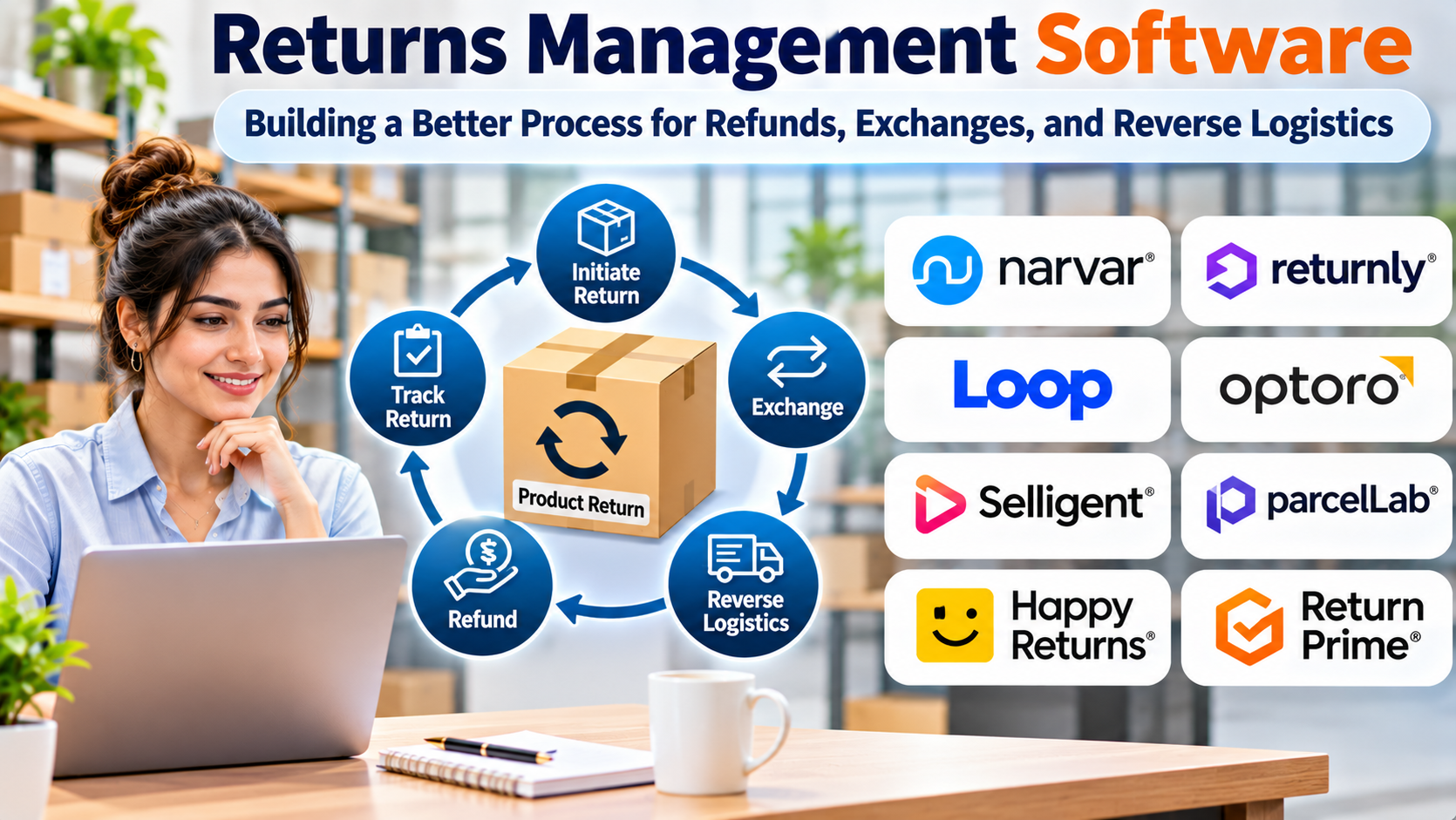
How a Modern Returns Workflow Operates
Consider an online retailer selling clothing and accessories.
A customer purchases a jacket but receives the wrong size.
Step 1: The Customer Starts a Return
The customer opens a branded returns portal and identifies the original order.
The system retrieves eligible items and presents available return options.
These might include an exchange, refund, or store credit.
The available choices depend on the retailer’s policies and software configuration.
Step 2: The System Checks Eligibility
The software evaluates relevant conditions.
These may include:
- Purchase date
- Return window
- Product category
- Item condition
- Final-sale restrictions
- Customer location
- Original payment method
A product that falls outside the standard return window may require manual approval.
An automated decision should follow the retailer’s documented policy rather than applying arbitrary restrictions.
Step 3: The Customer Selects a Resolution
The customer requests a larger jacket.
The system checks whether the replacement size is available.
If the exchange can proceed, the software may reserve inventory or create the appropriate replacement transaction.
If inventory is unavailable, the retailer may offer another resolution.
Step 4: Return Shipping Is Arranged
The customer receives instructions for returning the original item.
Depending on the retailer’s logistics arrangements, this may involve a printable shipping label, QR code, drop-off location, or another supported method.
The system records tracking information when available.
Step 5: The Warehouse Processes the Item
The returned jacket reaches a designated facility.
Warehouse personnel confirm receipt and inspect its condition.
The inspection result determines whether the item can be restocked or requires another disposition.
Step 6: The Financial Transaction Is Completed
The software coordinates the exchange or refund with the relevant commerce and payment systems.
Inventory records and financial records must reflect the outcome.
The customer receives confirmation.
This example illustrates why returns management is more than a customer service feature.
It is an operational process connecting multiple systems and departments.
The Capabilities That Matter Most
Customer Self-Service
A well-designed self-service portal allows customers to initiate eligible returns without contacting support.
It should clearly explain return options, deadlines, shipping instructions, and expected next steps.
However, automation should not make exceptional cases impossible to resolve.
Customers may need assistance when an order cannot be located, a product arrives damaged, or a shipment contains incorrect items.
Look for systems that combine self-service with practical escalation options.
Flexible Return Policies
Retailers rarely apply one policy to every product.
Different rules may apply to seasonal merchandise, electronics, personal care products, international purchases, and promotional items.
Returns management software should support policy variations without requiring employees to make repetitive manual decisions.
The system should also make policy changes manageable.
A retailer must be able to update return windows, eligibility conditions, and approval requirements without disrupting existing transactions.
Exchange Management
Exchanges are particularly important for apparel, footwear, and other categories where customers frequently need different sizes or variations.
An effective exchange workflow should consider inventory availability and the financial difference between products.
For example, exchanging a product for a more expensive item may require an additional payment.
Exchanging for a lower-priced product may require a partial refund or credit.
The software should maintain accurate transaction records throughout the process.
Shipping and Carrier Integration
Returns systems often connect with shipping services to generate labels and track parcels.
Businesses should verify which carriers, countries, and shipping methods are supported.
Carrier integration can also influence return routing.
A retailer may prefer to send certain products to a regional warehouse while directing damaged merchandise to a specialist processing facility.
These decisions affect transportation expenses and processing times.
Warehouse and Inventory Integration
A return is not operationally complete simply because the customer has shipped an item.
The business must determine what happens when the item arrives.
Integration with warehouse management or inventory software can help maintain accurate stock records.
Important questions include whether the system distinguishes received items from inspected items and whether it supports different inventory disposition outcomes.
Refund and Payment Controls
Refund processing requires dependable financial records.
The system should help prevent duplicate refunds, unauthorized adjustments, and mismatches between order records and payment transactions.
Some businesses need approval workflows for high-value refunds.
Others require detailed reconciliation across multiple payment providers.
The correct level of control depends on transaction volume, risk, and financial governance requirements.
Returns Management Software Worth Evaluating
Different products address different parts of the returns process.
The following examples illustrate relevant software approaches rather than an independently tested ranking.
Loop Returns
Loop focuses on returns and exchanges for e-commerce merchants.
Its product offering emphasizes customer-facing returns experiences and workflows designed to support exchanges and other resolutions.
It is particularly relevant to merchants seeking a more structured returns experience within their existing commerce operations.
Consider it when: Exchange workflows and customer experience are central priorities.
Evaluate carefully: Commerce platform compatibility, available integrations, policy configuration, and total operating cost.
AfterShip Returns
AfterShip Returns provides software for managing customer return requests and related workflows.
Its capabilities include branded return experiences, automation, and return tracking functionality.
Businesses already using other AfterShip products may also want to examine how the applications work together.
Consider it when: A retailer wants returns management connected to a broader post-purchase experience.
Evaluate carefully: Carrier coverage, exchange options, automation limits, and integration requirements.
Narvar
Narvar offers post-purchase experience technology that includes returns-related capabilities.
Its broader focus makes it relevant to retailers seeking to coordinate customer communication and experiences after checkout.
Consider it when: Returns are part of a larger post-purchase operations strategy.
Evaluate carefully: Implementation scope, enterprise requirements, and the specific returns workflows included in the proposed solution.
ReverseLogix
ReverseLogix focuses on returns management and reverse logistics operations.
Its positioning is relevant to organizations that need more than a customer-facing returns portal.
Businesses managing complex return routing, inspection, repair, or recovery processes may find this category of software especially relevant.
Consider it when: Operational processing and reverse logistics complexity are primary concerns.
Evaluate carefully: Warehouse workflows, system integration, deployment requirements, and operational reporting.
Comparing Returns Management Approaches
| Software approach | Main operational focus | Typical suitability |
|---|---|---|
| E-commerce returns applications | Customer requests, exchanges, refunds | Online retailers |
| Post-purchase experience platforms | Customer communication and returns journeys | Retailers improving post-purchase operations |
| Reverse logistics platforms | Return processing, routing, recovery | Complex retail and supply chain operations |
| ERP or commerce-native returns | Returns within existing business systems | Businesses with simpler workflows |
| Custom-built returns systems | Specialized policies and integrations | Organizations with unusual requirements |
The right choice depends on where the business experiences the greatest operational difficulty.
A retailer struggling with customer support requests may benefit from a self-service portal.
A distributor struggling with returned inventory may need stronger warehouse and reverse logistics functionality.
Buying an elaborate enterprise platform to solve a simple portal problem can create unnecessary expense.
Likewise, a lightweight portal may not solve complex warehouse processing problems.
How to Evaluate Returns Management Software
Begin With Return Volume and Complexity
Calculate how many returns the business processes during a typical month.
Then examine the variation between those returns.
A business processing many identical returns may be easier to automate than one handling fewer but highly complex cases.
Identify the percentage requiring manual approval, inspection, exchanges, or exceptional handling.
These details reveal which workflows need software support.
Map the Existing Technology
Returns software may need to connect with:
- E-commerce platforms
- Order management systems
- Warehouse management systems
- Payment providers
- Shipping carriers
- Customer support software
- ERP applications
Document where important records originate.
For example, the commerce platform may own the original order while the warehouse system owns the returned item’s inspection status.
Clear responsibility prevents conflicting records.
Test Exceptional Cases
A software demonstration should include more than a successful standard return.
Ask vendors to demonstrate scenarios such as:
- A customer returning only one item from a multi-item order
- An exchange for an unavailable product
- A damaged item requiring inspection
- A return arriving without the expected authorization
- A partial refund
- A return request outside the standard window
- An international return
These cases expose limitations that ordinary product demonstrations may overlook.
Examine Operational Reporting
Useful reports should help answer practical questions.
Which products generate the most returns?
What are the most common return reasons?
How long does processing take?
Which returns require repeated manual intervention?
How much inventory can be recovered and resold?
Analytics should support operational decisions rather than merely display transaction counts.
Understanding the Total Cost of Returns
The software subscription is only one part of returns management cost.
A complete calculation may include:
Transportation: Shipping returned items between customers and processing locations.
Labor: Customer support, warehouse handling, inspection, and financial administration.
Product recovery: Cleaning, repackaging, repair, or refurbishment.
Inventory loss: Products that cannot be resold at their original value.
Payment processing: Fees or charges associated with transactions and refunds.
Software operations: Subscriptions, integrations, maintenance, and implementation.
Consider a hypothetical return involving a product sold for $80.
If return transportation costs $7, handling costs $5, and repackaging costs $3, the direct reverse-logistics expense is already $15.
That calculation excludes possible inventory depreciation, customer support, and other financial effects.
The example illustrates why businesses should evaluate returns management as an operational cost problem, not merely a software purchasing decision.
Security, Privacy, and Compliance Considerations
Returns systems process customer information, including names, addresses, order details, and potentially payment-related references.
Businesses should examine data access controls, retention settings, integration security, and audit records.
Role-based permissions are particularly important.
A warehouse employee may need access to item condition and order identification without requiring broad access to financial administration.
Customer service employees may need to initiate exceptions but not approve unlimited refunds.
Consumer return rights also vary by jurisdiction.
Software configuration must support applicable legal requirements and should not be treated as a substitute for legal review.
A Practical Implementation Plan
A controlled rollout reduces disruption.
Start by documenting existing return policies and identifying inconsistent practices.
Next, configure the most common return scenarios.
Connect the software to the necessary order, payment, shipping, and inventory systems.
Test the complete workflow using representative transactions.
Train support and warehouse teams before making the portal widely available.
During the initial rollout, monitor failed requests, delayed refunds, integration errors, and customer complaints.
Expand automation only after the core process proves dependable.
Frequently Asked Questions
What is the difference between returns management and reverse logistics?
Returns management coordinates customer return requests and their resolution. Reverse logistics covers the broader movement and processing of products traveling backward through the supply chain.
Can returns management software reduce refunds?
It may help businesses offer exchanges or other appropriate alternatives. However, customers must still receive refunds when required by applicable law or the retailer’s policies.
Does returns management software work with physical stores?
Some systems support omnichannel returns. Businesses should verify whether the product handles online purchases returned in stores and other cross-channel scenarios.
Is returns management software necessary for small businesses?
Not always. Smaller retailers with limited return volume may manage returns through existing commerce tools. Dedicated software becomes more valuable as complexity and administrative effort increase.
What should retailers measure after implementation?
Useful metrics include processing time, refund accuracy, return reasons, handling cost, exchange completion, inventory recovery, and customer support workload.
Final Thoughts
Returns management software should make the entire return process more dependable, not simply make it easier to generate shipping labels.
The strongest implementation connects customer requests with policy decisions, shipping activity, inventory outcomes, and financial records.
For retailers with straightforward operations, a focused returns application may be sufficient. Organizations managing complex product recovery and reverse logistics may require a more comprehensive platform.
Before purchasing, trace several real returns from the customer’s first request to final inventory and financial reconciliation.
The problems uncovered during that exercise will reveal which software capabilities matter most.