Introduction
The cheapest shipping rate is not always the least expensive delivery option.
A carrier may advertise an attractive base price but apply additional charges for fuel, residential delivery, remote locations, oversized parcels, or special handling.
Another carrier may charge more upfront while offering a service that better matches the customer’s delivery expectations.
For businesses shipping hundreds or thousands of orders, these differences can substantially affect profitability.
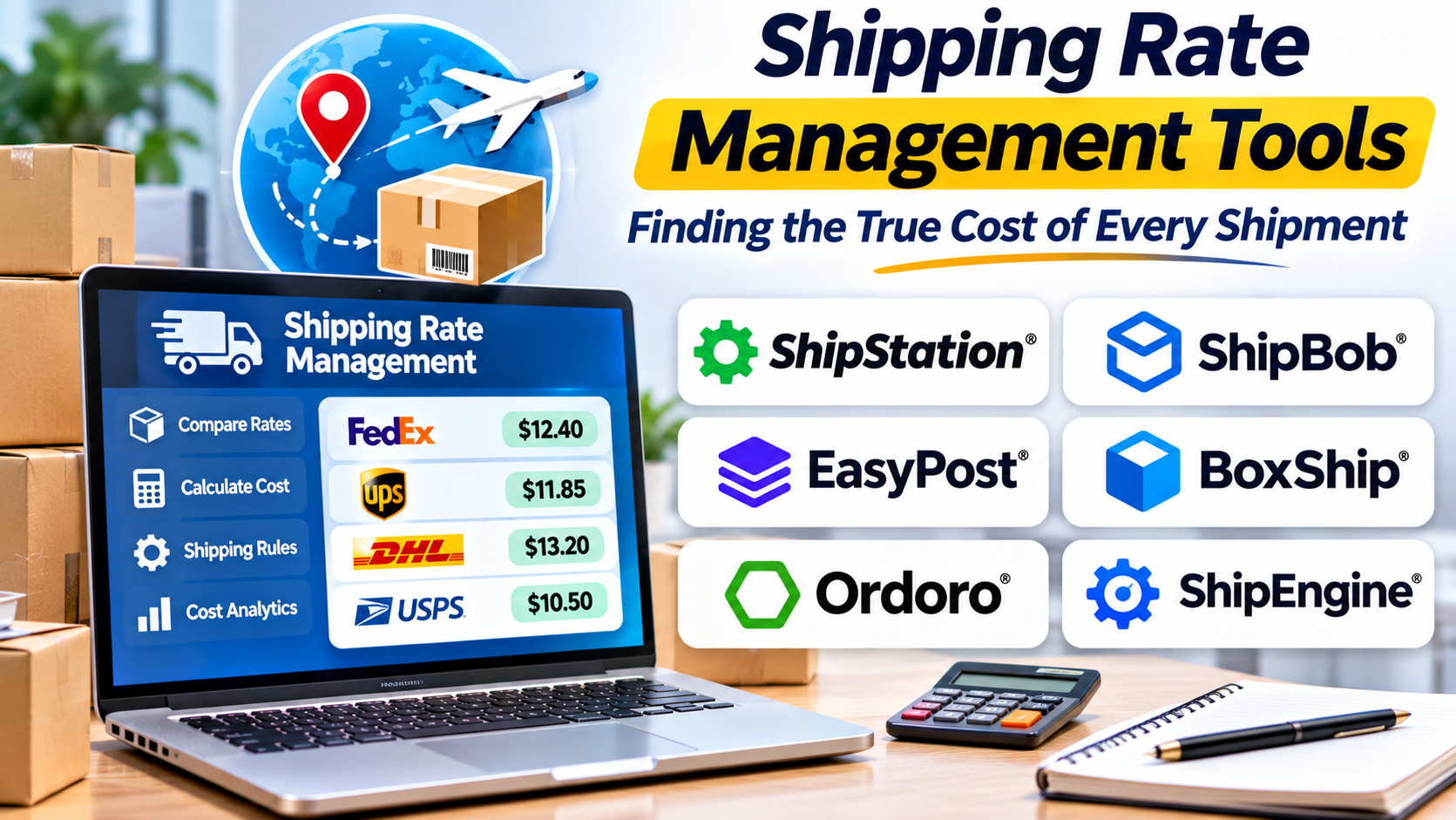
Shipping rate management tools help organizations calculate, compare, apply, and analyze transportation charges across carriers and shipping services.
The software can support decisions at checkout, during warehouse fulfillment, and throughout shipping cost analysis.
However, shipping rate management is not identical to shipping label creation or general transportation management.
The most valuable capabilities depend on whether a business needs accurate checkout prices, carrier selection, contract management, or detailed freight cost control.
What Shipping Rate Management Software Actually Does
Shipping rate management software helps businesses determine the cost of transporting goods under specific shipping conditions.
The calculation may consider:
- Package dimensions
- Actual weight
- Dimensional weight
- Shipping origin
- Destination
- Delivery service
- Carrier pricing agreements
- Fuel and handling surcharges
- Delivery requirements
- Applicable shipping rules
Some tools retrieve live carrier rates through integrations.
Others maintain rate tables, apply negotiated pricing rules, or calculate shipping charges using configured formulas.
More advanced systems may combine several approaches.
The result can support customer-facing shipping prices, internal carrier selection, or financial analysis.
These are related but distinct objectives.
A retailer might charge customers a fixed delivery fee while selecting the least expensive suitable carrier internally.
Another business might display calculated carrier rates directly at checkout.
A distributor may use contract rate management to estimate freight expenses before confirming large orders.
The appropriate system depends on which decision the business needs to automate.
The Three Shipping Prices Businesses Must Understand
Shipping costs become easier to manage when businesses separate three different figures.
The Carrier’s Transportation Charge
This is the amount charged by the carrier for transporting a shipment.
It may include base transportation charges and applicable adjustments.
The final invoice can differ from an initial estimate if package measurements, services, or surcharge conditions change.
The Customer’s Shipping Charge
This is the amount the business collects from the customer for delivery.
It may be calculated using live rates, flat fees, free-shipping thresholds, or promotional rules.
The customer charge does not have to equal the carrier charge.
However, businesses should understand the financial consequences of any difference.
The Business’s Total Fulfillment Cost
This includes transportation plus other relevant expenses.
Examples include packaging, warehouse labor, insurance, handling, and shipping software.
A business that focuses only on carrier rates may overlook substantial fulfillment expenses.
Shipping rate management tools primarily address transportation pricing, although some systems can incorporate additional cost components.
Why Dimensional Weight Changes Shipping Economics
One of the most important concepts in parcel shipping is dimensional weight.
Carriers may calculate charges using package size rather than actual mass when a shipment occupies substantial transportation space.
A large box containing a lightweight product can therefore cost more to ship than its physical weight suggests.
Dimensional weight is commonly calculated using:
Dimensional Weight = Length × Width × Height ÷ Dimensional Divisor
The units and divisor depend on the carrier and applicable service.
Consider an illustrative package measuring 40 × 30 × 20 centimeters.
Its volume is 24,000 cubic centimeters.
If the applicable divisor were 5,000, its dimensional weight would be 4.8 kilograms.
If the package’s actual weight were 2 kilograms, the carrier might use the greater billable weight, subject to its specific pricing rules.
This is why accurate package measurements matter.
An incorrectly configured dimensional divisor can produce misleading rate estimates.
Businesses should verify carrier-specific rules rather than assuming one formula applies universally.
Carrier Rate Shopping Versus Rate Management
These terms are often used interchangeably, but they describe different functions.
Rate shopping compares available shipping services for a particular shipment.
For example, a fulfillment system may retrieve several eligible carrier services and compare their estimated charges.
Rate management covers the broader administration of shipping prices, rules, contracts, adjustments, and cost decisions.
A rate management process may include rate shopping, but it may also involve negotiated contracts, customer shipping charges, margin controls, and invoice analysis.
This distinction matters when selecting software.
A company that only needs to choose between parcel services may not require an enterprise freight rate management system.
A logistics organization managing complex carrier contracts may need capabilities far beyond a basic rate comparison API.
The Main Categories of Shipping Rate Management Tools
Multi-Carrier Shipping Platforms
These applications connect businesses with multiple carriers through a common interface.
They may support rate retrieval, label creation, tracking, and shipment administration.
Examples include ShipStation, Easyship, and similar shipping operations platforms.
Their suitability depends on supported carriers, countries, account arrangements, and commerce integrations.
They are often relevant to online retailers and fulfillment teams.
Shipping APIs
Shipping APIs allow developers to embed shipping functionality into applications.
Products such as EasyPost and Shippo provide developer-oriented shipping capabilities.
An API-based approach can support custom checkout calculations, fulfillment applications, and automated carrier selection.
However, using an API introduces development and maintenance responsibilities.
The business must handle authentication, error conditions, retries, and integration monitoring.
Checkout Rate Calculation Tools
Checkout-oriented applications calculate the shipping charges customers see before placing orders.
They may use carrier rates, product characteristics, delivery zones, and configured business rules.
These tools are particularly useful when shipping costs vary significantly across products or destinations.
The main evaluation question is whether the calculated price reflects the actual shipping conditions closely enough to support the retailer’s pricing strategy.
Enterprise Transportation Management Systems
Transportation management systems, or TMS platforms, support broader transportation planning and execution.
Some include carrier contract management, freight rating, shipment optimization, and transportation cost analysis.
These systems are relevant to organizations managing complex freight operations, multiple transportation modes, or substantial logistics networks.
They may be unnecessarily complex for a smaller parcel-shipping business.
Shipping Rate Tools and Platforms to Examine
The following examples represent different shipping technology approaches.
They should be evaluated against current vendor documentation and the business’s specific shipping requirements.
ShipStation
ShipStation focuses on shipping operations for e-commerce businesses.
Its capabilities include order management, shipping label workflows, automation, and carrier-related shipping functionality.
It is relevant to merchants seeking to centralize shipping activity across sales channels.
Best evaluation scenario: A retailer handling orders from multiple storefronts and needing consistent fulfillment workflows.
Important questions: Which carrier services are available in the operating country, how negotiated accounts work, and which automation rules are supported.
Easyship
Easyship provides multi-carrier shipping technology with rate comparison and logistics-related capabilities.
Its offering is relevant to businesses shipping across domestic and international markets.
International operations introduce additional requirements involving customs documentation, duties, and delivery expectations.
Best evaluation scenario: An online business comparing multiple shipping services across different destinations.
Important questions: Geographic coverage, supported carriers, customs-related functionality, and total transaction costs.
Shippo
Shippo provides shipping technology through application interfaces and merchant-facing tools.
Its API capabilities make it relevant to businesses integrating shipping into custom commerce or operational systems.
Best evaluation scenario: A business that wants shipping rate and label functionality connected to its existing software.
Important questions: Integration effort, supported services, rate access, and error handling.
EasyPost
EasyPost provides shipping APIs for rate retrieval, labels, tracking, and related shipping operations.
It is relevant to development teams building shipping capabilities into custom applications.
Best evaluation scenario: A company requiring programmatic access to shipping functionality across carriers.
Important questions: API coverage, account configuration, service availability, reliability requirements, and operational support.
Enterprise TMS Solutions
Enterprise transportation management products, including offerings from established supply chain software vendors, can support more complex freight pricing and transportation operations.
They are relevant when shipping rate decisions depend on contracts, transportation modes, routing, and broader logistics planning.
Best evaluation scenario: A manufacturer, distributor, or logistics organization managing significant transportation complexity.
Important questions: Freight rating requirements, ERP integration, contract administration, and implementation cost.
How to Compare Shipping Rate Management Approaches
| Business requirement | Software approach to prioritize |
|---|---|
| Compare parcel rates during fulfillment | Multi-carrier shipping platform |
| Calculate shipping charges at checkout | Checkout rate calculation software |
| Build shipping into a custom application | Shipping API |
| Manage complex freight contracts | Transportation management system |
| Analyze differences between estimates and invoices | Shipping audit or freight analytics tools |
| Apply shipping discounts and customer-facing rules | Shipping rules and rate management software |
A business may require more than one category.
For example, a retailer might use a checkout rate application to quote delivery charges and a separate fulfillment platform to select carriers.
The systems must agree on relevant package, service, and destination information.
Otherwise, the customer may be charged one amount while the fulfillment team encounters a substantially different transportation cost.
The Features That Make Rate Calculations Dependable
Accurate Package Data
Shipping calculations depend on correct measurements.
Product weight alone may be insufficient.
Businesses may need package dimensions, packaging materials, combined order weight, and special handling characteristics.
Software should support realistic packing configurations rather than assuming every order ships in one standard box.
Carrier Contract Support
Some businesses use publicly available carrier pricing.
Others negotiate rates directly with carriers.
The system must support the relevant account and pricing arrangements.
A tool that retrieves only standard rates may be unsuitable for a company relying on negotiated contracts.
Shipping Rules
Rules allow businesses to apply commercial and operational requirements.
Examples include:
- Excluding certain carriers for specific destinations
- Selecting services based on delivery requirements
- Applying shipping discounts
- Restricting services for oversized products
- Offering free shipping above a purchase threshold
- Applying special handling charges
Rules should be understandable and testable.
Complicated configurations can produce unexpected results when conditions overlap.
International Shipping Support
International shipping involves more than currency conversion.
Businesses may need customs information, product classifications, duties, taxes, and destination-specific service restrictions.
The software should support the relevant shipping workflows without implying that every customs obligation is automatically resolved.
Rate Transparency
A useful rate comparison should make the basis of the estimate understandable.
Where available, teams should be able to distinguish transportation charges from surcharges and other cost components.
This helps identify why one carrier appears less expensive than another.
Reliability and Fallback Behavior
Rate calculation may be part of the checkout process.
If the shipping service becomes unavailable, customers may be unable to complete purchases.
Businesses should establish appropriate fallback rules and monitor calculation failures.
A fallback price must be designed carefully because an inaccurate estimate can create financial or customer service problems.
Why Shipping Estimates and Carrier Invoices Differ
A business may select a shipping service based on an estimated charge and later receive a higher invoice.
Several factors can explain the difference.
Incorrect dimensions: The carrier measures a package differently from the merchant’s recorded dimensions.
Weight adjustments: The actual or billable weight differs from the original estimate.
Additional services: Delivery conditions trigger charges that were not included initially.
Address corrections: The carrier applies an adjustment after correcting destination information.
Contract differences: The rate calculation does not reflect the applicable pricing agreement.
Service changes: The shipment is processed under different conditions than originally expected.
These discrepancies are not always software errors.
However, reliable shipping rate management should help businesses identify and investigate them.
A Practical Shipping Cost Calculation
Consider an illustrative online order with the following costs:
| Cost component | Amount |
|---|---|
| Carrier transportation | $8.50 |
| Packaging | $1.20 |
| Warehouse handling | $2.00 |
| Shipping-related adjustment | $1.30 |
| Total fulfillment shipping cost | $13.00 |
If the customer pays $9.00 for shipping, the business absorbs $4.00 of these expenses.
That subsidy may be commercially acceptable.
The important point is that the business understands it.
A shipping rate tool that reports only the $8.50 carrier estimate does not provide the complete fulfillment cost.
Financial planning should therefore connect shipping data with broader operational expenses.
Choosing Software Based on Shipping Volume
Small Online Retailers
Smaller retailers often benefit from tools integrated with their existing commerce platforms.
The priorities are ease of use, reliable carrier access, straightforward automation, and manageable costs.
Complex contract management may not be necessary.
Growing Multi-Channel Sellers
Businesses selling across several channels need consistent order and shipping information.
Centralized shipping rules can reduce repetitive work and inconsistent carrier selection.
Integration quality becomes increasingly important.
International E-commerce Businesses
International sellers should prioritize destination coverage, customs workflows, service availability, and delivery cost visibility.
A platform with many advertised carriers is not automatically suitable for every shipping corridor.
Manufacturers and Distributors
Organizations moving pallets, bulk goods, or complex freight may require TMS capabilities.
Their decisions can involve negotiated freight contracts, shipment consolidation, routing, and specialized carrier arrangements.
Parcel-focused tools may not address these needs.
Questions to Ask During a Software Demonstration
A meaningful evaluation should use real shipment examples.
Ask the vendor to calculate rates for a small domestic parcel, an oversized shipment, a remote destination, and an international order.
Then examine how the system handles missing dimensions, carrier unavailability, and negotiated rates.
Request a demonstration of shipping rules and their priority order.
Finally, determine how the business can compare estimated charges with actual carrier invoices.
These tests reveal whether the software can support day-to-day operations rather than simply retrieve a list of shipping prices.
Common Implementation Mistakes
One frequent mistake is selecting software based on the number of carrier integrations without checking whether those carriers operate in the required locations.
Another is ignoring packaging data.
Even sophisticated rate calculation cannot compensate for consistently inaccurate dimensions.
Businesses also sometimes automate carrier selection solely by price.
This can lead to unsuitable delivery services when transit requirements, reliability, or special handling needs are overlooked.
A more effective approach considers cost alongside operational constraints.
Finally, organizations should avoid assuming that customer-facing shipping charges and internal transportation costs must use the same pricing method.
They serve different business purposes.
Frequently Asked Questions
What is shipping rate management software?
It is software that helps businesses calculate, compare, administer, and analyze shipping charges using carrier information, package characteristics, and business rules.
Can shipping rate tools reduce delivery expenses?
They can help businesses identify lower-cost eligible services and improve rate visibility. Actual savings depend on shipment characteristics, contracts, carrier availability, and operational decisions.
Are shipping rate management tools the same as shipping software?
Not necessarily. General shipping software may focus on labels and tracking, while rate management emphasizes pricing calculations and cost decisions. Some products combine both.
Can businesses use their negotiated carrier rates?
Some tools support negotiated carrier accounts or pricing arrangements. Businesses should verify support for their specific carriers and contracts.
Do these tools calculate international duties and taxes?
Some platforms provide related international shipping capabilities. Coverage and calculation methods vary, and businesses remain responsible for meeting applicable requirements.
Final Thoughts
Shipping rate management is ultimately about making transportation decisions using accurate information.
The right software should help businesses understand what a shipment is likely to cost, which services are suitable, and how those costs affect profitability.
For an online retailer, that may mean dependable checkout rates and automated carrier comparison.
For a distributor, it may mean managing complex transportation contracts and analyzing freight expenses.
The most effective selection process begins with actual shipments, real carrier agreements, and clearly defined delivery requirements.
When software reflects those conditions accurately, shipping rate management becomes a practical tool for cost control rather than another layer of operational complexity.