A product requirement changes halfway through development.
The engineering team updates the design, but the testing team continues using the original specification. A supplier works from an outdated document, while project managers assume the change has already been approved.
The problem may remain invisible until integration testing or a formal review.
In complex engineering projects, this kind of inconsistency can cause substantial rework.
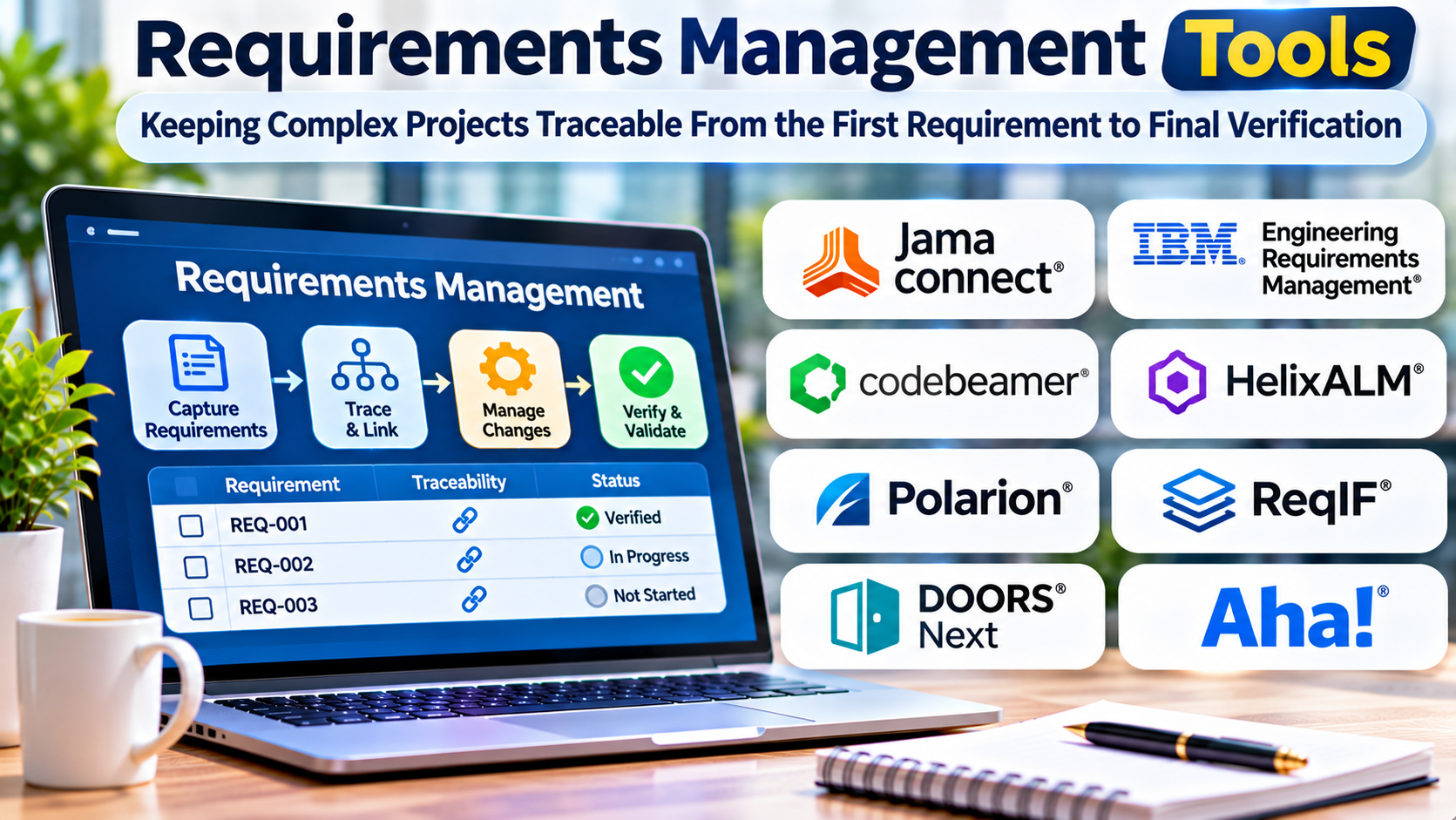
Requirements management tools help organizations prevent these failures by maintaining controlled records of what a system must do, why those requirements exist, how they relate to other work, and whether they have been satisfied.
For simple software projects, a structured document and issue tracker may provide sufficient control.
For safety-critical products, regulated systems, and large engineering programs, requirements management can become a central part of the development architecture.
The most important buying decision is understanding how much traceability, change control, and verification discipline the organization genuinely needs.
What Requirements Management Software Actually Manages
Requirements management software supports the creation, organization, review, approval, modification, and verification of requirements throughout a project or product lifecycle.
A requirement describes a condition, capability, constraint, or behavior that a system or product must satisfy.
Requirements may originate from customers, business stakeholders, regulations, technical architecture, or operational needs.
For example, an industrial monitoring system might include requirements concerning measurement accuracy, operating temperature, security, availability, and reporting behavior.
Each requirement may influence several design components and test procedures.
The challenge is maintaining those relationships as the system evolves.
A requirements management platform provides structure for tracking the requirement itself and the evidence associated with it.
Requirements Documents Versus Managed Requirements
Traditional requirements documents organize specifications into sections.
They can be useful for communication and formal review.
However, documents become difficult to maintain when requirements are reused across products or connected to numerous design and verification activities.
Consider a requirement stating:
“The system shall generate an alert when the monitored temperature exceeds the configured safety threshold.”
This requirement may relate to a sensor, processing component, alarm interface, software function, and several verification tests.
If the threshold behavior changes, engineers need to understand every affected element.
A document can describe the requirement.
A structured requirements management system can represent it as an identifiable artifact with attributes, relationships, history, and approval status.
That structure supports impact analysis and traceability.
The Requirements Lifecycle
Requirements management begins before development and continues after initial implementation.
Elicitation
Teams gather requirements from stakeholders, operational scenarios, regulations, existing systems, and technical constraints.
The objective is to understand what the product must accomplish.
Analysis
Requirements are examined for ambiguity, inconsistency, feasibility, and completeness.
Conflicting expectations should be resolved before they become expensive implementation problems.
Specification
Requirements are written in a form that can be understood and evaluated.
Good requirements describe clear, necessary, and verifiable outcomes.
Review and approval
Relevant stakeholders confirm that the requirements accurately represent the intended system.
Approval responsibilities should be defined according to project risk and governance needs.
Implementation and traceability
Requirements are connected to design decisions, development work, and verification activities.
These relationships help teams understand how the system satisfies its obligations.
Change management
When requirements change, the organization evaluates the consequences.
Affected designs, tests, dependencies, and approvals may need updating.
Verification and validation
Verification examines whether the implementation satisfies specified requirements.
Validation examines whether the resulting product fulfills its intended use and stakeholder needs.
Both are important, particularly in complex engineering programs.
Why Traceability Is the Defining Capability
Traceability allows teams to follow relationships between requirements and other engineering artifacts.
A requirement may connect to its source, related system requirements, design components, implementation tasks, test cases, and verification evidence.
This creates two important directions of analysis.
Forward traceability helps determine how a requirement is implemented and verified.
Backward traceability helps explain why a design component or test exists.
For example, a safety requirement might be linked to a particular control function and its verification tests.
If the requirement changes, the team can identify which linked elements require review.
Traceability also helps identify requirements without verification coverage.
However, simply creating links is not enough.
Relationships must be accurate, meaningful, and maintained as the project changes.
An outdated traceability matrix can create false confidence.
Requirements Management Tools Worth Evaluating
IBM Engineering Requirements Management DOORS Next
IBM DOORS Next is designed for structured requirements management in complex engineering environments.
Its capabilities include requirements capture, traceability, change analysis, collaboration, and configuration management.
It is particularly relevant to organizations managing large specifications with multiple engineering disciplines and formal review requirements.
For example, a transportation system program may need to connect stakeholder requirements with subsystem specifications and verification evidence.
DOORS Next can support the controlled management of these relationships.
Best suited to: Complex systems engineering and organizations requiring formal traceability.
Important consideration: Implementation effort, integration architecture, configuration management, and the skills needed to administer the environment.
Jama Connect
Jama Connect focuses on requirements management, review, collaboration, and traceability for complex product development.
It is relevant to organizations that need to coordinate requirements across engineering, quality, and other stakeholders.
A key evaluation scenario is how effectively teams can review proposed requirements, identify changes, and understand the impact on connected work.
Best suited to: Organizations emphasizing requirements collaboration and formal review processes.
Important consideration: Review workflows, traceability coverage, integration requirements, and the effort needed to maintain consistent data.
Siemens Polarion
Siemens Polarion combines requirements management with broader application lifecycle management capabilities.
Its approach is particularly relevant when requirements must remain connected with testing and other lifecycle activities.
Polarion supports structured requirements artifacts, collaboration, and traceability.
Organizations working on complex software-intensive products may value this broader connection.
Best suited to: Engineering programs needing requirements management within a larger lifecycle environment.
Important consideration: Deployment architecture, process configuration, lifecycle integrations, and long-term administration.
PTC Codebeamer
PTC Codebeamer is an application lifecycle management platform with requirements management and traceability capabilities.
It is relevant to organizations coordinating requirements, risks, testing, and development activities.
The central evaluation question is whether the platform can support the organization’s engineering process without excessive customization.
Best suited to: Product development organizations needing connected requirements and lifecycle workflows.
Important consideration: Integration depth, workflow governance, configuration management, and the requirements of applicable engineering standards.
Modern Requirements
Modern Requirements provides requirements management capabilities associated with Azure DevOps environments.
It is relevant to organizations that want to strengthen requirements documentation, traceability, and review while continuing to use an established Microsoft development workflow.
Best suited to: Teams with substantial investment in Azure DevOps.
Important consideration: Compatibility, licensing, traceability requirements, and whether the combined environment supports necessary approvals and baselines.
Requirements Management Platform Comparison
| Platform | Main orientation | Key evaluation question |
|---|---|---|
| IBM DOORS Next | Structured engineering requirements | Can it support complex traceability and configuration needs? |
| Jama Connect | Requirements collaboration and review | Does it support effective review and impact analysis? |
| Siemens Polarion | Connected lifecycle management | Can requirements remain linked to verification and delivery? |
| PTC Codebeamer | Engineering lifecycle traceability | Does it fit the organization’s regulated workflows? |
| Modern Requirements | Azure DevOps-based requirements | Can it extend existing development processes effectively? |
No single product is universally appropriate.
The right platform depends on engineering complexity, governance obligations, integration requirements, and operational resources.
What Makes a Requirement High Quality?
Requirements management software cannot compensate for poorly written requirements.
A vague statement such as “the system must respond quickly” is difficult to verify.
A more useful requirement defines the relevant operating conditions and measurable behavior.
For example:
“Under the specified normal operating workload, the system shall return a response within two seconds for at least 95 percent of requests.”
This statement provides a clearer basis for testing.
However, even measurable requirements must be justified by actual stakeholder needs and system constraints.
A useful requirement should be:
- Necessary for the intended system.
- Clear enough to avoid conflicting interpretations.
- Feasible within known constraints.
- Consistent with related requirements.
- Verifiable through an appropriate method.
- Traceable to its source or rationale.
Tools may help enforce templates and review processes, but engineering judgment remains essential.
Baselines and Change Control
A baseline represents an approved set of requirements at a particular point in time.
Baselines help teams establish what was agreed before subsequent changes occurred.
They are particularly important when multiple suppliers, teams, or product variants depend on the same specifications.
Suppose an approved requirement changes after design verification begins.
A controlled process should identify:
- What changed.
- Why the change is necessary.
- Which linked artifacts are affected.
- Who must review the change.
- Which tests or approvals must be repeated.
- Which product versions or configurations are affected.
Without this structure, teams may unknowingly work from different assumptions.
The requirements platform should make change history and impact analysis understandable.
Requirements Management in Regulated Industries
Some industries require substantial evidence that products have been developed and verified according to applicable obligations.
Examples include automotive, aerospace, medical devices, and industrial systems.
Requirements management can help maintain records needed for engineering assurance and regulatory review.
However, using a particular software product does not automatically make an organization compliant.
Compliance depends on the applicable standards, documented processes, engineering evidence, and actual implementation.
Buyers should distinguish between a vendor supporting compliance-oriented workflows and an independent certification of the organization’s processes.
The relevant requirements also vary by jurisdiction and product type.
Integration Architecture Matters
Requirements rarely exist independently of other engineering information.
Organizations may need to connect requirements with:
- Product lifecycle management systems.
- Architecture and modeling tools.
- Software issue trackers.
- Source code repositories.
- Test management platforms.
- Risk management records.
- Configuration management systems.
Integration quality should be evaluated carefully.
A connector that copies requirement titles into another platform is not necessarily sufficient for traceability.
Teams may need persistent identifiers, relationship integrity, change notifications, and controlled synchronization.
They should also establish which system owns each type of information.
Without clear ownership, integrations can create conflicting versions of the same requirement.
Evaluating Traceability With a Practical Test
A useful procurement exercise should include a controlled requirements change.
Begin with a small set of linked requirements, design artifacts, and test cases.
Create an approved baseline.
Then modify one important requirement.
Ask the platform to help identify affected artifacts and demonstrate how the change is reviewed.
Next, examine whether the tool can show which tests must be updated and whether the original baseline remains accessible.
Finally, generate a report suitable for the organization’s actual review process.
This exercise reveals whether traceability works operationally rather than only in a demonstration.
Common Implementation Mistakes
Migrating documents without restructuring information
Importing hundreds of documents into a platform does not automatically create useful requirements management.
Teams need appropriate identifiers, attributes, relationships, and ownership.
Creating excessive traceability links
Linking everything to everything can make impact analysis difficult.
Relationships should represent meaningful engineering dependencies.
Ignoring configuration management
Products with multiple variants or releases may require careful control over which requirements apply to each configuration.
Overcomplicating approval workflows
Formal governance should reflect actual risk and obligations.
Unnecessary approval stages can slow work without improving quality.
Neglecting user training
Engineers need to understand both the software and the requirements process.
Training should explain why information is captured, not merely where employees must click.
Total Cost of Ownership
Requirements management platforms can involve substantial costs beyond software licenses.
Organizations should consider deployment, integration development, migration, process design, training, administration, validation, and ongoing maintenance.
For long-lived engineering programs, the ability to preserve traceability and manage change may justify significant investment.
For smaller projects, a lighter approach may be more appropriate.
The cost of complexity should be balanced against the risk of inadequate control.
Choosing the Right Level of Requirements Management
A straightforward web application may need a well-maintained backlog, clear acceptance criteria, and documented decisions.
A complex medical device or transportation system may require formal baselines, multi-level traceability, controlled reviews, and extensive verification evidence.
These projects should not be forced into the same requirements management model.
IBM DOORS Next, Jama Connect, Siemens Polarion, PTC Codebeamer, and Modern Requirements represent different approaches worth evaluating according to organizational needs.
The strongest selection process begins with the consequences of requirements failure.
Determine what must be traceable, which changes require approval, how verification evidence is maintained, and which integrations are essential.
Then test those requirements using realistic project data.
Requirements management succeeds when everyone can establish what the product must do, why it must do it, what changed, and how the organization knows the result satisfies its obligations.
That clarity is more valuable than any individual feature in the software.